4 Conceptual OFDM System Multipath Channel and Cyclic Prefix - - PowerPoint PPT Presentation

4
SMART_READER_LITE
LIVE PREVIEW

4 Conceptual OFDM System Multipath Channel and Cyclic Prefix - - PowerPoint PPT Presentation

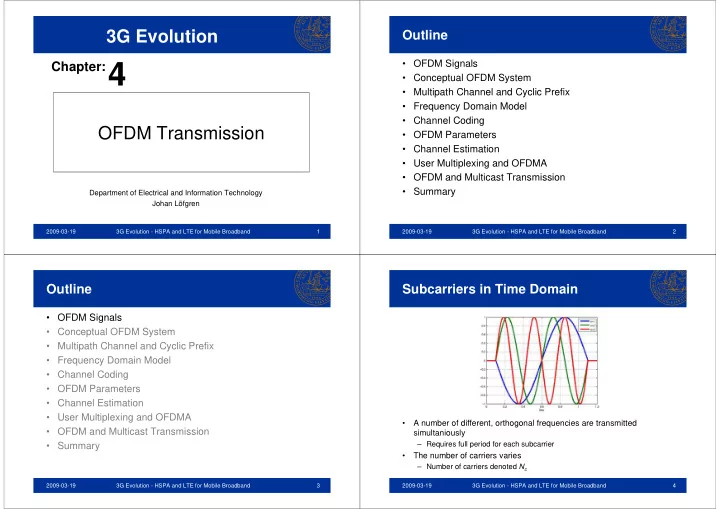
3G Evolution Outline OFDM Signals Chapter: 4 Conceptual OFDM System Multipath Channel and Cyclic Prefix Frequency Domain Model Channel Coding OFDM Transmission OFDM Parameters Channel Estimation User


slide-1
SLIDE 1

Department of Electrical and Information Technology Johan Löfgren

3G Evolution

Chapter:

2009-03-19 3G Evolution - HSPA and LTE for Mobile Broadband 1

4

OFDM Transmission

2009-03-19 3G Evolution - HSPA and LTE for Mobile Broadband 2

Outline

  • OFDM Signals
  • Conceptual OFDM System
  • Multipath Channel and Cyclic Prefix
  • Frequency Domain Model
  • Channel Coding
  • OFDM Parameters
  • Channel Estimation
  • User Multiplexing and OFDMA
  • OFDM and Multicast Transmission
  • Summary

2009-03-19 3G Evolution - HSPA and LTE for Mobile Broadband 3

Outline

  • OFDM Signals
  • Conceptual OFDM System
  • Multipath Channel and Cyclic Prefix
  • Frequency Domain Model
  • Channel Coding
  • OFDM Parameters
  • Channel Estimation
  • User Multiplexing and OFDMA
  • OFDM and Multicast Transmission
  • Summary

2009-03-19 3G Evolution - HSPA and LTE for Mobile Broadband 4

Subcarriers in Time Domain

  • A number of different, orthogonal frequencies are transmitted

simultaniously

– Requires full period for each subcarrier

  • The number of carriers varies

– Number of carriers denoted Nc

slide-2
SLIDE 2

2009-03-19 3G Evolution - HSPA and LTE for Mobile Broadband 5

OFDM Symbol in Time Domain

  • Combined symbol looks random

– Gives good spectral effiency

2009-03-19 3G Evolution - HSPA and LTE for Mobile Broadband 6

Subcarrier Orthogonality

  • In the frequency domain the orthognality is seen by zeros

– All other subcarriers are zero when one subcarrier peaks

2009-03-19 3G Evolution - HSPA and LTE for Mobile Broadband 7

Outline

  • OFDM Signals
  • Conceptual OFDM System
  • Multipath Channel and Cyclic Prefix
  • Frequency Domain Model
  • Channel Coding
  • OFDM Parameters
  • Channel Estimation
  • User Multiplexing and OFDMA
  • OFDM and Multicast Transmission
  • Summary

2009-03-19 3G Evolution - HSPA and LTE for Mobile Broadband 8

Conceptual Transmitter and Receiver

  • The transmitter can be seen as a number of single carrier system

added together

  • The receiver is in the same way thought of as a set of independent

correlators, one for each subcarrier

t f j

e

2π t f j

e

1

2π t f j

c N

e

1

2

π t f j

e

2π − t f j

e

1

2π − t f j

c N

e

1

2

− π

∫K ∫K ∫K

) (t x ) (t r

slide-3
SLIDE 3

2009-03-19 3G Evolution - HSPA and LTE for Mobile Broadband 9

IFFT/FFT Implementation

  • In an actual OFDM system, there is only one transmit path

– The structure with orthogonal subcarriers enables an implementation using an IFFT that translates the different frequencies into a combined time signal

  • The receive side is also simplified

– An FFT unit replaces the Nc correlators – The different subcarriers still have to be detected separately

  • The IFFT/FFT implemenation requiers sufficient sampling

– If so, the OFDM signal can be described mathematically as

∑ ∑ ∑

− = − = − = Δ

= = = =

1 / 2 ' 1 / 2 1 2

) (

N k N kn j N k N kn j k N k fnT k j k s n

e a e a e a nT x x

k c c s

π π π

⎩ ⎨ ⎧ ≤ ≤ ≤ ≤ = N k N N k a a

c c k k '

2009-03-19 3G Evolution - HSPA and LTE for Mobile Broadband 10

Outline

  • OFDM Signals
  • Conceptual OFDM System
  • Multipath Channel and Cyclic Prefix
  • Frequency Domain Model
  • Channel Coding
  • OFDM Parameters
  • Channel Estimation
  • User Multiplexing and OFDMA
  • OFDM and Multicast Transmission
  • Summary

2009-03-19 3G Evolution - HSPA and LTE for Mobile Broadband 11

Multi-path Components

  • Often there are many reflections of a signal sent between a transmitter

and a receiver

– These are seen as different paths for the signal to travel

  • Different paths have different delays which might pose a probelm

2009-03-19 3G Evolution - HSPA and LTE for Mobile Broadband 12

Cyclic Prefix

  • Since the paths do not arrive simultaniously the orthogonality between

the different subcarriers will be destroyed.

– When integrating over a full period the non-wanted subcarriers do not cancel

  • The solution is to pro-long the symbol with a so called cyclic prefix (CP)

– Copy of the final piece of each sub-carrier inserted in beginning – Restores the orthogonality

slide-4
SLIDE 4

2009-03-19 3G Evolution - HSPA and LTE for Mobile Broadband 13

Outline

  • OFDM Signals
  • Conceptual OFDM System
  • Multipath Channel and Cyclic Prefix
  • Frequency Domain Model
  • Channel Coding
  • OFDM Parameters
  • Channel Estimation
  • User Multiplexing and OFDMA
  • OFDM and Multicast Transmission
  • Summary

2009-03-19 3G Evolution - HSPA and LTE for Mobile Broadband 14

Frequency Domain Model

  • With a sufficient CP it is possible

to decouple the Nc different subcarrieres

– Each subcarrier is treated separately – Independent channel parameters and noise

  • The receiver can equalize the

independently

– One-tap equalizer – Maximum Likelihood Estimation (per subsymbol)

n

1

n

1 −

c

N

n

1 −

c

N

H

1

H H

*

H

1 *

H

1 * −

c

N

H

2009-03-19 3G Evolution - HSPA and LTE for Mobile Broadband 15

Time Frequency Grid

  • The different subsymbols are thus time and frequency independent

– They can be illustrated in a time frequencey grid – Each square is an indepedent subsymbol

2009-03-19 3G Evolution - HSPA and LTE for Mobile Broadband 16

Outline

  • OFDM Signals
  • Conceptual OFDM System
  • Multipath Channel and Cyclic Prefix
  • Frequency Domain Model
  • Channel Coding
  • OFDM Parameters
  • Channel Estimation
  • User Multiplexing and OFDMA
  • OFDM and Multicast Transmission
  • Summary
slide-5
SLIDE 5

2009-03-19 3G Evolution - HSPA and LTE for Mobile Broadband 17

Fading and Channel Coding

  • Another effect due to multi path is frequency fading

– Some frequencies will be much weaker due to canceling wave fronts

  • This may lead to poor SNR at certain frequencies

– Problem in OFDM since each subcarrier have different data

  • Calls for channel coding

– Channel coding spreads the information over many subcarriers

2009-03-19 3G Evolution - HSPA and LTE for Mobile Broadband 18

Outline

  • OFDM Signals
  • Conceptual OFDM System
  • Multipath Channel and Cyclic Prefix
  • Frequency Domain Model
  • Channel Coding
  • OFDM Parameters
  • Channel Estimation
  • User Multiplexing and OFDMA
  • OFDM and Multicast Transmission
  • Summary

2009-03-19 3G Evolution - HSPA and LTE for Mobile Broadband 19

OFDM Parameters

  • When dessigning an OFDM system a number of different

parameters have to be considered

– Subcarrier bandwidth – Number of subcarriers – Length of cyclic prefix

2009-03-19 3G Evolution - HSPA and LTE for Mobile Broadband 20

Subcarrier Bandwidth

  • The subcarrier bandwidth (or spacing) is affected by

– Cost of cyclic prefix

  • A small spacing leads to long symbol duration

hence less cost of cyclic prefix

– Doppler spread

  • A small bandwidth leads to high relative doppler spread

thus sensitivity to movement

  • The system designer has to trade off these contradicting

demands depending on the system

– How mobile is the system? – What data rates are needed? – et c.

slide-6
SLIDE 6

2009-03-19 3G Evolution - HSPA and LTE for Mobile Broadband 21

Number of subcarriers

  • When the subcarrier separation is decided the number of

subcarriers can be calculated

– If the system has a limited bandwidth this will give the maximum number of subcarriers

  • Some slack is needed to ensure low enough out-of-band transmission

– If instead a certain througput is needed, the number of subcarriers can be calculated based on constellation and coding

  • This will then set the total bandwidth of the system

2009-03-19 3G Evolution - HSPA and LTE for Mobile Broadband 22

Cyclic Prefix Length

  • The cyclic prefix should be long enough to ensure
  • rthogonality of the system

– Multipath spread has to be considered

  • Longer transmission distances normally call for longer CPs

– However at long distances, e.g. at cell edges, other effects may limit the performance and therefore it is possible to allow a system which is not completely orthogonal everywhere

  • Some systems support multiple cyclic prefix lengths to

handle different environments

2009-03-19 3G Evolution - HSPA and LTE for Mobile Broadband 23

Outline

  • OFDM Signals
  • Conceptual OFDM System
  • Multipath Channel and Cyclic Prefix
  • Frequency Domain Model
  • Channel Coding
  • OFDM Parameters
  • Channel Estimation
  • User Multiplexing and OFDMA
  • OFDM and Multicast Transmission
  • Summary

2009-03-19 3G Evolution - HSPA and LTE for Mobile Broadband 24

Channel Estimation

  • In the receiver the channel needs to be equalized so that

the transmitted information can be correctly interpreted

  • For this to be possible, the channel must be known
  • Since the channel constantly changes due to movement of

both the mobile unit and the surroundings, the channel cannot be known once and for all

  • The channel has to be re-estimated every once in a while
  • So called pilots are used to estimate the channel

– These are data that are known to the receiver

slide-7
SLIDE 7

2009-03-19 3G Evolution - HSPA and LTE for Mobile Broadband 25

Channel Estimation

  • Since the system should also transmit unknown data, pilots cannot be

transmitted continously

– Pilots are placed in different, strategic places in the time frequency grid – The other values have to be interpolated from the known values

  • Simple linear interpolation
  • MMSE estimation
  • FIR estimation

2009-03-19 3G Evolution - HSPA and LTE for Mobile Broadband 26

Outline

  • OFDM Signals
  • Conceptual OFDM System
  • Multipath Channel and Cyclic Prefix
  • Frequency Domain Model
  • Channel Coding
  • OFDM Parameters
  • Channel Estimation
  • User Multiplexing and OFDMA
  • OFDM and Multicast Transmission
  • Summary

2009-03-19 3G Evolution - HSPA and LTE for Mobile Broadband 27

User Multiplexing and OFDMA

  • Many users can share the same bandwidth in a system

– FDMA – TDMA – CDMA

  • In OFDM an advanced FDMA scheme, that uses the
  • rthogonality of the system is available.

– Different users are allowed to use different subsets of the subcarriers – Both in downlink and uplink

  • An uplink like this is refered to as OFDMA
  • The uplink requires some coordination so that the information of the

different units reaches the base station at approximately the same time (within the cyclic prefix) and same power

2009-03-19 3G Evolution - HSPA and LTE for Mobile Broadband 28

User Multiplexing and OFDMA

  • The subcarriers for each user can either be bundled together or

distributed

– Bundled subcarriers may lead to simpler implementation, e.g. a smaller FFT size, but is prone to fading dips

slide-8
SLIDE 8

2009-03-19 3G Evolution - HSPA and LTE for Mobile Broadband 29

Outline

  • OFDM Signals
  • Conceptual OFDM System
  • Multipath Channel and Cyclic Prefix
  • Frequency Domain Model
  • Channel Coding
  • OFDM Parameters
  • Channel Estimation
  • User Multiplexing and OFDMA
  • OFDM and Multicast Transmission
  • Summary

2009-03-19 3G Evolution - HSPA and LTE for Mobile Broadband 30

OFDM and Multicast Transmission

  • Often many users want the same information
  • To not waste bandwidth the users can listen to the same

subcarriers for this information

– Requires that the system is robust enough to handle the worst user condition – To improve worst case at the cell border a user can listen to more than one base station at a time

  • In OFDM all base stations can transmit the same

information at the same frequency and time

2009-03-19 3G Evolution - HSPA and LTE for Mobile Broadband 31

Outline

  • OFDM Signals
  • Conceptual OFDM System
  • Multipath Channel and Cyclic Prefix
  • Frequency Domain Model
  • Channel Coding
  • OFDM Parameters
  • Channel Estimation
  • User Multiplexing and OFDMA
  • OFDM and Multicast Transmission
  • Summary

2009-03-19 3G Evolution - HSPA and LTE for Mobile Broadband 32

Chapter summary

  • A correctly designed OFDM system can be decoupled into

a number of single carrier systems

– This makes OFDM an attractive choice for new systems – However the this comes at a price of wasted power and bandwidth for the cyclic prefix – It also requires channel coding to avoid information loss due to frequency fading

  • It is important to know what conditions the system is

designed for since different environments call for different system parameters

– Subcarrier separation – Number of subcarriers – Length of cyclic prefix

slide-9
SLIDE 9

2009-03-19 3G Evolution - HSPA and LTE for Mobile Broadband 33

Chapter summary

  • The channel needs to be known in order to extract the

information

– In OFDM correlation between different subcarriers and time instances can be used in order to estimate the channel – The pilots must thus not be available on all subcarriers

  • In multi user systems OFDM can be used as an access

method where the frequency spectrum is divided between the users.

– This is an advanced type of FDMA, that uses the orthogonality of the OFDM subcarriers – To make this possible in the uplink, OFDMA, certain care has to be taken to ensure that the information from different units reaches the base station at approximately the same time (within the cyclic prefix) and same power