SLIDE 1
Simple Logistic Regression
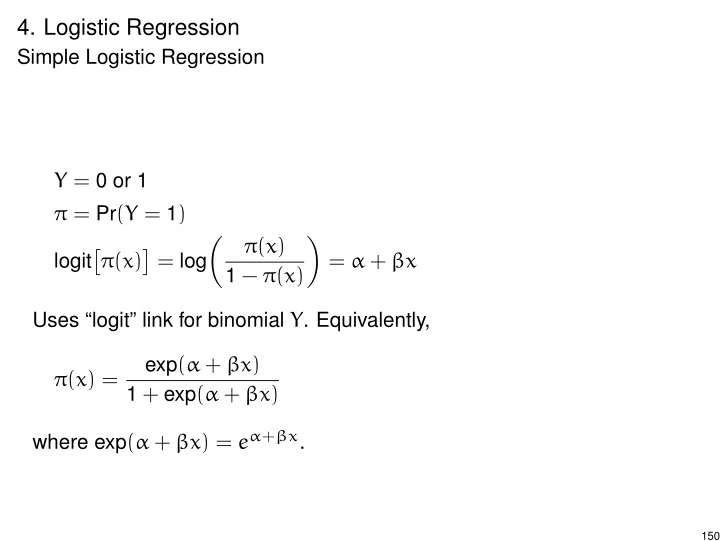
Y = 0 or 1 π = Pr(Y = 1)
logit
⇥ π(x) ⇤ = log ✓ π(x)
1 − π(x)
◆ = α + βx
Uses “logit” link for binomial Y. Equivalently,
π(x) =
exp(α + βx) 1 + exp(α + βx) where exp(α + βx) = eα+βx.
150
SLIDE 2
4.1 Interpreting the Logistic Regression Model I
I If β > 0, then π(x) increases as x increases.
If β < 0, then π(x) decreases as x increases.
I If β = 0, then π(x) =
eα
1 + eα constant in x (with π > 1
2 if α > 0). I Curve can be approximated near a fixed point x by a straight line
describing rate of change in π(x). Slope is βπ(x)
⇥
1 − π(x)
⇤
. E.g.,
I at x with π(x) = 1
2, slope = β · 1 2 · 1 2 = β 4
I at x with π(x) = 0.1 or 0.9, slope = β(0.1)(0.9) = 0.09 β I Steepest slope where π(x) = 1
2
151
SLIDE 3
4.1 Interpreting the Logistic Regression Model II
I If π(x) = 1 2 then
log
✓ π(x)
1 − π(x)
◆ = log ✓0.5
0.5
◆ = log(1) = 0 = α+βx = ) x = −α β
I
1
|β| ⇡ dist. between x values with π = 0.5 and π = 0.75 (or 0.25)
I ML fit obtained with iterative numerical methods.
152
SLIDE 4 Horseshoe Crabs
Model the relationship between weight and the probability of having one
- r more “satellites” for female horseshoe crabs.
Y =
if female crab has satellites if no satellites
x = weight (kg) π(x) = probability of at least one satellite
Model: logit
⇥ π(x) ⇤ = α + βx
153
SLIDE 5
> data(horseshoecrabs) > head(horseshoecrabs, 5) Color Spine Width Weight Satellites 1 2 3 28.3 3.05 8 2 3 3 22.5 1.55 3 1 1 26.0 2.30 9 4 3 3 24.8 2.10 5 3 3 26.0 2.60 4 > nrow(horseshoecrabs) [1] 173
154
SLIDE 6
> summary(horseshoecrabs) Color Spine Width Min. :1.00 Min. :1.00 Min. :21.0 1st Qu.:2.00 1st Qu.:2.00 1st Qu.:24.9 Median :2.00 Median :3.00 Median :26.1 Mean :2.44 Mean :2.49 Mean :26.3 3rd Qu.:3.00 3rd Qu.:3.00 3rd Qu.:27.7 Max. :4.00 Max. :3.00 Max. :33.5 Weight Satellites Min. :1.20 Min. : 0.00 1st Qu.:2.00 1st Qu.: 0.00 Median :2.35 Median : 2.00 Mean :2.44 Mean : 2.92 3rd Qu.:2.85 3rd Qu.: 5.00 Max. :5.20 Max. :15.00 > crabs.fit1 <- glm((Satellites > 0) ~ Weight, family=binomial, data=horseshoecrabs) > summary(crabs.fit1)
155
SLIDE 7 Call: glm(formula = (Satellites > 0) ~ Weight, family = binomial, data Deviance Residuals: Min 1Q Median 3Q Max
0.543 0.912 1.629 Coefficients: Estimate Std. Error z value Pr(>|z|) (Intercept)
0.880
2.7e-05 Weight 1.815 0.377 4.82 1.4e-06 (Dispersion parameter for binomial family taken to be 1) Null deviance: 225.76
degrees of freedom Residual deviance: 195.74
degrees of freedom AIC: 199.7 Number of Fisher Scoring iterations: 4
156
SLIDE 8
Horseshoe Crabs: Fitted Logistic Regression on Weight
ML fit: logit
⇥
ˆ
π(x) ⇤ = + x
i.e., ˆ
π(x) =
E.g., at x = x = 2.44, ˆ
π = = e0.729
1 + e0.729 = 2.07 3.07 = 0.675
157
SLIDE 9
> xbar <- mean(horseshoecrabs$Weight) > predict(crabs.fit1, data.frame(Weight=xbar), type="link") 1 0.72913 > predict(crabs.fit1, data.frame(Weight=xbar), type="response") 1 0.67461 > ab <- coef(crabs.fit1); ld50 <- -ab[1]/ab[2] > names(ld50) <- NULL; ld50 [1] 2.0355 > predict(crabs.fit1, data.frame(Weight = ld50 + c(0, 0.1, 1)), type="response") 1 2 3 0.50000 0.54525 0.85998
158
SLIDE 10
Horseshoe Crabs: Fitted Logistic Regression on Weight
I ˆ
β > 0, so ˆ π " as x "
I ˆ
π = 1
2 when x = − ˆ
α
ˆ
β = = 2.04
I ˆ
π ⇡ 3
4 when x = 2.04 + 1
ˆ
β = 2.04 +
1
= 2.04 + 0.55 = 2.59
I ˆ
π ⇡ 1
4 when x = 2.04 − 0.55 = 1.48 I At x = 2.04, the estimated slope is
ˆ
β ˆ π(1 − ˆ π) =
ˆ
β
4 = 4
= 0.454,
i.e., for a small change in weight, ∆x, ˆ
π(2.04 + ∆x) ⇡ ˆ π(2.04) + 0.454 (∆x) = 0.5 + 0.454 (∆x)
159
SLIDE 11
> logit <- make.link("logit") > ab <- coef(crabs.fit1) > attach(horseshoecrabs) > plot(Weight, (Satellites > 0), xlim=c(0,6), ylim=c(0,1), xlab="Weight", ylab="Has Satellites") > curve(logit$linkinv(ab[1] + ab[2]*x), add=TRUE) > detach(horseshoecrabs)
160
SLIDE 12
2 3 4 5 6 0.0 0.2 0.4 0.6 0.8 1.0 Weight Has Satellites
161
SLIDE 13 Horseshoe Crabs: Fitted Logistic Regression on Weight (ctd)
I Instantaneous rate of change of ˆ
π(x) at x = 2.04 is the slope,
0.454 per kg change in weight. This means that for a small change
π changes by about 0.454 (∆x).
What is “small” here? Sample std dev of weights is s = 0.58; half the interquartile range is 0.43. Small should be small relative to these amounts.
∆x
ˆ
π(2.04 + ∆x)
0.5 + (0.454) (∆x) Approximation is 0.1 0.545 0.545 Good 1.0 0.86 0.954 Poor
> sd(horseshoecrabs$Weight) [1] 0.57703 > IQR(horseshoecrabs$Weight)/2 [1] 0.425
162
SLIDE 14
Horseshoe Crabs: Fitted Logistic Regression on Weight (ctd)
I At x = 5.2 (max. obs. wt.), ˆ
π = 0.997, and est. slope is
ˆ
β ˆ π(1 − ˆ π) = = 0.0058.
If x increases by 0.1 kg, then ˆ
π increases by ⇡ (0.1)(0.0058) = 0.00058.
I Rate of change of ˆ
π(x) varies with x.
E.g., it is at x = 2.04 and at x = 5.2.
163
SLIDE 15
Remarks
I Fitting linear probability model (binomial w/ identity link) fails in the
crabs example.
I If we assume Y ∼ Normal and fit linear model µ = α + βx,
ˆ
µ = −0.415 + 0.323x
At x = 5.2, ˆ
µ = 1.53 !!! (estimated prob. of satellites)
I An alternative way to describe effect (not dependent on units of x)
is ˆ
π(UQ) − ˆ π(LQ)
For x = weight, LQ = 2.00, UQ = 2.85. At x = 2.00, ˆ
π = 0.483;
at x = 2.85, ˆ
π = 0.814. = ) ˆ π increases by 0.331 over middle half of x values.
164
SLIDE 16 Odds Ratio Interpretation
Since log
⇣ π
1 − π
⌘ = α + βx, odds are π
1 − π =
at x
eα+β(x+1) = eα+βxeβ
at x + 1
= ) odds at (x + 1)
=
⇠⇠⇠ ⇠
eα+βxeβ
⇠⇠⇠ ⇠
eα+βx = eβ
More generally,
= eα+β(x+∆x) eα+βx =
⇠⇠⇠ ⇠
eα+βxeβ∆x
⇠⇠⇠ ⇠
eα+βx = eβ∆x
If β = 0, then eα+βx = eα and odds do not depend on x.
165
SLIDE 17
Horseshoe Crabs (ctd)
ˆ
β = 1.82 = ) e ˆ
β = e1.82 = 6.1
Estimated odds of having at least one satellite increase by a factor of 6.1 for each 1 kg increase in weight. If weight increases by 0.1 kg, then estimated odds increase by factor
e = e0.182 = 1.20,
i.e., by %.
166
SLIDE 18 4.2 Inference for Logistic Regression
Confidence Intervals Wald (1 − α)100% CI for β is ˆ
β ± zα/2 SE Horseshoe Crabs (ctd)
95% CI for β: 1.82 ± (1.96)
= 1.82 ± 0.74 = (1.08, 2.55)
95% CI for eβ, multiplicative effect of a 1-kg increase in weight on odds:
= (2.9, 12.9)
95% CI for e0.1β, multiplicative effect on odds of 100-gram increase, is
= (1.11, 1.29)
Odds estimated to increase by at least % and at most %.
167
SLIDE 19 Remarks
I Safer to use LR CI than Wald CI.
For crabs example, 95% LR CI for eβ is (see next slide)
, e
I Can also construct CI for π(x). The convenience function
predCI() in the icda package does the calculation described in
Section 4.2.6 of the text (see next slide).
I For crabs data, at x = 3.05 (first crab), ˆ
π = 0.863. A 95% CI for π at x = 3.05 is (0.766, 0.924).
I For crabs data, at x = x = 2.44, ˆ
π = . A 95% CI for π at x = 2.44 is .
168
SLIDE 20
> confint(crabs.fit1) 2.5 % 97.5 % (Intercept) -5.5059 -2.0397 Weight 1.1138 2.5973 > exp(confint(crabs.fit1)[2,]) 2.5 % 97.5 % 3.0459 13.4275 > crabs.predCI <- predCI(crabs.fit1) > crabs.predCI[1,] fit lwr upr 0.86312 0.76606 0.92391 > xbar <- mean(horseshoecrabs$Weight) > predCI(crabs.fit1, newdata=data.frame(Weight=xbar)) fit lwr upr 1 0.67461 0.59213 0.74753
169
SLIDE 21 Hypothesis Tests for β
H0 : β = 0 states that Y indep. of X (i.e., π(x) constant in x) Ha : β 6= 0 Wald Test
z =
ˆ
β
SE =
=
z2 = 23.2, df = 1 (chi-squared)
p-value < 0.0001 : very strong evidence that π " as weight " Likelihood ratio test When β = 0, L0 = −112.88 (maximized log-likelihood under H0) When β = ˆ
β, L1 = −97.87
Test stat : −2(L0 − L1) = 30.02, df = 1 (chi-sq) p-value < 0.0001
170
SLIDE 22
> drop1(crabs.fit1, test="Chisq") Single term deletions Model: (Satellites > 0) ~ Weight Df Deviance AIC LRT Pr(>Chi) <none> 196 200 Weight 1 226 228 30 4.3e-08 > # anova(crabs.fit1, test="Chisq")
171
SLIDE 23 Remark
Recall for a model M, deviance = −2(LM − LS)
LS is log-likelihood under saturated model (perfect fit).
To compare model M0 with more complex model M1, LR statistic = −2(L0 − L1)
= −2 ⇥ (L0 − LS) − (L1 − LS) ⇤ = ⇥ −2(L0 − LS) ⇤ − ⇥ −2(L1 − LS) ⇤ = difference of (residual) deviances for two models Horseshoe Crabs (ctd)
Model: logit[π(x)] = α + βx (this is M1) H0 : β = 0 =
) logit[π(x)] = α
(this is M0)
− = 30.02 = LR stat.
172
SLIDE 24 4.3–4.4 Multiple Logistic Regression Y binary, π = Pr(Y = 1) x1, x2, . . . , xk can be quantitative, qualitative (dummy variables), or both.
Model form is logit(π) = α + β1x1 + β2x2 + · · · + βkxk
π =
exp(α + β1x1 + β2x2 + · · · + βkxk) 1 + exp(α + β1x1 + β2x2 + · · · + βkxk)
βi = partial effect of xi controlling for other variables in model eβi = cond. odds ratio at xi + 1 vs at xi keeping other x’s fixed = multi. effect on odds of 1-unit incr. in xi, w/ other x’s fixed
173
SLIDE 25 Horseshoe Crabs: Logistic Regression on Color and Weight Y =
sampled female has at least 1 satellite sampled female has no satellites
x = Weight c = Color (qualitative w/ 4 categories) c2 =
medium
c3 =
dark med
c4 =
dark
For “light medium” crabs, c2 = c3 = c4 = 0. Original data set had color coded 1–4 for “light med”, “medium”, “dark med”, and “dark”. R interprets this as a numeric variable, so we must convert it to factor.
174
SLIDE 26
Remark
To match textbook’s dummy variables (c1, c2, c3), use
> options(contrasts=c("contr.SAS","contr.poly"))
We are using R’s default, which is
> options(contrasts=c("contr.treatment","contr.poly"))
Textbook also uses crab width instead of weight.
175
SLIDE 27 > horseshoecrabs <- transform(horseshoecrabs, C = as.factor(Color)) > levels(horseshoecrabs$C) [1] "1" "2" "3" "4" > crabs.fit2 <- glm((Satellites > 0) ~ C + Weight, family=binomial, data=horseshoecrabs) > summary(crabs.fit2) Call: glm(formula = (Satellites > 0) ~ C + Weight, family = binomial, data = horseshoecrabs) Deviance Residuals: Min 1Q Median 3Q Max
0.510 0.868 2.075
176
SLIDE 28 Coefficients: Estimate Std. Error z value Pr(>|z|) (Intercept)
1.198
0.0066 C2 0.145 0.736 0.20 0.8441 C3
0.775
0.8102 C4
0.849
0.1348 Weight 1.693 0.389 4.35 1.3e-05 (Dispersion parameter for binomial family taken to be 1) Null deviance: 225.76
degrees of freedom Residual deviance: 188.54
degrees of freedom AIC: 198.5 Number of Fisher Scoring iterations: 4
177
SLIDE 29
Horseshoecrabs: Logistic Regression on Color and Weight (ctd)
Model: logit
⇥
Pr(Y = 1)
⇤ = α + β2c2 + β3c3 + β4c4 + βx
has ML fit logit( ˆ
π) =
I For light med. female (c2 = c3 = c4 = 0),
logit( ˆ
π) =
At x = x = 2.44, ˆ
π = = 0.704
178
SLIDE 30 Horseshoecrabs: Logistic Regression on Color and Weight (ctd)
I For medium female (c2 = 1, c3 = c4 = 0),
logit( ˆ
π) = = −3.11 + 1.69x
At x = x = 2.44, ˆ
π = 0.734.
I At each weight, estimate medium color females more likely than
light med. to have satellites: ˆ
β2 = 0.145 = ) e ˆ
β2 = e0.145 = 1.16
Estimated odds a medium color female has satellites are times estimated odds for a light med. female of the same weight. E.g., at x = 2.44,
- dds for medium
- dds for light-med = 0.734/0.266
0.704/0.296 = 1.16
179
SLIDE 31 Horseshoecrabs: Logistic Regression on Color and Weight (ctd)
I How do we compare, e.g., dark (c2 = c3 = 0, c4 = 1) to medium
(c2 = 1, c3 = c4 = 0)? ˆ
β4 − ˆ β2 = −1.269 − 0.145 = −1.41 e−1.41 = 0.243
Estimated odds a dark crab has satellites are 0.24 times estimated
- dds a medium crab of same weight has satellites.
Equivalently, 0.145 − (−1.269) = 1.41
e1.41 = 4.11 (= 1/0.243)
Estimated odds a medium crab has satellites are 4.11 times estimated odds a dark crab of same weight has satellites.
180
SLIDE 32 Horseshoecrabs: Logistic Regression on Color and Weight (ctd)
I Model assumes no interaction between color and weight effects.
- Coef. of x = Weight is same for each color ( ˆ
β = 1.69).
For fixed color, estimated odds of satellites at weight (x + 1) is
e1.69 = 5.4 times estimated odds at weight x.
Curves have same shape across colors, but shifted left or right.
181
SLIDE 33
2 3 4 5 0.0 0.2 0.4 0.6 0.8 1.0 Weight Satellites (Yes=1, No=0)
medium med−dark dark
182
SLIDE 34 Horseshoecrabs: Logistic Regression on Color and Weight (ctd)
I Do we need color in the model?
H0 : β2 = β3 = β4 = 0 (given weight, Y indep. of color) Likelihood-ratio statistic
−2(L0 − L1) = −2 ⇥ (−97.9) − (−94.3) ⇤ = 7.19
- r
- diff. of deviances = 195.7 − 188.54 = 7.19
df = 171 − 168 = 3 p-value = 0.066 Some evidence (not strong) of a color effect given weight. There is strong evidence of weight effect ( ˆ
β = 1.69 has SE = 0.39).
183
SLIDE 35 > anova(crabs.fit1, crabs.fit2, test="Chisq") Analysis of Deviance Table Model 1: (Satellites > 0) ~ Weight Model 2: (Satellites > 0) ~ C + Weight
- Resid. Df Resid. Dev Df Deviance Pr(>Chi)
1 171 196 2 168 188 3 7.19 0.066 > drop1(crabs.fit2, test="Chisq") Single term deletions Model: (Satellites > 0) ~ C + Weight Df Deviance AIC LRT Pr(>Chi) <none> 188 198 C 3 196 200 7.19 0.066 Weight 1 212 220 23.52 1.2e-06
184
SLIDE 36 Horseshoe Crabs: Logistic Regression on Color and Weight (ctd)
Other simple models are also adequate. logit( ˆ
π) = 8 > > > > < > > > > : −3.26 + 1.69x,
med-light
−3.11 + 1.69x,
med
−3.44 + 1.69x,
med-dark
−4.53 + 1.69x,
dark suggests logit(π) = α + β1z + β2x,
z =
dark 0,
ML gives ˆ
β1 = −1.295 (SE = 0.522).
Estimated odds of satellites for a dark crab is e−1.295 = 0.27 times estimated odds a non-dark crab of the same weight.
185
SLIDE 37 > crabs.fit3 <- glm((Satellites > 0) ~ I(Color == 4) + Weight, family=binomial, data=horseshoecrabs) > summary(crabs.fit3) Call: glm(formula = (Satellites > 0) ~ I(Color == 4) + Weight, family data = horseshoecrabs) Deviance Residuals: Min 1Q Median 3Q Max
0.513 0.848 2.087 Coefficients: Estimate Std. Error z value Pr(>|z|) (Intercept)
0.898
0.00023 I(Color == 4)TRUE
0.522
0.01311 Weight 1.729 0.383 4.52 6.2e-06
186
SLIDE 38 (Dispersion parameter for binomial family taken to be 1) Null deviance: 225.76
degrees of freedom Residual deviance: 189.17
degrees of freedom AIC: 195.2 Number of Fisher Scoring iterations: 4 > anova(crabs.fit3, crabs.fit2, test="Chisq") Analysis of Deviance Table Model 1: (Satellites > 0) ~ I(Color == 4) + Weight Model 2: (Satellites > 0) ~ C + Weight
- Resid. Df Resid. Dev Df Deviance Pr(>Chi)
1 170 189 2 168 188 2 0.629 0.73
187
SLIDE 39
Horseshoe Crabs: Logistic Regression on Color and Weight (ctd)
Compare model with 1 dummy for color to full model with 3 dummies. H0 : simple model vs Ha : more complex model Note H0 is β2 = β3 = 0 in more complex model. LR stat = diff. in deviances = 189.17 − 188.54 = 0.63 df = 170 − 168 = 2 p-value = 0.73 Simpler model appears to be adequate.
188
SLIDE 40
Horseshoe Crabs: Logistic Regression on Color and Weight (ctd)
How about interaction? logit(π) = α + β2c2 + β3c3 + β4c4 + βx + γ2c2x + γ3c3x + γ4c4x Color Dummies Weight Coef light-med
c2 = c3 = c4 = 0 β
medium
c2 = 1, c3 = c4 = 0 β + γ2
dark-med
c3 = 1, c2 = c4 = 0 β + γ3
dark
c4 = 1, c2 = c3 = 0 β + γ4
Testing H0: no interaction (γ2 = γ3 = γ4 = 0) LR stat = 188.54 − 181.66 = 6.89 df = 3 p-value = 0.076 Weak evidence of interaction. For easier interpretation, use simpler model (no interaction).
189
SLIDE 41 > crabs.fit4 <- update(crabs.fit2, . ~ C*Weight) > deviance(crabs.fit4) [1] 181.66 > anova(crabs.fit2, crabs.fit4, test="Chisq") Analysis of Deviance Table Model 1: (Satellites > 0) ~ C + Weight Model 2: (Satellites > 0) ~ C + Weight + C:Weight
- Resid. Df Resid. Dev Df Deviance Pr(>Chi)
1 168 188 2 165 182 3 6.89 0.076
190
SLIDE 42
> drop1(crabs.fit4, test="Chisq") Single term deletions Model: (Satellites > 0) ~ C + Weight + C:Weight Df Deviance AIC LRT Pr(>Chi) <none> 182 198 C:Weight 3 188 198 6.89 0.076
191
SLIDE 43
Quantitative Treatment of Ordinal Factors
Models with dummy variables for a factor treat that factor as qualitative (nominal), i.e., order is ignored. To treat as quantitative, assign scores such as (1, 2, 3, 4).
Horseshoe Crabs: Logistic Regression on Color and Weight (ctd)
Recall that color was originally coded with numerical scores (1, 2, 3, 4). Model: logit(π) = α + β1x1 + β2x2,
x1 : weight, x2 : color score > crabs.fit5 <- glm((Satellites > 0) ~ Weight + Color, family=binomial, data=horseshoecrabs) > summary(crabs.fit5)
192
SLIDE 44 Call: glm(formula = (Satellites > 0) ~ Weight + Color, family = binomial, data = horseshoecrabs) Deviance Residuals: Min 1Q Median 3Q Max
0.524 0.882 1.911 Coefficients: Estimate Std. Error z value Pr(>|z|) (Intercept)
1.116
0.069 Weight 1.653 0.382 4.32 1.5e-05 Color
0.223
0.021 (Dispersion parameter for binomial family taken to be 1) Null deviance: 225.76
degrees of freedom Residual deviance: 190.27
degrees of freedom AIC: 196.3 Number of Fisher Scoring iterations: 4
193
SLIDE 45
Horseshoe Crabs: Logistic Regression on Color and Weight (ctd)
ML estimates and SEs are ˆ
α = −2.03 (1.12)
ˆ
β1 = 1.65 (0.38)
ˆ
β2 = −0.51 (0.22)
logit( ˆ
π) = −2.03 + 1.65x1 − 0.51x2
ˆ
π # as Color ", controlling for weight.
Controlling for weight, odds of having at least one satellite estimated to decrease by a factor of
e−0.51 = 0.60
for each 1-category increase in shell darkness
194
SLIDE 46
Horseshoe Crabs: Logistic Regression on Color and Weight (ctd)
Does model treating color as nominal fit as well as model treating it as qualitative? H0 : simpler (ordinal) model holds Ha : more complex (nominal) model holds LR stat = −2(L0 − L1)
= diff in deviances = 190.27 − 188.54 = 1.73,
df = 2 Do not reject H0. Simpler model appears to be adequate.
195
SLIDE 47 > anova(crabs.fit5, crabs.fit2, test="Chisq") Analysis of Deviance Table Model 1: (Satellites > 0) ~ Weight + Color Model 2: (Satellites > 0) ~ C + Weight
- Resid. Df Resid. Dev Df Deviance Pr(>Chi)
1 170 190 2 168 188 2 1.73 0.42
196
SLIDE 48
FL Death Penalty Revisited > dpflat DeathPenalty Yes No Victim Defendant White White 53 414 Black 11 37 Black White 16 Black 4 139
Modeling approach: take death penalty (Yes/No) as response, race of defendant and race of victim as explanatory variables.
197
SLIDE 49
> deathpenalty DeathPenalty Defendant Victim Freq 1 Yes White White 53 2 No White White 414 3 Yes Black White 11 4 No Black White 37 5 Yes White Black 6 No White Black 16 7 Yes Black Black 4 8 No Black Black 139 > library(reshape2) > dp <- melt(deathpenalty) > dpwide <- dcast(dp, ... ~ DeathPenalty)
198
SLIDE 50
> dpwide Defendant Victim variable Yes No 1 White White Freq 53 414 2 White Black Freq 16 3 Black White Freq 11 37 4 Black Black Freq 4 139 > dp.fit1 <- glm(cbind(Yes,No) ~ Defendant + Victim, family=binomial, data=dpwide) > summary(dp.fit1)
199
SLIDE 51 Call: glm(formula = cbind(Yes, No) ~ Defendant + Victim, family = binomial, data = dpwide) Deviance Residuals: 1 2 3 4 0.0266
0.0938 Coefficients: Estimate Std. Error z value Pr(>|z|) (Intercept)
0.146
< 2e-16 DefendantBlack 0.868 0.367 2.36 0.018 VictimBlack
0.601
6.2e-05 (Dispersion parameter for binomial family taken to be 1) Null deviance: 22.26591
degrees of freedom Residual deviance: 0.37984
degrees of freedom AIC: 19.3 Number of Fisher Scoring iterations: 4
200
SLIDE 52 FL Death Penalty Revisited π = Pr(Y = yes)
death penalty
v =
victim black 0, victim white
d =
defendant black 0, defendant white Model: logit(π) = α + β1d + β2v ML fit: logit( ˆ
π) = −2.06 + 0.87d − 2.40v
Controlling for race of victim, estimated odds of death penalty for black defendant is e0.87 = 2.38 times estimated odd for white def. 95% CI for odds-ratio is
e0.868±1.96(0.367) = (e0.148, e1.59) = (1.16, 4.89)
201
SLIDE 53 Remarks
I No interaction term means estimated odds ratio between Y and
I d same at each level of v (e0.868 = 2.38) I v same at each level of d (e−2.40 = 0.09)
For white vic vs black vic: e2.40 =
1 0.09 = 11.1
Homogeneous association: odds ratio does not depend on level of
- ther explanatory variable.
I Test H0 : β1 = 0 (Y cond. indep. of d given v) vs Ha : β1 6= 0
z =
ˆ
β
SE = 0.868 0.367 = 2.36 p-value = 0.018 Evidence that controlling for race of victim, death penalty more likely for black defendants than white. LR stat = 5.39 − 0.38 = 5.01 df = 1 p-value = 0.025
202
SLIDE 54
> drop1(dp.fit1, test="Chisq") Single term deletions Model: cbind(Yes, No) ~ Defendant + Victim Df Deviance AIC LRT Pr(>Chi) <none> 0.38 19.3 Defendant 1 5.39 22.3 5.01 0.025 Victim 1 20.73 37.6 20.35 6.4e-06 > dp.fit2 <- update(dp.fit1, . ~ Victim) > deviance(dp.fit2) [1] 5.394 > df.residual(dp.fit2) [1] 2
203
SLIDE 55
Multi-Center Trials
A common application for logistic regression on multiple 2 ⇥ 2 tables is multi-center clinical trials: Center Treatment Response S F 1 1 2 2 1 2 . . . . . . . . . K 1 2 logit
⇥
Pr(Y = 1)
⇤ = α + β2c2 + · · · + βKcK + βx
Assumes odds ratio eβ is the same for each center.
204
SLIDE 56
A model like this is commonly expressed in the form logit
⇥
Pr(Y = 1)
⇤ = α + βc
i + βx
βc
i is effect for center i (relative to first center).
To test H0 : β = 0 (no treatment effect) for several 2 ⇥ 2 tables, could use
I likelihood-ratio test I Wald test I Cochran-Mantel-Haenszel test (p. 114) I generalization of Fisher’s exact test (pp. 158–159) (useful for small
samples)
205