4/16/2016 DIM Before DIMES: Conceptual Model to Wound Bed - - PowerPoint PPT Presentation

4 16 2016
SMART_READER_LITE
LIVE PREVIEW

4/16/2016 DIM Before DIMES: Conceptual Model to Wound Bed - - PowerPoint PPT Presentation

4/16/2016 DIM Before DIMES: Conceptual Model to Wound Bed Preparation No Relevant Disclosures Venita Chandra, MD Clinical Assistant Professor of Surgery Division of Vascular Surgery Stanford Medical School, Stanford, CA UCSF Vascular


slide-1
SLIDE 1

4/16/2016 1

STANFORD

Vascular Surgery

DIM Before DIMES: Conceptual Model to Wound Bed Preparation

Venita Chandra, MD Clinical Assistant Professor of Surgery Division of Vascular Surgery Stanford Medical School, Stanford, CA

UCSF Vascular Symposium April 16th, 2016

STANFORD

Vascular Surgery

  • No Relevant Disclosures

STANFORD

Vascular Surgery

3

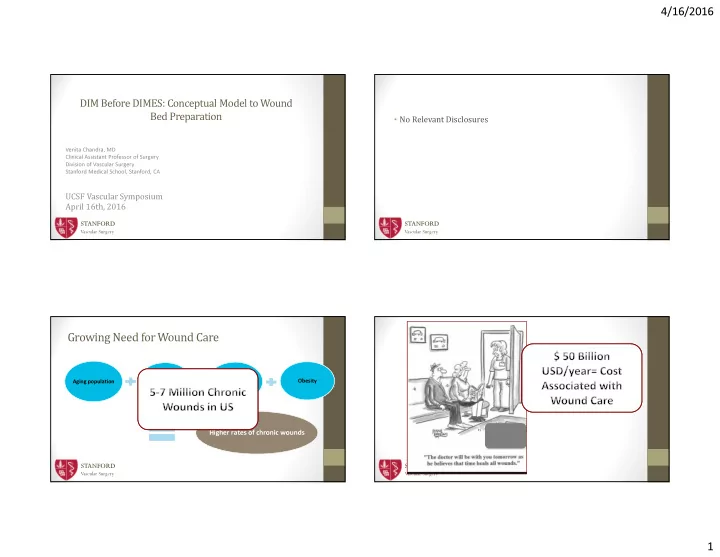
Growing Need for Wound Care

Aging population Higher rates of diabetes Chronic disease Obesity

Higher rates of chronic wounds STANFORD

Vascular Surgery

slide-2
SLIDE 2

4/16/2016 2

STANFORD

Vascular Surgery

Delayed Wound Healing

The vicious circle of delayed wound healing

Degradation of ECM and growth factors Bacterial proteases and toxins Increased inflammatory response Cells produce excess proteases

Falanga V. The Chronic Wound: Impaired Healing and Solutions in the Context of Wound Bed Preparation. Blood Cells and Diseases, 2004;32:88-94. Gibson D, Cullen B, Legersterr E, Harding KG, Schultz G. MMPs Made Easy. Wounds International 2009;

5

STANFORD

Vascular Surgery

Chronic Wound

  • Stuck in the

Inflammatory Phase

  • Defective remodeling of

ECM

  • Fail to re-epithelialize

STANFORD

Vascular Surgery

How do we get a chronic wound to heal?

Convert the chronic wound into an acute wound and allow normal healing to take place

STANFORD

Vascular Surgery

Wound Bed Preparation

  • Preparing the body to do its own healing
  • Hippocrates
  • “vis medicatrix naturae”
  • Natural forces within us are the true

healers of disease

slide-3
SLIDE 3

4/16/2016 3

STANFORD

Vascular Surgery

Wound Bed Preparation Paradigm

Sibbald RG et al. Ostomy/Wound Management 2000;46(11):14-35. Falanga V. Wound Repair Regen. 2000;8:347-352. (Biological Agents, Growth Factors, Skin Substitutes, Adjunctive Therapies) (Biological Agents, Growth Factors, Skin Substitutes, Adjunctive Therapies)

STANFORD

Vascular Surgery

  • Devitalized Tissue
  • Barrier to cell migration
  • Provides ideal environment

for bacterial proliferation

  • Prolongs the inflammatory

response

STANFORD

Vascular Surgery

  • Devitalized Tissue
  • Barrier to cell migration
  • Provides ideal environment

for bacterial proliferation

  • Prolongs the inflammatory

response

STANFORD

Vascular Surgery

slide-4
SLIDE 4

4/16/2016 4

STANFORD

Vascular Surgery

More frequent debridement = faster healing More frequent debridement = faster healing

Wilcox et. al. JAMA Derm. 2013

STANFORD

Vascular Surgery

  • All chronic wounds sit somewhere along a

bacterial spectrum

STANFORD

Vascular Surgery

  • Biofilm
  • Bacteria protected by

exopolysaccharide shield

  • Highly inflammatory
  • Shed bacteria
  • Suppress host immune

response

STANFORD

Vascular Surgery

  • Excessive Fluid
  • Exudate contain proteases,

inactivate growth factors

  • Dessication
  • Slows epithelial cell migration
  • Not too moist, not too

dry…..Just right

slide-5
SLIDE 5

4/16/2016 5

STANFORD

Vascular Surgery

STANFORD

Vascular Surgery

  • If wound edge not migrating

after appropriate wound bed preparation, then healing is stalled

  • First re-assess the patient
  • Consider advanced therapies:
  • Skin substitutes, Skin Grafting,

NPWT, HBOT Cliff Like Edge vs.

STANFORD

Vascular Surgery

Conclusions

  • Concept of wound preparation focused
  • n re-balancing the chronic wound

environment to stimulate and allow the natural healing process to continue

  • Wound Preparation:
  • Debridement
  • Bacterial balance/infection control
  • Moisture Management
  • Edge effect

STANFORD

Vascular Surgery

Thank You!

vascular.stanford.edu