4/14/2016 Thrombus Fragmentation and Extraction: Clinical Evidence - - PowerPoint PPT Presentation

4 14 2016
SMART_READER_LITE
LIVE PREVIEW

4/14/2016 Thrombus Fragmentation and Extraction: Clinical Evidence - - PowerPoint PPT Presentation

4/14/2016 Thrombus Fragmentation and Extraction: Clinical Evidence and Practical Application No Relevant Disclosures Venita Chandra, MD Clinical Assistant Professor of Surgery Division of Vascular Surgery Stanford Medical School, Stanford,


slide-1
SLIDE 1

4/14/2016 1

STANFORD

Vascular Surgery

Thrombus Fragmentation and Extraction: Clinical Evidence and Practical Application

Venita Chandra, MD Clinical Assistant Professor of Surgery Division of Vascular Surgery Stanford Medical School, Stanford, CA

UCSF Vascular Symposium April 14th, 2016

STANFORD

Vascular Surgery

  • No Relevant Disclosures

STANFORD

Vascular Surgery

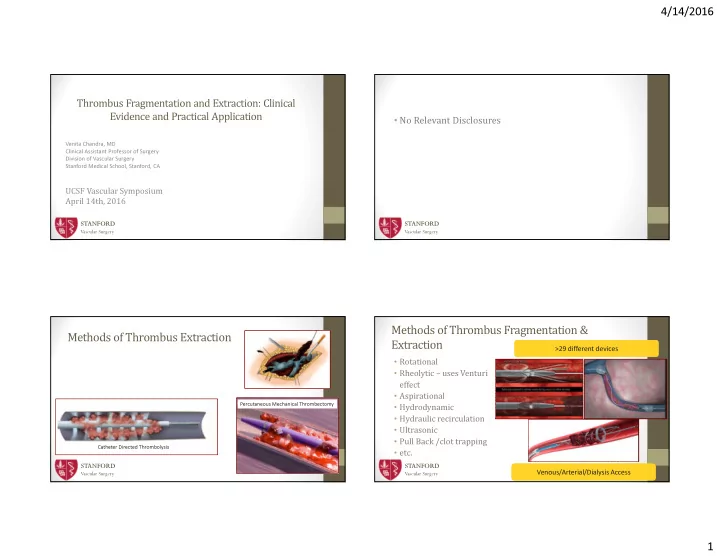
Methods of Thrombus Extraction

Catheter Directed Thrombolysis Percutaneous Mechanical Thrombectomy

STANFORD

Vascular Surgery

Methods of Thrombus Fragmentation & Extraction

  • Rotational
  • Rheolytic – uses Venturi

effect

  • Aspirational
  • Hydrodynamic
  • Hydraulic recirculation
  • Ultrasonic
  • Pull Back /clot trapping
  • etc.

>29 different devices >29 different devices Venous/Arterial/Dialysis Access Venous/Arterial/Dialysis Access

slide-2
SLIDE 2

4/14/2016 2

STANFORD

Vascular Surgery

TrellisTM*

  • Compliant occlusion

balloons

  • Compliant occlusion

balloons

  • Dispersion wire is

sinusoidal shape, connected to

  • scillation drive
  • Infusion port
  • Aspiration Port
  • Dispersion wire is

sinusoidal shape, connected to

  • scillation drive
  • Infusion port
  • Aspiration Port

* Bacchus Vascular, Santa Clara, CA

STANFORD

Vascular Surgery

TrellisTM

  • Pros: limited systemic leakage of thrombolytics,

potentially less embolization

  • Cons: limited in size

STANFORD

Vascular Surgery Hypotube and jet body

AngioJetTM Catheter*

  • Rheolytic Thrombectomy
  • Jet flow of saline creates

low pressure zone (Venturi Effect)

  • Low pressure:
  • Thrombus

fragmentation

  • Evacuation
  • Rheolytic Thrombectomy
  • Jet flow of saline creates

low pressure zone (Venturi Effect)

  • Low pressure:
  • Thrombus

fragmentation

  • Evacuation

* Boston Scientific, Marlborough, MA

STANFORD

Vascular Surgery

Case- Angiojet

  • Clotted Brachial-Axial AV graft
  • Technique
  • Access both retrograde/antegrade
  • Infuse TpA through Angiojet Catheter on Power pulse mode
  • Wait 20-30 minutes
slide-3
SLIDE 3

4/14/2016 3

STANFORD

Vascular Surgery

  • Retrograde sheath
  • Retrograde sheath
  • Antegrade sheath
  • Antegrade sheath
  • After Power Pulse
  • After Power Pulse
  • After Thrombectomy
  • After Thrombectomy

STANFORD

Vascular Surgery

AngioJetTM Catheter

  • Pros:
  • Less endothelial damage
  • Pharmacomechanical option
  • Arterial and venous uses
  • variety of sizes
  • Cons:
  • Cost
  • Hemolysis
  • Hematuria
  • Hyperkalemia
  • Bradycardia

STANFORD

Vascular Surgery

Penumbra Catheter*

  • Large lumen

aspiration

  • Separator Tip
  • Large lumen

aspiration

  • Separator Tip

* Penumbra, Alameda, CA

STANFORD

Vascular Surgery

  • Pros:
  • No Thrombolysis
  • Extremely trackable
  • Arterial and venous uses
  • Cons:
  • Risk of blood loss
  • Limitation of catheter sizes

PenumbraTM

slide-4
SLIDE 4

4/14/2016 4

STANFORD

Vascular Surgery

  • Safety & Feasibility Studies of various devices/Case

Series/Retrospective Reviews

  • Arterial
  • Technical success: 70-90%
  • AV access:
  • Technical success: 76-91%
  • DVT
  • Technical success: 28.5-100%
  • CDT + PMT
  • CDT vs. PMT

Results of PMT

Similar outcomes, shorter hospital stays and less thrombolytics with PMT* Similar outcomes, shorter hospital stays and less thrombolytics with PMT* *Kim et. al. Cardiovasc Intervent Radiol (2006) *Lin et. al. Am Journal of Surgery 2006

STANFORD

Vascular Surgery

Conclusions

  • Numerous options for PMT
  • Appear to associated with less thrombolytics, less treatment

time (less ICU stay) and potentially less hospital costs compared to CDT

  • Limited quality data to guide treatment
  • Clinical decisions:
  • Experience/Comfort level
  • Case by case

STANFORD

Vascular Surgery

Thank You!

vascular.stanford.edu

STANFORD

Vascular Surgery

PEARL Registry Results Venous

  • 58.5% had 100% clot burden

reduction

  • 96% had >50% clot burden

reduction

  • No significant difference in terms of

clot burden reduction

  • Significant differences in treatment

time

Garcia, JVIR June 2015, volume 26, Issue 6, pages 777-785 RT only 4% PCDT 35% CDT 9% PCDT + CDT 52%

n=329

1.4 hrs 2 hrs 22 hrs 41 hrs

slide-5
SLIDE 5

4/14/2016 5

STANFORD

Vascular Surgery

  • n=283, 48% PMT+CDT, 52% PMT only
  • Procedures were shorter in the PMT only

group (1.6 hrs vs. 23.0 hrs) compared to the PMT+CDT group (p<0.001)

  • Increased rate of stenting in PMT only group

PEARL Registry- Arterial

Daniel A. Leung et al. J Endovasc Ther 2015;22:546-557

STANFORD

Vascular Surgery

Comparison of outcomes by treatment

  • NOT RCT
  • Just a registry!!
  • NOT RCT
  • Just a registry!!

STANFORD

Vascular Surgery

Penumbra Case

  • Complicated diabetic, numerous prior interventions for CLI
  • ver many years
  • Infected SFA Viabahns after bout of sepsis
  • Partial resection of SFA Viabahns, and cadaveric fem-PT bypass
  • Occlusion of cadaveric bypass re-opened with CDT
  • Pseudoaneurysm/degeneration of bypass treated with covered

stent

  • Occlusion of bypass treated with CDT, complicated by bleeding
  • Presents with re-occluded bypass, rest pain and tissue loss

STANFORD

Vascular Surgery

Penumbra Case:

Occluded remnant native SFA stent Occluded stent in cadaveric bypass graft Single disease vessel runoff (PT) Distal anastomosis of

  • ccluded graft
  • Hoping for limb

salvage

  • Did not want

thrombolysis

  • Hoping for limb

salvage

  • Did not want

thrombolysis

slide-6
SLIDE 6

4/14/2016 6

STANFORD

Vascular Surgery

Penumbra Case

After passage of penumbra catheter After balloon angioplasty