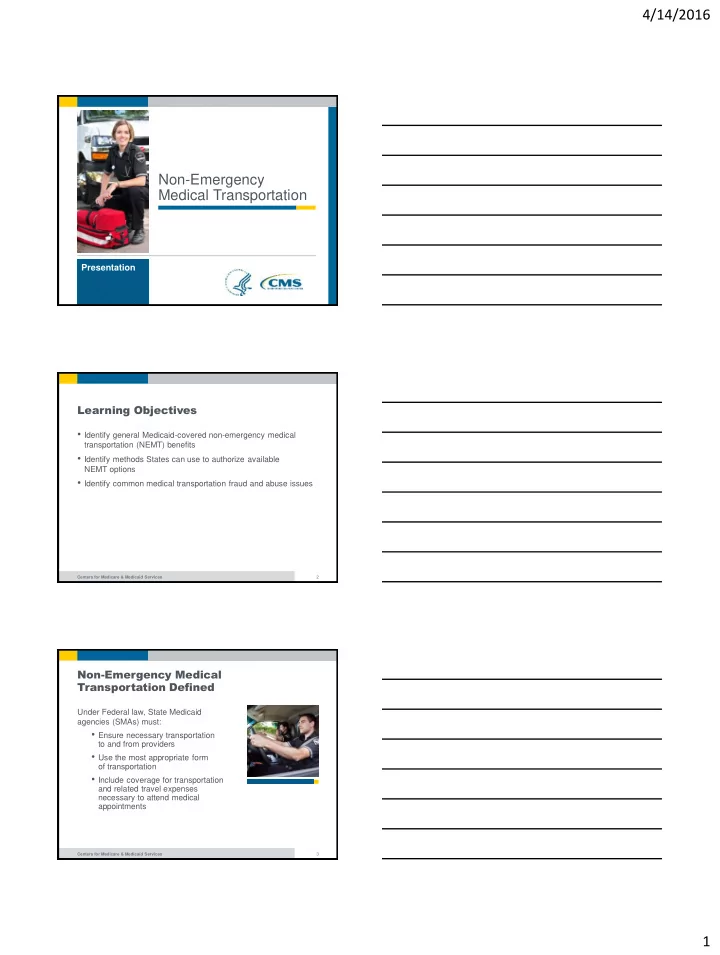
4/14/2016 Non-Emergency Medical Transportation Presentation - - PDF document

4 14 2016
SMART_READER_LITE
LIVE PREVIEW

4/14/2016 Non-Emergency Medical Transportation Presentation - - PDF document

4/14/2016 Non-Emergency Medical Transportation Presentation Learning Objectives Identify general Medicaid-covered non-emergency medical transportation (NEMT) benefits Identify methods States can use to authorize available NEMT options


slide-1
SLIDE 1

4/14/2016 1

Presentation

Non-Emergency Medical Transportation

Learning Objectives

Centers for Medicare & Medicaid Services 2

  • Identify general Medicaid-covered non-emergency medical

transportation (NEMT) benefits

  • Identify methods States can use to authorize available

NEMT options

  • Identify common medical transportation fraud and abuse issues

Centers for Medicare & Medicaid Services 3

Non-Emergency Medical Transportation Defined

Under Federal law, State Medicaid agencies (SMAs) must:

  • Ensure necessary transportation

to and from providers

  • Use the most appropriate form
  • f transportation
  • Include coverage for transportation

and related travel expenses necessary to attend medical appointments

slide-2
SLIDE 2

4/14/2016 2

Centers for Medicare & Medicaid Services 4

Unmet Transportation Need

Unmet transportation needs can include:

  • Not having a valid driver’s license
  • Not having a working vehicle available in the household
  • Not being able to drive because of a medical condition
  • Other situations, such as no money for gas

Centers for Medicare & Medicaid Services 5

Emergency Transportation Is Different

  • Medical needs are immediate
  • Symptoms are severe
  • Symptoms may be life-threatening (for

example, heart attack)

  • Symptoms may be due to a serious event

(for example, automobile accident)

Centers for Medicare & Medicaid Services 6

State Rules for Non-Emergency Medical Transportation

  • May vary by State
  • Require providers to

have a Medicaid contract

slide-3
SLIDE 3

4/14/2016 3

Centers for Medicare & Medicaid Services 7

State Rules for Non-Emergency Medical Transportation—Continued

  • Loaded mileage—beneficiary must be

in the vehicle

  • Appropriate location
  • Wait times are not usually reimbursable

Centers for Medicare & Medicaid Services 8

Types of Transportation

  • Wheelchair vans
  • Taxis
  • Stretcher cars
  • Buses
  • Other SMA

approved transportation

Centers for Medicare & Medicaid Services 9

Knowledge Check

For a transportation provider to receive reimbursement for furnished services, a transported beneficiary must: A. Have his or her own car B. Be ineligible for Medicaid C. Be eligible for Medicaid D. Take an ambulance

slide-4
SLIDE 4

4/14/2016 4

Centers for Medicare & Medicaid Services 10

Transportation Entities

  • States
  • Brokers
  • Managed care plans
  • Transportation companies

Centers for Medicare & Medicaid Services 11

Transportation Drivers

Drivers must be:

  • Licensed
  • Qualified
  • Competent
  • Courteous

Centers for Medicare & Medicaid Services 12

Qualified Vehicles

  • Proof of ownership
  • Legally licensed
  • Current license plates
  • Safe
  • Well-maintained
  • Liability insurance
slide-5
SLIDE 5

4/14/2016 5

Centers for Medicare & Medicaid Services 13

Knowledge Check

True or False? State Medicaid transportation services can only be furnished by the State.

Centers for Medicare & Medicaid Services 14

Fraud and Abuse in Medical Transportation

Most transportation providers want to do the right thing. Those providers:

  • Bill claims properly
  • Follow Medicaid rules
  • Understand fraud schemes
  • Take time to learn preventive strategies

Centers for Medicare & Medicaid Services 15

Fraud and Abuse in Medical Transportation—Fraud

A Medicare beneficiary:

  • Drove himself and others to dialysis appointments,

but allowed an ambulance company owner to bill for ambulance rides with their medical IDs

  • Received kickbacks for referring patients to the

ambulance company An owner of a Massachusetts medical transportation company:

  • Billed for rides for deceased beneficiaries
  • Was sentenced to 18 months in prison and ordered to

repay over $475,000

slide-6
SLIDE 6

4/14/2016 6

Centers for Medicare & Medicaid Services 16

Fraud and Abuse in Medical Transportation—Abuse

Two ambulance companies in Connecticut:

  • Allegedly provided ambulance transportation for

dialysis patients who did not have a medical need for ambulance transportation

  • Paid almost $600,000 to settle these allegations

Centers for Medicare & Medicaid Services 17

Fraud Scheme— Services Not Rendered

  • Not all NEMT fraud is perpetrated by

professional providers

  • The parent of a patient:
  • Was authorized to transport her child

for treatment

  • Billed Medicaid for trips that did not

take place

  • Was sentenced to 30 days in jail and
  • rdered to pay $21,500

Centers for Medicare & Medicaid Services 18

Fraud Scheme— Services Not Rendered

  • NEMT company owner billed for cancelled trips, used beneficiary

information without permission to bill for services never provided, and upcoded trips

  • Transportation company upcoded regular livery services as

ambulette services; $300,000 settlement

slide-7
SLIDE 7

4/14/2016 7

Centers for Medicare & Medicaid Services 19

Fraud Scheme— Vehicles

Owner of a transportation company forged forms that authorized taxi transportation to show more expensive ambulette transportation; $200,000 settlement

Centers for Medicare & Medicaid Services 20

Fraud Schemes— Travel Vouchers

Taxi driver:

  • Accepted Medicaid vouchers for

nonmedical locations

  • Purchased unused vouchers
  • Charges exceeded actual services
  • Lifetime exclusion

Centers for Medicare & Medicaid Services 21

Unqualified Drivers and Other Fraud Schemes

  • Company whose owner falsified drivers’ documentation was

fined $10,000

  • Other transportation fraud schemes include:
  • Billing for personal assistance when none was provided
  • Coding all 911-dispatched city ambulances at

the advanced life support rate regardless of the beneficiary’s condition

slide-8
SLIDE 8

4/14/2016 8

Centers for Medicare & Medicaid Services 22

Tips for Preventing Medical Transportation Fraud

  • Document what the State wants
  • Verify documented services
  • Bill correctly

Centers for Medicare & Medicaid Services 23

Tips for Preventing Medical Transportation Fraud—Documentation

Follow State documentation requirements. At a minimum include:

  • Beneficiary’s name
  • Medicaid identifier
  • Locations of pickup and drop-off
  • Date and time of pickup and drop-off
  • Loaded mileage

Centers for Medicare & Medicaid Services 24

Tips for Preventing Medical Transportation Fraud—Verify Services

It is management’s responsibility to:

  • Verify information
  • Make random survey calls
slide-9
SLIDE 9

4/14/2016 9

Centers for Medicare & Medicaid Services 25

Tips for Preventing Medical Transportation Fraud—Billing Accurately

Form CMS-1500 includes a notice that filing a false claim may lead to:

  • Criminal penalties
  • Civil penalties

Centers for Medicare & Medicaid Services 26

Final Action— Check for Excluded Individuals and Parties

  • Use the List of Excluded Individuals and

Entities (LEIE)

  • Use the System for Award Management

(SAM) Exclusions Extract

  • Check monthly

Centers for Medicare & Medicaid Services 27

Report It!

  • SMA and Medicaid Fraud Control Unit

https://www.cms.gov/medicare-medicaid-coordination/fraud- prevention/fraudabuseforconsumers/report_fraud_and_suspecte d_fraud.html

  • U.S. Department of Health and Human Services, Office of

Inspector General (HHS-OIG) Phone: 1-800-447-8477 (1-800-HHS-TIPS) TTY: 1-800-377-4950 Fax: 1-800-223-8164 Email: HHSTips@oig.hhs.gov Website: https://forms.oig.hhs.gov/hotlineoperations

slide-10
SLIDE 10

4/14/2016 10

Centers for Medicare & Medicaid Services 28

Conclusion

We are all enlisted to prevent fraud and abuse!

Centers for Medicare & Medicaid Services 29

Questions

Please direct questions or requests to: MedicaidProviderEducation@cms.hhs.gov To see the electronic version of this presentation and the other products included in the “Non-Emergency Medical Transportation” Toolkit, visit the Medicaid Program Integrity Education page at https://www.cms.gov/Medicare-Medicaid- Coordination/Fraud-Prevention/Medicaid- Integrity-Education/edmic-landing.html on the CMS website. Follow us on Twitter #MedicaidIntegrity

Centers for Medicare & Medicaid Services 30

Disclaimer

This presentation was current at the time it was published or uploaded

  • nto the web. Medicaid and Medicare policies change frequently so links

to the source documents have been provided within the document for your reference. This presentation was prepared as a service to the public and is not intended to grant rights or impose obligations. This presentation may contain references or links to statutes, regulations, or other policy

  • materials. The information provided is only intended to be a general
  • summary. Use of this material is voluntary. Inclusion of a link does not

constitute CMS endorsement of the material. We encourage readers to review the specific statutes, regulations, and other interpretive materials for a full and accurate statement of their contents. April 2016