3rd Grade Motion and Stability 2015-11-09 www.njctl.org Slide 3 / - - PDF document

3rd grade
SMART_READER_LITE
LIVE PREVIEW

3rd Grade Motion and Stability 2015-11-09 www.njctl.org Slide 3 / - - PDF document

Slide 1 / 106 Slide 2 / 106 3rd Grade Motion and Stability 2015-11-09 www.njctl.org Slide 3 / 106 Slide 4 / 106 Table of Contents Click on the topic to go to that section Forces and Motion Review Forces and Motion Balanced and


slide-1
SLIDE 1

Slide 1 / 106 Slide 2 / 106

3rd Grade

Motion and Stability

2015-11-09 www.njctl.org

Slide 3 / 106 Table of Contents

· Forces and Motion Review

Click on the topic to go to that section
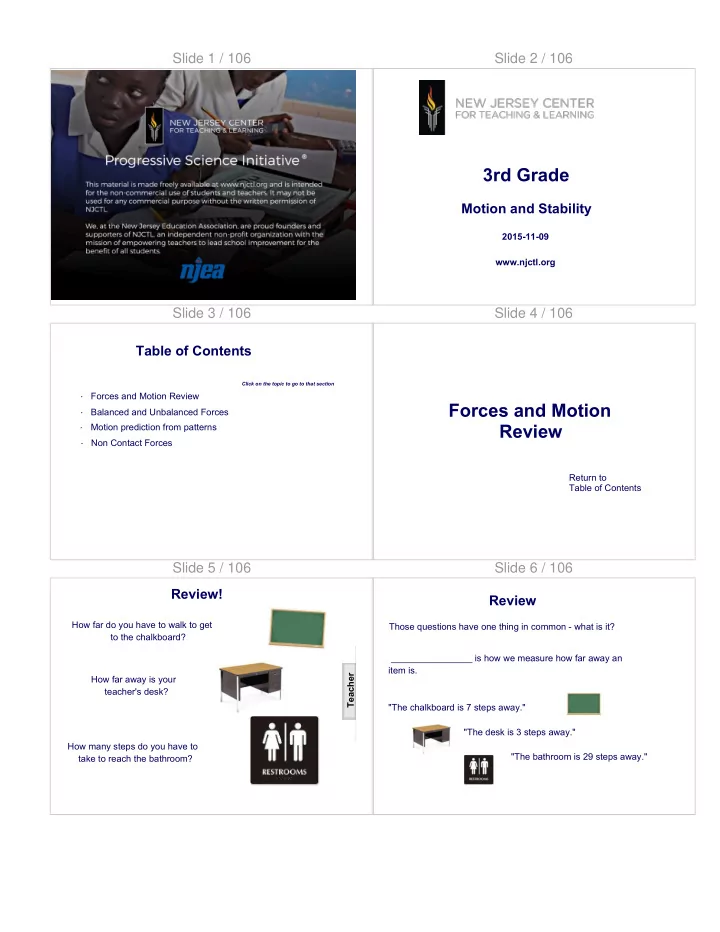
· Balanced and Unbalanced Forces · Motion prediction from patterns · Non Contact Forces

Slide 4 / 106

Forces and Motion Review

Return to Table of Contents

Slide 5 / 106 Review!

How far away is your teacher's desk? How many steps do you have to take to reach the bathroom? How far do you have to walk to get to the chalkboard? Teacher

Slide 6 / 106 Review

________________ is how we measure how far away an item is. "The chalkboard is 7 steps away." "The desk is 3 steps away." "The bathroom is 29 steps away." Those questions have one thing in common - what is it?

slide-2
SLIDE 2

Slide 7 / 106 Distance

The farther away something is, the _______________ its distance is from you. The closer something is, the ______________ its distance is from you. What's farther from you now, your desk or your home? Teacher

Slide 8 / 106

1 Which object is the closest to you (and has the smallest distance from you)? A Your house B The Moon C The Sun

Slide 8 (Answer) / 106

1 Which object is the closest to you (and has the smallest distance from you)? A Your house B The Moon C The Sun

[This object is a pull tab]

Answer A

Slide 9 / 106 Review

What takes longer to do, watching a TV show or washing your hands after dinner? What do we measure to figure this out?

Slide 10 / 106 Review

To figure those answers

  • ut we need to measure

_____________! __________ is used to show how long it takes to do something.

Slide 11 / 106 Time

What are some units we use to measure time? Think about very small measurements and very large measurements! Make a list at your table.

slide-3
SLIDE 3

Slide 12 / 106

2 When talking about how far away something is from you, we use the word ____________. A time B distance

Slide 12 (Answer) / 106

2 When talking about how far away something is from you, we use the word ____________. A time B distance

[This object is a pull tab]

Answer B

Slide 13 / 106

3 If you measured how long your desk is, you would be talking about a ___________. A time B distance

Slide 13 (Answer) / 106

3 If you measured how long your desk is, you would be talking about a ___________. A time B distance

[This object is a pull tab]

Answer B

Slide 14 / 106

4 If you measured how long it takes to walk from your house to your friend's house, you would be talking about ____________. A time B distance

Slide 14 (Answer) / 106

4 If you measured how long it takes to walk from your house to your friend's house, you would be talking about ____________. A time B distance

[This object is a pull tab]

Answer A

slide-4
SLIDE 4

Slide 15 / 106

5 If you were timing how long it took to walk a mile, you would probably use __________ as your unit. A seconds B minutes C hours D days

Slide 15 (Answer) / 106

5 If you were timing how long it took to walk a mile, you would probably use __________ as your unit. A seconds B minutes C hours D days

[This object is a pull tab]

Answer B

Slide 16 / 106

6 If you were timing how long it took to blink your eyes, you would probably use __________ as your unit. A seconds B minutes C hours D days

Slide 16 (Answer) / 106

6 If you were timing how long it took to blink your eyes, you would probably use __________ as your unit. A seconds B minutes C hours D days

[This object is a pull tab]

Answer A

Slide 17 / 106

7 If you were timing how long it took to fly from Africa to Spain in a airplane you would probably use __________ as your unit. A seconds B minutes C hours D days

Slide 17 (Answer) / 106

7 If you were timing how long it took to fly from Africa to Spain in a airplane you would probably use __________ as your unit. A seconds B minutes C hours D days

[This object is a pull tab]

Answer C

slide-5
SLIDE 5

Slide 18 / 106

8 Which of these activities takes the longest to do? A Eating dinner (half an hour) B Brushing your teeth (two minutes) C Watching a movie (hour and a half)

Slide 18 (Answer) / 106

8 Which of these activities takes the longest to do? A Eating dinner (half an hour) B Brushing your teeth (two minutes) C Watching a movie (hour and a half)

[This object is a pull tab]

Answer B

Slide 19 / 106 Discussion Questions

Does it take longer to walk or run home? Do people walk or run when they are in a race? Why? When you walk, are you going slow or fast? When you run, are you going slow or fast?

Slide 20 / 106 How fast do you go?

The word _____________describes how fast or how slow you go. How do you know whether you are going fast or slow?

Slide 21 / 106 Speed

Objects with more speed can move a greater distance in a set amount of time . This is why the fastest runner reaches the finish line first. Teacher

Slide 22 / 106 Speed

Objects with less speed move a shorter distance in a set amount of time . This is why it takes you longer to move somewhere if you are walking instead of running.

slide-6
SLIDE 6

Slide 23 / 106 Speed Math

Speed, mathematically, is distance divided by time. Distance ÷ Time = Speed Moving 10 meters in 5 seconds gives you a speed of (10 meters ÷ 5 seconds) ________ meters per second. Teacher

Slide 24 / 106

9 A block is pushed 30 meters in 5 second. What is its speed?

Slide 24 (Answer) / 106

9 A block is pushed 30 meters in 5 second. What is its speed?

[This object is a pull tab]

Answer 30 meters / 5 seconds = 6 meters per second.

Slide 25 / 106

10 A baseball is thrown 26 meters in 2 seconds. What is its speed?

Slide 25 (Answer) / 106

10 A baseball is thrown 26 meters in 2 seconds. What is its speed?

[This object is a pull tab]

Answer (26 meters / 2 seconds) 13 meters per second.

Slide 26 / 106

11 From the last 2 examples, which is faster? A block B baseball

slide-7
SLIDE 7

Slide 26 (Answer) / 106

11 From the last 2 examples, which is faster? A block B baseball

[This object is a pull tab]

Answer B baseball

Slide 27 / 106

12 Which of these is the slowest? A A walking man B A running track star C A speeding car

Slide 27 (Answer) / 106

12 Which of these is the slowest? A A walking man B A running track star C A speeding car

[This object is a pull tab]

Answer A

Slide 28 / 106

13 You slide a book, which moves 6 meters in 2 seconds. What is its speed? A 2 m/s B 3 m/s C 4 m/s

Slide 28 (Answer) / 106

13 You slide a book, which moves 6 meters in 2 seconds. What is its speed? A 2 m/s B 3 m/s C 4 m/s

[This object is a pull tab]

Answer B

Slide 29 / 106 Distance, Time, and Speed

The following lab explains what distance, time, and speed are through various activities

slide-8
SLIDE 8

Slide 30 / 106

What is this man doing?

Forces

What is this man doing? Teacher

Slide 31 / 106 Forces

There is a name for pushing or pulling something. When you push or pull something, you are using a force! A force is a push or a pull. Similar to how we can measure distance in _________ and time in ___________, we measure force in Newtons (N).

Slide 32 / 106 Forces

A force is a push or a pull, and is measured in Newtons (N). By the way, where did the word Newton come from? Teacher

Slide 33 / 106

14 This is an example of a ________. A push B pull

Slide 33 (Answer) / 106

14 This is an example of a ________. A push B pull

[This object is a pull tab]

Answer B

Slide 34 / 106

15 When you ring a doorbell, you ________ the buzzer. A push B pull

slide-9
SLIDE 9

Slide 34 (Answer) / 106

15 When you ring a doorbell, you ________ the buzzer. A push B pull

[This object is a pull tab]

Answer A

Slide 35 / 106

16 This boy is pushing his wagon. True False

Slide 35 (Answer) / 106

16 This boy is pushing his wagon. True False

[This object is a pull tab]

Answer FALSE

Slide 36 / 106 Motion

When you ________ or _________on something and make it move, you are causing motion ! The harder you push or pull on something while it is moving, the more you change its motion. More force leads to more change in speed.

Slide 37 / 106 Motion

Using a force on an object changes its motion. Imagine a ball rolling towards

  • you. When it gets to you, you

can push the ball away from you and slow it down. If you keep pushing hard enough, you can stop the ball.

Slide 38 / 106 Motion

If you kick a soccer ball, it eventually stops . What pushes back on the ball to make it stop?

slide-10
SLIDE 10

Slide 39 / 106 Friction

The ball stops its motion due to a force called friction. Friction is the force from two surfaces rubbing against each other. Friction is always present when two objects rub against one another.

Friction Motion of the ball

What two objects are rubbing in this example?

Slide 40 / 106 Friction

The friction force always acts against the object's motion. It always tries to slow things down. The grips on these socks provide more friction with the floor than the socks alone. Why is friction important to have with these socks?

Slide 41 / 106 Friction

The friction between two objects depends on the surface of each object. What will move farther, a hockey puck pushed across a gym floor,

  • r a puck pushed
  • n ice?

Teacher

Slide 42 / 106 Examples of Friction

At your table, talk about what you know about these two sports and how friction is involved with them.

Slide 43 / 106

17 Which example has the most friction? A A skater moving on an ice rink B A box pushed on tile that slides far before stopping C A box pushed on gravel that stops moving instantly

Slide 43 (Answer) / 106

17 Which example has the most friction? A A skater moving on an ice rink B A box pushed on tile that slides far before stopping C A box pushed on gravel that stops moving instantly

[This object is a pull tab]

Answer C

slide-11
SLIDE 11

Slide 44 / 106

Balanced and Unbalanced Forces

Return to Table of Contents

Slide 45 / 106 Balanced and Unbalanced Forces

We already know that a force is a push or pull. When you push on a ball, it moves. But, when you push on a wall, it doesn't. Why? When you play tug of war, even though both sides are pulling, the rope only moves in one direction. Why? Teacher

Slide 46 / 106 Balanced and Unbalanced Forces

The answer is because of balanced and unbalanced forces! What do you think it means if a force is balanced ? What do you think it means if a force is unbalanced ? Teacher

Slide 47 / 106 Balanced and Unbalanced Forces

Explain what is happening in this picture. Does this show the boys being balanced or unbalanced?

Slide 48 / 106 Balanced and Unbalanced Forces

Explain what is happening in this picture. What is different about this teeter totter compared to the last one? How is this one balanced?

Slide 49 / 106 Net Forces

In order to understand balanced forces, we should understand what net force is first. Net force is the total force applied to an object. 10 Newtons 5 Newtons Who is going to win this tug of war? How do you know?

slide-12
SLIDE 12

Slide 50 / 106 Net Forces

If one person pulls with 10 N of force on the left side, and the other person pulls with 5 N of force on the right side of a box, the net force is (10 N - 5 N) = 5 N of force to the left! 10 Newtons 5 Newtons 5 N more force to the left

Slide 51 / 106 Net Force Example Problem

If you push with 15 N of force on the left side of a box, and push with 6 N of force on the right side of a box, what will the net force on the box be?

6 N 15 N

? Slide 51 (Answer) / 106 Net Force Example Problem

If you push with 15 N of force on the left side of a box, and push with 6 N of force on the right side of a box, what will the net force on the box be?

6 N 15 N

?

[This object is a pull tab]

Answer The net force is (15 N - 6 N) = 9 N to the left

Slide 52 / 106 Net Forces

Try this example! force 1 = 5N force 2 = 5N What is the net force on the book?

Slide 52 (Answer) / 106 Net Forces

Try this example! force 1 = 5N force 2 = 5N What is the net force on the book?

[This object is a pull tab]

Answer The net force is (5 N - 5 N) = 0 N

Slide 53 / 106

18 What is the net force applied to this box?

3 N 8 N

Teacher

slide-13
SLIDE 13

Slide 54 / 106

19 What direction will the box move? A right B left C it will not move at all

3 N 8 N

Slide 54 (Answer) / 106

19 What direction will the box move? A right B left C it will not move at all

3 N 8 N

[This object is a pull tab]

Answer A

Slide 55 / 106

20 What is the net force applied to this box?

2 N 6 N

Teacher

Slide 56 / 106

21 What direction will the box move? A right B left C it will not move at all

2 N 6 N

Slide 56 (Answer) / 106

21 What direction will the box move? A right B left C it will not move at all

2 N 6 N

[This object is a pull tab]

Answer A

Slide 57 / 106 Balanced Forces

Balanced forces are two forces, equal in size, acting in

  • pposing directions on the same object.

When the forces on an object are balanced, the object does not move OR stays moving at a constant speed. Each finger is pushing with the same force on the toy car. What is the net force?

slide-14
SLIDE 14

Slide 58 / 106 Balanced Forces

When a book lies on a table, the forces on it are balanced. Gravity pulls down on it, but the table pushes up on it.

SCIENCE

table pushes up

  • n the book

gravity pulls down

  • n the book

As a result, the book doesn't move.

Slide 59 / 106

22 A student applies 5 N of force to the left side of a box. Another student applies 5 N to the right side of the box. What is the net force applied to this box?

5 N 5 N

Slide 59 (Answer) / 106

22 A student applies 5 N of force to the left side of a box. Another student applies 5 N to the right side of the box. What is the net force applied to this box?

5 N 5 N

[This object is a pull tab]

Answer 0 N

Slide 60 / 106

23 What direction will the box move? A right B left C it will not move at all

5 N 5 N

Slide 60 (Answer) / 106

23 What direction will the box move? A right B left C it will not move at all

5 N 5 N

[This object is a pull tab]

Answer C

Slide 61 / 106 Balanced Forces

What are some examples of balanced forces? With a partner, come up with a list of 5 examples. Teacher

slide-15
SLIDE 15

Slide 62 / 106

24 Which of these are a balanced force? A Two students push on a car, and it speeds up B A book slides to a stop across a table C Two groups play tug of war, and the rope does not move

Slide 62 (Answer) / 106

24 Which of these are a balanced force? A Two students push on a car, and it speeds up B A book slides to a stop across a table C Two groups play tug of war, and the rope does not move

[This object is a pull tab]

Answer C

Slide 63 / 106 Unbalanced Forces

If the opposing forces are not equal, then they are unbalanced. When you throw a bowling ball, you are applying an unbalanced force. Name 3 other examples. Teacher

Slide 64 / 106

25 Which of these represents an unbalanced force? A Two forces push a box, resulting in a net force of 0 Newtons B A student pushes on a wall and does not move C You kick a soccer ball into a goal

Slide 64 (Answer) / 106

25 Which of these represents an unbalanced force? A Two forces push a box, resulting in a net force of 0 Newtons B A student pushes on a wall and does not move C You kick a soccer ball into a goal

[This object is a pull tab]

Answer C

Slide 65 / 106

slide-16
SLIDE 16

Slide 66 / 106 Conclusion Questions

· For any object to stay completely still it must overcome what force that always pulls down? · In all of the activities you did what did you notice was the difference between unbalanced and balanced? Explain in terms of force. · In which direction did all the forces that went against gravity go? Were they always enough to stop the object from falling? · Can you think of some other activities in your life that show balanced or unbalanced forces? Do you think you can try it in class ask your teacher.

Slide 67 / 106

Motion Prediction From Patterns

Return to Table of Contents

Slide 68 / 106

Ball is thrown straight up? Magnet and is near paper clips? Ball collides with a wall?

Predict the motion when a... Predicting Motion Lab Slide 69 / 106 What forces are present?

Gravitational force Collision force Magnetic force

Predicting Motion Lab Slide 70 / 106 Motion Prediction From Patterns

How does the swing move? Where will the swing be next? Draw it on the picture.

Slide 71 / 106 Motion Prediction From Patterns

This question is all about motion prediction. Some objects always follow a pattern of motion. A ball thrown straight up will come straight down, and a swing keeps moving left and right.

slide-17
SLIDE 17

Slide 72 / 106

As a result, we can predict some objects' motion. Science does not just explain things. Instead, it allows us to make really good predictions of new things that will happen! We do this by observing something, and predicting what will happen in the future to it. We then do an experiment, measure and record data, then see if the prediction came true.

Motion Prediction From Patterns Slide 73 / 106

If our prediction came true, and it happens many, many times, we can create a theory (an explanation for what is happening).

Motion Prediction From Patterns

What if the prediction didn't come true? What do we do then?

Slide 73 (Answer) / 106

If our prediction came true, and it happens many, many times, we can create a theory (an explanation for what is happening).

Motion Prediction From Patterns

What if the prediction didn't come true? What do we do then?

[This object is a pull tab]

Answer Then the prediction was not a good

  • ne, and we don't have a good
  • theory. So - we come up with

another prediction and see if that

  • ne works! That is science - we

keep experimenting and trying to find new things. And, we're not afraid to say things we used to believe aren't true if the experiment doesn't show that they don't work.

Slide 74 / 106 Motion Prediction From Patterns

A pendulum is a ball attached to a string, which is taped to some point. The ball attached to the string is allowed to move freely. It looks just like a swing!

Slide 75 / 106 Motion Prediction From Patterns

Predict the path of motion for this pendulum. What is the reasoning behind your prediction? move the block for the answer

Slide 76 / 106 Motion Prediction From Patterns

Draw the path of this ball if it is thrown in the direction of the arrow Draw the path that the kids will follow on the seesaw. Teacher

slide-18
SLIDE 18

Slide 77 / 106

26 A ball is thrown off a building. Which diagram best predicts its path? A B C

Slide 77 (Answer) / 106

26 A ball is thrown off a building. Which diagram best predicts its path? A B C

[This object is a pull tab]

Answer A

Slide 78 / 106

Non-Contact Forces

Return to Table of Contents

Slide 79 / 106 Non-Contact Forces

Have you ever seen paper clips move towards a magnet without touching it? Why does an apple fall to the ground when you let go of it, even though nothing is touching it?

Slide 80 / 106 Non-Contact Forces

As it turns out, forces are actually not as simple as just a push or a pull. Objects can apply a force to one another without actually

  • touching. Things do not have to touch to cause a change

in motion. These are known as non-contact forces. Do you know the names of either of the non-contact forces from the last slide?

Slide 81 / 106 Non-Contact Forces

Gravitational, electrical, and magnetic forces are all examples of non-contact forces.

slide-19
SLIDE 19

Slide 82 / 106 Gravitational Force

Earth, due to its extremely large mass, pulls objects (like cows on diving boards) towards it, even though no contact is being made. Gravitational force occurs when two bodies physically attract

  • ne another by "pulling" on each other.

Slide 83 / 106

This is why a book speeds towards the ground when it is dropped. This is also why the moon does not move away from Earth.

Gravitational Force Slide 84 / 106

27 Gravity acts as a non-contact force, pulling down on

  • bjects towards Earth.

True False

Slide 84 (Answer) / 106

27 Gravity acts as a non-contact force, pulling down on

  • bjects towards Earth.

True False

[This object is a pull tab]

Answer True

Slide 85 / 106

Experiment 1: Bring the ends of two bar magnets near each other. Experiment 2: Using ring magnets and the stand, try to stack the magnets on the rod so that none of them touch (observe 2 rings first, then add the rest).

Magnetic Interactions Lab Slide 86 / 106

Experiment 3 Place a compass flat on your hand or table. Without being near a magnet, can you change the direction that the compass needle points? Experiment 4 Put the magnet near each of the objects you were given and write if they attract or not

Magnetic Interactions Lab

slide-20
SLIDE 20

Slide 87 / 106

Experiment 5 Using a stock or pencil, string, and a ring magnet, make a fishing pole. Use this to pick up a paperclip, then try to make a paperclip chain by touching one paperclip to the next.

Magnetic Interactions Lab Slide 88 / 106 Magnetic Force

Notice that magnets tend to push or pull on one another and other

  • bjects.

Magnets can apply a force to something without touching it due to a magnetic field.

Slide 89 / 106 Magnetic Force

A magnetic field is the area in which a magnet can apply a push or pull force without touching the object. Objects in a magnetic field can be attracted or repelled by the magnet. These nails are in the magnetic field, so they move towards the magnet.

Slide 90 / 106

The farther an object is from the center of a magnetic field, the weaker the force applied to it. The nails at the top are outside the magnetic field and are not affected by the magnet. You might notice sometimes magnets don't work if they are far from another object.

Magnetic Force Slide 91 / 106 Magnetic Force

Magnets have a North and South pole (just like Earth). The magnetic field goes from the North pole to the South pole . This is why like poles repel each other, and

  • pposite poles attract each other!

Slide 92 / 106 Magnetic Force

Earth itself is actually one giant magnet! It has its own magnetic field. That's how compasses work! The metal arrow lines up with the magnetic field of Earth. Teacher

slide-21
SLIDE 21

Slide 93 / 106

28 A magnetic field goes from the North pole to the South pole of a magnet. True False

Slide 93 (Answer) / 106

28 A magnetic field goes from the North pole to the South pole of a magnet. True False

[This object is a pull tab]

Answer True

Slide 94 / 106

29 You have a magnet that has the North and South pole

  • marked. How can you use this magnet to determine the

North and South pole of other magnets? Discuss this at your table. Click A on your responder when you are ready to share your ideas.

Students type their answers here

Slide 94 (Answer) / 106

29 You have a magnet that has the North and South pole

  • marked. How can you use this magnet to determine the

North and South pole of other magnets? Discuss this at your table. Click A on your responder when you are ready to share your ideas.

Students type their answers here

[This object is a pull tab]

Answer A possible answer to this question is to bring the North side of the magnet to any unknown end of the

  • ther magnet. If they repel each
  • ther, that side is North and the
  • ther is South. If they attract each
  • ther, that side is South and the
  • ther side is North.

Slide 95 / 106 Magnetic Racing

This lab explains and demonstrates magnetic forces by racing two magnets.

Slide 96 / 106 Electric Force

Have you ever gotten to school and then see you have pet hair stuck to your clothing? Why does that happen? Have you ever rubbed a balloon on your head and stuck it to a wall? Why does that happen?

slide-22
SLIDE 22

Slide 97 / 106 Electric Force

This occurs because of electric forces. All objects have charge , which is just a group of positives and negatives. Just like how magnets two poles, (North pole and South pole), the two kinds of charges are called positive (+) and negative (-). Electric force is how these charges interact with one another.

Slide 98 / 106 Electric Force

When the same magnetic poles come near each other, what did we say happens? What do you think happens when two positive charges come near each other? Teacher Opposite charges attract each other and identical charges repel each other.

Slide 99 / 106 Electric Force

As you rub a balloon on your head, you are charging it by giving it negative charge. This turns the balloon into one huge negative charge. This causes the positive charges in the wall to pull on the negative balloon and attract it to the wall!

  • +
  • +

+

  • pposite charges attract

like charges repel

Slide 100 / 106 Electric Force

Electric force is not just limited to balloons and hair. If you rub a glass rod with a silk cloth, it can attract small pieces of

  • paper. This also applies to many other objects! Can you think of

any other examples?

Slide 101 / 106 Electric Force Demonstration

Click on the image to access a PHeT demonstration which shows how rubbing a balloon

  • n a sweater can

cause it to become attracted to a wall.

Slide 102 / 106

30 If you put a balloon with negative charges next to a sweater with positive charges, the balloon will move towards the sweater. True False

slide-23
SLIDE 23

Slide 102 (Answer) / 106

30 If you put a balloon with negative charges next to a sweater with positive charges, the balloon will move towards the sweater. True False

[This object is a pull tab]

Answer True

Slide 103 / 106

31 If you put a comb with positive charges next to another comb with positive charges, they will move towards each

  • ther (attract).

True False

Slide 103 (Answer) / 106

31 If you put a comb with positive charges next to another comb with positive charges, they will move towards each

  • ther (attract).

True False

[This object is a pull tab]

Answer False

Slide 104 / 106

Electrostatic Forces-forces of attraction and repulsion through charged materials

What are electrostatic forces? Electricity Lab Slide 105 / 106

Balloon and cloths Comb, fur, and water Comb, fur, and paper Comb, fur, and coil Socks, Carpet, and teacher Balloon and balloon

Electricity Lab Slide 106 / 106 Building With Magnets

The following lab is an overall project, giving a full demonstration on magnetism.