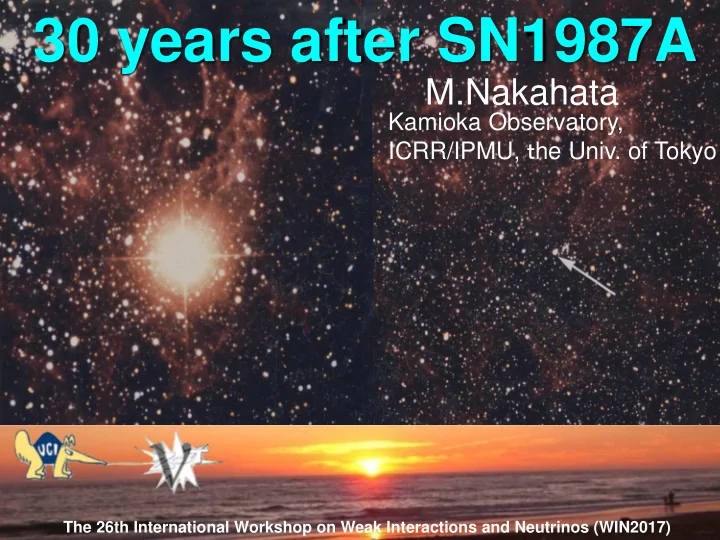
30 years after SN1987A
1
Kamioka Observatory, ICRR/IPMU, the Univ. of Tokyo
M.Nakahata
- M. Nakahata: 30 years after SN1987A
2017/6/19 The 26th International Workshop on Weak Interactions and Neutrinos (WIN2017)
30 years after SN1987A M.Nakahata Kamioka Observatory, ICRR/IPMU, - - PowerPoint PPT Presentation
30 years after SN1987A M.Nakahata Kamioka Observatory, ICRR/IPMU, he Univ. of Tokyo 2017/6/19 The 26th International Workshop on Weak Interactions and Neutrinos (WIN2017) 1 M. Nakahata: 30 years after SN1987A 30 th Anniversary of SN1987A
1
Kamioka Observatory, ICRR/IPMU, the Univ. of Tokyo
2017/6/19 The 26th International Workshop on Weak Interactions and Neutrinos (WIN2017)
2017/6/19
2
Cake made for an anniversary held on Feb.12, 2017 at the Univ. of Tokyo Cake made by Kamioka local people
Why big underground detectors were made Observed neutrino data of SN1987A What we have learned from the observation Supernova detectors in the world now Supernova relic neutrinos Future prospects
3
2017/6/19
4
Georgi and Glashow
Proton decay was predicted. Expected number of proton decay events was 30 ~ 300 events/1000ton/year for 1031 ~ 1030 years of proton lifetime.
2017/6/19
5
IMB (Irvine-Michigan-Brookhaven)
KAMIOKANDE
2,140 ton water Cherenkov detector 880 ton fiducial volume 1,000 20-inch PMTs Kamioka Mine (2700 m.w.e.) Started operation in 1983
2017/6/19
6 2017/6/19
7 2017/6/19
IMB group paper in 1983.
shield external gamma rays
Thanks to large photo-coverage, it was found that the detector is sensitive to low energy events. So, the detector was upgraded for solar neutrinos.
8
9
2017/6/19
5-inch PMT Photo-coverage(1.3%)
Added WLS plates for a factor of ~1.5 increase
In 1986 shut down to add 8-inch PMTs to bring coverage to effectively about 5%. Also added a WWVB clock to get absolute time to better than 50 milliseconds. IMB-3 detector Increased light collection efficiency in order to improve physics analysis. One of the main motivations was to improve the particle identification capability.
10
Vertical axis: Number of hit PMTs for each event, which is almost proportional to energy
12 events within 13sec. 11 of them are higher energy events. at 7:35:35(±1min)(UT) on Feb.23, 1987
2017/6/19
11
event #1
2017/6/19
Feb.23, 1987
T=0 s 20.0 MeV T=0.303 s 7.5 MeV T=0.107 s 13.5 MeV T=0.324 s 9.2 MeV T=0.507 s 12.8 MeV T=0.686 s 6.3 MeV T=1.541 s 35.4 MeV T=1.728 s 21.0 MeV T=1.915 s 19.8 MeV T=9.219 s 8.6 MeV T=10.433 s 13.0 MeV T=12.439 s 8.9 MeV
12
2017/6/19
UT 7:35:41.4 UT 7:35:41.8 UT 7:35:42.5 UT 7:35:42.0 UT 7:35:42.9 UT 7:35:44.1 UT 7:35:46.4 UT 7:35:46.9
February 23, 1987 SN 1987A Events in IMB Detector
The Baksan underground scintillation telescope (Russia)
scintillator detectors
Each detector
13 2017/6/19
5 events in Baksan detector
14
2017/6/19
Kam-II (11 evts.) IMB-3 (8 evts.) Baksan (5 evts.) 24 events total
Energy threshold (at 50% eff.) ~8.5 MeV @ Kamiokande ~28 MeV @ IMB ~10 MeV @ Baksan Detection efficiency
2017/6/19
15
Jegerlehner, Neubig & Raffelt, PRD 54 (1996) 1194 Binding energy (X1053erg) Sato and Suzuki, Phys.Lett.B196 (1987) 267
(gravitational mass)
However, no detailed information of burst process was observed because of low statistics.
1 9 8 1 9 8 1 1 9 8 2 1 9 8 3 1 9 8 4 1 9 8 5 1 9 8 6 1 9 8 7 1 9 8 8 1 9 8 9 1 9 9 1 9 9 1 1 9 9 2 1 9 9 3 1 9 9 4 1 9 9 5 1 9 9 6 1 9 9 7 1 9 9 8 1 9 9 9 2 2 1 2 2 2 3 2 4 2 5 2 6 2 7 2 8 2 9 2 1 2 1 1 2 1 2 2 1 3 2 1 4 2 1 5 2 1 6 2 1 7
Kamiokande (2140t water) IMB (7000t water) LVD (3301000t liq. sci.) Super-Kamiokande (32000t water) Amanda/IceCube Borexino(300t liq.sci.) SN1987a SNO (1000t D2O) KamLAND(1000t liq.sci.) HALO(76t Pb, 3He counter) Daya Bay(160t liq.sci.) NOvA(14kt liq.sci.)
16
No galactic supernova in last 37 years.
BAKSAN (330t liq.sci.) LSD(90t liq. sci.) MACRO(560t liq.sci.) SNO+
Super-Kamiokande KamLAND Baksan LVD Borexino SNO+ IceCube HALO Daya Bay
Liquid scintillator Water, Ice Other 32 kt 1 kt 0.3 kt 1 kt 0.3 kt
NOvA
surface 14 kt
1 kt 76 t 1 gt 0.16 kt target mass Pb
17
IceCube detector
Supernova neutrinos coherently increase single rates of PMTs.
From L.Koepke
18
luminosity energy IceCube “event” rate T.Lund et al., Phys. Rev. D82, 063007(2010). 2-D(axially symmetric) simulation with PROMETHEUS-VERTEX code Supernova at 10kpc
19 2017/6/19
Super-K: Number of events
Supernova at 10 kpc 32kton SK volume 4.5MeV(kin) threshold No oscillation case. Livermore simulation
T.Totani, K.Sato, H.E.Dalhed and J.R.Wilson, ApJ.496,216(1998)
Nakazato et al.
K.Nakazato, K.Sumiyoshi, H.Suzuki, T.Totani, H.Umeda, and S.Yamada, ApJ.Suppl. 205 (2013) 2, (20Msun, trev=200msec, z=0.02 case)
For each interaction Number of events vs. distance
Ethr=3.5MeV(kin)
32kton water Cherenkov Livermore Nakazato
ν̅ep e+n 7300 3100
ν+e- ν+e-
320 170
16O CC
110 57
Directional information
20
Sensitivity of Super-K for the model discrimination
For 10kpc supernova
Time variation of mean energy
High statistics enough to discriminate models
Cooperation: H. Suzuki
Time variation of event rate
21 2017/6/19
ν+e
Reconstructed direction
(Simulation of a 10kpc supernova)
ν+e ν̅e+p
Distance vs. pointing accuracy
3.1-3.8 deg. for 10kpc 4.3-5.9 deg. for 10kpc
ν̅e+p
22
Livermore Model Nakazato model
2017/6/19
KamLAND Borexino SNO+
1000ton liq.sci.
Running since 2002.
300ton liq.sci.
Running since 2007.
1000ton liq.sci.
(Kamioka, Japan) (Gran Sasso, Italy) (SNO Lab.,Canada)
23 2017/6/19
Expected energy spectrum (10kpc) νx parameter measurement with νp elastic scattering events (3000t eqv.)
Energy spectrum expected at the liquid scintillation detectors
νp elastic scattering Determine luminosity and mean energy of νx ν̅ep e+n NC gamma ν-e scattering ν̅eC e+B νeC e-N 2.2MeV gamma
From K. Ishidoshiro
(νx : νµ , ντ at the source) 1000ton, Nakazato-model Expected number of events for 1kton, 10kpc ν̅ep e+n ~300 ν+e- ν+e- ~20 ν+p ν+p ~80 (>200keV)
12C CC
60
24
Coherent elastic neutrino-nucleus scattering
XMASS (Xe 0.83ton)
Xe
CEνNS cross section
Ar
Total # for SN at 10 kpc
Livermore Nakazato 15 3.5 ~ 21
DEAP3600
(Ar 3.6ton)
XENON1T
(Xe 1ton)
25
2017/6/19
15:40 on June 21
JUNO(China) (20kton Liq. Sci.) Hyper-Kamiokande (440 kton Water) DUNE/LBNF (US) (40 kton Liq. Ar)
26 2017/6/19
Precise measurement
luminosity for all neutrino flavors. ~1% for <E> for ν̅e ~10% for <E> for νe ~5% for <E> for νX νe + 40Ar → e- + 40K* is the dominant interaction. ~4000 events for 10kpc
neutronization burst for IH case (~0 for NH). ~120k ν̅ep,~5k ν+e events for 10 kpc supernova. Precise measurement of time variation. ~1 deg. pointing accuracy. Detection of supernova neutrinos at nearby galaxies.
J.Reichenbacher from 17:10 on June 21 S.Nakayama from 14:50 on June 20
Big Bang Now
S.Ando, Astrophys.J. 607, 20(2004)
27
Supernova neutrinos from all past SNe ~1010 stars/galaxy ×~1010 galaxy×0.3%(massive star->SN) ~O(1017)SNe
2017/6/19
Identify ν̅e+p events by neutron tagging with Gd. 90%(50%) capture efficiency with 0.1% (0.01%) Gd in water.
γ
p n Gd e+ 8 MeV
ΔT~20μs, Vertices within 50cm
SRN prediction ν̅e fluxes)
Open widow for SRN at 10-30MeV Expected rate 1.3 -6.7 events/year/22.5kt(10-30MeV)
νe+p ν+e
Simulation of a 10kpc supernova
Improve pointing accuracy for supernova bursts, e.g. 4~5° 3°(90%C.L.) for 10kpc
28
29
Gd-loading, pre-cleaning and Gd-water circulation systems were constructed. Low radioactive Gd2(SO4)3 power has been developed and getting close to our goals. Uranium and radium removal resins have been developed.
201X 201X+1 201X+2 201X+3 201X+4 201X+5
Observation Observation
T0: Tank open work for leak tightening (~4 months) T1: Load first 10 ton Gd2(SO4)3
corresponds to 0.01% Gd (50% capture eff.)
T2: Load full 100 ton Gd2(SO4)3
0.1% Gd (90% capture eff.) Fill water (2.5 months) Pure water circulation Stabilize water transparency
T0 is planned to be 2018 (next year).
16:30 on June 21
for proton decay and they detected SN1987A neutrinos.
the basic scenario of supernova explosions.
are able to obtained detailed information to reveal explosion mechanism.
few years.
30
2017/6/19