# 30 20min Break and Networking reminder: stop and restart WebEx - - PDF document

30
SMART_READER_LITE
LIVE PREVIEW

# 30 20min Break and Networking reminder: stop and restart WebEx - - PDF document

Stakeholder presentations for the USDA OCS March 2, 2017 public listening session Visioning of United States Agricultural Systems for Sustainable Production Visioning of United States, (U.S.) Agricultural Systems for Sustainable


slide-1
SLIDE 1

Stakeholder presentations for the USDA‐OCS March 2, 2017 public listening session “Visioning of United States Agricultural Systems for Sustainable Production”

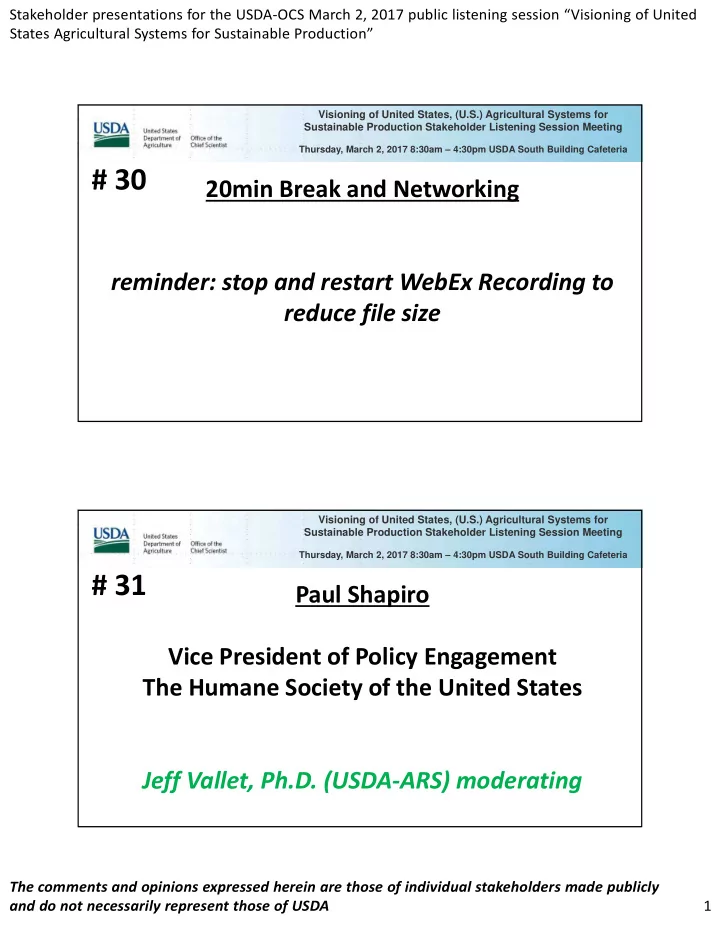
20min Break and Networking reminder: stop and restart WebEx Recording to reduce file size

Visioning of United States, (U.S.) Agricultural Systems for Sustainable Production Stakeholder Listening Session Meeting

Thursday, March 2, 2017 8:30am – 4:30pm USDA South Building Cafeteria

# 30

Paul Shapiro Vice President of Policy Engagement The Humane Society of the United States Jeff Vallet, Ph.D. (USDA‐ARS) moderating

Visioning of United States, (U.S.) Agricultural Systems for Sustainable Production Stakeholder Listening Session Meeting

Thursday, March 2, 2017 8:30am – 4:30pm USDA South Building Cafeteria

# 31

The comments and opinions expressed herein are those of individual stakeholders made publicly and do not necessarily represent those of USDA 1

slide-2
SLIDE 2

Stakeholder presentations for the USDA‐OCS March 2, 2017 public listening session “Visioning of United States Agricultural Systems for Sustainable Production”

THANK YOU

The comments and opinions expressed herein are those of individual stakeholders made publicly and do not necessarily represent those of USDA 2

slide-3
SLIDE 3

Stakeholder presentations for the USDA‐OCS March 2, 2017 public listening session “Visioning of United States Agricultural Systems for Sustainable Production” The comments and opinions expressed herein are those of individual stakeholders made publicly and do not necessarily represent those of USDA 3

slide-4
SLIDE 4

Stakeholder presentations for the USDA‐OCS March 2, 2017 public listening session “Visioning of United States Agricultural Systems for Sustainable Production” The comments and opinions expressed herein are those of individual stakeholders made publicly and do not necessarily represent those of USDA 4

slide-5
SLIDE 5

Stakeholder presentations for the USDA‐OCS March 2, 2017 public listening session “Visioning of United States Agricultural Systems for Sustainable Production”

“We heard loud and clear that consumers don’t think that a conventional cage the size of a podium for two years is enough. It isn’t enough. It’s ridiculous.”

—Chad Gregory, UEP President

“2015: The Year of the Cage-Free Hen”

“Everyone’s Going Cage-Free” “Are Cage-Free Eggs the Future?”

The comments and opinions expressed herein are those of individual stakeholders made publicly and do not necessarily represent those of USDA 5

slide-6
SLIDE 6

Stakeholder presentations for the USDA‐OCS March 2, 2017 public listening session “Visioning of United States Agricultural Systems for Sustainable Production” The comments and opinions expressed herein are those of individual stakeholders made publicly and do not necessarily represent those of USDA 6

slide-7
SLIDE 7

Stakeholder presentations for the USDA‐OCS March 2, 2017 public listening session “Visioning of United States Agricultural Systems for Sustainable Production”

“It’s no longer a discussion about whether to convert egg production from cage to cage‐free operations, but rather when it will happen.”

  • National School Lunch Program
  • Surplus buy‐ups
  • Food and Nutrition Service
  • Economic Research Service

How Can the Agency Help the Industry?

The comments and opinions expressed herein are those of individual stakeholders made publicly and do not necessarily represent those of USDA 7

slide-8
SLIDE 8

Stakeholder presentations for the USDA‐OCS March 2, 2017 public listening session “Visioning of United States Agricultural Systems for Sustainable Production” The comments and opinions expressed herein are those of individual stakeholders made publicly and do not necessarily represent those of USDA 8

slide-9
SLIDE 9

Stakeholder presentations for the USDA‐OCS March 2, 2017 public listening session “Visioning of United States Agricultural Systems for Sustainable Production”

David E. Starling American Veterinary Medical Association Oral / no slides

Visioning of United States, (U.S.) Agricultural Systems for Sustainable Production Stakeholder Listening Session Meeting

Thursday, March 2, 2017 8:30am – 4:30pm USDA South Building Cafeteria

# 32

Tad Sonstegard, Ph.D. Chief Scientific Officer Acceligen

Visioning of United States, (U.S.) Agricultural Systems for Sustainable Production Stakeholder Listening Session Meeting

Thursday, March 2, 2017 8:30am – 4:30pm USDA South Building Cafeteria

# 33

The comments and opinions expressed herein are those of individual stakeholders made publicly and do not necessarily represent those of USDA 9

slide-10
SLIDE 10

Stakeholder presentations for the USDA‐OCS March 2, 2017 public listening session “Visioning of United States Agricultural Systems for Sustainable Production”

Advanced Breeding: Precise Gene Editing for Animal Welfare & Sustainable Productivity

Tad Sonstegard

CSO of Acceligen

  • St. Paul, MN USA 55104

tad@recombinetics.com

USDA‐OSEC| 28 FEB| Washington DC 2017

20

Welcome to the Gene‐Editing Revolution

Transformative Technology in the News

Time The New York Times The Economist National Geographic Nature The Spectator Science Wired European Technology MIT Technology Review PRECISION BREEDING w/ EDITING PLANT, ANIMAL, MICROBE, ETC.

The comments and opinions expressed herein are those of individual stakeholders made publicly and do not necessarily represent those of USDA 10

slide-11
SLIDE 11

Stakeholder presentations for the USDA‐OCS March 2, 2017 public listening session “Visioning of United States Agricultural Systems for Sustainable Production”

RCI and its collaborators utilize proprietary, pioneering methods for precision breeding to provide natural livestock disease resistance, improve food productivity and enhance animal welfare in beef, dairy, pork and poultry production.

  • Reduce or eliminate use of antibiotics, vaccines and surgical production practices
  • Address animal welfare, while simultaneously meeting market demand for drug‐free animal proteins
  • Increase meat and dairy yields with reduced input and production costs – and reduced environmental impact
  • Enable humane, localized production through precise gender selection and genetic diversity optimized for specific

conditions

21

Acceli Acceligen: n: Heal Healthy, Pr Productive ve Ani Animals als & Sa Safer, Abundan Abundant Fo Food

Bee Beef & Dairy Dairy

  • Naturally Hornless (Polled)
  • Heat Tolerant (SLICK)
  • BRD (Respiratory Disease)
  • FMDv (Food and Mouth Disease)
  • Meat yield (Heavy Muscling)

Po Poultry

  • Avian Flu Resistance
  • Sex Selection

Swi Swine

  • PRRSv Disease Resistance
  • Swine Fever Resistance
  • Genetic Castration
  • Tail Docking
  • Cur

Curren ent re regulatory path pathway is is too too cos costly ly

  • design

designed fo for pr processe

  • cesses to

to mak make ani animals tha that produce duce phar pharmac aceu eutic tical products! ducts!!

  • The

The re regulation

  • n does

does not not ma match the the risk risk

  • Inappr

appropri

  • priat

ate to to re regulate a br breed eeding ing pr proce

  • cess ov
  • ver the

the food

  • od product

duct

  • Willf

illful ig ignorance of

  • f intell

llig igen ent peop people le wit with good

  • od intention

ions

  • Pr

Producer ducers and and retailer ilers wa wary of

  • f Pit

Pitchfork Na Nation (i.e (i.e – losin

  • sing mark

market sha share while while te testing ting the the tech technolog

  • logy)

y)

  • Internation

ional in influ fluence ‐ Em Emergin ging economi

  • nomies follo

llow our

  • ur lea

lead in in re regulation

  • n

22

Challe llenges fo for Co Commer mmercial alization

  • n – Access

ccess fo for the the Br Breeder eeders

The comments and opinions expressed herein are those of individual stakeholders made publicly and do not necessarily represent those of USDA 11

slide-12
SLIDE 12

Stakeholder presentations for the USDA‐OCS March 2, 2017 public listening session “Visioning of United States Agricultural Systems for Sustainable Production”

Joanna Grossman Senior Policy Specialist The Good Food Institute

Visioning of United States, (U.S.) Agricultural Systems for Sustainable Production Stakeholder Listening Session Meeting

Thursday, March 2, 2017 8:30am – 4:30pm USDA South Building Cafeteria

# 34

Joanna Grossman, Ph.D. Senior Policy Specialist The Future of Protein: Blending Markets and Food Technology to Solve Some of the World’s Biggest Problems

The comments and opinions expressed herein are those of individual stakeholders made publicly and do not necessarily represent those of USDA 12

slide-13
SLIDE 13

Stakeholder presentations for the USDA‐OCS March 2, 2017 public listening session “Visioning of United States Agricultural Systems for Sustainable Production”

O UR FO O D SYSTEM IS BRO KEN ENVIRO NMENT

Animal agriculture is “one of the ... most significant contributors to the most serious environmental problems, at every scale from local to global”; contributes to "problems

  • f land degradation, climate change and air pollution, water

shortage and water pollution, and loss of biodiversity.”

United Nations Food & Agriculture Organization, Livestock’s Long Shadow

Animal agriculture

  • is one of “the most significant

contributors to the most serious environmental problems, at every scale from local to global”

  • contributes to “problems of land

degradation, climate change and air pollution, water shortage and water pollution, and loss of biodiversity” “Livestock’s Long Shadow” –The United Nations Food & Agriculture Organization

O UR FO O D SYSTEM IS BRO KEN ENVIRO NMENT

Animal agriculture is “one of the ... most significant contributors to the most serious environmental problems, at every scale from local to global”; contributes to "problems

  • f land degradation, climate change and air pollution, water

shortage and water pollution, and loss of biodiversity.”

United Nations Food & Agriculture Organization, Livestock’s Long Shadow

The comments and opinions expressed herein are those of individual stakeholders made publicly and do not necessarily represent those of USDA 13

slide-14
SLIDE 14

Stakeholder presentations for the USDA‐OCS March 2, 2017 public listening session “Visioning of United States Agricultural Systems for Sustainable Production”

O UR FO O D SYSTEM IS BRO KEN ENVIRO NMENT

Animal agriculture is “one of the ... most significant contributors to the most serious environmental problems, at every scale from local to global”; contributes to "problems

  • f land degradation, climate change and air pollution, water

shortage and water pollution, and loss of biodiversity.”

United Nations Food & Agriculture Organization, Livestock’s Long Shadow

O UR FO O D SYSTEM IS BRO KEN ENVIRO NMENT

Animal agriculture is “one of the ... most significant contributors to the most serious environmental problems, at every scale from local to global”; contributes to "problems

  • f land degradation, climate change and air pollution, water

shortage and water pollution, and loss of biodiversity.”

United Nations Food & Agriculture Organization, Livestock’s Long Shadow

Plant‐based meats are in the early stages of a macro trend, similar to the way soy and almond milk changed the milk category. —Robert Gamgort, CEO, Pinnacle Foods

The comments and opinions expressed herein are those of individual stakeholders made publicly and do not necessarily represent those of USDA 14

slide-15
SLIDE 15

Stakeholder presentations for the USDA‐OCS March 2, 2017 public listening session “Visioning of United States Agricultural Systems for Sustainable Production”

Jeff Vallet, Ph.D. (USDA‐ARS) Moderated Questions and Discussion Time Paul Shapiro David E. Starling Tad Sonstegard Joanna Grossman reminder: if no live comments, go to WebEx chat

Visioning of United States, (U.S.) Agricultural Systems for Sustainable Production Stakeholder Listening Session Meeting

Thursday, March 2, 2017 8:30am – 4:30pm USDA South Building Cafeteria

# 35

Breakout Group number is on badges reminder: stop and restart WebEx Recording to reduce file size

Visioning of United States, (U.S.) Agricultural Systems for Sustainable Production Stakeholder Listening Session Meeting

Thursday, March 2, 2017 8:30am – 4:30pm USDA South Building Cafeteria

# 36

The comments and opinions expressed herein are those of individual stakeholders made publicly and do not necessarily represent those of USDA 15

slide-16
SLIDE 16

Stakeholder presentations for the USDA‐OCS March 2, 2017 public listening session “Visioning of United States Agricultural Systems for Sustainable Production”

What did you not hear today?

  • What are the major strengths of current agricultural systems that are important to

maintain in future systems?

  • What are the major weaknesses of current agricultural systems that could be improved
  • n in future systems?
  • What are the major opportunities for agricultural systems of the future? How can

technology and scientific findings facilitate these?

  • What are the major threats for agricultural systems of the future?
  • What research will be needed and how can this be accelerated?
  • What infrastructure will be needed?
  • What changes will be needed for new systems to succeed?
  • How can we educate the next generation to solve these challenges?

Visioning of United States, (U.S.) Agricultural Systems for Sustainable Production Stakeholder Listening Session Meeting

Thursday, March 2, 2017 8:30am – 4:30pm USDA South Building Cafeteria

# 36

Report Out reminder: stop and restart WebEx Recording to reduce file size

Visioning of United States, (U.S.) Agricultural Systems for Sustainable Production Stakeholder Listening Session Meeting

Thursday, March 2, 2017 8:30am – 4:30pm USDA South Building Cafeteria

# 36

The comments and opinions expressed herein are those of individual stakeholders made publicly and do not necessarily represent those of USDA 16