
SLIDE 1
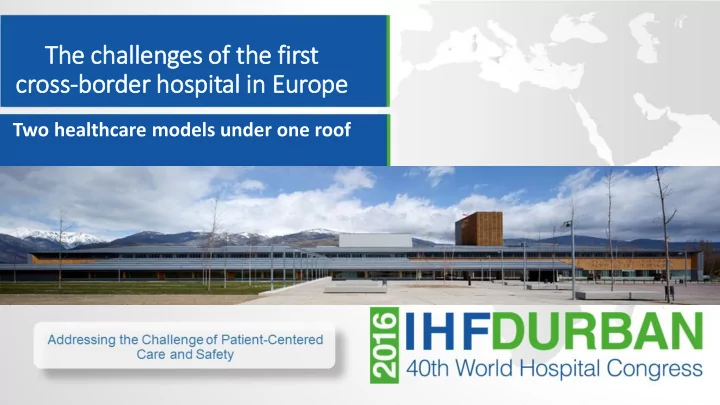
Th The challenges of f th the fi first cross-border hospital in in Europe
Two healthcare models under one roof
Th The challenges of f th the fi first cross-border hospital in - - PowerPoint PPT Presentation
Th The challenges of f th the fi first cross-border hospital in in Europe Two healthcare models under one roof The hospital Cross-border Why? Territorial characteristics Where? In Puigcerd, Catalonia, Spain How? Together: Catalonia
Th The challenges of f th the fi first cross-border hospital in in Europe
Two healthcare models under one roof
Territorial characteristics
In Puigcerdà, Catalonia, Spain
Together: Catalonia and France
Catalonia: Lower Cerdanya France: North Cerdanya Capcir ir
Spain), France and Andorra
and winter high season
hospitals: ₋ 2h 05m to Perpignan (France) and ₋ 1h 45m to Barcelona (Catalonia)
9
One hospital/Two models
1986 Catalan Health Service began to study the project 2002 First agreement to provide emergency services 2003 Agreement for pregnancy and childbirth services 2009 Building work begins. 2014 The hospital starts its activity
Catalunya 60% Francia 40%
Management budget
* Building costs: 60% from EU funds ERDF (European Regional Development Fund) FRANCE 40% CATALONIA
population
Governance
European Groupin ing of Territ itorial l Cooperation
between countries
between legislation and administrative procedures of the countries involved.
Governance: European Grouping of f Territorial Cooperation
Advisory Council (14) Management Board (15) Executive Commission (5) Direction Team (8)
9 million € invested in:
Human Resources
Workers 228 Time equivalent workers 206
HOSPITAL DISCHARGES
2015 % TOTAL DISCHARGES 1.856 100,0% CATALONIA 1.491 80,3% FRANCE 365 19,7% MEDICAL DISCHARGES 1.014 54,6% SURGICAL DISCHARGES 842 45,4% AVERAGE STAY 4,10 SPECIALTY DISCHARGE ORTHOPEDIC SURGERY 609 32,8% INTERNAL MEDICINE 505 27,2% GYNECOLOGY AND OBSTETRICS 257 13,8% GENERAL SURGERY 237 12,8% PEDIATRICS 154 8,3% OTHER SURGICAL SPECIALTIES 94 5,1%
EMERGENCY
2015 % TOTAL URGENCIES 23.997 100,0% CATALONIA 20.192 84,1% FRANCE 3.805 15,9% PEDIATRIC URGENCIES 7.063 29,4% URGENCIES/DAY 65,7 AVERAGE STAY 02:07 LEVEL EMERGENCY 222 0,9% URGENCY 5.849 24,4% LESS URGENT 12.734 53,1% NOT URGENT 5.192 21,6% DESTINATION HOME 22.135 41,8% OTHER HOSPITAL 452 1,9% DEATH 5 0,0% ADMISSION TO HOSPITAL 1.405 5,9%
SURGICAL INTERVENTIONS
2015 % TOTALS 1.181 100,0% CATALONIA 992 84,0% FRANCE 189 16,0% MINOR SURGERY 365 30,9% AMBULATORY SURGERY 352 29,8% CONVENTIONAL 464 39,3% BIRTHS 162 100,0% CATALONIA 119 73,5% FRANCE 43 26,5% CAESAREANS 29 17,9%
EXTERNAL CONSULTATIONS
2015 % TOTAL EXTERNAL CONSULTATIONS 42.450 100,0% CATALONIA 39.555 93,2% FRANCE 2.895 6,8% INDEX REITERATION 1,5
DIAGNOSTIC IMAGING
2015 % TOTAL DIAGNOSTIC IMAGING 27.701 100,0% CATALONIA 20.658 74,6% FRANCE 7.043 25,4% RADIOLOGY DEVICES 27.701 100,0% CONVENTIONAL RADIOLOGY 18.832 68,0% MAMMOGRAPHY 3.341 12,1% CAT SCAN 2.449 8,8% MRI 1.746 6,3% ULTRASOUND 1.333 4,8%
DIFFICULTY APPROACH
EGTC Complex, duplicity, slow Wide organization Management Style Delegation of functions to the CEO Empowerment vs control Process management Management by Objectives Incentive systems
DIFFICULTY APPROACH
Pyrenees mountain territory. Low population, aged and dispersed Long distances Communications High mountain climate Heavy touristic region. Fluctuating population Information systems Technological platform (exchange medical information) Telemedicine (Remote medical consultation) SEM / SAMU Mountain Rescue
DIFFICULTY APPROACH
Two Healthcare Models Two procedures and formalities Financing: 5 years budget National health Service (wide) Agreements Purchasing Services
Catalonia National Health Service Beveridge model
sector
France Social Security System Bismarck model
Bismarck
specialists
DIFFICULTY APPROACH
Sectorial agreement vs liberal professionals Remuneration Recognition academic degree Recognition competences & skills Double membership in collegial
New contracts by the EGTC –HC. Liberal practitioners French personnel provision of services Contracting services Training programs
DIFFICULTY APPROACH
BIRTHS Nationality: to obtain documents can take months Health insurance In negotiation Agreement take 1-2 weeks DEMISES Repatriation (costs could be € 6.000) Regulated by EU law. Allows neighboring countries to simplify matters in border areas (€ 300)
DIFFICULTY APPROACH
Language Working hours, Patient’s diets, Courtesy rules and formalities Three official languages translation Confluence in middle Mediterranean diet.. Single dish Knowing and use rules by country
DIFFICULTY APPROACH
Shared clinical protocols Double prescription forms Approach to screening Commissions and committees Before approval:
are consulted and adapted to our dual reality
corticosteroids vs NSAID
health authority
social security
Both countries apply European quality directives Regarding to contents, the same topics are covered in both countries. Both countries updates clinical practice guidelines (evidence-based medicine) In France, the Haute Autorité de Santé (HAS), In Catalonia, the quality agency (AQUAS)
Differences in Hospital Commissions and committees