
SLIDE 1
Boar taint – challenges and
- pportunities
- Prof. Olena Doran
University of the West of England Olena.doran@uwe.ac.uk BPEX Workshop, Peterborough, 20 March 2013
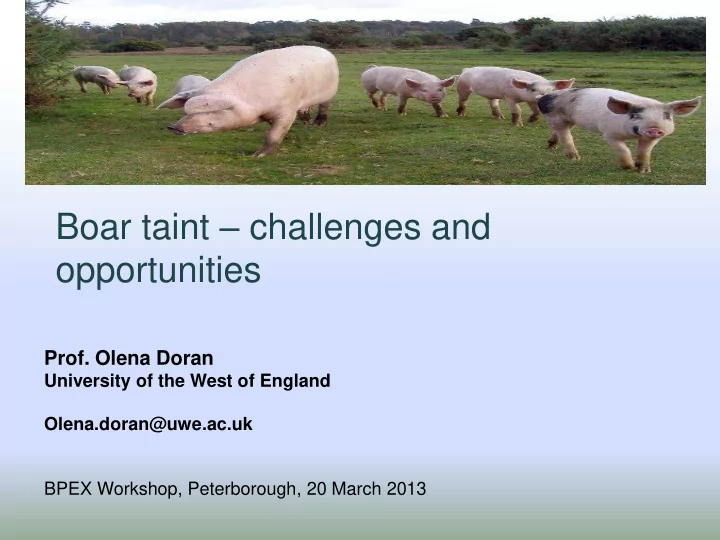
Boar taint challenges and opportunities Prof. Olena Doran - - PowerPoint PPT Presentation
Boar taint challenges and opportunities Prof. Olena Doran University of the West of England Olena.doran@uwe.ac.uk BPEX Workshop, Peterborough, 20 March 2013 Boar Taint An offensive odour in the meat of 5-10% of uncastrated male pigs Is
University of the West of England Olena.doran@uwe.ac.uk BPEX Workshop, Peterborough, 20 March 2013
Adipose tissue
Skatole Androstenone
Testes
Androstenone
Gut
Skatole
Liver Metabolism Excreted metabolites
Salivary glands
EU Directive on castration without anesthesia during the first week of life (2001/93/EC) Plan to voluntarily end surgical castration by 1 January 2018 (EU SANCO, 2010) European Partnership on Alternatives to Surgical Castration of Pigs Established (hedhttp://ec.europa.eu/food/animal/welfar)
Sources: Insitute for Food Reserach IRTA, PIGGAS project, Fredriksen, B., Font i Furnols, M., Lundström, K., Migdal, W., Prunier, A., Tuyttens, F.A.M. & Bonneau, M. 2009. Practice on castration of piglets in Europe. Animal, 1-8.
(EU Tender ALCASDE)
Surgical Castration Immunocastration Management/Diet Genetic selection Semen Sorting Slaughtering at Lower weight
Existing methods (examples) Technoloiges Under Development (examples)
Spectophotometric
(Mortensen and Sorensen, 1984)
Chemical sensor-base and gas sensor-based technologies
(i.e. Haugen, 2006; Vestergaard et al., 2006)
Immunoassay
(Claus et al.,2008; Tuomola et al., 1997)
Bio-sensors
Gas and liquid chromatography
(Annor-Frempong et al., 1997; Garcia-Regueiro and Diaz, 1989)
“There are no harmonised methods of consistently identifying carcases
with boar taint in commercial slaughter houses. Investigation of possible processing techniques to reduce the offensive properties of boar taint is hampered by the lack of such methods to asses levels of the compounds contributing to the phenomenon”
(The EFSA Journal, European Food Safety Authority, 2004)
Novel Technologies for Food Quality developed at the University of the West of England have been listed among the top 100 areas which will have a profound effect on our future in the Research Council UK report “Big Ideas for the Future”, 2011
EU ALCASDE Project “Study on the improved methods for animal-
friendly production, in particular on alternatives to the castration of pigs and on alternatives to the dehorning of cattle” EU: Health and Consumers Directorate General Tender “Study on rapid detection methods for boar taint used or being developed at slaughter plants in the European Union” “UK/China partnership for innovative technologies”.
Funder: UK Biotechnology and Biological Sciences Research Council (BBSRC) Leading organisation: University of the West of England Aims:
area of novel technologies for food quality and safety
http://rbi.uwe.ac.uk/chinapartnership/default.asp
Image from http://www.biosensores.com/EN/biosensores_afinidad_molecular.php
Commercially available portable device (Uniscan Instruments, UK)
Commercially available automated instrument (AET Ltd., UK)
Roger J. Lewis, Adam Baldwin, Tracey O'Neill, Habib A Alloush, Shona M Nelson, Tony Dowman, Vyv Salisbury, Journal of Food Engineering 2006 Vol 76 Pages: 41-48
EU legislations and initiatives emphasise the need in on- line detection of boar taint The need in boar taint detecting technology vary between countries and the sectors. A comprehensive market assessment is needed. A number of technologies for on-line boar taint detection are at various stages of development. Evaluation in industrial setting is essential. Harmonization of existing methods for boar taint detection is essential