3/25/16 Decision Making Finances: Save money or spend it? The - - PDF document

3 25 16
SMART_READER_LITE
LIVE PREVIEW

3/25/16 Decision Making Finances: Save money or spend it? The - - PDF document

3/25/16 Decision Making Finances: Save money or spend it? The Neural Mechanisms of Eating: Indulge in a second Risky Decision Making dessert? Medical: Medication with side effects? Rebecca Weldon Underage drinking:


slide-1
SLIDE 1

3/25/16 1

The Neural Mechanisms of Risky Decision Making

Rebecca Weldon Laboratory for Rational Decision Making Human Neuroscience Institute Cornell University

Decision Making

¤ Finances: Save money or spend it? ¤ Eating: Indulge in a second dessert? ¤ Medical: Medication with side effects? ¤ Underage drinking: Risk of getting caught ¤ Drugs: Risk of overdose ¤ Unprotected sex: Risk of HIV

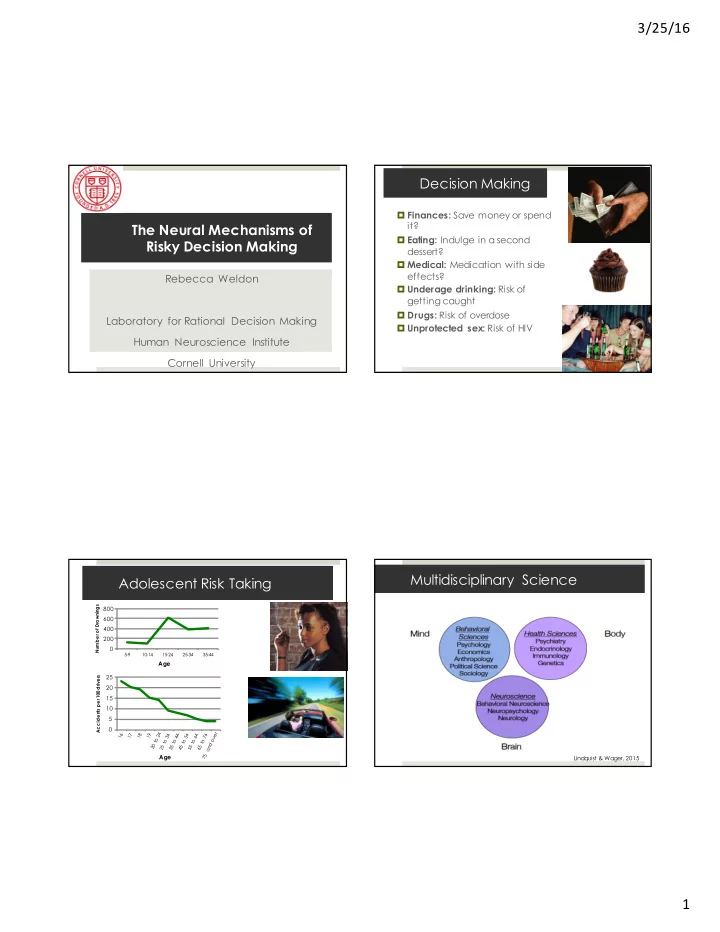
Adolescent Risk Taking

5 10 15 20 25

Accidents per 100 drivers

Age 200 400 600 800

5-9 10-14 15-24 25-34 35-44 Number of Drownings

Age

Multidisciplinary Science

Lindquist & Wager, 2015

slide-2
SLIDE 2

3/25/16 2

Multidisciplinary Science

Lindquist & Wager, 2015

MRI + Cognitive Science

Lindquist & Wager, 2015

Functional brain imaging

¤Functional brain imaging can be used to study both cognitive and affective processes. ¤Modalities include: ¤Positron emission tomography (PET) ¤Functional magnetic resonance imaging (fMRI) ¤Electroencephalography (EEG)

Lindquist & Wager, 2015

Human neuroimaging

Lindquist & Wager, 2015

slide-3
SLIDE 3

3/25/16 3

Magnetic Resonance Imaging (MRI)

Lindquist & Wager, 2015

  • An MR scanner consists
  • f an electromagnet

with a very strong magnetic field (1.5-7.0 Tesla)

  • Earth’s magnetic field

= .000005 Tesla

  • 3 Tesla magnet is

~60,000 times stronger than the Earth’s magnetic field.

MRI Principles

Principles: 1. Tissues are full of protons (H+) 2. Protons in a magnetic field align themselves and oscillate in an equilibrium state 3. Protons exposed to a directed radiofrequency (RF) pulse of magnetism absorb energy 4. When the RF pulse is removed, protons release energy as they relax toward their equilibrium state

From: William W. Seeley, MD; UCSF

fMRI data

¤ Each image consists of ~100,000 'voxels' (cubic volumes that span the 3D space of the brain). ¤ Each voxel corresponds to a spatial location (x, y, z) in the brain.

Lindquist & Wager, 2015

fMRI data

¤During the course of an experiment several hundred images are acquired (~ one every 2s).

Lindquist & Wager, 2015

slide-4
SLIDE 4

3/25/16 4

fMRI data

¤Tracking the intensity over time gives us a time series.

Lindquist & Wager, 2015

BOLD fMRI

¤fMRI uses the Blood Oxygenation Level Dependent (BOLD) signal. ¤BOLD fMRI measures the ratio of

  • xygenated to deoxygenated hemoglobin

in the blood. ¤BOLD fMRI does not measure neuronal activity directly--it measures the metabolic demands (oxygen consumption) of active neurons.

Lindquist & Wager, 2015

fMRI = Functional Magnetic Resonance Imaging

Stimulus Increase in neuronal activity Increase in blood flow to that neuronal re g io n = hemodynamic response function

Data Processing Pipeline

Lindquist & Wager, 2015

slide-5
SLIDE 5

3/25/16 5

Risky Choice Framing Problems

A disease outbreak is expected to kill 600 people. You must choose between two programs (A or B) to fight the disease:

A = 200 people will be saved B = 1/3 probability that 600 people will be saved, 2/3 probability that no one will be saved

Basic paradigm (Tversky & Kahneman, 1986)

Problem 1 A disease outbreak is expected to kill 600 people. You must choose between two programs (A or B) to fight the disease:

A = 400 people will die B = 2/3 probability that 600 people will die, 1/3 probability that no one will die

Problem 2

Basic paradigm (Tversky & Kahneman, 1986)

Disease outbreak expected to kill 600 people. You must choose between two programs (A or B) to fight the disease:

A = 200 people will be saved (sure) B = 1/3 probability that 600 people will be saved, 2/3 probability that no one will be saved (risky) A = 400 people will die (sure) B = 2/3 probability that 600 people will die, 1/3 probability that no one will die (risky)

Risky Choice Framing Problems

Basic paradigm (Tversky & Kahneman, 1986)

GAIN LOSS

200 saved 600-400 = 200 saved

slide-6
SLIDE 6

3/25/16 6

Risky Choice Framing Problems

Disease outbreak expected to kill 600 people. You must choose between two programs (A or B) to fight the disease:

A = 200 people will be saved (sure) B = 1/3 probability that 600 people will be saved, 2/3 probability that no one will be saved (risky) (Saving some people better than saving none.) A = 400 people will die (sure) B = 2/3 probability that 600 people will die, 1/3 probability that no one will die (risky) (None dying is better than some dying.)

GAIN LOSS

Adults derive the gist!

Fuzzy-Trace Theory Verbatim Gist

92 quarters A lot of quarters

Reyna, 2012

Gist Verbatim

Age

Fuzzy-Trace Theory

¤ Risk of contracting HIV from unprotected sex = “a 1/2000 chance” ¤ Risk of contracting HIV from unprotected sex = “a small chance”

Survey example Can we cue gist-based processing in adolescents to make their decision making resemble adult decision making? Gist processing leads to better decision making!

fMRI Experiment: Adolescent Risk Taking

¤How does representation of risk and reward information affect risky decision making?

¤ Adolescents versus adults ¤ Relationship between reward sensitivity and risky choice

slide-7
SLIDE 7

3/25/16 7

Decisions task completed in MRI scanner:

Experimental Design

¤ Between-subjects factors: ¤ Age (adolescents, adults) ¤ Hunger (non-hungry, hungry) ¤ Within-subjects factors: ¤ Frame (gain, loss) ¤ Fuzzy-trace truncation (verbatim, mixed, gist) ¤ Reward type (candy, money) ¤ Magnitudes (1, 6, 20)

Fuzzy-Trace Theory Manipulation

Condition Sure Option Risky Option Prediction Gist Win $20 for sure. 2/3 probability of winning nothing. LARGE Framing Effect SOME NONE Mixed Win $20 for sure. 1/3 probability of winning $60; 2/3 probability of winning nothing. NORMAL Framing Effect SOME SOME or NONE Verbatim Win $20 for sure. 1/3 probability of winning $60. NO Framing Effect SOME SOME

You have entered a raffle and $60 is at stake. Which would you choose? A: Win $30 for sure. B: 50% probability you win $60 and 50% probability you win nothing.

4 seconds PREAMBLE 7 seconds CHOICE 4 seconds CONFIDENCE RATING 4, 6, 8 seconds INTERTRIAL INTERVAL

Stimulus Presentation

Whole Brain Contrasts

¤Activation in one experimental condition – activation in another experimental condition

Risky > Sure

Risky

slide-8
SLIDE 8

3/25/16 8

Adults (n=51) Framing > No Framing Verbatim No Framing > Gist Framing Adolescents (n=24)

Dorsomedial PFC Right Middle Cingulate Cortex Right Precentral Gyrus Right Superior Occipital Lobule Right Supramar ginal Gyrus Middle Cingulate Cortex IPL Postcentral Precentral Dorsolateral PFC

Individual Differences May Affect Decision Making

Individual Difference Measure: Sensation Seeking

¤ 19-item Impulsive Sensation Seeking Subscale - Zuckerman- Kuhlman Personality Questionnaire (Zuckerman et al., 1993) ¤ I like doing things just for the thrill of it. ¤ I sometimes like to do things that are a little frightening. ¤ I like “wild” uninhibited parties.

Left dorsal striatal/insular area activation for Mixed + Verbatim Gain Risk > Mixed + Verbatim Gain Sure is correlated with Sensation Seeking Score

  • 1.2
  • 0.8
  • 0.4

0.4 0.8 1.2

0.00 0.50 1.00 1.50

Beta Value for Putamen Sensation Seeking Score

r=.725 P < .001

Left Putamen

Win $20 for sure

OR

1/3 chance of winning $60 and a 2/3 chance

  • f winning nothing.
slide-9
SLIDE 9

3/25/16 9

Summary

¤ fMRI is an incredibly powerful tool that allows us to examine activation in the entire brain in a matter of seconds. ¤ Risky decisions can be modulated as a function of the way information about risks and rewards is presented. ¤ There are specific gist-based processing areas (dorsolateral prefrontal cortex) and verbatim-based processing areas (dorsomedial prefrontal cortex) in the brain. ¤ People higher in sensation seeking show greater putamen activation during risky choice for gains.

Thank you!