A A deep ep l lear arni ning-bas based ed p pipel peline ne - - PowerPoint PPT Presentation

a a deep ep l lear arni ning bas based ed p pipel peline
SMART_READER_LITE
LIVE PREVIEW

A A deep ep l lear arni ning-bas based ed p pipel peline ne - - PowerPoint PPT Presentation

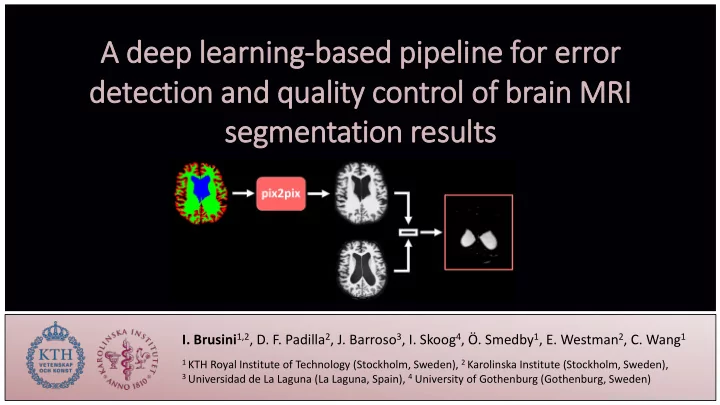
A A deep ep l lear arni ning-bas based ed p pipel peline ne f for e error de detecti tion and and qua quality ity c contr trol of of br brai ain M MRI segm egmentatio tion r resu esults ts I. Brusini 1,2 , D. F. Padilla


slide-1
SLIDE 1

A A deep ep l lear arni ning-bas based ed p pipel peline ne f for e error de detecti tion and and qua quality ity c contr trol of

  • f br

brai ain M MRI segm egmentatio tion r resu esults ts

  • I. Brusini1,2, D. F. Padilla2, J. Barroso3, I. Skoog4, Ö. Smedby1, E. Westman2, C. Wang1

1 KTH Royal Institute of Technology (Stockholm, Sweden), 2 Karolinska Institute (Stockholm, Sweden), 3 Universidad de La Laguna (La Laguna, Spain), 4 University of Gothenburg (Gothenburg, Sweden)

slide-2
SLIDE 2

Brusini et al., Automatic QC and error detection in brain MRI segmentation MIDL Conference 2020

  • Useful to study different properties of brain

structures (e.g. cortical thickness, ventricular volume, etc.)

  • Many tools available for automatic

segmentation, but prone to errors

  • Quality control (QC) is needed, but it can be

very slow and subjective if performed visually

Wh Whit ite ma matter (WM) l ) layer er Oute ter g grey ey m matte ter (GM) l ) layer er Cereb ebrospinal f fluid ( (CSF)

Brai ain M MRI segm egmentati tion

slide-3
SLIDE 3

1.

  • 1. Crea

eatio tion o

  • f er

error m map aps

Brusini et al., Automatic QC and error detection in brain MRI segmentation MIDL Conference 2020 Generator G s G(s) Original MRI slice

Post-processing: Error removal outside a dilated brain mask Thresholding > 0.5 Gaussian smoothing (σ = 1 mm)

ERROR MAP SLICE

One pix2pix model [5] for each view (axial, coronal, sagittal). All trained using random slices from 1600 segmentations that had been visually rated as good. Data from ADNI [1], GENIC [2] and H70 [3] cohorts. Input segmentations s from FreeSurfer [4]. Discriminator D Fake or real?

[1] Jack et al. (2008), J Magn Reson Imaging; [2] Ferreira et al. (2015), Psichotema; [3] Thorvaldsson et al. (2008), Neurology; [4] Fischl et al. (2012), NeuroImage;[5] Isola et al. (2017), Proc IEEE Comput Soc Conf Comput Vis Pattern Recognit.

slide-4
SLIDE 4

Brusini et al., Automatic QC and error detection in brain MRI segmentation MIDL Conference 2020 Enlarged ventricles from an Alzheimer’s patient had been misclassified and correctly highlighted in the error map. The error map shows a false positive that is related to subject-specific anatomical features. Other areas of the brain are dark and error-free. Identification of a small CSF misclassification in a segmentation that had been visually rated as good. Several cortical overestimations are visible, but the present method highlighted only some of them in the error map. Promising results for checking segmentation quality, evaluating its reliability and speeding the error correction up. Limitations: frequent false positives, and some false negatives in correspondence of cortical overestimations. Future work: better post-processing and testing other methods to compare generated and original MRI slices.

not visible in the error map!

slide-5
SLIDE 5

Brusini et al., Automatic QC and error detection in brain MRI segmentation MIDL Conference 2020

GAP

pbad

Input layer (128 × 128 × 128 × 2) Convolutional layers 1 × 128 1 × 128

Three convolutional blocks made of: 3D Conv (3×3×3) + BatchNorm + ReLU + 3D Conv (3×3×3, strides=2) + BatchNorm + ReLU

32 32 64 64 128 128

Binary classification using 10-fold cross-validation on 600 randomly selected subjects: 300 with segmentations rated as bad and 300 rated as good.

… …

2.

  • 2. C

Classi assificati tion of

  • f s

segm egmentati tion qua quality ty

slide-6
SLIDE 6

Classi sificati tion perf perform rmance ce

Brusini et al., Automatic QC and error detection in brain MRI segmentation MIDL Conference 2020

AUC = 0.85

High sensitivity (0.96 with a classification threshold of 0.3) is achieved with the proposed classifier, which can be used together with the error maps. Limitation: high presence of false positives (i.e. segmentations wrongly classified as bad). However, some errors were missed by the visual raters, so high sensitivity is here preferable to high specificity.