3/12/2019 Cardiac Cath Why Bother? Cardiac Catheterization in - - PDF document

3 12 2019
SMART_READER_LITE
LIVE PREVIEW

3/12/2019 Cardiac Cath Why Bother? Cardiac Catheterization in - - PDF document

3/12/2019 Cardiac Cath Why Bother? Cardiac Catheterization in Respiratory Status Preterm Infants with ventilatory settings, blood gases, chest CT UCSF Chronic Pulmonary Cardiac Status Pediatric Pulmonary Hypertension Program


slide-1
SLIDE 1

3/12/2019 1

David Teitel, MD

12th International Conference Neonatal & Childhood Pulmonary Vascular Disease, San Francisco, March 2019

UCSF Pediatric Pulmonary Hypertension Program

Cardiac Catheterization in Preterm Infants with Chronic Pulmonary Hypertension

Teitel – 12th International Neonatal and Childhood PVD Conference, March 2019

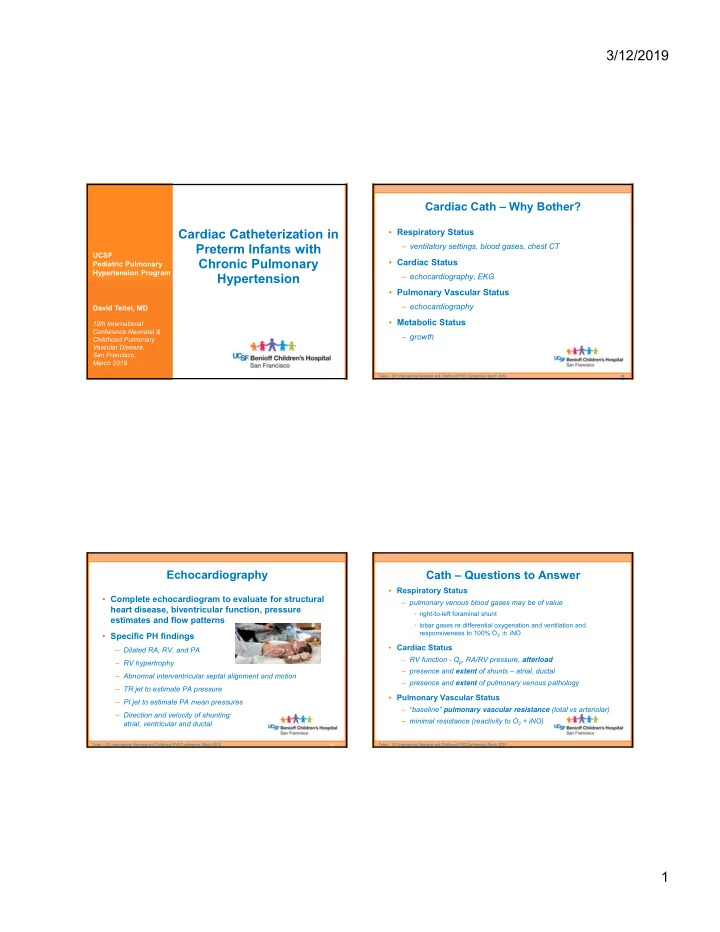
Cardiac Cath – Why Bother?

  • Respiratory Status

– ventilatory settings, blood gases, chest CT

  • Cardiac Status

– echocardiography, EKG

  • Pulmonary Vascular Status

– echocardiography

  • Metabolic Status

– growth

2

Teitel – 12th International Neonatal and Childhood PVD Conference, March 2019

Echocardiography

  • Complete echocardiogram to evaluate for structural

heart disease, biventricular function, pressure estimates and flow patterns

  • Specific PH findings

– Dilated RA, RV, and PA – RV hypertrophy – Abnormal interventricular septal alignment and motion – TR jet to estimate PA pressure – PI jet to estimate PA mean pressures – Direction and velocity of shunting: atrial, ventricular and ductal

3

Teitel – 12th International Neonatal and Childhood PVD Conference, March 2019

Cath – Questions to Answer

  • Respiratory Status

– pulmonary venous blood gases may be of value

  • right-to-left foraminal shunt
  • lobar gases re differential oxygenation and ventilation and

responsiveness to 100% O2 ± iNO

  • Cardiac Status

– RV function - Qp, RA/RV pressure, afterload – presence and extent of shunts – atrial, ductal – presence and extent of pulmonary venous pathology

  • Pulmonary Vascular Status

– “baseline” pulmonary vascular resistance (total vs arteriolar) – minimal resistance (reactivity to O2 + iNO)

slide-2
SLIDE 2

3/12/2019 2

Teitel – 12th International Neonatal and Childhood PVD Conference, March 2019

Cath – Problems to Fix

  • During cath

– device closure of PDA – device closure of ASD – pulmonary vein dilation

  • Post cath

– minimize RV afterload with a goal to reach minimal cath PVR with therapy to assist in vascular remodeling

Teitel – 12th International Neonatal and Childhood PVD Conference, March 2019

Cath – Considerations & Caveats

  • “Baseline state”

– effect of anesthesia, necessity to increase ventilatory support

  • Qp (Qs often equals Qp and less important to questions)

– if Fick, need to assume oxygen consumption

  • thermodilution when possible, and back-calculate VO2

– mixed pulmonary venous saturation in presence of atrial r-l shunt – mixed pulmonary arterial saturation with l-r ductal shunt – importance of including dissolved oxygen when pO2 ≥ 150 mmHg

  • Pulmonary vascular resistance

– what is normal for a premature infant? – how does one correct for damaged lung parenchyma?

Teitel – 12th International Neonatal and Childhood PVD Conference, March 2019

Oxygen Consumption

Seckeler MD, et al. A new predictive equation for oxygen consumption in children and adults with congenital and acquired heart disease. Heart. 2015;101(7):517-24.

Teitel – 12th International Neonatal and Childhood PVD Conference, March 2019

Oxygen Consumption

Seckeler MD, et al. A new predictive equation for oxygen consumption in children and adults with congenital and acquired heart disease. Heart. 2015;101(7):517-24.

slide-3
SLIDE 3

3/12/2019 3

Teitel – 12th International Neonatal and Childhood PVD Conference, March 2019

  • 7 mo, former 23 wk premie,

transferred from OSH with multiple complications, tracheostomy on ventilator, on sildenafil

  • Echo: RVP = ½ systemic, no RVH,

no TR, atrial septum not well seen

Patient 1

  • 7 mo, former 23 wk premie,

transferred from OSH with multiple complications, tracheostomy on ventilator, on sildenafil

  • Echo: RVP = ½ systemic, no RVH,

no TR, atrial septum not well seen

9

  • 23 mo, still trach/vent, on triple

therapy with sc Remodulin

  • Echo: normal RVP, no RVH, no

atrial communication (normal echo)

Teitel – 12th International Neonatal and Childhood PVD Conference, March 2019

  • 10 mo, former 25 wk premie,multiple

complications, transferred from OSH

  • n high flow O2, on sildenafil
  • Echo: RVP = ½ systemic, RVH,

small PDA, no atrial communication

Patient 2

  • 10 mo, former 25 wk premie,multiple

complications, transferred from OSH

  • n high flow O2, on sildenafil
  • Echo: RVP = ½ systemic, RVH,

small PDA, no atrial communication

10

  • 19 mo, off oxygen, no vasodilators,

g-tube feeds

  • Echo: none since 2 months post

cath – still mild RVH

Teitel – 12th International Neonatal and Childhood PVD Conference, March 2019

  • 10 wo, former 30 wk premie,

transferred from OSH with multiple anomalies, CLD on high flow O2

  • Echo: RVP > ½ systemic, RVH,

PDA and atrial level shunt

Patient 3

  • 10 wo, former 30 wk premie,

transferred from OSH with multiple anomalies, CLD on high flow O2

  • Echo: RVP > ½ systemic, RVH,

PDA and atrial level shunt

11

  • 6 mo, hospitalized, on bosentan &

sildenafil, high flow O2, g-tube

  • Echo: RVP > ½ systemic, RVH,

mild RA & RV dilation, fenestrated atrial septum

Teitel – 12th International Neonatal and Childhood PVD Conference, March 2019

Summary

  • Diagnostic value of cath

– pulmonary vascular resistance, “baseline” and minimal, can be accurately measured, and cannot be accurately estimated from echocardiography, even when pressure can be estimated

  • corollary: can differentiate the impact of increases in pulmonary blood

flow versus vascular resistance on RV pressure estimated by echo

– can independently evaluate individual pulmonary venous anatomy and lobar pulmonary function (oxygenation and ventilation)

  • Therapeutic value of cath

– can intervene on shunts when they are the source of elevated RVP – can intervene on pulmonary veins (if you are so pre-disposed)