3/12/20 2 Instructional Design Principles in Mathematics Webinar - - PDF document

3 12 20
SMART_READER_LITE
LIVE PREVIEW

3/12/20 2 Instructional Design Principles in Mathematics Webinar - - PDF document

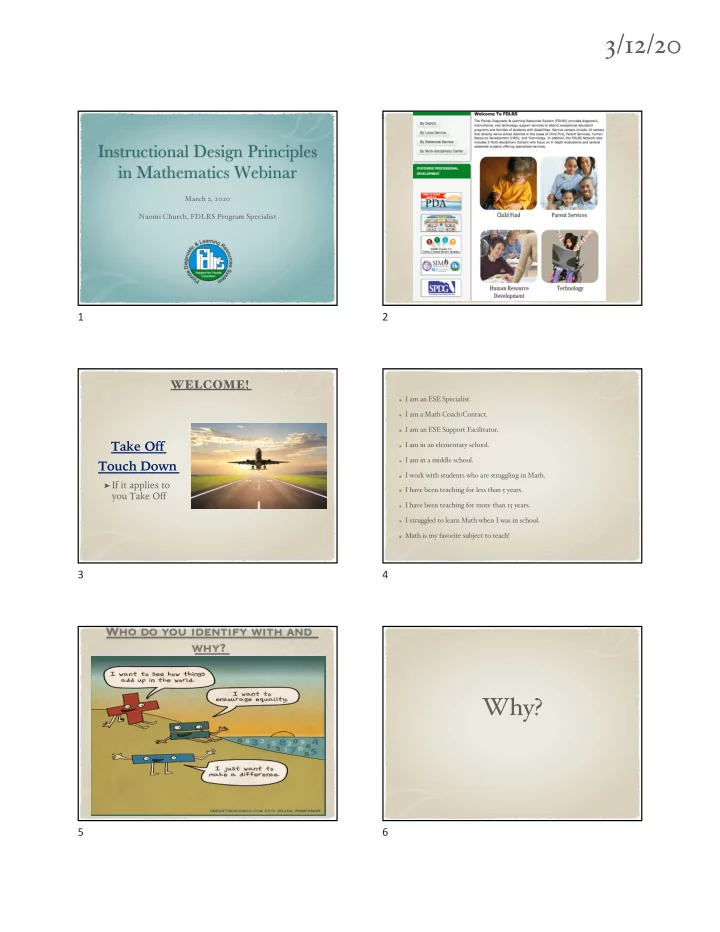
3/12/20 2 Instructional Design Principles in Mathematics Webinar March 2, 2020 Naomi Church, FDLRS Program Specialist 1 2 WELCOME! I am an ESE Specialist. I am a Math Coach/Contact. I am an ESE Support Facilitator. Take Off I am in an


slide-1
SLIDE 1

3/12/20

Instructional Design Principles in Mathematics Webinar

March 2, 2020 Naomi Church, FDLRS Program Specialist

1

2

2

Take Off Touch Down

➤If it applies to

you Take Off

WELCOME! 3

I am an ESE Specialist. I am a Math Coach/Contact. I am an ESE Support Facilitator. I am in an elementary school. I am in a middle school. I work with students who are struggling in Math. I have been teaching for less than 5 years. I have been teaching for more than 15 years. I struggled to learn Math when I was in school. Math is my favorite subject to teach!

4

Who do you identify with and why?

5

Why?

6

slide-2
SLIDE 2

3/12/20

58% of adults cannot compute a 10% tip.

7

71% of adults cannot compute the interest paid on a loan.

8

78% of adults cannot calculate miles per gallon on a trip.

9

25% to 35% of students struggle with mathematics knowledge and application skills in general education classrooms, indicating the presence of mathematics difficulty

(Mazzocco, 2007)

10

Most students fail to meet minimal mathematics proficiency standards by the end of their formal schooling.

(U.S. Department of Education, 2003)

11

Florida SEA Profile 2018

SPP Indicator 3: Participation and performance of children with disabilities on statewide assessments

  • Percent of students with IEPs in grades three through

ten that demonstrate proficiency in math.

  • SEA Target 51%
  • LEA Data 29.44%
  • Target NOT met

RA 2-1

12

slide-3
SLIDE 3

3/12/20

What is YOUR why?

13

What is Visible Learning?

14 15

Collective Teacher Efficacy 1.57 Student expectations 1.44 Response to Intervention 1.29 Classroom Discussion 0.82 Teacher Clarity (KUD) 0.75 Feedback 0.75 Study Skills 0.63 Worked Examples 0.57 Spaced versus mass practice 0.71 Problem-solving teaching 0.61 Peer Tutoring (like QQT) 0.55 Cooperative learning 0.42 Mathematics programs 0.40 Homework 0.29 Use of Calculators 0.27 Individualized instruction 0.22 Ability grouping 0.12 Open vs. traditional spaces 0.01 Retention (hold back a year)

  • 0.13

Mobility (shifting schools)

  • 0.34

16

“Quality is never an accident.

It is always the result of high intention, sincere effort, intelligent direction, and skillful execution, and it represents the wise choice of many alternatives.” Willa A. Foster

17

What is explicit instruction? aka intensive-explicit instruction

(Jim Knight)

direct instruction

(Hattie, 2011; Roehler & Duffy, 1984)

explicit, direct instruction

(Hollingsworth & Ybarra, 2008)

strategic instruction

(Ellis, Deshler, Lenz, Schumaker, & Clark, 1991)

Direct Instruction = .59

18

slide-4
SLIDE 4

3/12/20

19 20

Instructional Design Principles

Increase the Explicitness

  • f Instruction

21

Instructional Design: The Science

22

Critical Content

  • What does the student

need to Know Understand and Do?

  • What is the student’s

present level of readiness?

  • How can connections

between new content and previously learned content be made overt?

23

Number sense is to math what phonics is to reading

24

slide-5
SLIDE 5

3/12/20

1.

Number Sense

2.

Computation

3.

Problem Solving

25

Focus Skill Hierarchy

Number Sense Computation Problem Solving

Number Sense Computation (Basic Math Operations) Problem Solving

26

Mediated Scaffolding

27 28 29

Programmatic

  • r

Responsive

30

slide-6
SLIDE 6

3/12/20

31

Conspicuous Strategies

32

  • Describe
  • Tell the purpose
  • Model and explain
  • Provide adequate practice
  • Monitor and provide feedback
  • Promote student self-monitoring
  • Require the use of the strategy

Conspicuous Strategy

33

Primed Background Knowledge

34

Strategic Integration

35

Judicious Review & Practice

üSufficiently frequent üDistributed over time üCumulative üVaried üBased on student need

36

slide-7
SLIDE 7

3/12/20

Think, Write CHOOSE ONE TO RESPOND TO

Write 1 Teacher Delivery Method you do well and how you know you do it well. Write 1 Teacher Delivery Method you want to perfect, refine, or improve. Write something from the discussion about the Instructional Design Principles that validated your understanding and your current practice. Write 1 “AHA!” or something you want to remember about the Instructional Design Principles and one question that you still have.

37