$28b Annual Federal Grant Funds Managed by the State of Ohio 58 - - PDF document

28b
SMART_READER_LITE
LIVE PREVIEW

$28b Annual Federal Grant Funds Managed by the State of Ohio 58 - - PDF document

Ohio Enterprise Grants & Common Grants Compliance Issues Stacie Massey Ohio Office of Budget and Management June 12, 2018 The Growing Grants Business Adopting private sector concepts, the State of Ohio will manage efficiently and cost


slide-1
SLIDE 1

1 Ohio Enterprise Grants & Common Grants Compliance Issues

Stacie Massey Ohio Office of Budget and Management June 12, 2018

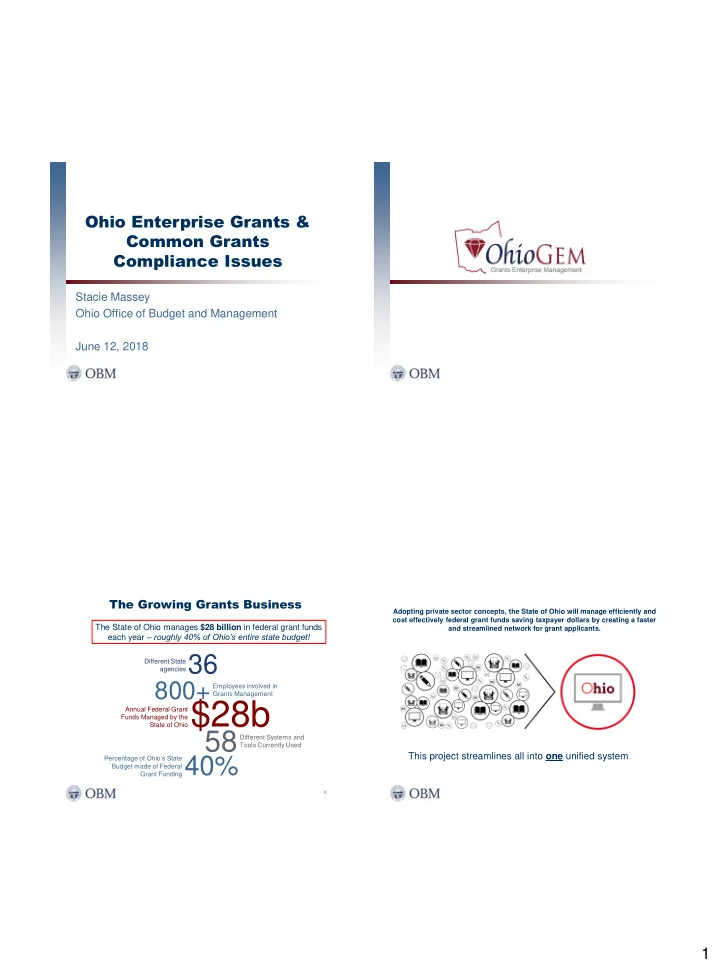
The State of Ohio manages $28 billion in federal grant funds each year – roughly 40% of Ohio’s entire state budget!

36

800+

$28b

40%

58

Employees involved in Grants Management Different Systems and Tools Currently Used Percentage of Ohio’s State Budget made of Federal Grant Funding Annual Federal Grant Funds Managed by the State of Ohio Different State agencies

The Growing Grants Business

3

Adopting private sector concepts, the State of Ohio will manage efficiently and cost effectively federal grant funds saving taxpayer dollars by creating a faster and streamlined network for grant applicants.

This project streamlines all into one unified system.

slide-2
SLIDE 2

2

5

Current State Challenges

Autonomous Roles Decentralized Policy and Process Lack of Collaboration Inconsistent subrecipient experiences Systems Not Integrated with State’s ERP System Lack of visibility into performance Inconsistent, manual processes Lack of Enterprise visibility and reporting

Why Change?

Efficient, easily accessible, unified programs and services for constituents (citizens, businesses, or government)

ACCESSIBILITY

Open and transparent engagement with citizens, agencies, sub-recipients, and the Federal government

TRANSPARENCY

Accurate, sharable and timely data and reporting for policy making, service delivery, and results evaluation

EFFECTIVENESS

Streamlined and cost effective grant operations in State Agencies

EFFICIENCY

Grants Enterprise Management (GEM) Enables Long-Term Institutional Outcomes and Savings

Modernized, integrated systems and elimination of redundant legacy systems

VALUE

GEM Program Vision This program ensures Ohio’s Governor and Agency Executives have accurate, timely decision-making information. The GEM process maximizes federal grant funding and aligns grant dollars with State and Agency goals and

  • bjectives.

Sub-recipients can identify, apply for, manage, and report

  • n individual grants using the same processes and tools

regardless of the State Agency administering the grants. State Agency Executives can routinely access information to view the efficiency and effectiveness of their grant management processes by program or across their entire agency. Ohioans have access to information which allows them to know the value they are receiving from their grant dollars.

  • Drafted business requirements
  • Identified need for enterprise

process

  • Developed business case

EGSS DISCOVERY & DESIGN PROGRAM SUSTAINMENT

  • Crafted standardized, end-to-end

enterprise process

  • Collected functional requirements

for enterprise system

  • Developed vendor Request for

Proposal (RFP)

BPR PROJECT PROGRAM FOUNDATION 2018 FORWARD 2013 2016-2017 2014-2015 2018

Program Roadmap - How will we change?

  • Refined functional into technical

requirements

  • Designed technical solution
  • Defined scope for Wave 1

participating agencies

  • Build, test and deploy solution
  • Prepare Wave 1 Agencies for adoption
  • Operationalize program for additional

Agency onboarding

  • Build pipeline and playbook for

subsequent Agency onboarding

  • Implement sustainment plan
  • Onboard all remaining Agencies
  • Stabilize operations for steady state
  • Refine program for continuous

improvement

The path to build the GEM foundation is outlined below. The project is currently in the build and testing phase. Establishes Enterprise Policies OBM will facilitate policy changes to the agencies. Establish Standard Business Process The new process will streamline grants management across all agencies. Implement OhioGEM Tool An agency may distribute funds received from Federal or non-federal programs, or private donations, to their subrecipients.

Provide OhioGEM Support Model The OhioGEM system will assist agencies in performing grants management. Maintain OhioGEM Tool The OhioGEM system will be maintained by OBM & OBM IT. Grants Enterprise Management Establish Standard Business Process Implement OhioGEM Tool Provide OhioGEM Support Model

Ohio Grants Enterprise Management Program

As a program, grants enterprise management seeks to standardize the way the state works with subrecipients, manages awards and sub-awards.

8
slide-3
SLIDE 3

3

Wave 1 Participating Agencies

Go Live is currently scheduled for Fall, 2018

What does this mean for those that receive grants from the State?

▪ You will utilize OhioGEM to:

▪ View & apply for grant funding opportunities; ▪ Negotiate and receive your notice of award; ▪ Submit payment requests; ▪ Submit required reports or documentation; ▪ Manage your grant budget; ▪ Submit amendment requests; and ▪ Communicate with state coordinator.

What do I need for registration once OhioGEM is live?

▪ Organization

▪ A DUNS Number (Dun & Bradstreet); ▪ Active SAM registration; and ▪ State of Ohio Supplier ID

▪ Individual

▪ State of Ohio Supplier ID

slide-4
SLIDE 4

4

Common Grants Compliance Issues Federal Procurement

▪ Why is this area so important?

▪ Required in Uniform Guidance (2 CFR 200.317 to 323); ▪ This is almost ALWAYS reviewed by auditors; ▪ Procurement rules protect against fraud, waste, and abuse; and ▪ Non-compliance could lead to questioned cost and repayment to the feds.

▪ Tarnishes program’s reputation and overshadows the successes of the program ▪ Purchase may have been legitimate, forwarded the program purpose, and was of reasonable cost.

14

What Procurement Rules Apply?

▪ 2 CFR 200.317 allows for a State to follow the same policies and procedures it uses for procurement from its non-Federal funds. ▪ All other non-Federal entities follow 2 CFR 200.318 through 200.326 ▪ These differences can cause confusion with subrecipients of State agencies

15

Uniform Guidance Changes

▪ Added Micro-purchase

▪ Acquisition of supplies/services with aggregated dollar amount less than $3,500 (or $2,000 subject to Davis-Bacon) without getting quotes ▪ Note that the micro-purchase rate changed effective 10/1/15. ▪ Should always refer to the Federal Acquisition Regulation (FAR) for rate changes.

▪ Changed the Small Purchase threshold to $150,000

16

slide-5
SLIDE 5

5

Procurement “Claw”

▪ Subrecipients must follow one of the five claws when procuring to be compliant:

▪ Micro-purchase (under $3,500) ▪ Small Purchases (up to $150,000) ▪ Sealed Bids (over $150,000) ▪ Competitive Proposals (over $150,000) ▪ Sole Source

▪ Rule of thumb- follow the most restrictive policy

17

19

Use of Sealed Bids

▪ Conditions should be present to use:

▪ Complete, adequate, and realistic spec or description; ▪ Two or more responsible bidders; and ▪ Firm fixed price contract and bidder can be selected

  • n basis of price

▪ Following requirements apply:

▪ Adequate number of known suppliers solicited with sufficient time to respond and publicly advertised; ▪ Public bid opening; and ▪ Lowest responsive and responsible bidder and rejected bids have sound documented reason

20

slide-6
SLIDE 6

6

Use of Competitive Proposals

▪ Used when conditions are not appropriate for the use of sealed bids. ▪ Following requirements apply:

▪ Request for proposal must be publicized along with evaluation criteria; ▪ Solicited from adequate number of qualified sources; ▪ Written method for conducting evaluations; and ▪ Most qualified competitor is selected which is most advantageous to the program with price and other factors considered.

21

Use of Sole Source

Can only be used if one of the following exists: ▪ Item is only available from a single source; ▪ Public exigency or emergency; ▪ Federal awarding agency or pass-through entity expressly authorizes noncompetitive proposals in response to a written request from the non-Federal entity; or ▪ Competition is determined to be inadequate

22

Case Study-When Procurement Regulations are Misunderstood

▪ US DHS, Office of the Inspector General report, Ohio’s Management of Homeland Security Grant Program https://www.oig.dhs.gov/assets/Mgmt/2015/OIG_15- 08_Jan15.pdf ▪ Subrecipient procurement practices by 14 led to a questioned cost of $3,559,066.76 ▪ Requested by FEMA to pay back or provide more documentation substantiating proper procurement

23

How did this happen?

▪ Confusion on what procurement requirements to follow

▪ ORC allows the use of joint contracting programs (i.e. STC, GSA, Small Communities Program, etc.) in lieu of bids or quotes

▪ Failed to keep documentation to support procurement action ▪ State agency did not request procurement documentation

24

slide-7
SLIDE 7

7

What OIG found?

▪ Counties were using STS, GSA, and U.S. Communities program to procure; ▪ Failing to get quotes for small purchase items; ▪ Claiming sole source due to lack of inadequate competition without justification or support; ▪ Considering need for sole source via emergency with no clear support; and ▪ Failing to perform a cost analysis for sole source purchases

25

Procurement Pitfalls

▪ Legacy purchases did not follow proper procurement thus impacting status of subsequent maintenance renewals or upgrades; ▪ Use of name brand in bid specifications thus exempting competition; ▪ Use of agency master service or supply agreements that were not competitive; ▪ Use of local procurement policy/ORC with disregard for federal requirements; ▪ Conflicts of Interest;

26

Procurement Pitfalls (continued)

▪ Use of same personal service contractors without re-bidding; ▪ Use of joint contracting programs (may not be competitive); ▪ Inappropriate justification for sole source;

▪ Short timeframe of grant funds does not constitute a public emergency for sole source ▪ Did not perform cost analysis indicating reasonable price/cost benefit

▪ Failure to keep documentation, especially

  • n no bid responses, solicitation, etc.; and

▪ Solicitation was limited

27

Equipment Requirements

▪ Requirements in 2 CFR 200.313 ▪ Property records must be maintained to include:

▪ Description of the property; ▪ Serial number or other identification number; ▪ Source of funding for the property; ▪ Who holds title, acquisition date, and cost of the property; ▪ Percentage of Federal participation; ▪ Location, use and condition of the property; and ▪ Any ultimate disposition data including the date of disposal and sale price of the property.

28

slide-8
SLIDE 8

8

Equipment Requirements (cont.)

▪ Physical inventory of the property at least once every two years. ▪ Ensure adequate safeguards to prevent loss, damage, or theft of the property. ▪ Adequate maintenance procedures to keep the property in good condition.

29

Equipment Disposal Requirements

▪ A state must use, manage and dispose of equipment acquired under a Federal award by the state in accordance with state laws and procedures. ▪ Other non-Federal entities must follow uniform guidance. ▪ Items of equipment with a current per unit fair market value of $5,000 or less has no further obligation to the Federal awarding agency.

30

Equipment/Inventory Pitfalls

▪ No inventory listing or inventory conducted; ▪ Improper use or still in the box; ▪ Not kept in working order; ▪ Not properly tagged; ▪ Missing or Disposed of Items; ▪ Not following proper procedures with State pass-through or federal agency for disposals; and ▪ Transfer equipment with no follow-up, agreement, or future monitoring.

31

Additional Issues to Avoid

▪ Lack of Support for Personnel Costs ▪ Ethics Issues

▪ Free gifts with order ▪ Related party contracts

▪ Unable to support the grant match (in-kind) ▪ Violates the grant’s period of performance

▪ Pre-payments

▪ Holding on to excess grant funds

▪ Request from quote and not purchase price ▪ Not disbursing timely

32

slide-9
SLIDE 9

9

Additional Issues to Avoid (cont.)

▪ Lack of adequate tracking/commingling ▪ Inadequate internal controls

▪ Segregation of duties ▪ Reconciling

▪ Program income not reported ▪ Inappropriate records retention

33

Questions

34

Stacie Massey, State Accounting Manager 3 Ohio Office of Budget and Management

(614) 338-4795 Stacie.Massey@obm.ohio.gov