25 F MOS Temperature Errors in the US Background Chinook Belt - - PowerPoint PPT Presentation

25 f mos temperature errors in the us
SMART_READER_LITE
LIVE PREVIEW

25 F MOS Temperature Errors in the US Background Chinook Belt - - PowerPoint PPT Presentation

25 F MOS Chinook Errors Billings 25 F MOS Temperature Errors in the US Background Chinook Belt Types of Errors Distribution Recent Cases Closing Thoughts Brian J. Billings Millersville University, Millersville, PA June 26, 2018 25


slide-1
SLIDE 1

25◦F MOS Chinook Errors Billings Background Types of Errors Distribution Recent Cases Closing Thoughts

25◦F MOS Temperature Errors in the US Chinook Belt

Brian J. Billings

Millersville University, Millersville, PA
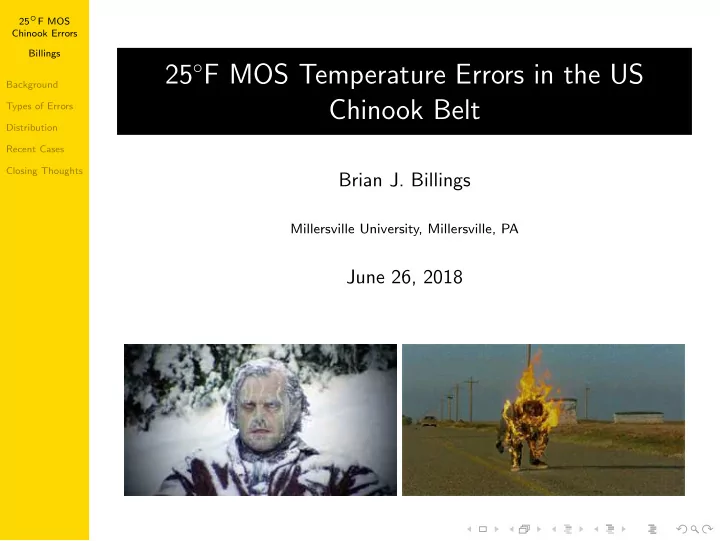
June 26, 2018

slide-2
SLIDE 2

25◦F MOS Chinook Errors Billings Background Types of Errors Distribution Recent Cases Closing Thoughts

ESCI 390 - Mountain Meteorology

  • One-time elective offered Fall 2017
  • A range of class projects/activities:
  • 2 NSF Educational Deployments

(P11)

  • analyzed data from DOW visit
  • participated in King Air visit
  • In MOS project students obtained

data for a complex terrain station

  • mesowest.utah.edu
  • mesonet.agron.iastate.edu
  • Using Excel macro, searched for

events with extreme model errors

slide-3
SLIDE 3

25◦F MOS Chinook Errors Billings Background Types of Errors Distribution Recent Cases Closing Thoughts

Methodology

  • Areas east of Rockies affected

by chinook warming

  • No formal chinook belt definition
  • c.f. Alberta: Longley (1967)
  • Selected the 6 NWS WFO’s nearest

to mountains

  • 72 hour forecasts back to 2002
  • 25◦F (14◦C) errors ≤ 24 hours

apart grouped as event

  • Event defined by largest error and

shortest forecast time

Available at www.metviz.com/MOS.xlsx

slide-4
SLIDE 4

25◦F MOS Chinook Errors Billings Background Types of Errors Distribution Recent Cases Closing Thoughts

Overchinooking

  • MOS chinook wind timing exceed observed
  • Break-in Broadening
  • Missed Pause
  • Onset Broadening
  • Phantom Chinook
slide-5
SLIDE 5

25◦F MOS Chinook Errors Billings Background Types of Errors Distribution Recent Cases Closing Thoughts

Cold Surges

  • Region also affected by cold surges
  • Colle and Mass (1995); Schultz et al (1997)
  • Late Cold Surge
  • No Cold Surge
slide-6
SLIDE 6

25◦F MOS Chinook Errors Billings Background Types of Errors Distribution Recent Cases Closing Thoughts

Other Types of Error

  • 24% of total number of events
  • Cloud/Precipitation (33)
  • Southerly WAA (10)
  • 9 in KRAP and KCOS
  • Late Chinook/Early Cold Surge (10/5)
  • 6 of former in 2007
  • Thunderstorm Outflow (27)
  • 17 in KRAP and KGTF-NAM
slide-7
SLIDE 7

25◦F MOS Chinook Errors Billings Background Types of Errors Distribution

Temporal Spatial

Recent Cases Closing Thoughts

Monthly and Hourly Distribution

  • January maximum;

slightly more after

  • more NAM events
  • utside cold season
  • Mid-late daytime

maximum

  • 2 extra 6-hourly

forecasts issued

  • Maximum for

longest forecasts

  • more GFS events

for shorter leads

slide-8
SLIDE 8

25◦F MOS Chinook Errors Billings Background Types of Errors Distribution

Temporal Spatial

Recent Cases Closing Thoughts

Annual Distribution

  • 357 total events
  • 119 (33.3%) in dataset’s first 22-25 months (13%)
  • 19 of 40 No Cold Surge events occur in this timeframe
  • (Lott and Miller 1997, QJRMS; Alpert 2004, WAF/NWP)
  • Low years have 8-14 events
  • 2005-06, 2010, 2012-13,

2015-16

  • High years have 20-29 events
  • 2007-09, 2011, 2014, 2017
slide-9
SLIDE 9

25◦F MOS Chinook Errors Billings Background Types of Errors Distribution

Temporal Spatial

Recent Cases Closing Thoughts

Total Events by Model

  • Similar NAM totals along most of Rockies
  • GFS minimum around Columbia-Snake channel
  • Higher totals in KRAP; Highest totals in KGTF
slide-10
SLIDE 10

25◦F MOS Chinook Errors Billings Background Types of Errors Distribution

Temporal Spatial

Recent Cases Closing Thoughts

Total Events by Error Type

CHK = Overchinooking; CDS = Late or No Cold Surge

  • Cold surges are largest total in 3 cities
  • Slightly more other events in KRAP and KCOS
  • Overchinooking significantly more important at KGTF
slide-11
SLIDE 11

25◦F MOS Chinook Errors Billings Background Types of Errors Distribution Recent Cases

KTFX Chinooks KDEN Cold Surges

Closing Thoughts

KTFX/KBIL Phantom Chinooks

  • 7 of 10 phantom chinooks occur in winter 2016/17

KTFX Observed Skew-T

  • Some chinooks observed at upstream MT DOT stations;
  • thers entirely absent from plains
slide-12
SLIDE 12

25◦F MOS Chinook Errors Billings Background Types of Errors Distribution Recent Cases

KTFX Chinooks KDEN Cold Surges

Closing Thoughts

KDEN Cold Surges

  • Extreme/large errors more often

affect two/six forecast periods

  • Forecast excess electricity sold to

market/utilities needs replacing 2014-2017 GFS and NAM MOS

slide-13
SLIDE 13

25◦F MOS Chinook Errors Billings Background Types of Errors Distribution Recent Cases Closing Thoughts

Closing Thoughts

  • A wider range of classroom activities leads to a better chance of

students getting more deeply involved

  • Knowledge of historically important changes to model

configurations is critical for comparing errors from past years

  • Four dominant causes of extreme MOS errors in this region are:

1 Late Cold Surges 2 Overchinooking 3 Clear or Overcast 4 Thunderstorms

  • Field campaigns for some phenomenon could be anywhere along

the lee of Rockies (1 and 3 above); others should be in MT/AB

  • Benefit for users in improving short-range model details, as well

as extending long-range