SLIDE 1
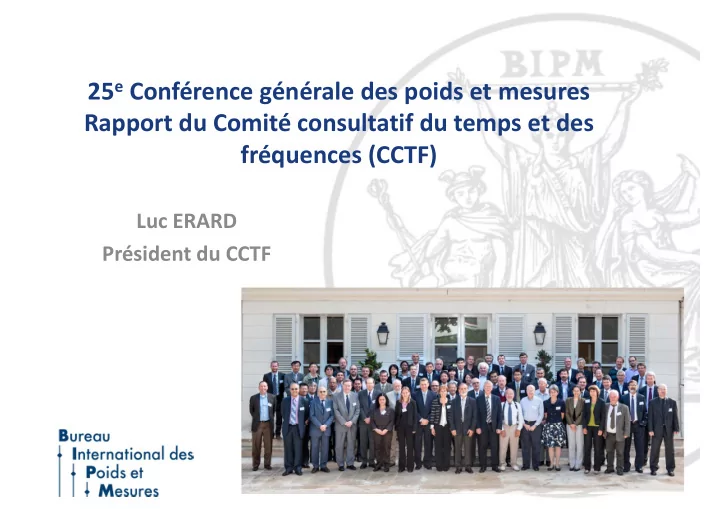
25e Conférence générale des poids et mesures Rapport du Comité consultatif du temps et des fréquences (CCTF)
Luc ERARD Président du CCTF
SLIDE 2 Metrological areas/Achievements: Time scales
NMIs, DIs and others – Real‐time local realizations UTC(k) – Local atomic time scales TA(k) – Primary/secondary frequency standards – Time/frequency transfer (i.e.
BIPM – UTC (CCTF‐K001.UTC) monthly, post‐ processed – UTCr (rapid solution) weekly, post‐ processed – TT(BIPMyy) yearly (post‐processed)
– Calibration of receivers (BIPM/RMOs)
Unique Key comparison CCTF‐K001.UTC BIPM Circular T
♦ Ongoing, monthly, 74 participants ♦ Two comparisons in one: ‒ local time scales: traceability of UTC (k) to the SI ‒ realizations of the second: comparison of the primary and secondary frequency standards for confirmation of the quality of the local realization of the SI second ♦ Information of the access to UTC via GNSS > broad dissemination of UTC
SLIDE 3 Metrological areas/Achievements: The SI second
Secondary representations of the second – Recommended list of frequencies/wavelengths (CI‐ 2013) – Microwave (Rb fountain, accuracy 2‐3 parts in 1016) – Optical transitions (accuracy parts in 1018), ratios of
Trapped single ions and neutral atoms trapped in optical lattices (Hg, Sr, Yb, Al, Ca, In, Mg,..)
♦ Primary realization: caesium ‒ 16 Cs frequency standards operated in NMIs have contributed since 2011: 2 thermal beams, 14 fountains ‒ Accuracy 2‐3 parts in 1016 (fountain), 10‐20 parts in 1015 (thermal beam) ‒ One under consideration (October 2014)
SLIDE 4
BIPM and contributing laboratories
– Improving UTC stability, accuracy and dissemination; providing prediction on a shorter delay; – Algorithms.
Major challenges
Redefinition of the SI second
– Developing optical standards with 10‐18 frequency accuracy at NMIs; – Comparing optical standards with the highest accuracy over long distances (optical fibres, TWSTFT, microwave and optical links, VLBI,..); – Operating optical standards over long intervals for reporting to the BIPM.
SLIDE 5
Stakeholders/Inter‐disciplinary issues
Organization/Activity Stakeholder Inter‐disciplinary issues
CCL Length metrology Wavelength Time scales NMIs, observatories, universities, space agencies Traceability to UTC Telecommunications Radiocommunications ITU Dissemination of UTC Synchronization to UT1 Global Navigation Satellite Systems (GNSS) GPS, GLONASS, Galileo, BeiDou, … Dissemination of UTC GNSS System Times Time transfer for UTC Earth and space sciences GNSS civil applications IAU, IUGG/IAG, URSI, IERS, IGS ICG, CGSIC Space‐time references Conventions Time transfer for UTC
SLIDE 6
Future strategy
Frequency standards – Assist to the decision of a new definition of the second by Determining the best representation of the SI second and its uncertainty: which physical standard(s) Developing portable highly accurate primary standards for confirming the innovative long‐distance comparison methods Time and frequency transfer – Implementing ground‐based techniques (optical fibres) targeting 10‐18 frequency transfer accuracy – Extending to novel space‐based techniques targeting 0.1 ns time transfer uncertainty and to allow 10‐18 frequency transfer accuracy over all distances Time scales – Stronger coordination work on upcoming time scales developed for different applications (GNSS, dynamical‐pulsar time scale, etc.) – Adapting algorithms following clock and frequency standard improvement – Providing the reference UTC on a shortest delay for supporting new applications