23 college campuses associated with population level improvements. - - PDF document

23
SMART_READER_LITE
LIVE PREVIEW

23 college campuses associated with population level improvements. - - PDF document

Presentation Descriptions Healthy Campus Summit mpus Summit Healthy Campus 2020: Lets Take Action THURSDAY Allison Smith , MPA; Manager of Public Health Initiatives and October Assessment, New York University Data shows there is a gap in


slide-1
SLIDE 1

Presentation Descriptions

Healthy Campus Summitmpus

Summit

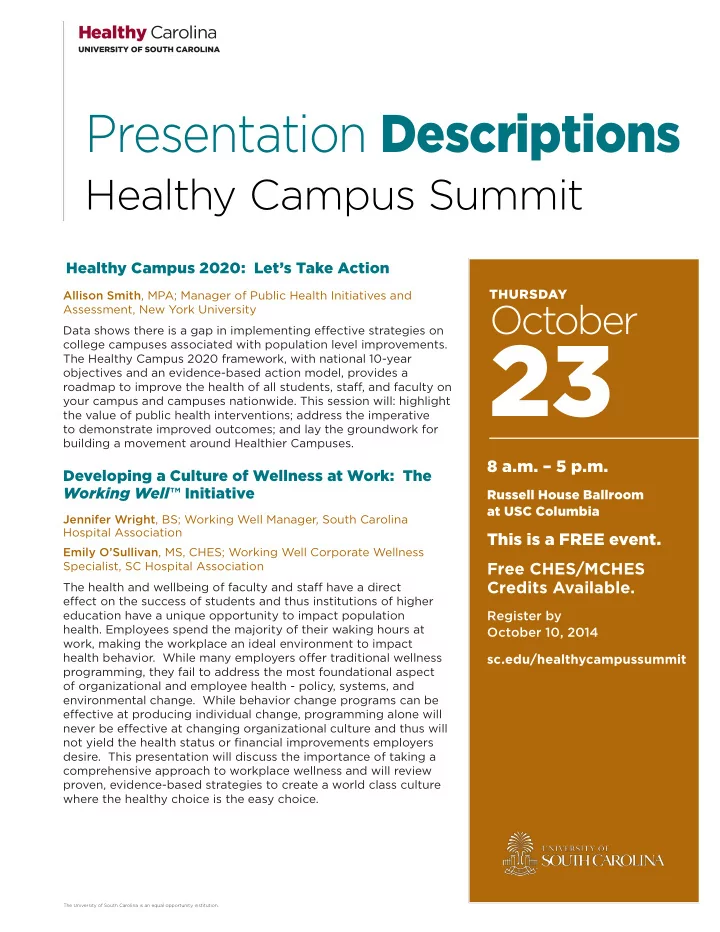
Healthy Campus 2020: Let’s Take Action Allison Smith, MPA; Manager of Public Health Initiatives and Assessment, New York University Data shows there is a gap in implementing efgective strategies on college campuses associated with population level improvements. The Healthy Campus 2020 framework, with national 10-year

  • bjectives and an evidence-based action model, provides a

roadmap to improve the health of all students, stafg, and faculty on your campus and campuses nationwide. This session will: highlight the value of public health interventions; address the imperative to demonstrate improved outcomes; and lay the groundwork for building a movement around Healthier Campuses.

Developing a Culture of Wellness at Work: The Working Well™ Initiative

Jennifer Wright, BS; Working Well Manager, South Carolina Hospital Association Emily O’Sullivan, MS, CHES; Working Well Corporate Wellness Specialist, SC Hospital Association The health and wellbeing of faculty and stafg have a direct efgect on the success of students and thus institutions of higher education have a unique opportunity to impact population

  • health. Employees spend the majority of their waking hours at

work, making the workplace an ideal environment to impact health behavior. While many employers ofger traditional wellness programming, they fail to address the most foundational aspect

  • f organizational and employee health - policy, systems, and

environmental change. While behavior change programs can be efgective at producing individual change, programming alone will never be efgective at changing organizational culture and thus will not yield the health status or fjnancial improvements employers

  • desire. This presentation will discuss the importance of taking a

comprehensive approach to workplace wellness and will review proven, evidence-based strategies to create a world class culture where the healthy choice is the easy choice.

8 a.m. – 5 p.m.

Russell House Ballroom at USC Columbia

This is a FREE event. Free CHES/MCHES Credits Available.

Register by October 10, 2014 sc.edu/healthycampussummit THURSDAY

October

23

The University of South Carolina is an equal opportunity institution.
slide-2
SLIDE 2

Engaging Students for Success: Social Media, Incentives and Beyond

Sara Stahlman, MA; Marketing and Communication Coordinator for Campus Health Services, University of North Carolina at Chapel Hill Our biggest potential for engaging students lies at the intersection of student development, public health and technology. This session will allow participants to dive into the nexus of these three content areas. We will review a dynamic paradigm to engage students in health, explore several initiatives full of promising practices and ultimately identify ways to increase the reach and engagement of health interventions on our campuses.

Tobacco-Free Campuses Panel

Ian Hamilton, MSW; State Tobacco Control Plan Manager, South Carolina Tobacco-Free Collaborative

  • Dr. Susan Johnson, PhD; Director of Health Promotion, Medical University of South Carolina

Kerri McGuire, MEd, LPC, NCC; Director of Counseling and Support Services, York Technical College Kimberly Shannon, RN, MPH; Director of Wellness Center, Lander University Monique Dawson, BSN; College Wellness Coordinator, South Carolina Tobacco-Free Collaborative Given that tobacco use is the number one preventable cause of death and disease in the US, Colleges and Universities have the responsibility to provide a healthy campus that supports and encourages both excellent learning and working environments for students, faculty, and stafg. A key part of any healthy campus is a 100% tobacco-free policy that covers all property both inside and out. This session will include an update on tobacco use and trends, and three experienced panelists will discuss their keys to a successful, sustainable tobacco-free campus policy, from the support of administration and student buy-in to policy enforcement and compliance. There will also be a discussion of tobacco- free campus resources.

Mental Health and Emotional Well-being Initiatives for Student Success

Jennifer Myers, MA, LPC; Assistant Director of Campus Mental Health Initiatives, Coordinator of Suicide Prevention Services, University of South Carolina Mandy Medlock, BA; Director of Operations, National Alliance on Mental Illness Mid-Carolina This session will provide attendees with an overview of two resources for creating a campus environment that is conducive to the wellbeing of students living with mental health disorders. The NAMI (National Alliance on Mental Illness) “College Students Speak: A Survey Report on Mental Health” and the Campus Mental Health Action Plan (CampusMHAP) from The Jed Foundation and Education Development Center (EDC). The NAMI report provides recommendations as to what services and support systems schools should implement to support this population based on feedback provided from the student perspective. The CampusMHAP was created to assist college professionals in developing a strategic plan for a campus environment conducive to mental health promotion and suicide prevention. Facilitators will review how this plan has been applied at the University of South Carolina specifjcally and discuss what components they can utilize at their respective campuses.

Alcohol and Substance Abuse Initiatives for Student Success

Chloe Green, MEd; Associate Director of Healthy Campus, Clemson University Rhonda DiNovo, MSW; Director of Substance Abuse Prevention and Education, University of South Carolina Prevention to address substance use on a college campus is comprehensive. It consists of a portfolio

  • f targeted strategies, including programmatic and environmental approaches. This session will allow

participants to gain an understanding of Clemson University’s program, Aspire to Be Well, which is a peer-led health and safety focused dialogue focusing on alcohol and other drug abuse prevention, sexual violence prevention, mental health and campus resources. Also learn how the University of South Carolina addresses environmental factors that contribute to student substance use through bar observations, collaboration with local hospitality district retailers, and implementation of a Responsibility Toolkit.

slide-3
SLIDE 3

Strategies for Improving Health Literacy for Student Success

Megan Weis, MPH, DrPH, MCHES; Associate Director for Outreach and Program Development, South Carolina Institute of Medicine and Public Health Aaron Guest, BA; Changing Carolina Peer Leaders Graduate Advisor, University of South Carolina Health literacy has been recognized as an important predictor of an individual’s health status and utilization of health services. With this in mind, in the Spring of 2014 the University of South Carolina (USC) convened a Health Literacy Task Force to develop a health literacy plan focusing on the evaluation of current student health literacy and informed consumerism and the development of methods to make resources available for students. The goal of an initial needs assessment conducted by the task force was to identify the sources of health and medical information that USC students are utilizing; how USC students make their health care decisions; where they receive health care services; perceptions about health care services available on-campus; and, understanding of recent health care

  • legislation. The session will discuss the formation of the task force, the development of the needs

assessment, tools, and resources, and future steps in the Health Literacy Task Force activities.

Creating a Holistic Model for Health: From Program to Policy

  • Dr. Deborah Beck, MPA, RRT, EdD; Executive Director of Student Health Services, University of South

Carolina Jessica Johnston, MPH; Director of Healthy Carolina, University of South Carolina This presentation will cover the design, implementation and evaluation of a holistic model of health at the University of South Carolina. Using the National Prevention Strategy, the Socio-Ecological Model and Healthy Campus 2020, Student Health Services and Healthy Carolina have developed programs, policies, services and initiatives to address the full spectrum of health and wellness intervention. This includes the delivery of healthcare through the Patient-Centered Medical Home (PCMH) model and includes environmental health strategies that make the healthy choice simple for faculty, stafg and students.

#HCSummit2014 HealthyC@mailbox.sc.edu www.facebook.com/HealthyCarolina @MyHlthyCarolina For more information on the agenda or to RSVP, visit:

www.sc.edu/healthycampussummit

Healthy Campus Summit

Empowering Students to Succeed: Creating and Sustaining a Culture of Health