
SLIDE 1
23‐9‐2016 1
Promoters:
- prof. dr. ir. Grietje Zeeman
- prof. dr. ir. Cees J.N. Buisman
Supervisors:
- dr. Renata D. van der Weijden
- dr. ir. Lucía Hernández Leal
MSc Jorge Ricardo Cunha
Simultaneous calcium phosphate granules and methane recovery from black w ater
This image cannot currently be displayed.Resources Recovery - Oriented Sanitation
This image cannot currently be displayed. This image cannot currently be displayed.Black water
(Feces + Urine)
Kitchen waste Grey water
Volume
L cap-1 d-1
6 0.6 79 300 CODTotal
g L-1
8 98 0.7 0.6 P Total
mg L-1
190 330 5 12 NH4
+- N
g L-1
0.8
- 0.02
0.07
Tervahauta et al. (2013) Water
Conventional sewer 2 of 13
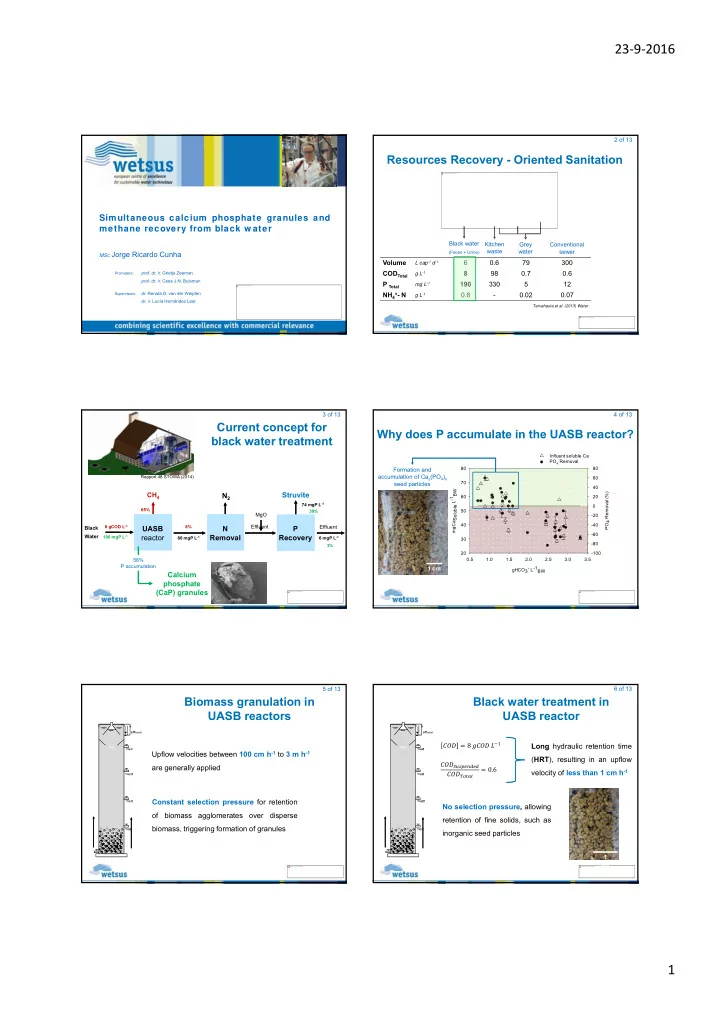
Current concept for black water treatment
This image cannot currently be displayed.MgO
CH4
UASB reactor P Recovery N Removal Struvite
Effluent
Calcium phosphate (CaP) granules
190 mgP L-1 80 mgP L-1 6 mgP L-1
58% P accumulation
N2
3% 74 mgP L-1 39% 8 gCOD L-1 65% 8% Rapport 48 STOWA (2014)
Effluent Black Water
3 of 13
Why does P accumulate in the UASB reactor?
This image cannot currently be displayed.gHCO3- L-1BW 0.5 1.0 1.5 2.0 2.5 3.0 3.5 mgCaSoluble L-1BW 20 30 40 50 60 70 80 PO4 Removal (%)
- 100
- 80
- 60
- 40
- 20
20 40 60 80 Influent soluble Ca PO4 Removal
Formation and accumulation of Cay(PO4)x seed particles 1 cm 4 of 13
Biomass granulation in UASB reactors
This image cannot currently be displayed.Upflow velocities between 100 cm h-1 to 3 m h-1 are generally applied Constant selection pressure for retention
- f
biomass agglomerates
- ver
disperse biomass, triggering formation of granules
5 of 13
This image cannot currently be displayed.8
No selection pressure, allowing retention of fine solids, such as inorganic seed particles
Black water treatment in UASB reactor
1 cm
- 0.6
Long hydraulic retention time (HRT), resulting in an upflow velocity of less than 1 cm h-1
6 of 13