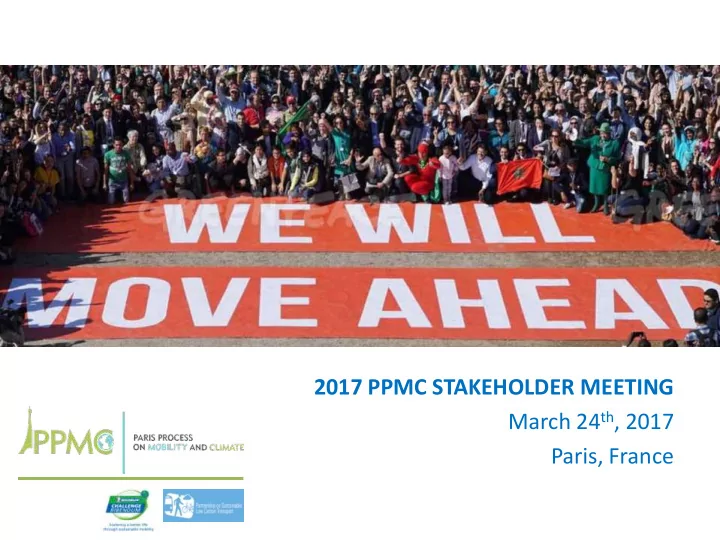
2017 PPMC STAKEHOLDER MEETING March 24 th , 2017 Paris, France - - PowerPoint PPT Presentation
2017 PPMC STAKEHOLDER MEETING March 24 th , 2017 Paris, France Agenda 13.30 13.45 Welcome by PPMC and host French Ministry of Environment, Energy and the Sea 13.45 14.30 Updates on 2017 Transport and Climate Change Agenda and Process
13.30 – 13.45 Welcome by PPMC and host French Ministry of Environment, Energy and the Sea 13.45 – 14.30 Updates on 2017 Transport and Climate Change Agenda and Process 14.30 – 15.00 Adaptation and Transport 15.00 – 15.15 Tea break 15.15 – 16.15 Consultation on the Global Macro-Roadmap: An Actionable Vision on Transport Decarbonization 16.15 – 17.15 Marrakech Partnership-Global Climate Action Transport Initiatives in 2017 17.15 – 18.00 Transport Decarbonization Alliance (TDA) Agenda
- I. Updates on 2017 Transport & Climate Change
Agenda and Process
Story line for today
Policy Advocacy To Promote the Integration of Sustainable Transport in Global Policies on Sustainable Development and Climate Change
2009- 2015 2016
Ambition Advocacy Implementation Advocacy
The Big Picture
SLoCaT Knowledge Base
(NDCs, emissions, finance, methodologies)
Adaptation
(Declaration Follow-up)
Transport Decarbonization Alliance SUM4ALL Green Goal Transport & Climate Change Global Status Report NDC Partnership
(Capacity building)
MP – GCA
(Including Transport Initiatives)
Global Macro – Roadmap
(+ regional versions)
IPPC 1.5O Paper
Knowledge/ Concepts Policy - Convening
Implementation/ Tracking
SLoCaT Theory of Change
SLoCaT and PPMC Transport and Climate Products & Processes
Outreach
The 2017 Marrakech Partnership for Global Climate Action Cycle of Activities
Engage to deliver Recognize achievement Define priorities
Land-use Oceans Water Human Settlements Energy Transport Industry
Fiji’s High Level Climate Champion, Inia Seruiratu
Morocco’s High Level Climate Champion, Hakima El-Haite
Tasks and Roles in Marrakech Partnership for Global Climate Action Cycle of Activities
Mobilizers (PPMC) UNFCCC support unit High Level Champions Defining priorities
- pre-2020 actions that
contribute to medium – long term change
- Priorities to be
updated on a regular basis
- Recommend priority
actions
- Convene stakeholders,
receive and synthesize inputs
- Recommend priorities for
Champions
- Publish work-plans &
roadmaps to address the priorities Engagement
- Engage within
constituency to scale up ambition
- Identify and report
barriers to implementation
- Convene stakeholders to
provide opportunities for advocacy
- Connect stakeholders
with common/supportive
- bjectives
- Political engagement to
advocate for priority actions
- Convene senior
policymakers and actors to remove barriers Recognition
- Provide data on progress
and impact
- Prepare and publish
sectoral/regional progress reports
- Recognize commitments
and impacts on NAZCA
- Showcase best practice
- Compile and synthesize
sectoral progress reports
- Guide the Summary for
Policymakers/Yearbook
- f Climate Action
- Amplify the positive
messages from implementation
Priority Actions to Put Transport on well-below 2 Degree Pathway and strengthen resiliency
Impacts
Linked to SLoCaT/PPMC Transport and Climate Products
Priority Actions + Indicators
Policy Finance Technology Implementation Civil society
Urban Transformation
1. 2. 1. 2. 1. 2. 1. 2. 1. 2.
Production Sustainable Energy
1. 2. 1. 2. 1. 2. 1. 2. 1. 2.
Modal Efficiency
1. 2. 1. 2. 1. 2. 1. 2. 1. 2.
Supply Chains
1. 2. 1. 2. 1. 2. 1. 2. 1. 2.
Travel Demand
1. 2. 1. 2. 1. 2. 1. 2. 1. 2.
Rural Transport
1. 2. 1. 2. 1. 2. 1. 2. 1. 2.
Adaptation
1. 2. 1. 2. 1. 2. 1. 2. 1. 2.
Economic Instruments
1. 2. 1. 2. 1. 2. 1. 2. 1. 2.
Priority Actions should be Impact oriented and NOT process Priority Actions should be backed up by indicators Objective that 50% of recommended priority actions are joint actions with other thematic areas
PPMC Event Plans 2017 - COP 23
- UNFCCC May Session:
– Possible side event? – Resilient Cities event – Side meetings on Transport Decarbonization Alliance – Contribute to TEM – Off-site event hosted at GIZ
- Participate in UNFCCC Regional Meetings Africa – Benin; LAC –
Mexico, and Asia – Bangkok??
- COP23
– TDA Launch – NDC Partnership event – Clean Mobility Reception – Participate in Cities Summit – Joint Transport – Energy event
Transport week, rather than Transport Day at COP23?
Announcements
- Moving’ On – MCB
- Global Status Report REN21
- II. Transport & Adaptation
COP22 Declaration on Accelerated Action on Adaptation in Transport
- Signed by 395 individuals
and by 55 organizations including:
- World Bank
- International Energy Agency
- Global Environment Facility
- Islamic Development Bank
- International Road Federation
- PIANC
- International Union of Railways
- UN-ECE
- Nordic Development Fund
- International Association of Public
Transport
Read more about it here: http://www.slocat.net/news/1780
2017 Activities by SLoCaT on Adaptation
- Overview of Transport and Adaptation in UNFCCC
Processes: – Transport Adaptation as part of NAPs and NAPAs; – Transport Adaptation as part of Climate Finance; – Transport Adaptation as part of NDCs;
- Tools related to Transport Adaptation
- Adaptation as part of Global Macro Roadmap – Actionable
Vision on Transport’s Decarbonization
- Transport as part of the Netherlands funded Global Center
- f Excellence on Adaptation to Climate Change
- Possible Leadership Forum on Transport Adaptation.
NAPs and NAPA Analysis
- Analysis of 80 national plans on adaptation:
– all 51 NAPAs received by UNFCCC; – all 7 NAPs submitted to UNFCCC NAP Central; – 22 other national climate change adaptation plans
- 41% include adaptation measures on transport
- Strong (expected) focus on infrastructure:
Analysis of NDCs
- 75% of NDCs highlight transport as a
potential mitigation source
- 20 of 160 NDCs (13%) consider
general adaptation measures for transport sector
- Specific adaptation measures for
transport are mentioned in 6 countries’ NDCs (4%): – Bangladesh – Belize – Gambia – Maldives – Moldova – Nigeria
75 63 13 4 20 40 60 80 100
NDCs Highlighting Transport Sector for Mitigation NDCs with Specific Transport Mitigation Measures NDCs Highlighting Transport Sector for Adaptation NDCs with Specific Transport Adaptation Measures
% of NDCs
NDC Analysis
Climate Finance Capturing Transport Adaptation
- Adaptation is main focus of 23 projects
- Only 136 million USD co-financed through climate finance for transport
adaptation
- Nordic Development Fund has strong adaptation focus:
– Adaptation approaches for the transport sector in Cambodia – Developing capacity for climate resilient road sector in Mozambique and Rwanda – Integrating climate change adaptation to transport in Vietnam
0% 20% 40% 60% 80% 100% 2009 2010 2011 2012 2013 2014 2015 2016 2017
Avoid-Shift-Improve Share of Projects by Year (in %)
Avoid Avoid-Shift Shift Shift-Improve Improve Avoid-Shift-Improve
- Climate Finance Database records
transport projects of CDM, CTF, GEF, IKI, JCM, NAMA, NDF and green bonds allocated to transport
- Currently 264 projects and 91 green
bonds are in database
Adaptation in Global Macro-Roadmap for Decarbonizing the Transport Sector
Roadmap for a ‘zero net emission’ economy early in the second part of the century, to secure a ‘well below 2°C’ climate target called for in Paris Agreement
Synergistic urban transformation
1
Low-carbon energy supply strategy
2
Modal efficiency improvement
3
Shortened supply chains
4
Unnecessary travel reduction
5
Adapted solutions for ‘rural’ world
6
Investment in adaptation &
- ffsetting
7
Financial & regulatory tools
8
2060 2050
2016
2020 2040 2030
2025 2035 2045
2080
- Adaptation to be a
key part of SLoCaT/PPMC Roadmap on the Decarbonization of Transport
- Pursue integrated
adaptation – mitigation approach
How does SLoCaT envisage working with Global Center of Excellence
Knowledge:
– Development of a common vocabulary on Transport and Adaptation – Provider of knowledge products (transport) – Reviewer of knowledge products (general) – Provider of expertise / advice on transport
Networking:
– Provider of contacts in transport/development community – Relay for information to/from: Global and regional transport events; SLoCaT/PPMC members; MP-GCA Transport Initiatives
Policy Leverage:
– Facilitate integration of transport related outputs CGEA in national, regional and global policy processes on transport and climate change rove,
Adaptation Leadership Forum
- Suggested to create (political) leadership forum on adaptation to
climate change in the transport sector
- Help create visibility for adaptation in transport sector with the
aim to see greater emphasis on adaptation in transport in UNFCCC processes as well as other global and regional processes on sustainable development and transport
- Ensure greater share of climate finance for adaptation in transport
Raising Adaptation in UNFCCC in 2017
- Work with the Adaptation Committee to have transport as key sector in
UNFCCC adaptation activities and processes in 2 years from now
- The Nairobi Program of Action offers good opportunities to raise
Transport focus.
– There will be a call for submissions on Adaptation by September. – This will be followed by a 2.5 hour session during the COP in November. – Based on this a synthesis paper will be prepared for SBSTA 48 in May 2018. A strong contribution of the transport sector to these efforts would be very much appreciated.
- UNFCCC is conducting training in support of National Adaptation Plans
and National Adaptation Programs of Action. For this UNFCCC would like to make use of case studies on adaptation in the transport sector.
- UNFCCC is organizing an annual NAP Expo, the next one of which will be
in April of next year in Bonn.
- SLoCaT has agreed to work with ICLEI on a session on transport and
adaptation as part of the Resilient Cities conference the week before the UNFCCC May session.
- III. Global Macro-Roadmap:
An Actionable Vision on Transport Decarbonization
Global Macro-Roadmap
Second Consultation on Global Macro-Roadmap
- Consultation from March
1st to March 15th (extended to March 24th)
- 27 people from 17
- rganizations Responded
so-far
- Representing
development agencies, academia, energy
- rganizations, transport
- rganization, UN agencies
Male Respondents 70% Female Respondents 30%
Responses by Gender
Question 1: Climate Change and Development
- Main focus is seen to be on climate change
- Less on sustainable development
- SDGs are only covered in introduction and final part of
Chapter III
- Components 1 to 6 can link well to SDGs
- Impacts on SDGs and linking them to components
must be made more explicit throughout document
Climate Change Sustainable Development
Question 2: 8 Components & Country Groupings
- Strong consent on relevance and ease to adapt components
- Questions about rationale and justification for components and
the targets
- Many request to add each component’s mitigation potential
- Country grouping in OECD countries (or trail blazers) and fast
followers isn’t favored (“outdated”) but no alternative approach is suggested
- Need to acknowledge leapfrogging countries, best example:
China
- Regarding attention to national and local specifics, comments
recognize Roadmap as paper with global scale and macro-view
- If translated to regional or national scale, then specifics have to
be considered
Question 3: Avoid-Shift-Improve
- Improve measures (esp. technology solutions) are currently dominating
- Avoid and Shift have to be addressed more - In developing countries, avoid
and improve very important
- Fuel measures can be added to the concept
- Comments mention following measures to be missing/not sufficiently
discussed: – Pricing – Land-use policy – E-commuting – Walking and cycling – Intermodal transport and combined travel – Transport demand management
- Avoid-Shift-Improve can be sufficiently discussed in 8 components
- Some components have to highlight Avoid and Shift more, for example
Component 3 only about Improve
Question 4: Milestones of Global Macro-Roadmap
- Milestones are helpful and provide guidance for
policy makers
- Unknown on what information milestones are based
- n
- Milestones need to based on realistic goals and
quantifiable information
- Quick wins are regarded as valuable
- Importance of implementation of quick win
measures has to be highlighted further
Question 5: Involvement of Stakeholders
- Responders agree that a compromise between different
stakeholders is key for success of Global Macro-Roadmap
- Comments mention governments, transport sector, civil
society/non-governmental organizations, private sector (and industry-led initiatives), development banks, general public, research communities as relevant stakeholders
- Currently document has good balance between stakeholders
and their goals/interests
- Mixed comments on which stakeholder should dominate
- Government has to be proactive and set framework for
industry
- Industry has to lead change
General Feedback
- Rethink position of adaptation in Global Macro-Roadmap
- Include more discussion of financing decarbonization
- Integrate local level (cities) and urban transport solutions to
Roadmap
- Connect transport decarbonization to other sectors
Next Steps
- Integrate comments for next draft to be ready for May session UNFCCC + ITF
Leipzig
- After that ”final” version for COP23 in November
- Regional versions Europe, LAC, Africa?
- IV. Marrakech Partnership-Global Climate Action
Transport Initiatives in 2017
PPMC Action Plan on Global Climate Action Transport Initiatives
- 1. Foster the setting up of new Transport initiatives
- 2. Help the initiatives expand the geographic coverage of their
work
- 3. Actively support/help existing initiatives through bilateral
contacts
- 4. Look to streamline / focus the initiative better
- 5. Facilitate and improve reporting on the initiatives
- 6. Improve communications and outreach
Action 1: Fostering the setting up of new Transport initiatives
- Integrating existing + new transport initiatives
into the Climate Action Transport initiatives, e.g.
– Beyond 50: an initiative on sustainable fuels by WBCSD – EV 100: an initiative on corporate leadership on e- mobility by the Climate Group – WBCSD Indicators: an initiative to structure planning of urban low carbon transport – Eco-mobility: an initiative to promote the role of eco-mobility by the Eco-mobility Alliance – 100,000 KM Sidewalks Challenge
- Identifying Strategic Gaps
– Identifying thematic gaps – Ranking the new themes – Finding organizations to possibly lead the new initiatives
Criteria for Climate Action Initiatives
Relevance Scale Specific Transparency in progress Impact/results-oriented Ownership/capacity Time Frame
- Ensure clarity by May
2017 on possible new initiatives to have time to prepare for COP23
PPMC proposes to better balance geographical discrepancy & increase the impact of initiatives in Global South:
- Work with the initiatives to identify priority
geographic areas
- Link the initiatives to the regional events and
activities (e.g. regional UNFCCC events)
- Use SLoCaT Members to help identify regional
contacts and opportunities.
- Make use of contacts through NDC Partnership
which has 30 developing country members
Action 2: Help the initiatives expand the geographic coverage of their work
Action 3: Intensified support to existing initiatives through bilateral contacts
- Provide targeted support based on initiative’s unique conditions
- Carefully review available public information on the initiatives
- Be more proactive in reaching out to initiatives and asking about
plans/activities for 2017
- Learn about barriers/challenges of individual initiatives
- Maintain regular contact during 2017
- Identify specific actions to support the initiatives in 2017 through:
– Online brainstorming / Link interested initiatives more actively to other members/initiatives/ Meet with the coordinator from time to time (if possible/local)/ Invite initiatives to take part in PPMC outreach/ Include request for help from initiatives in bi-weekly SLoCaT Members´ Updates/ Organize conference calls of sub groups of initiatives
Action 4: Streamlining of the initiatives
- Possible options for initiatives that lost momentum;
– Should they be discontinued? – Absorbed in other initiatives? – Combine initiatives with similar focus (e.g e-mobility) under one larger initiative with sub components?
- Following principle of self-organization we would like to
hear from the initiatives on this.
Action 5: Facilitate and improve reporting on the initiatives PPMC 2017 Report on Transport Initiatives
- Plan: One major report on the Initiatives in preparation of the COP in November 2017
- Focus: highlighting progress compared to what needs to be achieved by 2020 (3
years).
- Main story: transport sector is taking action on climate; based on individual
initiatives & sector-wide transformation
- Contribution of initiatives to other reports: Global Status Report & Urban Initiatives
for 2018 HLPF review of SDG 11
Coordination with NAZCA & UNEP-DTU
- To ensure that all Climate Action Transport Initiatives are included in NAZCA and
UNEP-DTU Websites
- To harmonize reporting formats for PPMC, CIP and NAZCA
- To coordinate/align timing and frequency of reporting
Feedback from Initiatives on the role of PPMC in coordinating reporting?
Action 6: Communication & Outreach
- Fundamental revision and update of the PPMC/SLoCaT websites by
summer 2017
- Identify “success stories” - facilitate links to initiatives
- Identify channels to link initiatives / and connect the to the broader
SLoCaT/PPMC Members
- Develop a structured Twitter campaign around COP23
- Make more use of the initiatives to relay general PPMC messages
- Promote the Transport Initiatives in presentations and events
throughout the year
UPDATES FROM: AIRPORT CARBON ACCREDITATION (ACA)
Progress / achievements (since September 2016)
- First carbon neutral airports outside
Europe: Dallas Fort Worth, Delhi, Hyderabad, Sunshine Coast
- 183 airports worldwide, 37.3% of global
passenger traffic
- 29 carbon neutral airports
- Continued cooperation with UNFCCC &
Climate Neutral Now
Challenges
- Increase programme visibility in Latin
America and Africa
- Identify potential funding opportunities
Main plans for 2017 & 2018
- Provide additional guidance on
carbon neutrality
- Strengthen programme uptake
in Africa and Latin America
UPDATES FROM: GLOBAL FUEL ECONOMY INITIATIVE (GFEI)
Main plans for 2017 & 2018
- New target for HDVs – 35by35
- Engage on EVs
- Focus on Africa
- New research
Progress / achievements (since September 2016)
- Working in more countries Delivering
- n SDGs and NDCs
- New global trends announced
- Substantial outreach
Challenges
- Engage with countries
- Spread the message – even more!
UPDATES FROM: GLOBAL GREEN FREIGHT ACTION PLAN
Main plans for 2017 & 2018
- Organize regional workshops on green
freight – Europe workshop on April 6-7, 2017 in Brussels – Latin America workshop in June 2017 in Buenos Aires
- Launch technical papers on green
freight (Q2 2017) – Guidance on Freight Assessment – Brazil Freight Assessment – Mexico Freight Assessment – Vietnam Green Freight Paper – Report on Black Carbon Methodology for the Logistics Sector
Progress / achievements (since September 2016)
- Regional Meetings for Africa (focus on Northern
Corridor) and Asia
- The first Green Freight Strategy in Africa has
been launched under the Northern Corridor Transit and Transport Coordination Authority
- Preparatory meetings and work to deliver
technical papers and reports.
Challenges
- Awareness-raising on the Action Plan and its
developments, including support for promoting events
- Linkage with other transport initiatives and
climate/sustainable development initiatives
UPDATES FROM: ITS4CLIMATE
Main plans for 2017 & 2018
- Identify those 20 ITS solutions which are the most
efficient and easiest-to-be deployed in cities for achieving quick WINs
- Develop a new Climate Service Blueprint aimed at
building the ITS part of Sustainable Urban Development Mobility Plans as a function of territories specific features
- Instigate a collaborative approach at the
international level
- Creation of an International scientific committee
to support the best ITS solution candidates
- Organisation of a Special Interest Session during
the European ITS Congress in Strasbourg (June 2017)
- Participation to the 5th EU US Transport Research
symposium on ‘Decarbonizing transport for a sustainable future : mitigating climate change’ Washington 17-18 May 2017
- Hackathon and Ideas Box challenges
Progress / achievements (since September 2016)
- Inquiry on best practices and success-stories
- Web site launch,
- Participation to the COP22 in Marrakech
- Ideas box challenge on Spatial, ITS and
Climate
Challenges
- Help finding sponsors, partnerships and
international speakers for the Bordeaux Congress
- Promote the 20 ITS Solutions & associated
Climate Service Blueprint
- Help find funding for pilot projects
UPDATES FROM LOW CARBON ROAD & ROAD TRANSPORT INITIATIVE Main plans for 2017 & 2018
- Several PIARC technical
committeEs involved
- Review by mid-2017
- Seminar to be organized in
Cuba (11/17),
- Final reports by mid-2019
Progress / achievements (since September 2016)
- Release of a “Climate change
adaptation framework in the road sector) in English (2015), French (2016), Spanish (2017)
- Routes/Roads magazine on climate
change and our commitments published in September 2016
Challenges
- Keeping us up to date on related events
UPDATES FROM: MOBILISEYOURCITY
Main plans for 2017 & 2018
Deliver and Develop!
- Implement the initiative on the ground
(local, national levels) in partner cities/countries (Morocco, Cameroon, Tunisia, Senegal, India, Philippines)
- Engage more countries/cities
(interested countries: Brazil, Dominican Republic, Ecuador, Ethiopia, Ghana, Indonesia, Kenya, Mexico, Togo, Peru, Madagascar, Sri Lanka)
- Reach out to potential new partners
and link with other initiatives/programmes
- Set up the MobiliseYourCity
knowledge platform to build a strong and large Community of Practice among all partners
Progress / achievements (since September 2016)
- Successful launch of the operational phase @COP22
- First Steering Committee during COP22 acknowledged new
country/city partners (Cameroon, Morocco, India)
- First kick-off workshop held in Morocco in October
- Opening of the Brussels office for the Secretariat and hiring
- f additional full time staff
- Next Steering Committee in May (new countries, cities and
partners to join the initiative)
Challenges
- Keep raising the voice of transport in international
negotiations (development and climate)
- Promote the initiative towards potential city/country
partners, as well as knowledge & network and funding partners
- Offer dedicated slots in international conferences /
common booth
UPDATES FROM: NAVIGATING A CHANGING CLIMATE
Main plans for 2017 & 2018
- Partner events: ESPO conference in
June 2017 and IHMA congress in 2018
- New Publications: PIANC ports and
waterways adaptation guidance; also PIANC climate change background
- info. document
- ESPO progressing introduction of
climate change into their EcoPorts tools
- Smart Freight Centre working to
harmonise existing emissions calculation methodologies for ports and terminals
- Enhancing NaCC website: Sector
‘needs’ questionnaire being added to website
Progress / achievements (since September 2016)
- launched its new website:
navclimate.pianc.org/
- published a revised Action Plan
navclimate.pianc.org/about/action-plan
Challenges
- Resources! Very small budget for
ambitious programme of work
- Awareness raising – still a perception
that climate change (particularly adaptation) is “for future”- How to change that??
UPDATES FROM: TAXIS4SMARTCITIES
Main plans for 2017 & 2018
- Structuring of the
Taxis4SmartCities initiative (May 2017): an association based in Brussels
- Promotion of taxis as key
elements of Smart Cities – mainly via media, digital, events, meetings with public stakeholders, business cases and modernization of the website)
Progress / achievements (since September 2016)
- Agreement on common goals
(above the official objectives on CO2 : modernisation, accessibility
- etc. ), budget and action plan
- Launch of the monitoring on CO2
- New member : Taxi24 (Germany)
Challenges
- Get new members, in Europe and
worldwide
UPDATES FROM: UIC LOW CARBON SUSTAINABLE RAIL TRANSPORT CHALLENGE
Main plans for 2017 & 2018
- Workshops on rail adaptation
- Railway handbook 2017
- Participation in COP23
Progress / achievements (since September 2016)
- Railway climate responsibility pledge
- Participation in COP22
- Railway handbook 2016
Challenges
- Consult the rail sector on the
proposed roadmap (April 2017)
- Communication & visibility
UPDATES FROM: ECF/WCA CYCLING COMMITMENT Main plans for 2017 & 2018
- Monitoring the Cycling Delivers
city index
- Development of WCA network
Progress / achievements (since September 2016)
- Habitat III and New Urban Agenda
advocacy, cycling is in
- Growth of WCA network (12 new
members)
Challenges
- Lacking clear data
- V. TRANSPORT DECARBONIZATION ALLIANCE
- Bring together countries, regional
and business leaders to provide political leadership for decarbonizing the transport sector in the UNFCCC process
- Give visibility to leaders in the field
and support them to realize their ambitious objectives on transport
- Raise profile of transport and raise
ambition for action on transport in the context of the Facilitative Dialogue on increased ambition in the UNFCC
5000 10000 15000
2010 2020 2030 2050
Global Land Transport …
Estimated BAU 2DS 1.5DS
New Partnership: Transport Decarbonization Alliance
- Political attention to transport: Countries started defining
their mid- to long-term decarbonization plans
- Scaled up ambition: UNFCCC through Facilitative Dialogue
encourages all stakeholders to scale up their ambition on climate action
- Action by non-state action: MPGCA calls for breaking down
distinctions between Parties and non-state actors through joint initiatives, to support on-the-ground implementation
- Organization of the transport sector: PPMC facilitates to
mobilize action amongst non-state actors on transport and climate change & raised profile of transport at COP21 and COP 22
Why the time is right for Transport Decarbonization Alliance
Proposed Composition of Transport Decarbonization Alliance
Countries Sub-national Entities Private Sector
WBCSD, WEF, WMB
- Establish confidence that cost effective decarbonization of transport compatible
with economic development and greater prosperity is feasible
- Provide a forum in which leaders (countries, cities, companies) on low carbon
transport can exchange information on their respective approaches and actions to low carbon transport
- Spearhead discussion of decarbonization of transport in relevant parts of
UNFCCC processes
- Support delivery on the long term Paris Agreement emission reduction objective
by – optimizing contribution of transport sector to decarbonization process as part
- f the 2018 Facilitative Dialogue through phased 2020, 2030, 2040 and 2050
targets – ramping up ambition on actions in the transport sector in the next generation
- f NDCs
Envisioned Role and Impact of TDA
- Champion transport by raising in relevant meetings and processes
(with technical support from SLoCaT Partnership and PPMC members e.g. speeches, briefing notes, lines to take);
- Participate in transport related events;
- Use existing networks and contacts to expand interest in transport
decarbonization;
- Share their transport decarbonization plans, experiences and
progress;
- Advise TDA on opportunities and activities to advance transport
decarbonization;
- Show support to TDA by signing TDA publications/communique´s;
and
- Participate in Press Events
Expectation from TDA Members
- March 2017- Discussion of the TDA concept @ the PPMC
Stakeholder Meeting in Paris
- May 2017- Soft launch of the TDA concept @ the May 2017
UNFCCC session in Bonn
- June 2017- High Level public/private discussions on TDA
@Movin'On event in Montreal
- November 2017- Formal launch of TDA @COP23 in Bonn
- Spring 2018 – Planning meeting TDA
- May 2018 & November/December 2018 Expansion of