
SLIDE 1
2017 ISOCARP AWARD FOR EXCELLENCE TRANSFORMING THE SEGREGATED - - PowerPoint PPT Presentation
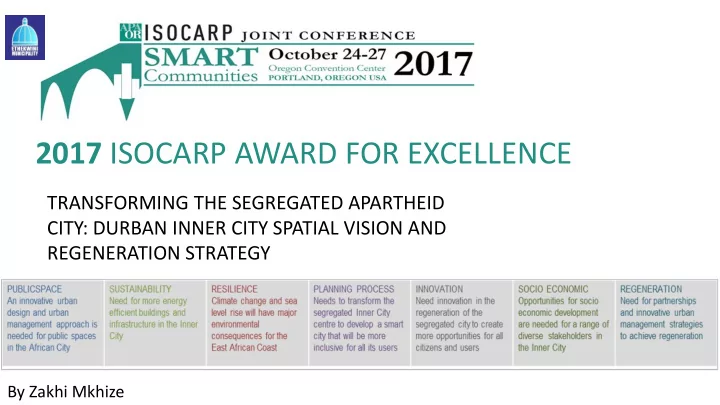
2017 ISOCARP AWARD FOR EXCELLENCE TRANSFORMING THE SEGREGATED APARTHEID CITY: DURBAN INNER CITY SPATIAL VISION AND REGENERATION STRATEGY By Zakhi Mkhize CONTENT AND CONTEXT OF THE PROJECT 1. Background information of the Durban inner city
1. Background information of the Durban inner city 2. Inner City Spatial vision and Spatial principles 3. Inner City Land Use strategy 4. Inclusive Regeneration strategy 5. CBD demonstration Project ( Art precinct)
3
The Durban Inner City, is within the eThekwini Metropolitan area in Kwazulu Natal - South Africa
citizens- ocean; river estuary and working harbour
approximately 17km2 and accommodates +- 70,000 people -2% of the eThekwini Metropolitan population)
land –potential for mixed use including higher residential densities
in sustaining the livelihoods of vulnerable groups and providing an entry point into emerging small businesses
vegetation, local parks and verges, the estuaries, and various sports clubs
SOUTH AFRICAN CITIES ARE EMBRACING THE URBANIZATION DYNAMICS OF SUB-SAHARA AFRICA AND ARE TRANSFORMING APARTHEID SEGREGATED SPATIAL FORMS
Spatial Principle 2 A Walkable City a core of higher density commercial, residential and social facilities within a 5- minute walking distance Spatial Principle 1 A Connected City provide a variety of movement routes and integrated connections to meet local, regional and international expectations Spatial Principle 3 Land Use Intensity an Integrated and inclusive city to create a mix of land uses and activities and a more inclusive public realm Spatial Principle 4 Unleash the Potential approximately 200 hectares of new developable land for mixed use and housing
2
by 2040 the Inner City of Durban will be Africa’s leading, most vi vibr brant, ant, li livea eable ble, , walk alkab able le Cit City y Centre Centre pr provi vidi ding ng ec econ
, re resid sidenti ential, al, sporti sporting ng and and lei leisu sure re opportun
itie ies s fo for a r all ll
Integrated Inner City LAP and Regeneration Plan 5
and income groups
dysfunctional practices
affordability
A well-functioning Mixed use property market that provide a range of accommodation and commercial options for people across the socio-economic spectrum, delivered by a wide range
from the public, private, and not–for–profit sectors
The Centrum Precinct - Implementation of a multi modal public transport node; transit
The Spatial Vision and the Regeneration Strategy provide implementation programmes of various priority projects within the eight precincts that will jump start the transformation of the Inner City into a Smart City
Regeneration Strategy – coordinated public realm activation through pop-up activities and public art in all the precincts to jump start the regeneration of the Arts Precinct
The Centrum and Arts Precincts
4
and derelict buildings
advertising bylaw, informal trade bylaw etc
and management ( safe, Waste Management and activation)
NGO’s key actions such as Waste Management: reduce, reuse, and recycle
efficiency of service, (smart tech, surveillance and communication)
*Transport Edges & Zones of Action
needs to be addressed together – Rationalized & Redesigned.
street furniture, street lighting.
maintenance plan.
within the design.
create a sense of identity and theme.
civic space
public realm.
cars and people
Strategy (2016)
REFERENCES