2016 Summer Law Conference School Law: A Year in Review Part II - - PDF document

2016 summer law conference school law a year in review
SMART_READER_LITE
LIVE PREVIEW

2016 Summer Law Conference School Law: A Year in Review Part II - - PDF document

The N EW Y ORK S TATE S CHOOL B OARDS A SSOCIATION presents 2016 Summer Law Conference School Law: A Year in Review Part II First Amendment and Social Media Pubic employees dont surrender all of their 1 st Amendment rights merely


slide-1
SLIDE 1

1

The NEW YORK STATE

SCHOOL BOARDS ASSOCIATION

presents

2016 Summer Law Conference School Law: A Year in Review Part II First Amendment and Social Media

  • Pubic employees don’t surrender all of their 1st

Amendment rights merely because of their employment status.

  • When citizens enter public service, they by

necessity must accept certain limitations on their freedoms.

  • Is the employee speaking as a citizen (not as an

employee) and does the speech involve a matter

  • f public concern? If yes, courts with balance

interests.

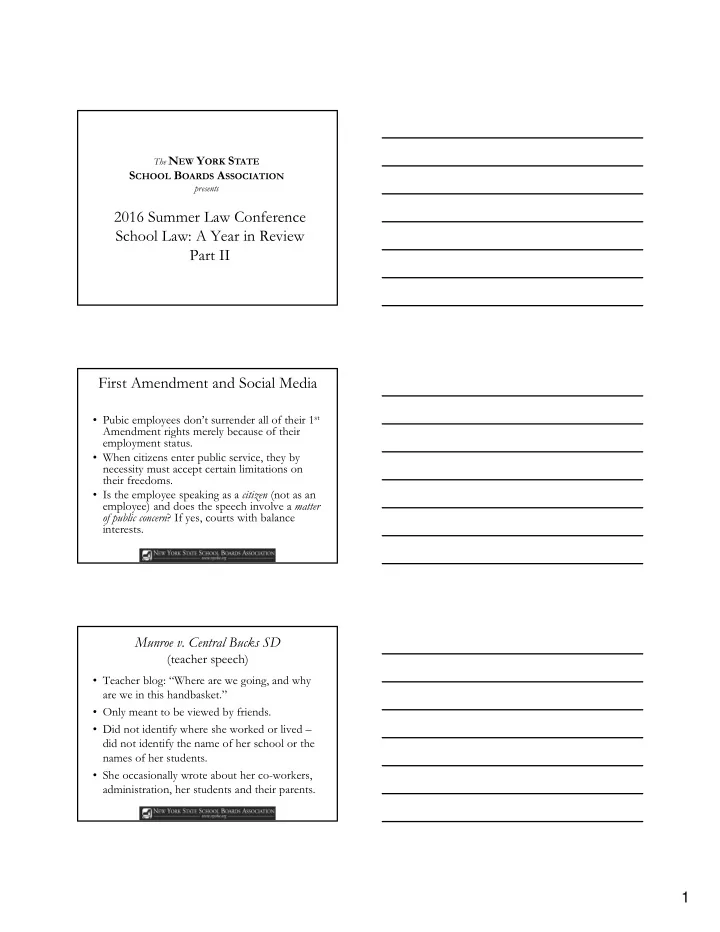
Munroe v. Central Bucks SD

(teacher speech)

  • Teacher blog: “Where are we going, and why

are we in this handbasket.”

  • Only meant to be viewed by friends.
  • Did not identify where she worked or lived –

did not identify the name of her school or the names of her students.

  • She occasionally wrote about her co-workers,

administration, her students and their parents.

slide-2
SLIDE 2

2

Offered comments she would like to see added to the comment list used for fill out students’ report cards.

  • Two words come to mind: brown AND nose.
  • Dunderhead.
  • Nowhere near as good as her sibling. Are you sure

they’re related?

  • Rat-like.
  • Sneaking, complaining, jerkoff.
  • Utterly loathsome in all imaginable ways
  • There is no way to say this: I hate your kid.
  • Teacher placed on paid suspension.
  • “Fevered reactions” of students and their

parents.

  • The district received over 200 “opt out”

requests from parents.

  • Story picked up by internet news site and

teacher appears on ABC, CBS, NBC, CNN, Fox News and other stations.

  • Ultimately terminated by district.
  • Lower court: district did not violate her

constitutional right to free expression.

  • Third Circuit: reluctantly assumed that her

speech satisfied the “public concern”

  • requirement. BUT speech not

constitutionally protected because balancing test weighed in favor of district.

slide-3
SLIDE 3

3

Bell v. Itawamba

(off-campus student speech)

  • Tinker: Students do not “shed their

constitutional rights to freedom of speech or expression at the schoolhouse gate.”

  • Students do not forfeit their First Amendment

rights to freedom of speech and expression. Conduct which materially disrupts classwork or involves substantial disorder or invasion of the rights of others is not protected.

  • Student posted rap recording on his public

Facebook profile page and later on You

  • Tube. Alleges misconduct against female

students by coaches.

  • Contained at least four instances of

threatening, harassing, and intimidating language against the coaches.

  • Suit claimed that he was disciplined in

violation of the First Amendment.

  • Issue: How, if at all, does Tinker apply to
  • ff-campus conduct?
slide-4
SLIDE 4

4

  • Court: Tinker applicable when a student

intentionally directs at the school community speech reasonably understood by school officials to threaten, harass, and intimidate a teacher – even when the speech was disseminated off-campus without use of school resources.

CPS (on-campus interviews)

  • Social Services Law Section 425 – Basis for

school districts to allow CPS workers to interview students on school grounds?

  • 1979 SED guidance memorandum –

school should adopt policies allowing the interviews on school grounds.

Phillips v. County of Orange

  • Involved a multidisciplinary team that was

permitted to interview a five year old child at school.

  • Multidisciplinary team consisted of CPS

caseworker and police officer.

slide-5
SLIDE 5

5

  • MDT interviews child.
  • Superintendent allows the interview.
  • School district had a practice that

permitted CPS interview on-campus.

  • Family sued various entities including the

school district for violations of the Fourth Amendment.

  • Did the interview at school by the MDT

violate the student’s 4th Amendment rights?

  • Court concludes that their was a seizure for 4th

amendment purposes.

  • Court also concludes that there was no

“probable cause” for the seizure.

  • Court denies the district’s summary judgment

motion.

Emergency Regulation

  • 18 NYCRR 432.3(i): Access includes

conducting an interview of child without a court order or the consent of the parent or guardian when CPS encounters circumstances that warrant interviewing the child apart from the family or the home.

slide-6
SLIDE 6

6

Special Education

  • T.K. v. NYC Dep’t of Educ.: Student became the

target of bullying by classmates. The bullying allegedly affected her academic and non- academic development.

  • Family’s attempts to raise the issue of bullying

with the school were consistently rebuffed.

  • School refused to discuss the bullying issue

during the development of the IEP. Student parentally placed in a private school.

  • Issue: Whether the district denied the

student a FAPE by refusing to discuss bullying with the parents during the IEP development process?

  • Answer: Yes, district denied a FAPE by

refusing to discuss an issue that may substantially interfere with a child’s learning opportunities.

  • Requirements resulting from T.K.:

1.Where there is a legitimate concern that bullying will severely restrict a disabled student’s educational

  • pportunities – must consider evidence of bullying in

developing an IEP. 2.Where there is a substantial probability that bullying will severely restrict a disabled student's educational

  • pportunities - an anti-bullying program is required to

be included in the IEP. 3.If the school addresses bullying in an IEP, it may not do so in abstract terms.

slide-7
SLIDE 7

7

Policy Memorandum 122r3

  • Plainview-Old Bethpage Congress of Teachers v. NYS

Health Ins. Plan (2016 WL 3190160): Civil Service Policy Memo 122r3 - put limitations on district health insurance buyout programs.

  • Proceedings filed that challenged memo 122r3.
  • Cases dismissed by the Third Department as

time-barred.

  • Third Department: concludes that policy

memorandum 122r3 constitutes a “rule or regulation” within the meaning of the law.

  • “As such, it is invalid and without effect until it

is filed with the Department of State.”

  • Statute of limitations never began to run on

claims.

  • New legislation?

Immunization (religious exemption)

  • Appeal of N.C. (Dec No. 16,805): had a “change
  • f heart and mind on the subject” after

speaking to a friend who told her that vaccination “goes against the Christian faith.”

  • Final straw: “a number of vaccines contain

cells from aborted fetuses” and “abortion is … considered a mortal sin and is[an] abhorrent act to any Christian.”

slide-8
SLIDE 8

8

  • District denied her request - submissions were

inadequate and failed to substantiate a genuine and sincere religious belief which is contrary to immunization.

  • She provided a link to the CDC website which

provides a list of ingredients in vaccinations, including MMR#2 –indicating that the vaccine uses human cell cultures that were isolated from an aborted fetus.

  • Religious exemption granted.

District Elections

  • Appeal of Williams (Dec. No. 16,900):

Petitioner (585 votes) challenged incumbent board member (599 votes).

  • Several irregularities were alleged including

the claim that district resources were improperly used to promote 2 candidates.

  • Claimed that the Teachers Association used the

district’s email system to encourage district employees to vote for two candidates, to volunteer with flyer distribution and to vote in favor of the budget.

  • District submitted affidavits from the

superintendent and two candidates stating that they were unaware of the Association’s use of the district’s email system prior to May 19, 2015.

slide-9
SLIDE 9

9

  • While a BOE may disseminate information

“reasonably necessary” to educate and inform voters, it cannot “exhort the electorate” to cast their ballots for a particular position.

  • Even indirect support, such as giving a PTA

access to its established channels of communication to espouse a partisan position has been deemed improper.

  • Commissioner dismissed the appeal.
  • No evidence that the board knew about or

sanctioned the email.

  • Admonished the board “to review its

policies on elections and the use of the district’s resources to ensure that adequate safeguards are in place to prevent improper partisan political activity.”

Opt-Out Decisions

  • Appeal of a Student with a Disability (Dec. No.

16,835): District’s view was that it was legally required to administer state assessments. Did not provide alternate locations for students who refused to complete their tests, did not permit students to bring reading material. Parents challenged the district’s practice of making the opt out students “sit and stare” during the tests.

slide-10
SLIDE 10

10

  • Regulations specifically require school districts

to annually administer certain state assessments in certain grades.

  • There exists no authority for parents to opt

their children out of participation in required state assessments.

  • Districts have discretion, but are not required,

to permit students to read silently if they finish the test before the time expires.

3020-a (unemployment)

  • Parke R. Brown v. Erie 2 BOCES: BOCES

initiated disciplinary charges. Hearing

  • fficer found the employee guilty of a

number of charges and directed a period of suspension without pay.

  • The employee applied for and received

unemployment benefits for the suspension period.

  • Court concluded that the employee was

“totally unemployed.”

  • Court, however concluded that the facts

“leave no question that claimant committed disqualifying misconduct.”

  • Fact-sensitive – not every suspension or

termination will result in disqualifying misconduct.

slide-11
SLIDE 11

11

DASA (no private right of action)

  • Motta Jr., et al., v. Eldred CSD, Third Dep’t,

#522416 (7/7/16):

  • Plaintiff subjected to bullying.
  • Plaintiff’s commenced action alleging, in part, a

violation of DASA.

  • Third Department: “There is no explicit

private right of action in the statutory scheme nor can one be implied from the statutory language and the legislative history.”

Negligence (assumption of risk)

  • Duffy v. Long Beach City S.D.: Before

practice started, 15 year old member of the JV football team and other team members began taking turns using the blocking sled to catapult each other into the air.

  • Unsupervised. Sustained injuries.
  • Commenced action based on negligent

supervision.

  • Court denied the school district’s motion

to dismiss.

  • Court rejected the district’s argument that

the district relinquished custody and control of the plaintiff.

  • The court also rejected the district’s

argument that the case was barred by the doctrine of assumption of the risk.

slide-12
SLIDE 12

12

Negligence (notice)

  • Emmanuel B. v. The City of New York: 2nd grade

student alleged injuries after an altercation with

  • classmate. Plaintiff had informed his teacher

that the classmate was picking on him and calling him names. Plaintiff testified that “other boys” in his class had been teasing him during the school year. Plaintiff’s mother complained to the principal that several boys had been bullying her son, but she did not identify the

  • ffenders by name.
  • Court dismissed the case - no evidence that the

school had notice that the classmate had a proclivity to engage in physically aggressive conduct.

  • Knowledge of taunting does not support a

finding of actual or constructive notice of the risk that classmate would engage in violent or physically aggressive behavior against plaintiff.

Challenge To Tax Cap

  • NYSUT v. State of New York: Third

Department upheld the dismissal of a challenge by NYSUT to New York’s property tax cap.

  • Court: no showing that the tax cap law

impairs financing of local educational programs sufficiently to prevent them from meeting the state’s minimum standard.

slide-13
SLIDE 13

13

  • Court rejected equal protection argument:

there is nothing irrational in the purpose behind the tax cap law - the law doesn’t prevent a tax increase over the cap if there is sufficient support for the increase.

  • Court also rejected the fundamental right to

vote argument because there was no allegation that the supermajority requirement discriminated against any identifiable class.

ADA (associational discrimination)

  • Graziadio v. Culinary Institute of America: Elements
  • f “associational discrimination”: (1) employee

qualified for the job at the time of an adverse employment action; (2) employee subjected to adverse employment action; (3) employee was known at the time to have a relative or associate with a disability; and (4) that the adverse employment action occurred under circumstances raising a reasonable inference that the disability of the relative was a determining factor in the employer’s decision.

  • 1. “expense” – employee suffers adverse

action because of his association with a disabled person covered by the employer’s insurance, which the employer believes will be costly; 2. “disability by association” – employer fears that the employee may contract

  • r is genetically predisposed to develop the

disability of the person with whom his is associated; 3. “distraction” – employer fears that the employee will be inattentive at work due to the disability of the disabled person.

slide-14
SLIDE 14

14

Discrimination (adverse employment action)

  • Tolbert v. Smith: Plaintiff, an African-

American, non-tenured culinary arts teacher bought discrimination suit.

  • Principal allegedly made racially insensitive

statements.

  • Denied tenure, but offered a fourth year of

probation.

  • Court: Denying the plaintiff tenure and

extending his probation was an adverse employment action - denial of a material improvement in the conditions of his employment.

  • Discrimination case allowed to proceed.

Universal Pre-K

Lawrence Teachers’ Association v. PERB: Whether the district committed an improper practice when it unilaterally transferred certain prekindergarten instructional services from the teachers to St. Joseph College. Issue: Improper practice of transferring unit work to non-unit personnel?

slide-15
SLIDE 15

15

  • Section 3602-e: “Notwithstanding any other

provision of law, the school districts shall be authorized to enter any contractual or other arrangements necessary to implement the district’s pre-k plan.”

  • PERB: the broad and explicit language of

3602-e demonstrates a clear intent to grant districts the right to contract with eligible agencies for any necessary pre-k services – notwithstanding the Taylor law

  • Supreme Court (Alb. Cty.): vacated and

annulled PERB’s decision.

  • “… the Court finds that Education Law

3602-e does not defeat the District’s bargaining obligation with the Association under the Taylor Law, and thus, PERB’s determination was affected by an error of law.”