
SLIDE 1
2016
annual report
2016 People Governing Board 10 Scientific Advisory Board 11 - - PDF document
annual report 2016 People Governing Board 10 Scientific Advisory Board 11 Introduction 12 27 Group Listings Letter from the Director 4 5 28 29 Other Staff CQT at a glance 6 7 30 31 Alumni 32 33 Introducing our
annual report
On the cover
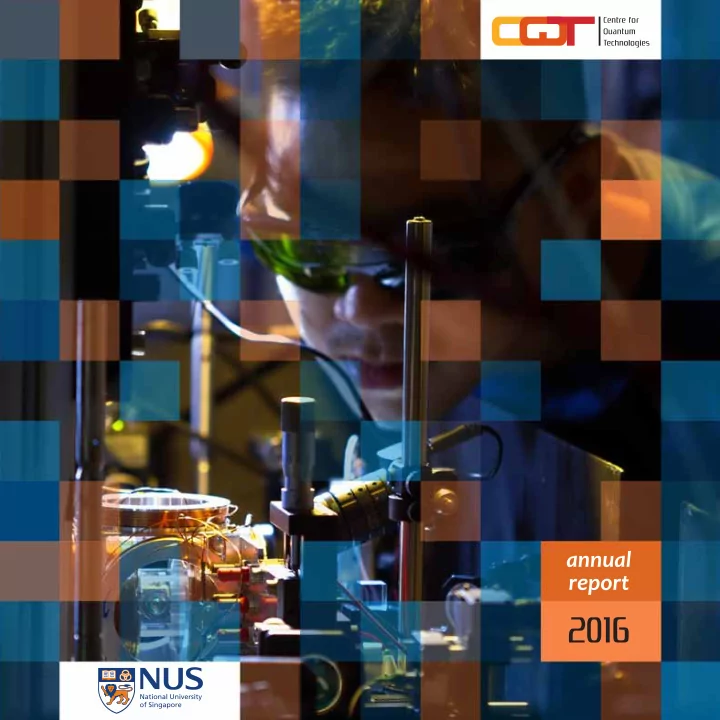
On the front, CQT student Nguyen Chi Huan peers into an apparatus that can isolate and trap a single atom between two mirrors. The goal is to make single photons interact with the atom. Such atom-photon interfaces could be a building block for quantum computers, with the trapped atoms doing logic on information-carrying photons. The back photo shows a CQT lab in perspective.
Letter from the Director CQT at a glance Governing Board Scientific Advisory Board Group Listings Other Staff Alumni Introducing our new Chairman News in brief Science updates From research to the real world Future-ready cybersecurity for Singtel A quantum random number generator Earn a PhD at CQT What comes next? Papers Events Outreach Visitors Money Matters Supporters 4–5 6–7 10 11 12–27 28–29 30–31 32–33 36–39 40–43 64–65 66–67 67 46–49 50–53 54–56 57–59 60–61 70–71 72–73 76–81 82–83 84–85 86–87 88–89 90 People News Industry collaboration Projects in focus Education Listings Introduction Are quantum machines better than classical ones? When QCMC came to town Security in the age of quantum computing What do the data tell us? University arts festival takes quantum flavour
4 5
Centre for Quantum Technologies Annual Report 2016
The annual report introductions I have been writing for the last nine years follow a well- established pattern. I write a few opening sentences, bits and pieces about the research I found exciting, something about
an occasional joke, and a word or two about the future. There are many accomplishments I could write about this year too; however, allow me to deviate from my usual pattern. As we approach our tenth anniversary, I would like to offer a few, more personal, remarks on how CQT happened. I can refer you to the rest of this report for details of our new results, projects and people, while I turn the clock
recalled for the book 50 Years of Science in Singapore (World Scientific, 2017). 2016 felt like the end of an era when Lam Chuan Leong, a distinguished civil servant before his retirement, stepped down as Chair of our Governing Board. His help was
technologies required strategic decisions. He was always available to discuss them with me and nudge me in the right direction. There is no narrative, simple or embellished, that can capture the pioneering spirit of the days when Singapore took the first step towards becoming a quantum island. It happened in a truly quantum fashion, in more than one way. One narrative leads us to the corridors of
the time Deputy Prime Minister and Minister for Defence, took a personal interest in the Millennium Conference on Frontiers in Science, at which I gave an overview
meeting with Tony Tan and a long over-dinner conversation left me confused. I was not used to politicians talking in an intelligent and persuasive way about big problems that science can address. Another narrative takes us to the hawker stalls and Indian eateries that I frequented with Kwek Leong Chuan and Kuldip Singh, talking mostly about quantum physics. Their enthusiasm for this emerging field was
together faculty members, including Lai Choy Heng, Oh Choo Hiap and Tan Eng Chye, who despite heavy admin duties, found time to discuss science. Then I can tell a story about Chan Chui Theng, a brave woman who decided to risk her job security to offer temporary administrative support (now in its tenth year) to a wacky ang moh talking quantum mumbo-jumbo, and also about her assistant, Evon Tan, who from day
anyone asked for them). Yet another narrative must include a wonderful duo from the Ministry of Education, Benny Lee and Perry Lim, who spent days drafting policies for our new centre. I shall not tell you any anecdotes about them, for they are very serious people today, but they stayed in touch, showing a genuine interest in our work. The two of them redefined for me the meaning of civil service. Or perhaps I can tell you a story about an
Kurtsiefer explained the magic of quantum interference to a Singaporean boy. The glow
made a big impact on me. At this moment, I understood that no matter how many ground- breaking papers, patents and quantum contraptions we produce, there would be another legacy. We can shape how the next generation sees and understands the world, how they solve problems and how they will make good use of quantum technologies. I can tell many more stories, big and small, funny and sentimental, but none of them give a truly comprehensive answer to the question
am so glad that it happened, for I truly believe we were given an opportunity to create something exceptional. It is heartening to have the incoming Chair
Defence Scientist Quek Gim Pew, describe CQT as "a jewel in Singapore's R&D landscape" (see pp. 32–33). We welcome his help as we do our best to keep CQT sparkling.
Principal Investigators Research Assistants/ Associates Postdocs Postgraduate students Admin, IT & Research Support
19 15 40 27 53
Asia Singapore Europe Oceania Others USA UK
40% 22% 24% 2% 3% 4% 5%
Stafg nationalities Budget overview Publications
Equipments Manpower Other Operating Expenditure
1,169,352 7,132,726 4,558,050
Core External
64% 36%
IF > 10 N/A 5 < IF < 10 2 < IF < 5 0 < IF < 2
13 9 37 109 31
Publications during 2016 by journal impact factor (IF).
7
Annual Report 2016
6
Centre for Quantum Technologies
The Centre for Quantum Technologies is a national Research Centre of Excellence in Singapore. It brings together quantum physicists and computer scientists to conduct interdisciplinary research into the foundations of quantum theory and the ways quantum physics enables new technologies. The Centre was established in December 2007 with support from Singapore’s National Research Foundation and Ministry of Education. CQT is hosted by the National University of Singapore (NUS). The Centre also has stafg at Nanyang Technological University (NTU) and Singapore University of Technology and Design (SUTD).
Stafg numbers
CQT scientists are pushing the frontiers of human knowledge and the future of technology. This massive experiment controls tiny quantum systems, positioning ultracold atoms close to the surface of superconducting circuits measuring less than one millimeter
CQT's Rainer Dumke is to transfer information between the atoms and circuits. Nationalities of all research stafg, admin stafg and students employed in 2016. Count of CQT–NUS stafg as of 31 December 2016. In addition, the Centre has 18 visiting stafg. Spending over the 2016 calendar year. See pp. 88–89 for details.
Meet the people behind the Centre's achievements
Quek Gim Pew (Chairman)
Serguei Beloussov
Capital
Parallels
Quantum Center
Nicholas Bigelow
University of Rochester
Chang Yew Kong
(Information and Communications Technology), Singapore Institute of Technology
Ignacio Cirac
Planck Institute of Quantum Optics
Atac Imamoglu
Group, Institute of Quantum Electronics, ETH Zurich
Gerard Milburn
Systems, University of Queensland
Michele Mosca
for Quantum Computing, University of Waterloo
Christophe Salomon
Brossel, CNRS
Artur Ekert
National University of Singapore
University of Oxford
Ho Teck Hua
Deputy President (Research and Technology), National University of Singapore
Benjamin Koh
Division and Divisional Director, Higher Education Operations Division, Ministry of Education, Singapore
Alternate: Mr Vincent Wu
Policy, Ministry of Education, Singapore
Umesh Vazirani
Center (BQIC), Computer Science Division, College of Engineering, UC Berkeley
Jun Ye
and National Institute of Standards and Technology
George Loh
Research Foundation, Singapore
Lui Pao Chuen
Singapore
Tan Eng Chye
Provost, National University of Singapore
Tan Sze Wee
Research Council, A*STAR Changes to the Governing Board in 2016
Chair in November.
from MOE in September.
representative from MOE in August.
10 11
Centre for Quantum Technologies Annual Report 2016
Students
Wilson Chin Yue Sum Lee Jianwei Nguyen Chi Huan Mathias Seidler Shen Lijiong Adrian Nugraha Utama
12 13
Centre for Quantum Technologies Annual Report 2016
"One of our publications was picked up by a popular science news outlet and shared over 1000 times on
photons."
Matthias Steiner
Lee Kuan Yew Postdoctoral Fellow
Alex's group is building compact and rugged
systems for experiments including a satellite- borne test. The team is also working on nonlinear optics. Christian's group implements quantum information building blocks with photons and atoms, with expertise in entangled sources, single photon detection and atom–photon interactions.
Alexander Ling
Principal Investigator Other appointments: Assistant Professor, Department of Physics, National University of Singapore
Christian Kurtsiefer
Principal Investigator Other appointments: Professor, Department of Physics, National University of Singapore
Research stafg
Bai Xueliang Robert Bedington Brigitta Septriani Kadir Durak James Grieve Md Tanvirul Islam Tan Yue Chuan Edward Truong-Cao Yau Yong Sean
Research stafg
Alessandro Cerè Chng Mei Yuen, Brenda Leong Xu Heng Victor Nicholas Charles Lewty Lim Zheng Jie Janet Poh Hou Shun Shi Yicheng Matthias Steiner Tan Peng Kian
Students
Rakhitha Bandara Chandrasekara Aswin Alexander Eapen Tang Zhongkan Kamiyuki Tang Zong Sheng Aitor Villar Zafra
Experimental Physics
Visiting Stafg
Antia Lamas Linares Names shown black are stafg as of 31 December 2016 Names shown grey are stafg who left or move into new roles during 2016
14 15
Centre for Quantum Technologies Annual Report 2016
Dzmitry's group develops methods to prepare, manipulate and detect the internal states of trapped molecular ions for spectroscopy, precision measurements and information processing.
Dzmitry Matsukevich
Principal Investigator Other appointments: Assistant Professor, Department of Physics, National University of Singapore
Research stafg
Gleb Maslennikov
Students
Ding Shiqian Gan Huat Chai Jaren Roland Hablutzel
Kai's group carries
including investigation
dipolar molecules.
Kai Dieckmann
Principal Investigator Other appointments: Associate Professor, Department of Physics, National University of Singapore
Research stafg
Chen Miaoqing Andrew Laugharn Sambit Bikas Pal Tan Senmao Yang Anbang
Students
Christian Gross Lam Mun Choong Mark Sambit Bikas Pal
"2016 was eventful for me. After a long search, we fjnally observed the fjrst signatures of a two-photon resonance in
Sambit Pal
Research Fellow
16 17
Centre for Quantum Technologies Annual Report 2016
Students
Swarup Das Tarun Dutta Noah Van Horne Debashis De Munshi
"My highlight this year, even more than getting my degree, was observing Rabi
‘feel’ for quantum mechanics."
Debashis De Munshi
CQT PhD Student
Manas' group prepares ion trap systems to emulate condensed matter and test fundamental physics. The team is also interested in ions for information processing and metrology.
Manas Mukherjee
Principal Investigator Other appointments: Assistant Professor, Department of Physics, National University of Singapore
Research stafg
Tarun Dutta Noah Van Horne Liu Peiliang
Murray's group focuses
atoms and photons via cavity QED for quantum information applications and precision metrology. The group is working on a new design of optical atomic clock.
Murray Barrett
Principal Investigator Other appointments: Associate Professor, Department of Physics, National University of Singapore
Research stafg
Kyle Arnold Ravi Kumar Lee Chern Hui Eduardo Javier Paez Arpan Roy
Students
Rattakorn Kaewuam Zhang Zhiqiang
18 19
Centre for Quantum Technologies Annual Report 2016
Rainer's group is working on hybrid quantum systems, superconducting atom chips, atomtronics and a portable gravimeter.
Rainer Dumke
Principal Investigator Other appointments: Associate Professor, School
Sciences, Nanyang Technological University, Singapore
Research stafg
Paul Condylis Ew Chee Howe Gan Koon Siang Christoph Hufnagel Tin Nguyen Maria Martinez Valado Yu Deshui
Students
Filip Auksztol Phyo Bawse Naveinah Chandrasekaran Gan Koon Siang Alessandro Landra Lim Chin Chean Oon Fong En Francesca Tosto
Visiting Stafg
Luigi Amico
"We have realised coherent microwave-to-optical conversion via frequency mixing in Rydberg atoms this year. We look forward to publishing the details."
Wenhui Li
Principal Investigator
Wenhui's group explores the coherent excitation and manipulation of cold Rydberg gases, aiming to investigate quantum many-body physics and quantum optics in such systems.
Wenhui Li
Principal Investigator Other appointments: Assistant Professor, Department of Physics, National University of Singapore
Research stafg
Christian Gross Thibault Thomas Vogt
Student
Han Jingshan
Visiting Stafg
Thomas Gallagher
Research stafg
Victor Manuel Bastidas Valencia
20 21
Centre for Quantum Technologies Annual Report 2016
Student
Marek Wajs
Visiting Stafg
Pawel Kurzynski
Dagomir Kaszlikowski
Principal Investigator Other appointments: Associate Professor, Department of Physics, National University of Singapore
Research stafg
Debasis Mondal Ryu Jeonghee
Dag's group studies the foundations of quantum
include the concept
boundary, contextuality and constraints on quantum correlations. Theoretical Physics
Students
Kishor Bharti See Tian Feng Jirawat Tangpanitanon
Dimitris' group works on theoretical quantum optics and implementations of quantum information. Particular interests include quantum simulations of condensed matter and exotic physics phenomena with photons and ions.
"This year my group and I established a new collaboration with experimentalists from Google. My fjrst PhD paper was also accepted in Physical Review Letters."
Jirawat Tangpanitanon
CQT PhD Student
Dimitris Angelakis
Principal Investigator Other appointments: Associate Professor, School
Engineering, Technical University of Crete, Greece
22 23
Centre for Quantum Technologies Annual Report 2016
Students
Ulrike Bornheimer Chai Jing Hao Sanjib Ghosh Gu Yanwu Alexander Hue Len Yink Loong Li Xikun Jiaan Qi Seah Yi-Lin Sim Jun Yan Ye Luyao
Research stafg
Chau Thanh Tri Ng Hui Khoon Shabnam Safaei Shang Jiangwei Martin Trappe
Berthold-Georg Englert
Principal Investigator Other appointments: Professor, Department of Physics, National University
Berge's group studies what can be known about a quantum system, for example by quantum state tomography, and the theory of cold atoms in lattices.
Kwek Leong Chuan
Principal Investigator Other appointments: Associate Professor, National Institute of Education and Deputy Director, Institute of Advanced Studies, Nanyang Technological University, Singapore
Kwek's group works on quantum information with an emphasis
including quantum processors and simulators. Research stafg
Davit Aghamalyan Andy Chia Kwong Chang Jian Nguyen Thi Phuc Tan
Visiting Stafg & Scholars
Chen Jingling Masahito Hayashi David Hutchinson Song Guozhu Sai Vinjanampathy Zhang Kejia
Students
Tobias Florian Haug Hermanni Heimonen Thi Ha Kyaw Frederic Leroux Ewan Munro Wei Nie
"During my 3.5 years as a postdoc, I benefjted from the collaborative energy at CQT. I look forward to my future visits."
Sai Vinjamapathy
Visiting Research Fellow
24 25
Centre for Quantum Technologies Annual Report 2016
Valerio's group bridges theory and experiment, with a particular focus on quantum thermodynamics and the usefulness of non-locality in device- independent processing. Research stafg
Juan Miguel Arrazola Cai Yu Cong Wan Dai Jibo Stefan Nimmrichter
Students
Goh Koon Tong Alexandre Roulet Stella Seah Angeline Shu Sze Yi Wu Xingyao
Valerio Scarani
Principal Investigator Other appointments: Professor, Department of Physics, National University of Singapore
Vlatko Vedral
Principal Investigator Other appointments: Professor, Department of Physics, National University
University of Oxford, UK
Vlatko's group investigates topics in quantum information ranging from discord, an alternative measure
to thermodynamics. His team also ventures into quantum biology. Research stafg
Michele Dall'Arno Andrew Garner Mile Gu Michal Hajdusek Jayne Thompson
Visiting Stafg
Tristan Farrow Rosario Fazio
Students
Jungjun Park Suen Whei Yeap
Research stafg
Han-Hsuan Lin Anupam Prakash Jamie Sikora Antonios Varvitsiotis Naqueeb Warsi Wei Zhaohui
26 27
Centre for Quantum Technologies Annual Report 2016
Visiting Stafg & Scholars
Itai Arad Dmitry Gavinsky Gabor Ivanyos Iordanis Kerenidis Thomas Vidick Hoeteck Wee Zhang Shengyu
This group explores the intersection of computer science and quantum theory, including quantum algorithms, communication complexity, interactive proofs & quantum games.
Rahul Jain
Principal Investigator Other appointments: Associate Professor, Department of Computer Science, National University of Singapore
Hartmut Klauck
Principal Investigator Other appointments: Assistant Professor, School
Sciences, Nanyang Technological University, Singapore
Troy Lee
Principal Investigator Other appointments: Associate Professor, School
Sciences, Nanyang Technological University, Singapore
Miklos Santha
Principal Investigator Other appointments: Senior Researcher at CNRS in the Institut de Recherche en Informatique Fondamentale at the University Paris Diderot, France
Divesh Aggarwal
Principal Investigator Other appointments: Assistant Professor, Department of Computer Science, National University of Singapore
Students
Anurag Anshu Srijita Kundu Priyanka Mukhopadhyay Supartha Podder Erick Purwanto Maharshi Ray Aarthi Sundaram Yang Siyi
Computer Science
Lai Choy Heng Deputy Director Kuldip Singh Admin Director
Research Support
Clifg Cheng Too Kee Bob Chia Lian Chorng Wang Mohammad Imran Dileej Radhakrishnan Nair Ren Yaping Teo Kok Seng Akimov Volodymr
28 29
Centre for Quantum Technologies Annual Report 2016
Benoît Grémaud
CQT Fellow Other appointments: Researcher at CNRS and Visiting Associate Professor, Department of Physics, National University of Singapore
Choo Hiap Oh
CQT Fellow Other appointments: Emeritus Professor, Department of Physics, National University of Singapore
Research stafg
Georges Batrouni Kho Zhe Wei Christian Miniatura Stephanie Wehner was a Principal Investigator at CQT who completed her move to TU Delft this year. Her group at CQT has now closed, with research stafg Le Phuc Thinh, Shalima Binta Manir and Nelly Ng Huei Ying and students Jedrzej Kaniewski and Corsin Pfjster also leaving CQT in 2016.
Exploratory Initiatives
Joseph Fitzsimons Martin Kifgner Loh Huanqian Robert Pisarczyk Mohamed Riadh Rebhi David Wilkowski
Administrative Stafg
Chan Chui Theng Chin Pei Pei Giam Lay Enn, Kelly Jessie Ho Jenny Hogan Valerie Hoon Lim Siew Hoon Lim Mei Yin, Valerie Lim Mui Lian, Amell Lim Ah Bee Lim Fang Eng Jacky Norima Binte Mohamat Sarnon Resmi Poovathumkal Raju Evon Tan Tan Ai Leng Irene Tan Lay Hua Yvonne Toh Yeo Kwan San Timothy
Visiting Stafg
John Baez Dieter Jaksch Jose Ignacio Latorre Yu Sixia
Visiting Scholars
Wang Fei Wang Xinwen
31
Annual Report 2016
30
Centre for Quantum Technologies
In the academic world, students and postdocs typically move between between institutes and even countries at the end of their terms. They acquire expertise and experience from different groups, bringing to each new position a richer skillset. CQT is staying in touch with the staff and students that have been members of our community. We hope that current and former CQTians will continue to support each other in their research and careers. We’re delighted when alumni come back – sometimes just for visits, other times to take new jobs. We surveyed CQT alumni about where they are and what they’re doing. This page shares inputs from some 111 former CQTians. Where in the world are they? What kinds of work are they doing?
Academic Others Science-related industry
75% 16% 9%
In academia – Locally, CQT alumni are Assistant Professors at the Nanyang Technological University (NTU) and Singapore University of Technology and Design (SUTD), others have lecturing and research positions at NTU and NUS, and some are employed at A*STAR insti-
Max Planck Institutes, the University of Copenhagen, Delft University of Technology, the Universitat Autonoma de Barcelona, the University of Oxford, Seoul National University, the University of Technology Sydney, Monash University, the University of Maryland and the University of Texas at Austin. In industry – In Singapore, CQT alumni are working at companies including Singtel, Apple Inc and World Scientific Publishing. Overseas they are in companies including Google, Becker Photonik, Siemens and running their own start-ups.
CQT will be holding a two-day conference 7–8 December 2017 to mark the Centre’s tenth anniversary. We invite all alumni to join us for this event. Watch for invitations by email and event details on quantumlah.org.
As an NUS physics undergrad, Tan Ting Rei did a final-year project at CQT in Murray Barrett's group, staying on as a Research Assistant. In 2010 he left to pursue a PhD at the University of Colorado, Boulder, working with Nobel Laureate David Wineland at NIST. One of Ting Rei’s results with trapped ions was named a top ten breakthrough of 2016 by the UK’s Institute of Physics. His team created entanglement between two different ion species (Nature 528, 380 (2015)). Such a 'mixed-species' gate could be a building block for quantum computers. He will join Murray's group again in 2017 as a Research Fellow.
32 33
Centre for Quantum Technologies Annual Report 2016
CQT welcomes Singapore’s Chief Defence Scientist, Mr Quek Gim Pew, as the new chair of the Centre’s Governing Board. In this Q&A, he introduces himself and his vision
Tell us about your work in defence I've been in defence ever since I started work in ’81. My background is electrical
engineer, doing signal processing, then going
was CEO of DSO National Laboratories for 12
lab of the Ministry of Defence (MINDEF) where we undertake R&D to try to solve problems that the Singapore Armed Forces (SAF) faces. DSO was started in the 70s, when the SAF was still in its infancy. Our pioneer generation had foresight. It’s amazing what you can do if you focus your resources and it’s sustained for a long time – the compound investment means a lot. It’s the same as in CQT. How did you come to be appointed as the CQT Chairman? Well, it so happened that from when I was in DSO, I was always very interested in working with academics to multiply our resources and in how future advances in science and technology will change the way the SAF
the National Research Foundation (NRF) and at A*STAR. CQT obviously stands out.
After I came over to MINDEF, I mentioned to NRF and to the Permanent Secretary that CQT has done so well, the time is right that we can tap it, that we create industry out of what CQT has done. I suppose it’s because of that I got the job – it’s me and my big mouth. I see this as a tremendous responsibility. CQT has done wonderfully well. It's a challenge to ensure that I move it to the next level. What vision do you have for the future, or plans for change? It's too early for me to say what we should do to change. In a short span of years, I think CQT has made phenomenal progress. I think CQT stands out really as a jewel in Singapore’s R&D landscape. So, my role, and in fact the role of the governing board, I think is quite straightforward: it is really to see how we can facilitate and support CQT to grow and develop. Also, as a very personal agenda, I would like to see whether CQT can be an inspiration to future generations of Singaporeans to come to research. Based on what I have been doing in MINDEF, I think for anything to grow and to succeed, we need three key ingredients. We need the environment that brings the people, the leadership to organise the resources that are available and the committed and supportive stakeholders that will provide long-term
elements in all three and this puts CQT in a healthy condition. I hope that CQT will continue to distinguish itself as a centre that advances our fundamental understanding of quantum physics while at the same time being a centre that harnesses quantum technology to improve the quality of life. Today we are seeing companies offering quantum-based products. We're seeing venture capitalists targeting companies
those big players with very deep pockets aggressively pursuing quantum computing. So I'm hopeful that in 10 to 20 years we will see the next wave of quantum-based products embedded in everyday life, and I think Singapore is well positioned to play a role in this – and this is because we have CQT. Have you been following quantum tech for a long time? I have always been very interested in
at undergrad is because at that time in Singapore, if you do physics you can only be a teacher. I was not particularly keen to be a teacher so the closest to physics was engineering, and the closest in engineering to physics was electrical engineering. But I would say the physics that we are seeing here is way beyond my understanding, so there is a lot of reading up to do. I have asked Artur for a reading list! What do you do in your leisure time? There are a few things I do other than reading
she paints and does calligraphy – so I will join her for exhibitions and events. I’m an armchair
taken up tai chi as a form of exercise, and I’m intrigued by the ideas behind it. I’m studying it when I have time.
A distinguished career in defence
Mr Quek Gim Pew was appointed Chief Defence Scientist of the Singapore Ministry of Defence (MINDEF) in July 2016. Previously, he was the Chief Executive Offjcer of DSO National Laboratories from February 2004 until June 2016. Other appointments he has held in the defence technology community include Director of R&D at the Ministry of Defence and the Deputy Chief Executive (Technology) DSTA. He also sits on various boards of organizations, institutions and directorship of companies. He graduated from the National University of Singapore with a Bachelor of Engineering (1st Class Hons) in Electrical Engineering in 1981, and a Master
from the Naval Postgraduate School, USA in 1986. He is married with three children. He was appointed Chair of CQT’s Governing Board with efgect from 13 November 2016.
"I see this as a tremendous responsibility. CQT has done wonderfully well. It's a challenge to ensure that I move it to the next level."
34 35
Centre for Quantum Technologies Annual Report 2016
Digest our year's highlights in bite-sized stories
Image credit: Michael Manomivibul
36 37
Centre for Quantum Technologies Annual Report 2016
Visiting Prof honoured twice This year CQT Visiting Research Professor Masahito Hayashi was awarded the Japan Academy Medal and announced as an IEEE Fellow. The Japanese prize gives "formal recognition to
and was presented in February at a ceremony attended by their Imperial Highnesses Prince and Princess Akishino. His IEEE Fellowship, beginning January 2017, is “for contributions to Shannon theory, information- theoretic security, and quantum information theory”. Masahito is on the faculty of Nagoya University, Japan, and spends up to half of each year in Singapore. CQT’s Director elected Fellow of the Royal Society In April, CQT's Director Artur Ekert was named a Fellow
continuous existence. Highlights
publishing Isaac Newton's Principia Mathematica and approving Charles Babbage's Difference Engine. Artur said “the Royal Society has been doing interesting and heroic things since its inception in 1660, and I am keen to contribute to its mission, which is to promote excellence in science and to encourage the development and use of science for the benefit of humanity." Alumnus back as NRF Fellow Mile Gu, formerly a CQT Research Fellow, was one of seven scientists to be awarded the prestigious National Research Foundation (NRF) Fellowship in 2016. He won the five-year fellowship for a project bringing together complexity and quantum science: "Enhancing the Efficiency of Modelling and Simulating Complex Systems via Quantum Mechanics". He joined the Complexity Institute of Nanyang Technological University as Nanyang Assistant Professor and the Centre for Quantum Technologies as Research Assistant Professor in February. CQT delivered fjrst industry workshop The commercial potential of quantum technologies makes companies keen to learn more. CQT is helping to meet this
researchers delivered a one-day workshop on practical quantum technologies to staff of ST Electronics (Info-Security) Pte Ltd, a subsidiary of Singapore Technologies Electronics Limited. ST Electronics is a provider
technologies founded in 1969 and having more than 5000 employees. Many-worlds fjction won Quantum Shorts What if checking for monsters under your bed doomed a parallel you to a grisly end? A story exploring the ethics of the many worlds interpretation won CQT’s international contest for flash fiction inspired by quantum
announced in April, included two youth entries. CQT’s Quantum Shorts competition series has alternated between calls for fiction and film since 2012. It is run with media partners Scientific American and Nature. 2016’s call for film entries was supported by scientific partners and screening partners in five countries – with results to come in 2017.
Image credit: Michael Manomivibul Image credit: dag the dogg
Dance, music and drama given quantum twist CQT was the Creative Partner
2016, “Wonder", presented by NUS Centre for the Arts. The two-week festival in March explored the intersection of science, technology and the arts over 30 performances by NUS students and professional
CQT researchers working with arts students, choreographers
and with an orchestral ensemble (read more at pp. 60–61).
38 39
Centre for Quantum Technologies Annual Report 2016
International conference drew 300 scientists Some 300 delegates came to NUS for the International Conference on Quantum Communication, Measurement and Computing (QCMC) in July. It was the 13th meeting in the biennial series. The conference featured special sessions
nonlocality and on industrial efforts in quantum computing. Industry speakers came from Google, Microsoft, D-Wave Systems and the NTT Basic Research Laboratory (see pp. 50–53). Meeting focused on quantum engineeringg Quantum researchers from France and Singapore came together for the Quantum Engineering Science and Technologies Symposium held in November at NUS. The week- long conference featured over 30 speakers across topics including nanophotonics, quantum thermodynamics, quantum simulation, quantum computing, graphene, spintronics and many-body physics. CQT helped
supported by the Institut Français Singapour, the NUS Department
international joint research unit in Singapore of the French national research organisation CNRS. 13 CQT students earned their doctorates At the NUS commencement in July, 13 students from the CQT PhD programme received their degrees (find the details at pp. 70–71). CQT also congratulated
completed his PhD with the NUS School of Computing and Tan Peng Kian who did his PhD with the NUS Department of Physics with CQT supervisors or co-
valedictorian for his cohort at the commencement ceremony. Quantum pioneer made Emeritus Professor CQT Fellow Oh Choo Hiap was appointed NUS Emeritus Professor in July after more than three decades with the University. Choo Hiap is one of the pioneers
Physics Department from 2000 to 2006, he recruited researchers who later contributed to forming
required a little bit of courage and insight to bet on this newly emerging area," said CQT Director Artur Ekert. Choo Hiap shared Singapore's National Science Award with colleagues in 2006 for quantum research and became
Principal Investigators in 2007. CQT researcher selected for Nobel meeting CQT’s Dai Jibo was one of 387
chosen to meet with Nobel prize winners and other luminaries
Nobel Laureate Meeting in Germany in July. Jibo's invitation followed a lengthy national and international selection process. Now a Research Fellow with CQT, he is a physics graduate of NUS and an alumnus of CQT’s PhD Programme. CQT partnered with Singtelab The NUS-Singtel Cyber Security Research and Development Laboratory, a $42.8 million, five-year research venture between the university and Asia’s leading communications group, launched in October. The lab will develop techniques to detect and respond to security attacks and approaches to IT systems that are 'secure by design'. The lab is under the National Research Foundation’s Corporate Laboratory@University scheme. CQT’s Alexander Ling is leading a project worth $3.5 million to develop quantum key distribution for Singtel’s fibre network (read more at pp. 66–67). Youth met quantum at Generation Q Campamp Students barely encounter quantum concepts in the syllabus, but new quantum technologies could shape their
Generation Q Camp back for a second year for students to explore the foundations and frontiers of this research field. 33 students registered from 13 local schools for the five-day workshop in June that offered lectures, activities and lab visits. The participants, mainly aged 16-19, were taught by over 20 of CQT's researchers and PhD students.
40 41
Centre for Quantum Technologies Annual Report 2016
Making light work An international team including CQT Principal Investigator Vlatko Vedral built a demon that extracts work from disorder in a photonic system (Physical Review Letters 116, 050401). The team's work brought to life Maxwell's demon, proposed in a 19th Century thought
to the second law of thermodynamics – the idea that a system will become more disordered over time, increasing in entropy as it tends to equilibrium. The demon meddles with a system in a way that appears to reduce entropy. With modern experimental techniques, researchers have been able to build Mawell's demons in a few setups. These experiments carried out by collaborators at the University of Oxford, UK, captured work in a capacitor thanks to the demon choosing how to direct incoming light pulses. Quantum satellite success CQT’s Alexander Ling and team reported data from their quantum payload in space (Physical Review Applied 5, 054022) – shortly before China launched its quantum satellite
device carrying components used in quantum communication and computation, built into an NUS nanosatellite called Galassia. Having quantum nodes in space may be a route to establishing a global quantum network. Since the satellite launched in December 2015, data sent back show it is making pairs of correlated photons as expected. The device is a first step in a roadmap calling for a series of launches
experiments will pave the road to secure quantum communication and distributed quantum computation on a global scale,” said Artur Ekert, co-inventor of quantum cryptography and CQT’s Director. Thicker may be smarter A thick crystal can work just as well as a thin one when it comes to making pairs of correlated light particles, reported Alexander Ling’s group at CQT. A common trick for making entangled photons is to use spontaneous parametric down-conversion (SPDC), which relies on the strong interaction
interaction causes some of the photons in the original beam to split in half. Often researchers use crystals that are less than a millimetre thick. The CQT team systematically tested crystals almost 16mm thick – which are cheaper and easier to handle – to find parameters that give a bright and efficient source (Optica 3, 347). The used beta barium borate and a blue laser with wavelength 405nm. Atoms emit superfmashes "I remember that it was by mistake. We had a detector in front of the laser. We turned
Professor David Wilkowski, CQT Visiting Research Associate Professor at Singapore's Nanyang Technological University. His team have since worked out how to harness the ‘superflash’ phenomenon they saw in their cold atoms experiment to make a sequence of
223601 (2014) and 115, 223601 (2015)). A setup involving a cloud of some 100 million Strontium atoms generated high-intensity pulses at a rate of 400kHz with high efficiency. The discovery could lead to new technology for telecoms and other applications. The researchers have submitted a patent application on the approach. Non- Markovian Mirrors Look into a mirror and you take for granted that the image you're seeing is reflected straight back at you. But when mirrors are quantum, you can't assume a reflection is
researchers led by Valerio Scarani in studying the behaviour of quantum objects (Physical Review A 93, 023808). More technically, they found the ‘Markovian assumption’ doesn’t hold. Calculations done without this assumption showed that quantum mirrors can be used to do experiments in cavity quantum electrodynamics (CQED). In such experiments, an atom trapped between the mirrors shows an enhanced interaction with light. The team will explore ideas for experimenting with mirrors in superposition or entangled states. Discord at play in quantum illumination Quantum illumination is a technique that uses entangled photons to improve the signal-to-noise ratio when imaging a faint
be entanglement but also discord that helps, CQT’s Vlatko Vedral and colleagues have shown (New Journal of Physics 18, 043027). Discord is a measure of more general
gentle treatment, discordant correlations are noise-resilient. This could explain why quantum illumination works even when the ambient light is bright enough to destroy all entanglement. The team calculated that the amount of discord that survives the illumination process is exactly related to the performance advantage of quantum illumination. Record correlations CQT theorists contributed to showing that a cloud of ultracold Rubidium atoms exhibits Bell correlations – the ‘non-local’ links that can exist only in the quantum world. CQT’s Jean- Daniel Bancal and Valerio Scarani worked with experimentalists at the University of Basel in Switzerland to make the observation. The result smashes a size record. The team used a new approach to detect the correlations in clouds of some 480 atoms trapped above a microchip (Science 352, 441). Previously the biggest system in which such correlations had been measured was 14 ions. Zip to the boundary "We found a new way to see a difference between the quantum universe and a classical one," says CQT's Dagomir
researchers from CQT and collaborators at the Jagiellonian University and Adam Mickiewicz University in Poland to show that a zip program, applied to experimental data, can detect evidence of entanglement between two particles (New Journal of Physics 18, 035011). It does so without an assumption made in other tests of entanglement.
< < <
42 43
Centre for Quantum Technologies Annual Report 2016
A simple trap Quantum experiments can be very complicated, meaning scientists are always
members found one such trick, describing a way to achieve with one optical trap what would usually take two or more. The team showed that a ‘crossed optical dipole trap’ can not only contain a cloud of atoms but also transport it. The trap, made by crossing two laser beams, holds cold atoms in the bright spot where the lasers intersect. The researchers loaded 8 million lithium-6 atoms into the trap, moved them 25cm in less than a second, and cooled them into a condensate (Physical Review A 93, 053424). Error-free transition measurements Physicists are interested in measuring Barium atoms because calculations suggest Barium will show atomic parity violation, an asymmetry that may point to physics beyond the Standard
showing up in larger than expected quantities in some kinds of stars. Manas Mukherjee and his group members measured the transition probabilities of Barium’s decay from an excited state into different channels (Science Reports 6, 29772) with record precision. The achievement rests on their invention of a novel technique to eliminate systematic errors due to magnetic fields. The technique should work for
Games at the quantum boundary The mathematics of quantum physics describes what particles can do, but what principles guide it? Researchers think that studying the quantum boundary, the limits of quantum behaviour, may lead to answers. In work published in 2016 (Physical Review A 94, 022116), CQT researchers collaborated with colleagues from University of Science and Technology of China (pictured) to extend a result that characterised a point on the quantum boundary. Other researchers had earlier identified that point by making a connection between the quantum phenomena
thought some counterexamples had killed
says CQT’s Valerio Scarani. They found new sets of boundary points that follow the same pattern. Super-resolution imaging A novel imaging technique that beats Rayleigh’s criterion was verified in the labs of Alexander Ling’s group. The team carried out proof-of-principle experiments to test ideas from their NUS colleague Mankei Tsang and his coauthors. For over 100 years, people accepted Rayleigh’s criterion as setting a minimum angular resolution for optical imaging. Mankei’s team, inspired by studying quantum information, proposed ways to get round this limit to measure the separation of two close light sources. Alexander’s group first learned about the team’s work when Mankei gave a seminar at CQT in November 2015. "This is our fastest ever paper from concept to result," says Alexander (Optics Express 24, 22004). The paper’s first author is CQT PhD student Tang Zhong Sheng (pictured). Topological transport CQT's Dimitris Angelakis and his collaborators proposed a scheme to move groups of interacting quantum particles. The idea is an example of Thouless pumping, invented by 2016 Physics Nobelist David J.
the quantum particles similar to the way that an Archimedes' screw pump moves water up a hill (Physical Review Letters 117, 213603). One co-author is at Google building superconducting circuits for quantum computing – and the team hopes to see the idea implemented in similar hardware. The rise and fall of a photon A close look at the most fundamental interaction between light and matter – the absorption of a single photon by a single atom – revealed that photon shape has a role to play. CQT’s Christian Kurtsiefer and his group members carefully shaped infrared photons, which they shone one at a time
space and thus having a shape, but the ones in this experiment were some four metres
arrived dimly, from the atom's point of view, then ended brightly, the peak probability
when the photon arrived bright and had a long, fading tail (Nature Communications 7, 13716). The work builds understanding for communication and computing schemes that require photons to write information into atoms. Security beyond encryption Covert communication is when a message is sent in a way that is undetectable – it’s not only that an eavesdropper can’t decode the message, but they can’t even tell it is there. CQT’s Valerio Scarani and Juan Miguel Arrazola became the first to consider protocols for covert quantum communication, finding that it's possible to hide signals that are single photons or coherent states
way for quantum covert communication to be self-sustaining, exploiting quantum key distribution (Physical Review Letters 117, 250503). "People in the field of quantum communication are hungry for new ideas. When we put this paper out, many people were interested," says Juan Miguel.
< < < < <
44 45
Centre for Quantum Technologies Annual Report 2016
Explore the depth and diversity of CQT's contributions to science and community
Image credit: NUS Centre for the Arts
CQT Research Fellow Stefan Nimmrichter introduces CQT's investigations into quantum thermodynamics
Thermodynamic principles such as the conservation of energy and the tendency
design of power plants and car engines. They help chemists understand reactions and physicists model the behavior of atoms and
“the only physical theory of universal content” and was convinced “it will never be
It hasn’t been overthrown, but thermodynamics is coming under new scrutiny as we enter the age of quantum
framework describing the average behavior
constituent is irrelevant or even impossible. As miniaturization reduces our machines to the size of a few particles and experimental techniques give us control of those particles’ individual degrees of freedom, does classical thermodynamics still apply? Knowing may help us better understand biomolecular processes, too. CQT has seen a focused effort in this field this year. We aim to find out if we might exploit quantum fluctuations to
be able to reconcile the thermodynamic description with models based on quantum
have set up a lecture series (see box "The quantum thermodynamic sessions") and already have some early results. Hot and Cold The textbook example of thermodynamics is an ideal gas. If you have many atoms in a given volume, you can describe their average behaviour with only two macroscopic quantities, pressure and temperature. The laws of thermodynamics govern how these quantities behave. These same laws describe the workings of devices such as refrigerators and heat engines. But the thermodynamics of engines and fridges is not restricted to complicated mechanical systems. In 2010, for example, researchers in the UK published a description
comprising just three quantum bits. Two fridge qubits at different temperatures interact with a target qubit in such a way that heat is effectively removed from the latter. These bits could be single atoms. Dzmitry Matsukevich’s group at CQT has recently realized a variant of this quantum absorption refrigerator with three harmonic
resonant conversion process. One phonon of the high-frequency mode can transform into a pairwise excitation of the other two modes, and vice versa. If the oscillators are initially prepared in independent thermal states of different temperatures the interaction will entangle
months of measurement in the lab and by supporting theoretical simulations in Valerio Scarani’s research group. Valerio’s group, which I am part of, has also been thinking about heat engines. We’ve designed a basic rotor engine model to
by car engines. Our motivation was to make a direct comparison between the performance
The world's smallest refrigerators are built with just a few particles. This graphic illustrates a three-ion system engineered to show cooling by Dzmitry Matsukevich's CQT group.
47
Annual Report 2016
46
Centre for Quantum Technologies
explore, it is not obvious that quantum will always outperform classical. Why so quantum? Dzmitry observed cooling in his experiment, as the quantum theory predicted, but was it really a quantum phenomenon? It’s tempting to say yes because we showed that entanglement is involved, and entanglement is quantum, but that’s too simplistic. We checked with old school theory and got our answer. The quantum thermodynamics sessions When we plunged into the murky waters of quantum thermodynamics in late 2015, we didn't know all the traits and pitfalls of the field. With some rough ideas
theorists and experimentalists in Singapore with similar interests and similar questions. This is how the quantum thermodynamics sessions were born in January 2016. We started a loosely regular series of talks on the topic for interested folk. People come not only from CQT but also from other departments in NUS, from the Singapore University of Technology and Design and from Nanyang Technological University. The first presentations by Juan Jaramillo (NUS Department of Physics) and Dahyun Yum (Manas Mukherjee's group at CQT) attracted a broad audience and sparked fruitful discussions. Later we also invited external speakers such as Alexia Auffèves from the Institut Néel in Grenoble, Paul Skrzypczyk from the University of Bristol and NUS Visiting Professor Peter Hänggi, who gave us epic and incisive lectures on quantum notions of work. By now, the sessions have become well established, both as a forum to exchange new ideas and results amongst the local researchers and as a platform for invited talks and contributions from external speakers. For our classical treatment, we replaced all quantum operators by canonical variables and solved the Newtonian equations of
data as well as the quantum predictions – even outperforming them a little. What this tells us is that while the investigated refrigerator model employs three-body correlations to operate, there is no ‘quantum advantage’ due to coherence
<
team also showed that if the calculations are done using this effective temperature, the system still respects the Carnot limit. This highlights a confusion in quantum
challenge to distinguish useful energy (work) from entropic energy (heat). In others, we have to worry about the energetic cost of external resources used in the design of thermal machines. That’s the case in the example above, which needs a cooling laser and active injection of noise. If we exploit quantum resources without accounting for them, we can cheat our way to ad-hoc quantum advantages. The desire for a clean and objective comparison of engine performance in the quantum and classical regime motivated our proposal for an autonomous rotor heat engine [5]. It generates useful rotational motion solely from its coupling to a hot and a cold heat reservoir (see figure opposite). We analysed the performance in both quantum and classical frameworks. It turns
systematically worse because it suffers from additional sources of uncertainty. Our work so far suggests that quantum advantages are not just lying on the table, instead they require a clever, non-intuitive use of additional resources, with the costs of those resources evaluated and included in the energy balance.
[1] N. Linden, S. Popescu, P. Skrzypczyk “How small can thermal machines be? The smallest possible refrigerator” Phys. Rev. Lett. 105, 130401 (2010). [2] G. Maslennikov, S. Ding, R. Hablutzel, J. Gan,
Matsukevich, "Quantum absorption refrigerator with trapped ions" arXiv:1702.08672 (2017). [3] J. Roßnagel et al. “A single-atom heat engine” Science 352, 325 (2016). [4] J. Roßnagel, O. Abah, F. Schmidt-Kaler, K. Singer,
Limit” Phys. Rev. Lett. 112, 30602 (2014). [5] A. Roulet, S. Nimmrichter, J. M. Arrazola, V. Scarani “Autonomous Rotor Heat Engine” arXiv:1609.06011 (2016).
A quantum machine inspired by the car engine. Our proposed autonomous rotor heat engine has interlocked gears providing a rotational degree of freedom, a harmonic resonator mode (green), and a cold and a hot heat bath (blue and red). The resonator exerts a radiation pressure in proportion to its thermal excitation, pushing on a piston that is attached to the rotor. As the latter starts spinning, it changes the coupling of the resonator to the hot and the cold bath by opening and closing additional valves, modulating the resonator's average excitation. The result is an accelerated clockwise rotation driven by the difgerence in bath temperatures. The piston is efgectively pushed down more strongly on the right, where the hot bath heats up the resonator, than on the left, where the resonator dumps heat into the cold bath.
and entanglement. The latter are merely a consequence of the quantum description. But what about quantum heat engines? Literature on heat engines is ample: there are proposals and realisations of various quantum schemes that act as a kind of machine turning disordered thermal energy into useful work. A widely acclaimed example came from researchers in Germany experimenting with a single trapped ion. They made the motional state of the ion act as the working medium
heated by injecting electrical noise into funnel-shaped trap electrodes that keep the ion confined in space, thereby pushing the ion like a piston back and forth along a predefined trapping axis. Remarkably, the team calculated [4] that it is possible to break the conventional Carnot efficiency limit – a hard limit on the efficiency
hot thermal reservoir. The caveat is that the squeezed reservoir can be considered as having an effective higher temperature. The 48 49
Centre for Quantum Technologies Annual Report 2016
51
Annual Report 2016
50
Centre for Quantum Technologies
Programme Notes
Valerio Scarani, Chair of the Local Organising Committee
All conferences in quantum information are interdisciplinary. QCMC leans towards experimental and theoretical physics, with mathematics and theoretical computer science playing a minor role. This is complementary to some of the conferences CQT has hosted in the past, such as the international workshop
Communication and Cryptography (TQC) and QCrypt, an annual conference on quantum cryptography. We had 31 invited speakers, chosen by the steering committee with a mind of balancing topics, geographical areas and seniority. Being an invited speaker to QCMC is highly recognized in the community but both the speakers and the organisers are aware that many other colleagues would have been just as deserving to be there. This gives rise to very balanced talks, with credit given where it is due. For this edition of QCMC, we had the idea of proposing two special sessions of invited speakers. The first was dedicated to three reports of loophole-free Bell tests, which in 2015 removed assumptions from tests
Technology, the Netherlands; the University of Vienna, Austria; and the National Institute of Standards and Technology in Boulder, Colorado, US. The second special session was a series of four presentations by representatives of industrial groups that have invested in quantum technologies: Google, Microsoft, D-Wave and NTT. At each QCMC, an Award Committee recognizes two scientists for their outstanding achievements in quantum communication. This time, the committee chose Rainer Blatt, from the University of Innsbruck, Austria, and Artur Ekert – yes, our own director, but I was clearly told that the committee was international and so I shouldn’t fear any conflict of interest. The fact that Artur could not be present was turned into entertainment with the help of my colleague Dagomir Kaszlikowski and team, who produced a very clever video in two parts (see “The teleportation of Artur Ekert”). I am sure you have all been to conferences where the organisers are running around during the talks, sorting
“Planning Notes”)
The International Conference
Measurement and Computing (QCMC) is one of the longest-standing series of conferences in quantum information
travelled the world with four more editions in Europe, three in North America, one in Australia and four in Asia, including the thirteenth edition held in Singapore at NUS University Town in 2016
QCMC by numbers 279 submissions 21 accepted talks 206 accepted posters 317 delegates 75 students
Planning notes
Evon Tan, Conference Secretariat, explains how she coordinates these big events
How did CQT come to host QCMC? If a PI wants to bid for a conference, they will come to me and ask if we can fit the event into our schedule. Usually the answer is yes. Valerio presented a proposal at QCMC 2014 in Hefei, China, and it was then set that CQT would host the next conference in 2016. How did you plan the conference? The organising committee made decisions at critical points, then trusted the secretariat team to follow up. I organised the logistics. On the science side, Valerio and the programme chair, Norbert Lutkenhaus, worked hard. What are the things you organise? The ball gets rolling almost two years before the event date. There’s a set of basic things to get done, like getting a venue that is easily accessible and the right size, looking for banquet places where you can show a different side of Singapore, finding hotels for the speakers and guests at the right budget, arranging accommodation for students, renting poster panels, making a delegate kit and so on. For registration we work with CQT’s IT and Finance teams. I have a checklist but every event is different and every committee has different expectations. One of the difficult parts is that people need help with visa applications. For QCMC we were quite lucky that we managed to get all visas approved. How many conferences have you organised for CQT? Counting major conferences with over 300 delegates, this was the third. There was QIP in 2011, ICOLS in 2015 and then QCMC. We’ve also hosted lots of smaller conferences, workshops and schools. Do you have any tips for organising conferences? Just do what you need to do and be prepared for surprises. From the event organiser point of view, as much as you try your best to avoid problems, Murphy’s law applies. You also need a good team. We had great support at QCMC from admin staff, student and researchers. Were there surprises for QCMC? Actually everything went very smoothly, though we had one issue on the first day. It was the last talk, on many worlds theory, and we could hear voices from the PA system. We didn’t know where the sound was coming from. Later we discovered it was a briefing for another event by external
Another interesting episode was the video we made with CQT’s Director Artur Ekert. As he couldn’t attend to collect his award, he had the brilliant idea to teleport himself from where he was going to be – an attempt that would be filmed. Artur recruited Dagomir Kazslikowski, our movie-making PI, Valerio, me and Samson Tan, an undergraduate good at special effects, to make this happen. When we were thinking what to use for a teleportation device, Valerio came up with the idea of a portable toilet. I sourced and reserved this ‘device’. Somehow, the surprises are fun memories when we look back! What do you enjoy about leading the conference secretariat? In this role, I am the first point of contact, and this gives me the opportunity to meet many different people, from young to old. One thing good about physicists is that they are relaxed and it is fun to connect with them.
< < <
The next morning, there was a video link to Artur getting ready for the teleportation. He had some problems with the teleportation device, because the manual was only in Italian. Could Valerio help translate? Watch at youtu.be/FcPDzF3C07w The QCMC audience waited for him to materialise in the teleportation device on the conference stage. He didn’t. But we can report that he was later located in spacetime.
The teleportation of Artur Ekert
Having been overseas when QCMC started, Artur announced via video link to the conference banquet that he would be teleporting himself to the awards
youtu.be/8MaJzh7xEno
The QCMC Award Committee selected CQT Director Artur Ekert to receive one of two awards presented at the 2016 meeting.
53
Annual Report 2016
52
Centre for Quantum Technologies
Divesh Aggarwal
In 2015, the US National Security Agency changed its advice on cryptography. The agency now recommends that secrets be protected with encryption resistant to quantum computers – just as soon as such schemes exist. Divesh Aggarwal, appointed a Principal Investigator at the Centre for Quantum Technologies in 2016, is one of the scientists working to come up with quantum-safe cryptosystems. It has been known since the ‘90s that a large quantum computer could easily break public- key encryption. But it’s only recently that quantum computers have come to be seen as an imminent threat, thanks to accelerating progress and investment. The timeframe to develop code-breaking machines may already be clashing with the duration of security that governments and businesses may require – without counting the years it takes to certify new cryptosystems. Divesh is an expert in lattice-based
resistant scheme that can be realised with software, he says “it’s probably the only contender for now”. Quantum key distribution creates a key resistant to cracking by quantum computers, but requires new hardware. The only contender Divesh did his undergraduate degree at the Indian Institute of Technology, Kanpur, then completed a PhD in number theory at ETH Zurich in Switzerland. It was during his PhD that he began to study
notes in the area of theoretical computer
that got me really interested,” says Divesh. Oded Regev is a Professor at the New York University’s Courant Institute of Mathematical Sciences and one of the pioneers of lattice- based crypto. Divesh joined his group as a
got many results,” he says. Divesh has since moved to Singapore, joining the NUS School of Computing as an Assistant Professor at the same time as joining CQT. He lives with his wife, infant daughter and parents in NUS staff housing. “The entire environment here – the work environment, the living environment – everything is pretty appealing,” he says. He brings a new research direction to CQT’s collective computer science group led by PIs Miklos Santha, Rahul Jain, Troy Lee and Hartmut Klauck. Make and break For Divesh, the quantum side is new. “I work
and to break them. Before I’ve looked only at classical attacks. Now that I am here, I want to collaborate with people to try to come up with new quantum algorithms,” he says. Lattice-based encryption makes use of a public key and a private key that describe the same lattice – the keys define a repeating grid of points in space. Messages get hidden in lattices having hundreds of dimensions. The public key spreads the bits through the lattice, the private key can recover them. The mathematical core of the approach’s security is hard calculations such as the shortest vector problem. “It is considered quantum safe. The question is whether it really is,” says Divesh. No-one has yet found quick algorithms to solve the underlying lattice problems, but nor can anyone be sure they don’t exist. Divesh will explore what can be proven about the hardness of the problem and search for possible attacks. “To find an algorithm that breaks this crypto would be really interesting. It would kill 20 years of work, but if it’s going to happen it’s good if someone from the research community finds out first,” he says. And if the cryptosystem continues to stand strong, researchers can more confidently deploy it. 55
Annual Report 2016
54
Centre for Quantum Technologies
CQT has welcomed two new Principal Investigators in computer science, exploring approaches to data security in a quantum future
Joe Fitzsimons
Joe remembers what got him started in quantum technologies. He was 17 when he read The Code Book, a history of cryptography by science journalist Simon
widely-used cryptosystem. RSA also happens to be vulnerable to cracking by quantum
it set him on the path he still follows today. “Most of what my group does and most of where our funding comes from is for secure quantum computing,” says Joe, who is an Assistant Professor at the Singapore University
appointment as a CQT Principal Investigator, confirmed in 2016, will start in January 2017. Growing roots The title may be new, but Joe’s association with the Centre goes back to 2010. That year he moved to Singapore to join CQT as a Senior Research Fellow. He had just completed a fellowship at the University of Oxford in the UK, where he’d done his PhD
Singapore was a comfortable place for his family to settle. “My wife is from China so for us Singapore is a very good mix of cultures,” he says. In 2013, Joe was awarded a prestigious fellowship from the National Research Foundation (NRF) in Singapore, bringing five year’s funding for him to establish his
position at the newly-established SUTD. Meanwhile Joe retained a Research Assistant Professorship at CQT. The shift to being a PI makes him part of the Centre’s Executive Committee, which takes management decisions, and gives access to CQT’s core funding. For now, Joe’s research group – numbering 7 postdocs, 4 PhD students and a few undergraduates – is supported by the NRF Fellowship and a grant from the US Air Force Office of Scientific Research (AFOSR). The NRF Fellowship is focused on verification
computers are crunching problems that can’t be solved any other way, how can we know if they are working properly? “We’re developing protocols that let you test that the output of some device that is allegedly a quantum computer is correct, that it's consistent with quantum mechanics” explains Joe.
"My feeling is that people vastly underestimate the power of quantum technologies"
Security boost The AFOSR funding supports work on building blocks for secure quantum
classical computing,” says Joe. Moves to use quantum systems for key distribution (see pp. 66–67) is an example of how quantum and classical systems can work together. “It seems like there are other things we might do with not very complicated quantum devices, maybe requiring one or two qubits, that could add functionality or security,” says Joe. Early results have led to a patent application. Joe won’t be building a quantum computer or a quantum network – he’s a theorist – but he’s
lots of caveats that go with the experimental results that you see mentioned in news reports, but at the same time it's very clear that our ability to control the quantum states of matter and of light has dramatically increased
He hopes these technologies will bring applications beyond those we’re planning for, just as we’ve integrated computing into more facets of our lives than the inventors of the first computers could have imagined. “My feeling is that people vastly underestimate the power of quantum technologies. We get stuck listing very specific applications that come from heavily-studied, toy problems. Some applications that are likely to be very promising would probably sound ridiculous at the moment,” says Joe. “I would like to help discover some of the applications we haven’t thought of yet.” 57
Annual Report 2016
56
Centre for Quantum Technologies
CQT Assistant Professor Ng Hui Khoon and Principal Investigator Berge Englert advocate for a refjned method of estimating quantum states
How can you identify the properties of a quantum state from measurements of many copies? The method developed by Ng Hui Khoon, Berge Englert and their colleagues calculates multi- dimensional error bars from noisy experimental data, taking as a prior that the data is quantum. Their ‘smallest credible regions’ for two simulated data sets are shown in this fjgure. Any point in the triangle can represent observed relative frequencies, whereas only points in the circle stand for quantum probabilities. The star indicates the actual state. They made two data sets by simulating measurements on only 24 copies of this state, then used the data to generate the two sets
contain the state, the outer regions 90% likely.
Quantum experimenters, like classical ones, make measurements and take data to find
ten-qubit state of certain properties to run a
system is producing that state? A standard approach is to make many copies and, through measurements on those copies, infer the starting properties. This is the process of quantum tomography. But how should the inference happen? It’s an important and rich question. After studying the statistical techniques, we encourage more of our fellow quantum physicists to move away from frequentist statistics to Bayesian methods, which take into account prior knowledge. In this article, we lay out
have developed for calculating uncertainties in quantum state estimation, for which we provide open-source code that others can try. A naive approach Arguably, the quantum experimenter faces a tougher job than the classical experimenter in acquiring reliable information. In addition to grappling with noise fluctuations, the fundamental indeterminacy of quantum processes means that the data are unavoidably random. Quantum physics predicts only the probabilities of occurrence
quantum experiments performed on fragile systems also tend to yield much fewer data than typical of classical experiments. The statistics we apply to our limited and fundamentally random quantum mechanical data must achieve a number of goals. Among the desiderata are a reliable estimate of the quantity of interest, a meaningful statement
as a consistent approach to incorporating prior information from given premises and, perhaps, previous experiments. Consider that we probe independently and identically prepared copies of the system, getting one measurement outcome for each
form the data. We infer the quantum- mechanical probabilities from the observed data, and then the quantum state of the system from these probabilities. It is tempting to simply use the relative frequency fj with which the jth outcome
^j for the probability pj of its occurrence, that is: p ^j= fj. After all, the law of large numbers ensures fj tends to pj when many copies are measured. However, this naive approach can be dangerous. Establishing credibility The possible values of the frequencies are
the fjs cannot be negative and they must have unit sum. In technical terms, the fjs are points in a simplex, such as the equilateral triangle in the simple situation illustrated on the preceding page. The possible values
however, are a subset of this simplex, such as the disk inscribed into the triangle. It can easily happen that the relative frequencies are not quantum-permissible probabilities. The assignment p ^j = fj then yields an estimate that flies in the face of the most basic of prior information: that the data comes from measuring a quantum system. There are even cases in which the law of large numbers won’t help, for example where the circle touches the triangle. Clearly, we need a better way of determining estimates for the probabilities from the relative
among them the so-called maximum- likelihood (ML) estimation, where one sets the probabilities to match those for the state most likely, among all quantum states, to give the gathered data. Our work has focussed
uncertainty in this point estimation, identifying a region in the quantum-probability space that has a good chance of containing the actual
the error bar on an estimated number, and we speak of an error region. In work published in 2013 [1], we showed how to construct error regions that are
are the smallest regions for a pre-chosen
prior chance that the actual probabilities are inside; it reflects our prior knowledge about the apparatus that prepares the quantum systems before any data is taken. The smallest credible region (SCR) with, say,
“the quantum experimenter faces a tougher job than the classical experimenter in acquiring reliable information”
95% credibility does have a 95% chance of containing the actual probabilities. The SCRs are regions around the ML estimator. We find these regions by refining our prior information about the identity of the quantum state, becoming more confident of the states consistent with the observed data, and consider the inconsistent ones as less likely. This refinement is rigorously carried out within the Bayesian framework by the update of the prior-before data-probability distribution to the posterior-after data-distribution. By contrast, popular methods for constructing error regions produce sets of ‘confidence regions’. These have the defining property that if we repeat the experiment very often, and each time we identify the confidence region for the fjs of the observed data, then 95% of these regions will contain the actual
for the data of one run of the experiment does not have the meaning that the actual pjs – among all permissible pjs – are inside with a 95% chance. This may be overlooked. It is more useful to identify a region in the quantum-probability space with a good chance of containing the actual values. Crunching numbers The identification of the SCRs for the given data requires the computation of high- dimensional integrals. In Refs 2 and 3, we have developed fast algorithms employing Monte Carlo integration for constructing the SCRs. These algorithms are capable of generating high-quality samples from any given distribution on the quantum-probability space, and are useful for many other quantum information tasks beyond tomography. (See
generating more.) In many situations, especially for high- dimensional systems, one seeks not information about the full state, but the values
state of a ten-qubit system, say, has more than a million parameters and it is impossible, not to mention pointless, to completely characterize the system. Besides, even if full characterization is feasible, if the focus is on a particular property-computable as a function f(p) of the quantum probabilities, the best estimate of the property value from the data is usually not given by putting into the function the estimated probabilities. Instead, best use of the data calls for a direct estimation of f, without first estimating p. In
procedure, supplemented by SCRs in the low- dimensional space of property values. We have taken definitive steps towards fulfilling the list of desiderata for properly inferring what the data tell us about quantum mechanical systems. We hope to see more work adopting such Bayesian methods. There are quantum physicists using such statistics but many in the field do not yet see the advantages.
[1] J. Shang, H. K. Ng, A. Sehrawat, X. Li, and B.-G. Englert, "Optimal error regions for quantum state estimation" New J. Phys. 15, 123026 (2013). [2] J. Shang, Y.-L. Seah, H. K. Ng, D. J. Nott, and B.-G. Englert, " Monte Carlo sampling from the quantum state
[3] Y.-L. Seah, J. Shang, H. K. Ng, D. J. Nott, and B.-G. Englert, " Monte Carlo sampling from the quantum state
[4] http://www.quantumlah.org/publications/software/ QSampling/ [5] X. Li, J. Shang, H. K. Ng, and B.-G. Englert, "Optimal error intervals for properties of the quantum state" arXiv:1602:05780v3 (2016).
58 59
Centre for Quantum Technologies Annual Report 2016
At the invitation of the NUS Centre for the Arts, CQT was the creative partner
Tan said they wanted to challenge students to think “how might the study
wonder?” CQT ofgered a seminar to members of student art groups in June 2015, giving an introduction to the quantum world and the research carried out at CQT. Ultimately researchers at the Centre collaborated closely in a few of the festival’s 39 events, consulted on others and saw a physics fmavour spread through other shows. The graphic to the left is from the festival guide. In a feature in local newspaper the Straits Times, CQT’s Director Artur Ekert explained why the Centre supports such art-science events. He said “The quantum reality that lies behind our everyday world is quite magical and full
because they get stuck thinking, quantum physics is too hard for them. When the physics appears instead as surprises in plays, fjlm and dance, I think the audience gets to experience a little of the excitement and wonder that we scientists feel when we do research.” This 11th edition of the NUS Arts Festival was held 11-26 March reaching an audience of around 11,000 people. CQT will be a collaborator again in events for the 2017 NUS Arts Festival: Brave New World.
Quantum world through dance
Singapore Cultural Medallion recipient Mrs Santha Bhaskar, the Artistic Director for NUS Indian Dance, raised her hand when NUS Centre for the Arts issued a call for artists curious to explore the quantum world. She read widely and met regularly with CQT scientists Roland Hablutzel and Sai Vinjanampathy to dig into new ideas. “The physicists’ experiments were an eye-opener for me to ‘the world’ I am existing in,” she
to inspire a short work of Bharatnatyam, a type of classical Indian dance. Called Sambhavna (probability), the piece performed in 2016 featured seven dancers and original music that mixed the cosmic sound of the cello with traditional flute and
a full-length show for the 2017 festival. Mrs Bhaskar holds the honorary title of CQT Outreach Fellow until April 2017.
Speaking about spooky action at distance
CQT invited award-winning science writer George Musser to Singapore to give a public talk during the NUS Arts Festival. Back in 2011, George spent two months at CQT as writer-in-residence. George is a contributing editor to Scientific American magazine and was then doing research for a popular book about quantum entanglement. The result was Spooky Action at Distance published by Scientific American / Farrar, Straus and Giroux in 2015. With the bold subtitle The Phenomenon That Reimagines Space and Time – and What It Means for Black Holes, the Big Bang, and Theories of Everything, the book is a deep exploration of what entanglement tells us about the nature of
E.O. Wilson Literary Science Writing Award and short-listed for Physics World's 2016 Book of the Year
Quantum visualizers
CQT’s Jirawat Tangpanitanon, Rattakorn Kaewuam and Poh Hou Shun worked together to visualise sound for a concert by the Asian Contemporary Ensemble. When the ensemble performed Terry Riley’s minimalist composition "In C" (1964), microphones on individual instruments fed signals to a trio of ‘laser spirograph sound visualizers’ built by the three experimental
green patterns directly from the changing sounds. We later showed these same devices at the Singapore Maker Faire, where CQT researchers also talked about how they use lasers in the lab. “We have enjoyed working as a team, solving a few challenges and communicating science to both kids and enthusiastic adults,” says Jirawat. The design of the visualizers is documented at www.instructables.com/id/Laser-Spirograph- Sound-Visualizer-LSSV/
Image credit: Kinetic Dance Expressions, courtesy NUS Centre for the Arts Image credit: NUS Centre for the Arts Image credit: NUS Centre for the Arts
61
Annual Report 2016
60
Centre for Quantum Technologies
62 63
Centre for Quantum Technologies Annual Report 2016
Find out how we are working to realise the commercial impact of
64 65
Centre for Quantum Technologies Annual Report 2016
It is with great pleasure that I am re-joining the family at CQT after more than ten years away in industry. The academic environment has a very special meaning to me, especially here at NUS where many mentors and professors helped shaped my views of the
for Quantum Technologies before the Centre even existed. So, when I came across this
was excited. My new colleagues in the Industry Relations team, Alexander Ling and Evon Tan, have already made significant progress in engaging industry. I hope my experience can complement their efforts. Going forward, our activities will have three main themes: Inform – Following the success of the one- day seminar held in 2016 for ST Electronics (see p. 37), we plan to organize more such seminars based on themes of interest for different industry sectors at varying degrees
and the dialogues that follow, we also hope to
gather insights on the challenges they face to better inform our researchers of industry pain points. Engage – How do you inform and convince industry players that they should take a closer look at, adopt or invest in quantum technolo- gies? This will involve proactive interaction with companies that do not have quantum technologies as a core business, but which could benefit from its application. The NUS- Singtel Corporate Lab launched in October 2016 is a good example (see pp. 66–67), where Singtel’s interest in future-ready cyber security systems matched our expertise in
A career path comes full circle
Prior to joining CQT, Lum Chune Yang was responsible for business development activities in Asia-Pacifjc for SES, a global satellite operator. In this role, he led engagements with private companies on commercial deals and government agencies on national satellite projects. He also led the market entry strategy and implementation plan for China and was involved in internal innovation initiatives. Before his stint at SES, he was a management consultant with ZS Associates, based initially in the US, then in Shanghai to help set up the company’s fjrst offjce in China. In this role, he advised MNCs on their market entry and sales strategy, as well as post-merger integration activities. Chune Yang holds an MBA from INSEAD, an MSc in Physics from the Pennsylvania State University, and a BSc (Hons) in Physics from the National University of Singapore. At NUS, he was a research assistant at the Quantum Information Technology lab, the precursor to the Centre for Quantum Technologies.
CQT welcomes Lum Chune Yang as the Centre’s new Head of Strategic Development, Industry Relations. He explains how he came to the role and what he hopes to achieve
quantum cryptography. In other cases, we may have to look more broadly to find a fit. For example, the team is in discussion with a commercial telecommunications satellite
value-added service for their top-end cus-
working with our researchers to evaluate what kind of companies could augment or enhance their research. Create – Quantum technology is at the leading edge of the technology curve, and in some cases, industry or customers may not see its value yet. Sometimes, there are no examples of use cases. We may be able to create new markets. To my colleagues at CQT, I say, if you have an idea for a startup that everyone says is crazy, or have some neat device that you want to commercialise, come talk to us! Borrowing Peter Thiel’s idea, from his best-selling business book of 2014 about startups that have impact, we very much like the process of turning “Zero to One” (pun intended). I am mindful of questions about the balance
in centres such as CQT. As a physics student, I firmly believe that researchers should maintain independence over their research direction to have the freedom to go
as someone who has spent time in industry working on products, strategy, marketing and the like, I also see the tangible value that a good product or service can bring to people and the important role such companies play in the value chain. I think there needs to be healthy debate and constructive tension between these two directions in order to arrive at an optimal allocation of resources for CQT. I think we will have some exciting times ahead, and I look forward to helping raise CQT’s profile in the industry. In the meantime, let’s revel in the pleasure of finding things out, and trust that the rest will follow.
“Borrowing the title of a best-selling business book, we very much like the process of turning 'Zero to One' (pun intended)”
CQT Principal Investigators Alexander Ling, Christian Kurtsiefer and Valerio Scarani are collaborating with Singtel, Asia’s leading communications group, to bring quantum key distribution (QKD) to commercial fibre in Singapore. Advantages of using the quantum properties of light particles, photons, to distribute encryption keys include that QKD is impervious to quantum computers (and all computing attacks), offers automatic symmetric key delivery, and allows detection of tampering or intrusion on the communication line. The photon arrival times can also be used for clock synchronisation. A first generation of QKD devices are already commercially available. Using weak laser pulses approximating single photons, QKD has been demonstrated for applications including secure transmission of votes in a Swiss election, by company ID Quantique, and encryption
projects coming up, including China’s plans to operate a quantum network of trusted nodes between Beijing and Shanghai. CQT has expertise in entanglement-based quantum cryptography, a next-generation technology that has additional security advantages. These include integration of the randomness generation process into the physical key distribution. It may also be possible to verify the security of the key by observation of the violation of a Bell Inequality, a measure of the strength of the quantum correlations. A possible
untrusted components. Alexander leads the project under the NUS-Singtel Cyber Security Research and Development Laboratory, themed “Future-Ready Cyber Security Systems”. The lab launched in October 2016 (see p. 39). The objectives of the three-year, $3.5 million initiative are to develop a fibre-compatible quantum signal generator, characterise Singtel fiber for quantum signals and to deliver quantum signals over Singtel’s fiber network. An interdisciplinary team of scientists, engineers and business people from CQT and Singtel is coming together to achieve these goals. 66 67
Centre for Quantum Technologies Annual Report 2016
CQT researchers have filed a provisional patent covering technology for fast generation of random numbers by hardware, as opposed to algorithmic approaches. The method relies on measurement of vacuum fluctuations of the electromagnetic field. Random numbers are used in simulations and gaming. When software is used to generate ‘pseudo-random numbers’, there can be subtle patterns in the outcomes that affect the results or may be exploited. The idea is that quantum random number generators (QRNGs) avoid this problem because quantum physics says that nature is inherently random. Developed by members of the CQT quantum optics group led by Christian Kurtsiefer, the optical QRNG is described in Appl. Phys. Lett. 109, 041101 (2016). The team is in talks to license the technology.
69
Annual Report 2016
68
Centre for Quantum Technologies
Join us in celebrating the successes of CQT's students and graduates
PhD Programme CQT offers high-quality education and supports graduate students in making original contributions to
dynamic field of quantum technologies. We offer opportunities in experimental and theoretical physics and in computer science. In 2016, CQT had 66 students studying under its PhD@CQT programme, which offers a generous scholarship plus allowances for travel and other expenses. Doctoral degrees are awarded by the National University of Singapore, consistently ranked among the leading universities in the world. CQT also accepts students funded by other sources. Find more information on the student programme and a description of how to apply at quantumlah.org. Internships CQT offers internships to students near the end of an undergraduate degree or during masters studies who are contemplating a career in research. Applications should be made directly to the PI with whom the student would like to work. A successful intern making a follow up application to the PhD@CQT programme will be given high priority.
Cai Yu
Quantum Sizes: Complexity, Dimension And Many-box Locality
Supervised by Valerio Scarani CQT PhD Programme
Protocols for Quantum Networks
Supervised by Stephanie Wehner and Hugh Anderson NUS School of Computing PhD Programme
Jedrzej Kaniewski
Relativistic quantum cryptography
Supervised by Stephanie Wehner CQT PhD Programme
Ding Shiqian
Entangled Photon Pairs: Effjcient Generation and Detection, and Bit Commitment
Supervised by Dzmitry Matsukevich CQT PhD Programme
Ved Prakash
Effjcient Delegation Algorithms For Outsourcing Computations On Massive Data Streams
Supervised by Hartmut Klauck CQT PhD Programme
Jiabin You
Majorana Fermion in Topological Superconductor and Mott-superfmuid Transition in Circuit-qed System
Supervised by Oh Choo Hiap CQT PhD Programme
Ritayan Roy
An Integrated Atom Chip for The Detection and Manipulation of Cold Atoms Using a Two-photon Transition
Supervised by Bjorn Hessmo CQT PhD Programme
Le Phuc Thinh
Advances In Quantum Key Distribution And Quantum Randomness Generation
Supervised by Valerio Scarani CQT PhD Programme
Poh Hou Shun
Testing the Quantum- Classical Boundary and Dimensionality of Quantum Systems
Supervised by Christian Kurtsiefer CQT PhD Programme
Li Xikun
Error Regions for Properties
Supervised by Berge Englert CQT PhD Programme
We welcome students from all over the world to do research in quantum technologies
Davit Aghamalyan
Atomtronics: Quantum Technology with Cold Atoms in Ring Shaped Optical Lattices
Supervised by Kwek Leong Chuan CQT PhD Programme
Dai Jibo
Experimental Entanglement Witness Family Measurement And Theoretical Aspects Of Quantum Tomography
Supervised by Berge Englert CQT PhD Programme
70 71
Centre for Quantum Technologies Annual Report 2016
Congratulations to the graduates
Tan Peng Kian
Stellar Temporal Intensity Interferometry
Co-supervised by Christian Kurtsiefer and Chan Aik Hui Phil NUS Department of Physics PhD Programme
A doctoral degree is just the fjrst milestone in a young scientist’s
By the end of 2016, some 41 students had graduated from the PhD programme under CQT’s core and grant funding. What do these students do with their hard-earned expertise in quantum technologies and creative problem solving? Here are some of their stories. Colin Teo Having graduated in 2014 with a thesis on “Quantum Optics in Information and Control”, Colin recently made a career move – into
November to work on a technique known as flash x-ray imaging, which is used to deduce the shape of large molecules such as viruses. His job is verifying algorithms that calculate a molecule's structure from tens of thousands of images. It’s interdisciplinary work. “My group has people with different backgrounds. There's an electrical engineer, a mechanical engineer, a computer engineer and three physicists," he says. Before an interest in data science led him to this new role, Colin did two quantum postdocs, first at the Institute for Quantum Optics and Quantum Information in Austria and then at the Singapore University of Technology and Design. He finds his training in quantum information useful for his job. Each 2D image is snapped of a different molecule, which is destroyed in the process. The molecules' orientation in each image is unknown. "The problem is similar to cryptography," he says. "The algorithms try to find the most likely orientations for the 2D images to map to a 3D structure. Since the orientation for each image is 'hidden' in the data, it is like trying to decrypt a message with a key buried in the message itself."
A sampling
graduates’ paths
Davit Aghamalyan is back.
After he fjnished his PhD in 2015, he did a postdoc at the University of Rennes in France. He returned to Singapore in 2016 to take up a postdoctoral position at CQT.
Ved Prakash, who defended
his thesis in 2015, fjrst joined Singapore’s Ministry of Defence as a data scientist. He is moving to Singtel in a data scientist role in 2017.
Markus Baden, a graduate
in 2014, is now a consultant in Zurich Switzerland. He works at d-fjne AG, an IT, risk management and fjnancial consultancy.
Han Rui who completed her
PhD in 2012, is a postdoc at the Max Planck Institute for the Science of Light in Erlangen,
return trips to CQT to continue collaborations.
Tan Kok Chuan Bobby, a
graduate in 2014, is a postdoc at Seoul National University in South Korea.
72 73
Centre for Quantum Technologies Annual Report 2016
Nick Lewty CQT PhD graduate Nick is now a Hardware Engineer for Apple in Singapore, developing devices to go into the company’s products. “The CQT PhD gives graduates the skillsets they need to compete in industry at a high level,” says Nick. He was hired by Apple in 2016 after an intense interviewing process that included technical exams. Nick completed his PhD in one of CQT’s ion-trapping groups in 2014. He then worked at the Centre as a postdoc in quantum optics, before looking for jobs in optical engineering in industry. He found the Apple position through an advert online. At CQT Nick was involved in designing, building and programming complicated setups for precision measurements. “I use a lot of what I learnt in the lab. It’s not exactly the same tools, but the lab skills,” he
really enjoying it.” Nick is married to a Singaporean journalist. They live together with their two adopted cats.
74 75
Centre for Quantum Technologies Annual Report 2016
Read on for a comprehensive review
events in 2016
Cumulative CQT Publications
IF > 1 5 < IF < 1 2 < IF < 5 0 < IF < 2 Not applicable
2007 2008 2009 20102 011 2012 2013 2014 2015 2016 2017 1000 800 600 400 200 1200 1400 1600
76 77
Centre for Quantum Technologies Annual Report 2016
A compositional framework for Markov processes Baez, JC; Fong, B; Pollard, BS
A new device-independent dimension witness and its experimental implementation Cai, Y; Bancal, JD; Romero, J; Scarani, V
A quantum approach to homomorphic encryption Tan, SH; Kettlewell, JA; Ouyang, YK; Chen, L; Fitzsimons, JF
A universal test for gravitational decoherence Pfister, C; Kaniewski, J; Tomamichel, M; Mantri, A; Schmucker, R; McMahon, N; Milburn, G; Wehner, S
Absolute Te-2 reference for barium ion at 455.4 nm Dutta, T; De Munshi, D; Mukherjee, M
All the self-testings of the singlet for two binary measurements Wang, YK; Wu, XY; Scarani, V New J. Phys. 18, 25021 (2016) An atomtronic flux qubit: a ring lattice of Bose-Einstein condensates interrupted by three weak links Aghamalyan, D; Nguyen, NT; Auksztol, F; Gan, KS; Valado, MM; Condylis, PC; Kwek, LC; Dumke, R; Amico, L New J. Phys. 18, 75013 (2016) An exacting transition probability measurement - a direct test of atomic many-body theories Dutta, T; De Munshi, D; Yum, D; Rebhi, R; Mukherjee, M
An upper bound on the second order asymptotic expansion for the quantum communication cost of state redistribution Datta, N; Hsieh, MH; Oppenheim, J
Atomic properties of Lu+ Paez, E; Arnold, KJ; Hajiyev, E; Porsev, SG; Dzuba, VA; Safronova, UI; Safronova, MS; Barrett, MD
Atomic Response in the Near-Field of Nanostructured Plasmonic Metamaterial Aljunid, SA; Chan, EA; Adamo, G; Ducloy, M; Wilkowski, D; Zheludev, NI Nano Lett. 16, 3137 (2016) Beating the Clauser-Horne-Shimony-Holt and the Svetlichny games with optimal states Su, HY; Ren, CL; Chen, JL; Zhang, FL; Wu, CF; Xu, ZP; Gu, ML; Vinjanampathy, S; Kwek, LC
Bell's Nonlocality Can be Detected by the Violation of Einstein-Podolsky-Rosen Steering Inequality Chen, JL; Ren, CL; Chen, CB; Ye, XJ; Pati, AK
Beyond mean-field bistability in driven- dissipative lattices: Bunching-antibunching transition and quantum simulation Mendoza-Arenas, JJ; Clark, SR; Felicetti, S; Romero, G; Solano, E; Angelakis, DG; Jaksch, D
Breaking RSA Generically Is Equivalent to Factoring Aggarwal, D; Maurer, U IEEE Transactions On Information Theory 62, 6251 (2016) Charge-qubit-atom hybrid Yu, DS; Valado, MM; Hufnagel, C; Kwek, LC; Amico, L; Dumke, R
Chiral quantum walks Lu, DW; Biamonte, JD; Li, J; Li, H; Johnson, TH; Bergholm, V; Faccin, M; Zimboras, Z; Laflamme, R; Baugh, J; Lloyd, S
Coherent chemical kinetics as quantum
pairs Chia, A; Tan, KC; Pawela, L; Kurzynski, P; Paterek, T; Kaszlikowski, D
Coherent Microwave Control of Ultracold (NaK)-Na-23-K-40 Molecules Will, SA; Park, JW; Yan, ZZ; Loh, HQ; Zwierlein, MW
Communication capacity of mixed quantum t-designs Brandsen, S; Dall'Arno, M; Szymusiak, A
Conic formulations of graph homomorphisms Roberson, DE Journal of Algebraic Combinatorics 43, 877 (2016) Converting Coherence to Quantum Correlations Ma, JJ; Yadin, B; Girolami, D; Vedral, V; Gu, M
Correcting for accidental correlations in saturated avalanche photodiodes Grieve, JA; Chandrasekara, R; Tang, Z; Cheng, C; Ling, A
Correlation detection and an operational interpretation of the Renyi mutual information Hayashi, M; Tomamichel, M
Correlations, operations and the second law of thermodynamics Vinjanampathy, S; Modi, K
Covert Quantum Communication Arrazola, JM; Scarani, V
Deterministic remote two-qubit state preparation in dissipative environments Li, JF; Liu, JM; Feng, XL; Oh, C Quantum Inf. Process. 15, 2155 (2016) Device-independent parallel self-testing of two singlets Wu, XY; Bancal, JD; McKague, M; Scarani, V
Device-independent two-party cryptography secure against sequential attacks Kaniewski, J; Wehner, S New J. Phys. 18, 55004 (2016) Dirac equation in 2-dimensional curved spacetime, particle creation, and coupled waveguide arrays Koke, C; Noh, C; Angelakis, DG
Driven Open Quantum Systems and Floquet Stroboscopic Dynamics Restrepo, S; Cerrillo, J; Bastidas, VM; Angelakis, DG; Brandes, T
Duality in entanglement of macroscopic states of light Lee, SY; Lee, CW; Kurzynski, P; Kaszlikowski, D; Kim, J
Dynamical error bounds for continuum discretisation via Gauss quadrature rules-A Lieb-Robinson bound approach Woods, MP; Plenio, MB
Entangled simultaneity versus classical interactivity in communication complexity Gavinsky, D Proceedings of ACM STOC (2016) Entanglement convertibility by sweeping through the quantum phases of the alternating bonds XXZ chain Tzeng, YC; Dai, L; Chung, MC; Amico, L; Kwek, LC
Entanglement criteria for noise resistance
Dutta, A; Ryu, J; Laskowski, W; Zukowski, M
Entanglement witness via symmetric two- body correlations Tan, EYZ; Kaszlikowski, D; Kwek, LC
Evaluation of entanglement measures by a single observable Zhang, CJ; Yu, SX; Chen, Q; Yuan, HD; Oh, CH
Excessive distribution of quantum entanglement Zuppardo, M; Krisnanda, T; Paterek, T; Bandyopadhyay, S; Banerjee, A; Deb, P; Halder, S; Modi, K; Paternostro, M
Experimental Quantification of Asymmetric Einstein-Podolsky-Rosen Steering Sun, K; Ye, XJ; Xu, JS; Xu, XY; Tang, JS; Wu, YC; Chen, JL; Li, CF; Guo, GC
Experimental test of genuine multipartite nonlocality under the no-signalling principle Zhang, C; Zhang, CJ; Huang, YF; Hou, ZB; Liu, BH; Li, CF; Guo, GC
Experimental verification of multipartite entanglement in quantum networks McCutcheon, W; Pappa, A; Bell, BA; McMillan, A; Chailloux, A; Lawson, T; Mafu, M; Markham, D; Diamanti, E; Kerenidis, I; Rarity, JG; Tame, MS
Fast graph operations in quantum computation Zhao, LM; Perez-Delgado, CA; Fitzsimons, JF
Fault-tolerant and finite-error localization for point emitters within the diffraction limit Tang, ZS; Durak, K; Ling, A
Focus on device independent quantum information Pironio, S; Scarani, V; Vidick, T New J. Phys. 18, 100202 (2016) Fourier Analytic Approach to Quantum Estimation of Group Action Hayashi, M
General framework for quantum macroscopicity in terms of coherence Yadin, B; Vedral, V
Generation of three-photon polarization- entangled decoherence-free states Dong, L; Lin, YF; Li, QY; Dong, HK; Xiu, XM; Gao, YJ
Geometric phases causing lifetime modifications of metastable states of hydrogen Trappe, MI; Augenstein, P; DeKieviet, M; Gasenzer, T; Nachtmann, O EPJ D 70, 76 (2016) Graph properties in node-query setting: effect of breaking symmetry Balaji, N; Datta, S; Kulkarni, R; Podder, S MFCS (2016) Hellinger volume and number-on-the- forehead communication complexity Lee, T; Leonardos, N; Saks, M; Wang, FM
Hierarchy of multipartite nonlocality in the nonsignaling scenario Wang, XX; Zhang, CJ; Chen, Q; Yu, SX; Yuan, HD; Oh, CH
How discord underlies the noise resilience
Weedbrook, C; Pirandola, S; Thompson, J; Vedral, V; Gu, ML New J. Phys. 18, 43027 (2016) How to observe duality in entanglement of two distinguishable particles Karczewski, M; Kurzynski, P
78 79
Centre for Quantum Technologies Annual Report 2016
Hubbard Model for Atomic Impurities Bound by the Vortex Lattice of a Rotating Bose-Einstein Condensate Johnson, TH; Yuan, Y; Bao, W; Clark, SR; Foot, C; Jaksch, D
Hydrogen-plasma-induced Rapid, Low- Temperature Crystallization of mu m-thick a-Si: H Films Zhou, HP; Xu, M; Xu, S; Liu, LL; Liu, CX; Kwek, LC; Xu, LX
Implementing a neutral-atom controlled- phase gate with a single Rydberg pulse Han, R; Ng, HK; Englert, BG EPL 113, 40001 (2016) Improved Bounds for the Randomized Decision Tree Complexity of Recursive Majority Magniez, F; Nayak, A; Santha, M; Sherman, J; Tardos, G; Xiao, D Random Struct. Alg. 48, 1098 (2016) Information Geometry Approach to Parameter Estimation in Markov Chains Hayashi, M; Watanabe, S
Initial system-bath state via the maximum- entropy principle Dai, JB; Len, YL; Ng, HK
Intensity-intensity and intensity-amplitude correlation of microwave photons from a superconducting artificial atom Wang, F; Feng, XL; Oh, CH Laser Phys. Lett. 13, 105201 (2016) Leading gradient correction to the kinetic energy for two-dimensional fermion gases Trappe, MI; Len, YL; Ng, HK; Muller, CA; Englert, BG
Linear time algorithm for quantum {2SAT} Arad, I; Santha, M; Sundaram, A; Zhang, S Automata, Languages And Programming (2016) Local quantum thermal susceptibility De Pasquale, A; Rossini, D; Fazio, R; Giovannetti, V
Macroscopic limit of nonclassical correlations Kurzynski, P; Kaszlikowski, D
Measurement-device-independent quantification of entanglement for given Hilbert space dimension Goh, KT; Bancal, JD; Scarani, V New J. Phys. 18, 45022 (2016) Measuring correlations of cold-atom systems using multiple quantum probes Streif, M; Buchleitner, A; Jaksch, D; Mur-Petit, J
Measuring quantum correlations using lossy photon-number-resolving detectors with saturation Tan, SH; Krivitsky, LA; Englert, BG
MMH* with arbitrary modulus is always almost-universal Bibak, K; Kapron, BM; Srinivasan, V
More Efficient Privacy Amplification With Less Random Seeds via Dual Universal Hash Function Hayashi, M; Tsurumaru, T IEEE Transactions On Information Theory 62, 2213 (2016) Multipartite Quantum Correlation and Communication Complexities Jain, R; Wei, ZH; Yao, P; Zhang, S Computational Complexity 1, 30 (2016) Nanosatellite experiments to enable future space-based QKD missions Bedington, R; Xueliang, B; Edward, TC; Tan, YC; Durak, K; Zafra, AV; Grieve, J; Oi, D; Ling, A EPJ Quantum Technology 3, 12 (2016) Nearly deterministic Fredkin gate based
Dong, L; Lin, YF; Wang, JX; Li, QY; Shen, HZ; Dong, HK; Ren, YP; Xiu, XM; Gao, YJ; Oh, CH
Nearly deterministic preparation of the perfect W state with weak cross-Kerr nonlinearities Dong, L; Wang, JX; Li, QY; Shen, HZ; Dong, HK; Xiu, XM; Gao, YJ; Oh, CH
Non-adiabatic holonomic quantum computation in linear system-bath coupling Sun, CF; Wang, GC; Wu, CF; Liu, HD; Feng, XL; Chen, JL; Xue, K
Nondestructive probing of means, variances, and correlations of ultracold- atomic-system densities via qubit impurities Elliott, TJ; Johnson, TH
Nonlinear Faraday rotation on the strontium intercombination line
Wilkowski.
Nonlocal games and optimal steering at the boundary of the quantum set Zhen, YZ; Goh, KT; Zheng, YL; Cao, WF; Wu, XY; Chen, K; Scarani, V
Non-local games and optimal steering at the boundary of the quantum set Y-Z Zhen, K.T. Goh, Y-L Zheng, W Cao, X. Wu, K. Chen, V. Scarani.
CQT researchers collaborate widely with colleagues abroad.The world map shows the number of publications coauthored by CQTians with researchers from each country.
80 81
Centre for Quantum Technologies Annual Report 2016
Observation of the S-1(0) to D-3(1) clock transition in Lu-175(+) Arnold, KJ; Kaewuam, R; Roy, A; Paez, E; Wang, S; Barrett, MD
On deciding the existence of perfect entangled strategies for nonlocal games Mancinska, L; Roberson, DE; Varvitsiotis, A CJTCS 1, 16 (2016) On the complexity of probabilistic trials for hidden satisfiability problems Arad, I; Boul, A; Grier, D; Santha, M; Sundaram, A; Zhang, S MFCS (2016) On the second-order asymptotics for entanglement-assisted communication Datta, N; Tomamichel, M; Wilde, MM Quantum Inf. Process. 15, 2569 (2016) Optical bistability and multistability via quantum coherence in chiral molecules Wang, F; Feng, XL; Oh, CH
Optical intensity interferometry through atmospheric turbulence Tan, PK; Chan, AH; Kurtsiefer, C
Optimal bounds for parity-oblivious random access codes Chailloux, A; Kerenidis, I; Kundu, S; Sikora, J New J. Phys. 18, 45003 (2016) Optimal decoy intensity for decoy quantum key distribution Hayashi, M
Optimal error intervals for properties of the quantum state Li, XK; Shang, JW; Ng, HK; Englert, BG
Optimization of phonon dynamics protocols in ion traps Dutta, T; Mukherjee, M; Sengupta, K
Partition bound is quadratically tight for product distributions Harsha, P; Jain, R; Radhakrishnan, J Automata, Languages And Programming (2016) Permutation-invariant codes encoding more than one qubit Ouyang, Y; Fitzsimons, J
Phase locking and quantum statistics in a parametrically driven nonlinear resonator Hovsepyan, GH; Shahinyan, AR; Chew, LY; Kryuchkyan, GY
Photon-number-resolving detectors and their role in quantifying quantum correlations Tana, SH; Krivitsky, LA; Englert, BG SPIE- Quantum Communications And Quantum Imaging XIV 9980E (2016) Pinning of fermionic occupation numbers: General concepts and one spatial dimension Tennie, F; Ebler, D; Vedral, V; Schilling, C
Pinning of fermionic occupation numbers: Higher spatial dimensions and spin Tennie, F; Vedral, V; Schilling, C
Possible light-induced superconductivity in K3C60 at high temperature Mitrano, M; Cantaluppi, A; Nicoletti, D; Kaiser, S; Perucchi, A; Lupi, S; Di Pietro, P; Pontiroli, D; Ricco, M; Clark, SR; Jaksch, D; Cavalleri, A Nature 530, 461 (2016) Power of one bit of quantum information in quantum metrology Cable, H; Gu, ML; Modi, K
Power of one qumode for quantum computation Liu, NN; Thompson, J; Weedbrook, C; Lloyd, S; Vedral, V; Gu, ML; Modi, K
Probing quantum spin glass like system with a double quantum dot Koh, CY; Kwek, LC
Probing quantum-classical boundary with compression software Poh, HS; Markiewicz, M; Kurzynski, P; Cere, A; Kaszlikowski, D; Kurtsiefer, C New J. Phys. 18, 35011 (2016) Probing the dynamic structure factor
BCS-BEC crossover using atomic impurity qubits Mitchison, MT; Johnson, TH; Jaksch, D
Protection of quantum correlations against decoherence Sun, CF; Chen, ZH; Wang, GC; Wu, CF; Xue, K; Kwek, LC Quantum Inf. Process. 15, 773 (2016) QMA with subset state witnesses Grilo, AB; Kerenidis, I; Sikora, J MFCS (2016) Quantum conditional operations Bisio, A; Dall'Arno, M; Perinotti, P
Quantum mechanical calculation of Rydberg-Rydberg Auger decay rates Kiffner, M; Ceresoli, D; Li, W; Jaksch, D
Quantum Monte Carlo Study of the Rabi- Hubbard Model Flottat, T; Hébert, F; Rousseau, VG; Batrouni, G EPJ D 70, 213 (2016) Quantum phase estimation using path- symmetric entangled states Lee, SY; Lee, CW; Lee, J; Nha, H
Quantum quasi-Zeno dynamics: Transitions mediated by frequent projective measurements near the Zeno regime Elliott, TJ; Vedral, V
Quantum State Transmission in a Superconducting Charge Qubit-Atom Hybrid Yu, DS; Valado, MM; Hufnagel, C; Kwek, LC; Amico, L; Dumke, R
Quantum statistics in a time-modulated exciton-photon system Kryuchkyan, GY; Shahinyan, AR; Shelykh, IA
Quantum thermodynamics for a model of an expanding Universe Liu, NN; Goold, J; Fuentes, I; Vedral, V; Modi, K; Bruschi, DE
Rabi oscillation in a quantum cavity: Markovian and non-Markovian dynamics Guimond, PO; Roulet, A; Le, HN; Scarani, V
Random numbers from vacuum fluctuations Shi, YC; Chng, B; Kurtsiefer, C
Randomness in post-selected events Thinh, LP; de la Torre, G; Bancal, JD; Pironio, S; Scarani, V New J. Phys. 18, 35007 (2016) Recent Advances in Contextuality Tests Thompson, J; Kurzynski, P; Lee, SY; Soeda, A; Kaszlikowski, D Open Syst Inf Dyn 23, 1650009 (2016) Reformulating noncontextuality inequalities in an operational approach Xu, ZP; Saha, D; Su, HY; Pawlowski, M; Chen, JL
Relative thermalization del Rio, L; Hutter, A; Renner, R; Wehner, S
Resolved-sideband Raman cooling of an
Zhang, J; Zhang, Q; Wang, XZ; Kwek, LC; Xiong, QH
Roadmap on quantum optical systems Dumke, R; Lu, ZH; Close, J; Robins, N; Weis, A; Mukherjee, M; Birkl, G; Hufnagel, C; Amico, L; Boshier, MG; Dieckmann, K; Li, WH; Killian, TC
Secret Key Agreement: General Capacity and Second-Order Asymptotics Hayashi, M; Tyagi, H; Watanabe, S IEEE Transactions On Information Theory 62, 3796 (2016) Secure Multiplex Coding With Dependent and Non-Uniform Multiple Messages Hayashi, M; Matsumoto, R IEEE Transactions On Information Theory 62, 2355 (2016) Security Analysis of epsilon-Almost Dual Universal(2) Hash Functions: Smoothing
Entropy of Order 2 Hayashi, M IEEE Transactions On Information Theory 62, 3451 (2016) Separability criteria with angular and Hilbert space averages Fujikawa, K; Oh, CH; Umetsu, K; Yu, SX
Separation in query complexity based on pointer functions Ambainis, A; Balodis, K; Belovs, A; Lee, T; Santha, M; Smotrovs, J Proceedings of ACM STOC (2016) Separations in communication complexity using cheat sheets and information complexity Anshu, A; Belovs, A; Ben-David, S; Göös, M; Jain, R; Kothari, R; Lee, T; Santha, M Proceedings of IEEE FOCS (2016) Sifting attacks in finite-size quantum key distribution Pfister, C; Lutkenhaus, N; Wehner, S; Coles, PJ New J. Phys. 18, 53001 (2016) Simple proof of the detectability lemma and spectral gap amplification Anshu, A; Arad, I; Vidick, T
Single logical qubit information encoding scheme with the minimal optical decoherence-free subsystem Dong, L; Wang, JX; Li, QY; Shen, HZ; Dong, HK; Xiu, XM; Gao, YJ
Solving the scattering of N photons on a two-level atom without computation Roulet, A; Scarani, V New J. Phys. 18, 93035 (2016) Spectral shift and dephasing of electromagnetically induced transparency in an interacting Rydberg gas Han, JS; Vogt, T; Li, WH
State-recycling method for testing quantum contextuality Wajs, M; Lee, SY; Kurzynski, P; Kaszlikowski, D
Structure of Optimal State Discrimination in Generalized Probabilistic Theories Bae, J; Kim, DG; Kwek, LC Entropy 18, 39 (2016) Superconducting resonator and Rydberg atom hybrid system in the strong coupling regime Yu, D; Landra, A; Valado, MM; Hufnagel, C; Kwek, LC; Amico, L; Dumke, R
Suppression of Clock Shifts at Magnetic- Field-Insensitive Transitions Arnold, KJ; Barrett, MD
Teleportation of a general two-photon state employing a polarization-entangled chi state with nondemolition parity analyses Dong, L; Wang, JX; Li, QY; Dong, HK; Xiu, XM; Gao, YJ Quantum Inf. Process. 15, 2955 (2016) The next iteration of the small photon entangling quantum system (SPEQS-2.0) Durak, K; Villar, A; Septriani, B; Tang, ZK; Chandrasekara, R; Bedington, R; Ling, A Proceedings of SPIE- Advances in Photonics of Quantum Computing, Memory, and Communication IX 9762, 976209 (2016) The photon pair source that survived a rocket explosion Tang, ZK; Chandrasekara, R; Tan, YC; Cheng, C; Durak, K; Ling, A
The Space "Just Above" BQP Aaronson, S; Bouland, A; Fitzsimons, J; Lee, M ITCS'16: Proceedings Of The 2016 ACM Conference On Innovations In Theoretical Computer Science (2016) The thick-crystal regime in photon pair sources Septriani, B; Grieve, J; Durak, K; Ling, A Optica 3, 347 (2016) Thermodynamical cost of some interpretations of quantum theory Cabello, A; Gu, ML; Guhne, O; Larsson, JA; Wiesner, K
Three-dimensional visualization of a qutrit Kurzynski, P; Kolodziejski, A; Laskowski, W; Markiewicz, M
Time-resolved scattering of a single photon by a single atom Leong, V; Seidler, MA; Steiner, M; Cere, A; Kurtsiefer, C
Two coupled one-atom lasers Yu, DS
Two photons on an atomic beam splitter: Nonlinear scattering and induced correlations Roulet, A; Le, HN; Scarani, V
Two-way interconversion of millimeter- wave and optical fields in Rydberg gases Kiffner, M; Feizpour, A; Kaczmarek, KT; Jaksch, D; Nunn, J New J. Phys. 18, 93030 (2016) Corrigendum: Two-way interconversion
Rydberg gases (vol 18, 093030, 2016) Kiffner, M; Feizpour, A; Kaczmarek, KT; Jaksch, D; Nunn, J New J. Phys. 18, 109502 (2016) Uniform Random Number Generation From Markov Chains: Non-Asymptotic and Asymptotic Analyses Hayashi, M; Watanabe, S IEEE Transactions On Information Theory 62, 1795 (2016) Universal Steering Criteria Zhu, HJ; Hayashi, M; Chen, L
Verifying Heisenberg's error-disturbance relation using a single trapped ion Zhou, F; Yan, LL; Gong, SJ; Ma, ZH; He, JZ; Xiong, TP; Chen, L; Yang, WL; Feng, M; Vedral, V
82 83
Centre for Quantum Technologies Annual Report 2016
Conferences & Workshops
Quantum Engineering Science and Technologies Symposium (QuESTS) 2016, Singapore
University Town Plaza, Auditorium 1 NUS, Singapore 14-18
NOV
International Conference on Quantum Communication, Measurement and Computing (QCMC) 2016, Singapore
University Town Stephen Riady Centre, NUS, Singapore 4-8
July
Quantum-Safe Crypto Workshop 2016, Singapore
Level 3 Seminar Room, CQT, Singapore 3
OCT
Workshop SU(N), gauge fjelds and cold atoms, Singapore
Level 3 Seminar Room, CQT, Singapore 18-20
Jan
84 85
Centre for Quantum Technologies Annual Report 2016
Sharing science and people news throughout the year
3000 followers 500 subscribers receiving CQT’s quarterly email newsletters 350 subscribers 12,000 views of channel’s videos in 2016 65,000 unique visitors and 400,000 page views
2700 likes 1950 followers
A year in events Online reach
In March, CQT was the creative partner for the NUS Arts Festival 2016: Wonder, presented by NUS Centre for the Arts (see pp. 60–61 for details). CQT Principal Investigator Alexander Ling spoke at the EuroScience Open Forum, the largest interdisciplinary science meeting in Europe. It was held in the UK in July. He featured in the panel session "Quantum theory in space: more than just rocket science". Quantum Shorts launched as a film festival with an open call for films up to five minutes long inspired by quantum physics. The festival is supported by media partners Scientific American and Nature, scientific partners and screening
in 2017. Principal Investigator Manas Mukherjee appeared in the TV show Make me a Super on Singapore channel okto. The science series aimed at kids explored research in Singapore through the lens of
he cools atoms to near absolute zero. Our most talked-about research paper of the year was “Time- resolved scattering of a single photon by a single atom” published as Nature Communications 7, 13715 (2016) on 2 December, with more than 17 media mentions. The launch of the NUS-Singtel Cyber Security Research and Development Laboratory (see pp. 66–67) hit the news in October. The Straits Times, ZDNet and Channel NewsAsia were among those to run
40 articles on CQT or CQT research in 2016. We were at Singapore’s Maker Faire in June – attended by crowds
virtual reality visits to CQT research labs and an interactive ‘laser spirograph sound visualiser’ built by CQT students. Over 200 participants in the NUS Physics Enrichment camp visited CQT for lab tours this month. We also hosted some 30 students for a week for Generation Q Camp (pictured). We exhibited and offered a talk on CQT’s work with small satellites, known as cubesats, at the inaugural one north festival in Singapore in August. The festival drew 6000 visitors. The exhibit was in partnership with the NUS Faculty of Engineering and startup Bhattacharya Space Enterprises. Alexander Ling, the Principal Investigator leading work on CQT’s quantum cubesat, was widely quoted in the media after China launched its own quantum satellite. He was also interviewed for live TV show The Rundown on CNBC. March July September November December October June August
86 87
Centre for Quantum Technologies Annual Report 2016
Anshi Indian Institute of Technology Delhi Sushant Agarwal Chennai Mathematical Institute Giovanni Amelino-Camelia University of Rome La Sapienza Médéric Argentina Nonlinear Institute of Nice -Sophia Antipolis Markus Arndt University of Vienna Nikolay Asmolovskiy Space Structures Alexia Auffeves Institut Néel, CNRS Joonwoo Bae Hanyang University (ERICA) Shrobona Bagchi Harish-Chandra Research Institute Ken Baldwin Australian National University Nicholas Bigelow University of Rochester Klaus Blaum Max-Planck-Institut für Kernphysik Michael Block University of Mainz Naresh Goud Boddu Indian Institute of Technology Madras Pieter Bogaert University of Oxford Daniel Braun Universität Tübingen Michael Brooks Freelance writer Cormac Browne University of Oxford Sylvain Capponi Laboratoire de Physique Théorique Frédéric Chevy Laboratoire Kastler Brossel Kennard Chng Boston University Sayan Choudhury Cornell University Chung Kai-Min Academia Sinica, Taiwan Charles Clark National Institute of Standards and Technology Kate Elizabeth Alexandra Clements The University of Nottingham Andrea Coalangelo Caltech Olivier Defauchy Space Structures Deng Zhitao South China Normal University Michel de Rougemont Université Paris VII, France Dong Lihong University of Science and Technology of China Pengfei Du Tsinghua University Yaroslav Dudin National Institute of Standards and Technology Thomas Elliott University of Oxford Michael Evans University of Toronto Bess Fang Institut d'Optique Edward Farhi MIT Feng Xunli Shanghai Normal University Kai Frye Leibniz University of Hanover Kazuo Fujikawa Nihon University Marissa Giustina University of Vienna Markus Grassl Universität Erlangen-Nürnberg Kevin Gregory University of Waterloo Doug Griffin University of New South Wales Alioscia Hamma Tsinghua University Han Rui MPL, Erlangen Neranga Prasadi Kaluappuwa Hannadige University of Sri Jayewardenepura Hao Fan Shanxi University He Ren Tsinghua University Frédéric Hébert Nonlinear Institute of Nice -Sophia Antipolis Bjorn Hessmo Sweden Hu Xiangming Central China Normal University Kirthanaa Indumathi Indian Institute of Technology Guwahati Sudhir R. Jain Bhabha Atomic Research Centre Karol Jalochowski Polityka Varun Rajeev Jorapur Indian Institute of Technology Kanpur Vishal Katariya Indian Institute of Technology Madras Robert Keil University of Innsbruck Kiran Khosla The University of Queensland Kihwan Kim Tsinghua University Ravi Kumar Zakarya Lasmar Adam Mickiewicz University Ruvi Lecamwasam Australian National University Philippe Lecheminant Laboratory of Theoretical Physics and Modeling Lee Kean Loon Joint Quantum Centre Durham-Newcastle & Newcastle University Leo Ducas Centrum Wiskunde & Informatica (CWI), Amsterdam Leung Kon Hunn Imperial College London Federico Levi Nature Communications Maciej Lewenstein ICFO Ley Li Yuen Tuebingen University Thomas Tianyi Li University of Waterloo Li FuLi Xi'an Jiaotong University Cedric Yen-Yu Lin University of Maryland Liu Yupan Zhejiang University Alexander Lohrmann University of Melbourne Lu Shengyuan NUS High Norbert Lutkenhaus IQC, Waterloo Stuart Masson The University of Auckland Nils Thøger Møller GomSpace Cord Muller University of Konstanz Bill Munro NTT Basic Research Labs George Musser Scientific American Pavan Kumar Nandgiam Indian Institute of Technology Bombay Denis Naughton University of New South Wales Kae Nemoto National Institute of Informatics, Japan Dragan Novkovic Direct Media Alexandra Olaya-Castro University College London Micha Oszmaniec ICFO Kanhaiya Pandey Indian Institute of Technology, Guwahati Scott Parkins University of Auckland Carina Prunkl University of Oxford Amit Rai National Institute of Technology Patrick Rebentrost MIT Jean-François Roch Laboratoire Aimé Cotton Jérémie Roland Université Libre de Bruxelles Guillermo Romero University of Santiago, Chile Florian Ruess Space Structures Daniel Sahagun Instituto de Física de la UNAM (IFUNAM) Shiro Saito NTT Basic Research Laboratories Po Samutpraphoot Harvard University Narayana P. Santhanam University of Hawaii at Manoa Swagato Sanyal Jadavpur University Vusirikala Venkata Satyanarayana Indian Institute of Technology Guwahati Christian Schilling University of Oxford Krister Shalm National Institute of Standards and Technology Atsushi Shimbo The University of Tokyo Sudarshan Shyam Indian Institute of Technology Kharagpur Paul Skrzypczyk University of Bristol Alan Smith University College London Song Guozhu Beijing Normal University Adriaan Johannes Stolk Delft University of Technology Nickos Sxetakis Technical University of Crete Aravind Reddy Talla Indian Institute of Technology Kanpur Tan Ting Rei National Institute of Standards and Technology Benjamin Tan University College London Jake Taylor National Institute of Standards and Technology Robert Taylor University of Oxford Felix Tennie University of Oxford Nicholas Joshua Teh University of Notre Dame du Lac Tseng Ko-Wei National Taiwan University Anupama Unnikrishnan University of Oxford Anirudh Venu Indian Institute of Technology Madras Jevgenijs Vihrovs University of Latvia Pascal Viot LPTMC Université Pierre et Marie Curie Akshay Vishwanathan Nanyang Technological University Carlos Viviescas Universidad Nacional de Colombia Jook Walraven University of Amsterdam Hoeteck Wee CNRS and ENS, Paris Eberhard Widmann Austrian Academy of Sciences Benjamin Yadin University of Oxford Yang Siyi Shanghai Jiao Tong University Zhang Yichi Shanxi University Zhang Zhichao Beijing University of Posts and Telecommunications Zhang Kejia Heilongjiang University Zhang Tiantian Norwegian University of Technology and Science Tian Zhang University of Oxford Zhou Yuqian Beijing University of Posts and Telecommunications Heng Zhu University of Science and Technology of China
89
Annual Report 2016
88
Centre for Quantum Technologies
Expenditure in 2016
For a listing of all current grants, see www.quantumlah.org/main/funding
Manpower Other Equipment TOTAL
Core
4,741,536 2,879,762 669,104 8,290,402
External
NRF CRP
1,158,523 761,445 378,744 2,298,712
MOE Tier 2 & 3
1,086,048 730,137 103,277 1,919,462
A*STAR
74,732 36,109 15,237 126,078
NRF Fellowship
2,990 106,493
The John Templeton Foundation
71,887 19,370
MERLION
Total 7,132,726 4,558,050 1,169,352 12,860,128
Stakeholder support
CQT's operations are supported by its stakeholders through direct funding and other contributions. Singapore's National Research Foundation and Ministry of Education (MOE) awarded $195 million in core funding for the Centre's first ten years. Following the Centre's international review in 2015, CQT will receive a further $100 million in follow-on-funding starting in 2017. CQT is an autonomous research centre hosted by the National University of Singapore, with additional staff and facilities at the Nanyang Technological University (NTU). Support from the universities includes provision of building space, administrative staff and contributions to PI salaries commensurate with the PI's service to the university.
NRF CRP
Four grants from Singapore's National Research Foundation (NRF) under its Competitive Research Programme support projects "Hybrid Quantum Technologies" ($4,325,456) led by Christian Kurtsiefer, "Space Based Quantum Key Distribution" ($5,869,535) led by Alexander Ling, "QSYNC: Theory and experiments of quantum synchronisation in trapped ions and nano-mechanical resonators" ($4,555,766) led by Vlatko Vedral and "Engineering of a Scalable Photonics Platform for Quantum Enabled Technologies" ($323,760) led out of A*STAR's Data Storage Institute with CQT's Kwek Leong Chuan as co-PI.
A*STAR
Singapore's Agency for Science, Technology and Rearch (A*STAR) funds a 3-year project ($664,143) led by Murray Barrett on the development of an optical atomic clock based on small ensembles of singly ionized Lutetium.
NRF Fellowship
Computer scientist Troy Lee is funded by a fjve-year Fellowship ($2,710,660) from Singapore's National Research Foundation. Portions of the grant are managed by the Nanyang Technological University.
The John Templeton Foundation
Two grants support the projects "Occam's Quantum Mechanical Razor" (USD 246,100 ) led by Mile Gu and "Many Box Locality as a Physical Principal" ($147,200) led by Valerio Scarani.
MERLION
A two-year MERLION workshop grant ($30,000) from the Institut Francais supports the organisation of a Quantum Engineering Science and Technologies Symposium (QuESTS), bringing together researchers from France and Singapore. The project is led by Kwek Leong Chuan.
MOE Tier 2 & 3
CQT has four research projects supported in 2016 by competitive funding from Singapore's Ministry of Education (MOE). The largest is "Random numbers from Quantum Processes" ($9,931,731) involving 13 PIs led by Valerio Scarani. The other projects are "Dynamics of coherent dipole-dipole energy transport of Rydberg excitations" ($782,610) led by Wenhui Li, "Controlling Quantum Matter: Dipolar Molecules in Optical Lattices" ($770,139) led by Kai Dieckmann and "Atomtronics- persistent currents through ring lattice architectures" ($859,248) led by Rainer Dumke.
90
Centre for Quantum Technologies
Find us online
www.quantumlah.org facebook.com/quantumlah twitter.com/quantumlah gplus.to/quantumlah youtube.com/quantumblah
National University of Singapore S15 #03-18 Science Drive 2 Singapore 117543
Centre for Quantum Technologies