
SLIDE 1
Permanent Interstate Body – International Organization
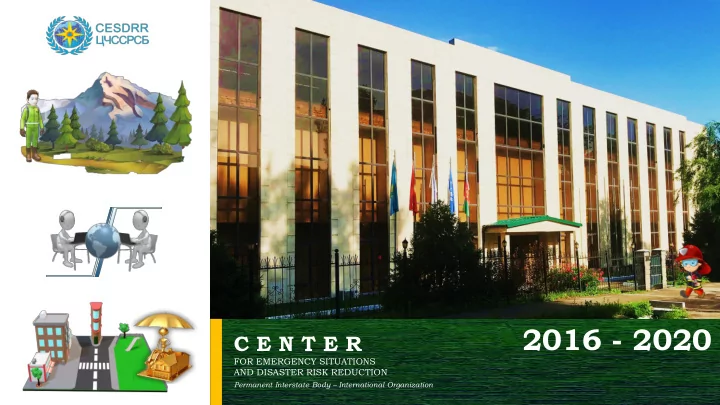
2016 - 2020
C E N T E R
FOR EMERGENCY SITUATIONS AND DISASTER RISK REDUCTION
2016 - 2020 C E N T E R FOR EMERGENCY SITUATIONS AND DISASTER RISK - - PowerPoint PPT Presentation
2016 - 2020 C E N T E R FOR EMERGENCY SITUATIONS AND DISASTER RISK REDUCTION Permanent Interstate Body International Organization BACKGROUND OF THE CENTERS ESTABLISHMENT: 2005: Kazakhstan first initiated a proposal to establish a Central
Permanent Interstate Body – International Organization
FOR EMERGENCY SITUATIONS AND DISASTER RISK REDUCTION
17th May, 2013: In Almaty, the Heads of the Ministries for emergency situations of the Republic of Kazakhstan and the Kyrgyz Republic signed the Agreement between the Government of the Republic of Kazakhstan and the Government of the Kyrgyz Republic on establishment of the Center for Emergency Situations and Disaster Risk Reduction (hereinafter - Center) 2005: Kazakhstan first initiated a proposal to establish a Central Asian Center for emergency situations at the second World Conference for disaster risk reduction in Kobe (Japan)
2
By the decision of the Center’s Council of 14 September 2016, the Islamic Republic of Afghanistan was granted an
The Center is open to join the other countries. The accession of the other States is decided by a mutual agreement of the Parties
THE CENTER AIMS TO: ensure an efficient mechanism for disaster risk mitigation; reduction of its consequences; joint response through an activities agreed by the Parties; stimulate the regional and international cooperation.
3
Observance of the generally recognized norms and principles of international law; Cooperation in accordance with a national legislation of the Parties; Interaction in a spirit of solidarity and equal partnership.
The Center’s Council consist of the Head of the competent authority from each country. The Center’s Council defines strategical directions of the Center’s activity and supervises It.
4
Permanent Interstate body – International Organization; The Secretariat of the Regional Forum-Meeting of the Heads of Emergency Authorities of Central Asian countries; The Regional Resource Center on monitoring and implementation of the Sendai Framework for Disaster Risk Reduction 2015-2030 in Central Asia and South Caucasus region.
5
elimination of emergencies.
Parties.
development and implementation of joint international projects.
analysis of data of the Parties.
6
use of mutual reserve capacities of the States-Parties.
Parties, introduction the United terminology for appropriate use by competent authorities of the States-Parties.
causes and consequences.
Parties in the field of emergencies and civil defense.
7
DIRECTOR DEPUTY DIRECTOR Head of the DRR Department Head of the Emergency Department Senior Expert Senior Expert Senior Expert Senior Expert Senior Expert Senior Expert Head of the Administrative Technical Sector Lawyer Chief accountant IT specialist Technical staff
8
prevention and elimination of emergency situations.
and legal framework, institutional framework, mechanisms, strategies, policies, and risk management practices of disasters and emergencies.
disaster risk reduction, prevention of emergency situations.
humanitarian operations, reconstruction and rehabilitation.
and capacity building of the Center.
9
Center is funded by the contributions of the Parties, donor funds, grants of international
don’t contradict the national legislation of the Parties. The Center has established and is currently engaged in interaction and cooperation at the regional and international level with: Emergency departments and other state structures of more than 25 states; About 60 donor agencies, international and non-governmental
10
Memorandums (Letters-Agreements)
with 24 international and non-governmental organizations
11
From 2016 to 2019, the Center, together with the emergency departments of the countries of the region, international and non-governmental organizations, implemented more than 30 Programs and Projects in the field of DRR and ES. UNDRR “Strengthening Regional Cooperation and Facilitating the Implementation
12
World Bank "Strengthening Financial Resilience and Accelerating Risk Reduction in Central Asia"
FAO in the Kyrgyz Republic “Strengthening capacities for disaster risk reduction and preparedness for disasters in the agricultural sector” UNICEF "Development of unmanned aerial vehicles in prevention and elimination of the emergency consequences with the focus on the vulnerable population" ESCAP "Assessment of drought challenges and drought monitoring models in Central Asian region" MapAction “Geoinformation systems, mapping and data processing”
13
UNDP in the Kyrgyz Republic "Strengthening Integrated Risk Governance Capacities
During a series of Regional Ministerial Conferences held in Central Asian countries in 2013-2015, mainly with the technical and financial support of the Government of Japan and UNDP, an ongoing high-level consultative platform in the format. of the Regional Forum - Meetings of Heads of Emergency Authorities of Central Asian Countries was created (hereinafter Regional Forum). The Regional Forum carries out the following main functions: Assisting in capacity building for disaster risk reduction, emergency prevention and response at the regional and national levels; Assistance in the strengthening cooperation with international and non-governmental
Meetings of the Regional Forum are held at least once every 2 years. The functions of the secretariat of the Regional Forum are assigned to the Center. The working body of the Regional Forum is the Working Group of the Regional Forum. The Regional Forum organizes its activities on the basis of the approved Action Plans (Roadmap).
14
OF THE REGIONAL FORUM – MEETING OF THE HEADS OF EMERGENCY AUTHORITIES OF CENTRAL ASIAN COUNTRIES Almaty city, chaired by the Kazakhstan Party
APRIL 2018
SESSION OF THE REGIONAL FORUM – MEETING OF THE HEADS OF EMERGENCY AUTHORITIES OF CENTRAL ASIAN COUNTRIES Bishkek city, chaired by the Kyrgyzstan Party
JULY 2019
NEXT MEETING OF THE REGIONAL FORUM IS PLANED TO BE CONDUCTED IN 2021 UNDER THE CHAIRMANSHIP OF UZBEK PARTY
15
The Regional Scientific and Technical Council for Emergencies was formed, which began to carry
The Regional Register of forces and assets of the Central Asian countries was formed for emergency rescue operations on their territory in case of emergency; The Regional Register of experts in the field of Civil Protection / Defense, Disaster Risk Reduction, Emergency Prevention and Response has been compiled; In accordance with the approved Action Plan - Road Map, activities are planned and carried out aimed at strengthening the potential of Central Asian countries in the field of DRR and emergency situations; Emergency departments of Central Asian countries provide support and assistance in the implementation of Regional programs and projects in the field of DRR and emergency; The issues of creating the Regional Coordination Mechanism for Emergency Response and the Development of Unmanned Aerial Vehicles (UAV) in order to prevent and eliminate the consequences of emergencies are being elaborated; The draft of Regional Strategy for DRR is being developed.
16
CENTER, TOGETHER WITH INTERNATIONAL AND NON-GOVERNMENTAL ORGANIZATIONS, WITH TECHNICAL AND FINANCIAL SUPPORT, WITHIN THE IMPLEMENTATION OF PROGRAMS AND PROJECTS, FOR THE PURPOSES OF: capacity building for disaster risk management; increase the level of security of the population and territories of the states of the region; strengthening preparedness for an effective emergency response, rescue and humanitarian
17
promoting the development of national emergency response and response systems; assistance in creating modern information and communication systems for the collection, processing and analysis of information; advanced training of experts and specialists in the field of disaster risk management. CENTER, TOGETHER WITH INTERNATIONAL AND NON-GOVERNMENTAL ORGANIZATIONS, WITH TECHNICAL AND FINANCIAL SUPPORT, WITHIN THE IMPLEMENTATION OF PROGRAMS AND PROJECTS, FOR THE PURPOSES OF:
HAS PREPARED AND HELD MORE THAN 80 INTERNATIONAL EVENTS
(FORUMS, CONFERENCES, MEETINGS, SEMINARS, TRAININGS, TRAINING COURSES, STAFF TRAININGS AND EXERCISES),
IN WHICH MORE THAN 2,500 THOUSAND EXPERTS AND SPECIALISTS
TOOK PART, OVER 20 COUNTRIES OF CENTRAL ASIA AND OTHER STATES, AND ALSO INTERNATIONAL AND NON- GOVERNMENTAL ORGANIZATIONS, SCIENTIFIC AND EDUCATIONAL INSTITUTIONS.
18
THE APPROPRIATE INSTITUTIONAL, TECHNICAL AND EXPERT CAPACITY TO IMPLEMENT ACTIVITIES IN ACCORDANCE WITH THE GOALS AND OBJECTIVES ASSIGNED TO IT
19
050022, Kazakhstan, Almaty city, Amangeldy str. 73, tel: +7-727-220-73-31, 220-73-32 E-mail: cesdrr@cesdrr.org web-site: cesdrr.org
TO SUPPORT CENTER'S EFFORTS ON STRENGTHENING THE REGIONAL AND INTERNATIONAL COOPERATION BY IMPLEMENTING JOINT ACTIVITIES IN REDUCING DISASTER RISKS AND EMERGENCY SITUATIONS
20