2016.05.03. Djordje Nikoli holds Doctoral Degree from University of - - PDF document

2016 05 03
SMART_READER_LITE
LIVE PREVIEW

2016.05.03. Djordje Nikoli holds Doctoral Degree from University of - - PDF document

2016.05.03. Djordje Nikoli holds Doctoral Degree from University of Belgrade in Engineering Management, and he received this scientific degree in the year of 2010. Since 2008, working at the University of Belgrade- Technical Faculty in Bor as


slide-1
SLIDE 1

2016.05.03. 1

Dr Djordje Nikolić, associate professor University in Belgrade, Technical Faculty in Bor Е-mail: djnikolic@tf.bor.ac.rs April 26, 2016

Djordje Nikolić holds Doctoral Degree from University of Belgrade in Engineering Management, and he received this scientific degree in the year of 2010. Since 2008, working at the University of Belgrade- Technical Faculty in Bor as an associate professor for subjects: Decision Theory, Management Information Systems, Management Systems and Quantitative methods. He is interested in applied management, especially in quantitative methods and multi-criteria decision theory. He is author or co-author of two books and several scientific papers: 22 papers have been published in SCI and SCIE journals, 11 papers have been published in national scientific journals, and

  • ver 30 papers are published on international and national

symposiums.

Savic, M., Nikolic, Dj., Mihajlovic, I., Zivkovic, Z., Bojanov, B., Djordjevic, P. Multi-criteria decision support system for optimal blending process in zinc production, Mineral Processing and Extractive Metallurgy Review, Vol 36, No 4, 2015, pp. 267-280. Dejan Bogdanovic, Djordje Nikolic and Ivana Ilic, Mining method selection by integrated AHP and PROMETHEE method, Anais da Academia Brasileira de Ciências, Vol 84, No 1, 2012, pp. 1-4. Živković, Ž., Nikolić, Dj., Djordjević, P., Mihajlović, I., Savić, M. Analytical network process in the framework of SWOT analysis for strategic decision making (Case study: Technical faculty in Bor, University of Belgrade, Serbia). Acta Polytechnica Hungarica, Vol 12, No 7, 2015, pp. 199-216.

  • N. Milijić, I. Mihajlović, Đ. Nikolić, Ž. Živković, Multicriteria analysis of safety climate measurements at

workplaces in production industries in Serbia, International Journal of Industrial Ergonomics, Vol 44, No 4, 2014, pp. 510-519. Nikolić Djordje, Milošević Novica, Živković Živan, Mihajlović Ivan, Kovačević Renata, Petrović Nevenka, Multi- criteria analysis of soil pollution by heavy metals in the vicinity of the Copper Smelting Plant in Bor (Serbia), Journal of the Serbian Chemical Society, Vol 76, No 4, 2011, pp. 625-641. Djordje Nikolić, Jelena Spasić, Živan Živković, Predrag Djordjević, Ivan Mihajlović, Jyrki Kangas, SWOT - AHP model for prioritzation of strategies of the resort Stara Planina, Serbian Journal of Management, Vol 10, No 2, 2015, pp. 141-150 Djordje Nikolić, Novica Milošević, Ivan Mihajlović, Živan Živković, Viša Tasić, Renata Kovačević, Nevenka Petrović, Multi-criteria Analysis of Air Pollution with SO2 and PM10 in Urban Area Around the Copper Smelter in Bor, Serbia, Water, Air and Soil Pollution, Vol 206, 2010, pp. 369-383. Đorđe Nikolić, Ivan Jovanović, Ivan Mihajlović, Živan Živković, Multi-criteria ranking of copper concentrates according to their quality- An element of environmental management in the vicinity of copper-smelting complex in Bor, Serbia, Journal of Environmental Management, Vol 91, No 2, 2009, pp. 509-515.

Understand the concept of multi-criteria decision making and how it differs from situations and procedures involving a single criterion Know how to apply the analytic hierarchy process (AHP) to solve a problem involving multiple criteria. Learn how to apply hybrid multi-criteria models to improve the analysis of the different management problems. An illustrative example: supplier prioritization in supply chain management

Multiple criteria (objective) decision making is aimed at

  • ptimal design problems

in which several (conflicting) criteria are to be achieved simultaneously. The characteristics of MCDM are a set of (conflicting) criteria and a set of well-defined constraints.

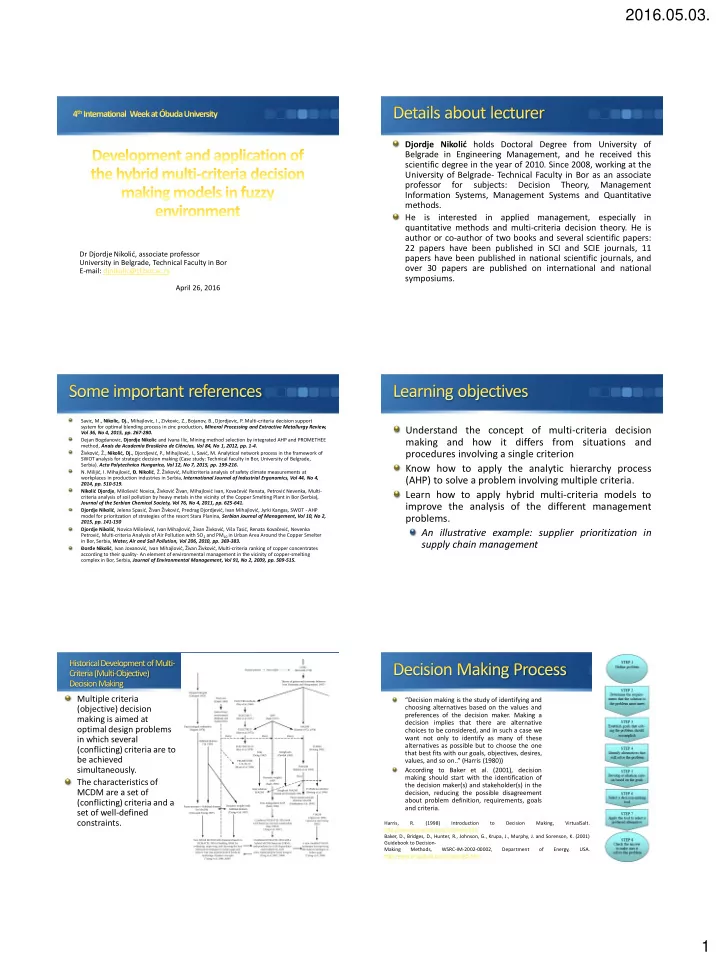
“Decision making is the study of identifying and choosing alternatives based on the values and preferences of the decision maker. Making a decision implies that there are alternative choices to be considered, and in such a case we want not only to identify as many of these alternatives as possible but to choose the one that best fits with our goals, objectives, desires, values, and so on..” (Harris (1980)) According to Baker et al. (2001), decision making should start with the identification of the decision maker(s) and stakeholder(s) in the decision, reducing the possible disagreement about problem definition, requirements, goals and criteria.

Harris, R. (1998) Introduction to Decision Making, VirtualSalt. http://www.virtualsalt.com/crebook5.htm Baker, D., Bridges, D., Hunter, R., Johnson, G., Krupa, J., Murphy, J. and Sorenson, K. (2001) Guidebook to Decision- Making Methods, WSRC-IM-2002-00002, Department

  • f

Energy, USA. http://www.virtualsalt.com/crebook5.htm

slide-2
SLIDE 2

2016.05.03. 2

AHP is one of the most popular multi-criteria methods developed by Thomas Saaty in 1980 (Saaty, 1980), as a method of solving socio-economic decision- making problems, and has been used to solve a wide range of decision- making problems. AHP is a multi- criteria decision making technique that can help express the general decision operation by decomposing a complicated problem into a multilevel hierarchical structure of objective, criteria and alternatives. AHP performs pairwise comparisons to derive relative importance of the variable in each level of the hierarchy and / or appraises the alternatives in the lowest level of the hierarchy in order to make the best decision among alternatives. What do we want to accomplish? Learn how to conduct an AHP analysis Understand the how it works Deal with controversy Rank reversal Arbitrary ratings Show what can be done to make it useable

Many scientific papers have confirmed that the AHP method is very useful, reliable and systematic MCDM tool for solving complex decision problems (Kurttila et al., 2000; Kangas et al., 2001; Kajanusa et al., 2004; Lee et al., 2011). For example, the authors Vaidya and Kumar (2006) in their review work analyzed 27 papers, of about 150 papers cited in the references, pertaining to the application of the AHP method in various scientific fields. Furthermore, the AHP method allows pairwise comparisons between evaluation factors in order to determine the priorities among them, while using the approach

  • f

calculating eigenvalues (Gorener et al., 2012). Determination of the relative priority, when comparing pairs within the AHP methodology, is achieved by assigning an importance score according to the 1–9 scale of Saaty. Relationship between two elements that share a common parent in the hierarchy and numerical representation (Matrix) Comparisons ask 2 questions: Which is more important with respect to the criterion? How strongly? Matrix shows results of all such comparisons Typically uses a 1-9 scale Requires n(n-1)/2 judgments Inconsistency may arise Intensity of Importance Definition 1 Equal Importance 3 Moderate Importance 5 Strong Importance 7 Very Strong Importance 9 Extreme Importance 2, 4, 6, 8

For compromises between the above

Reciprocals of above

In comparing elements i and j

  • if i is 3 compared to j
  • then j is 1/3 compared to i

Rationals

Force consistency Measured values available CR0.1

Building hierarchy Collecting information i.e. performing pairwise comparison between elements Calculate eigenvector Results of synthesis

To determine the importance of the criteria and sub-criteria, in this study, following steps of AHP method were conducted: Defining pairwise comparison matrix A: after decomposition of the decision problem and forming of the hierarchical structure, the subsequent procedure for determining the relative importance of criteria pairs is based on the Saaty's scale 1 - 9. For defined set of criteria within the appropriate level of the hierarchy C={Cj|j=1,2,..n}, results of a comparison of the elements at a given level of the hierarchy are placed in the appropriate pair-wise comparison matrix A (n x n). Each element aij (i,j=1,2,...n) of the matrix A can be defined as the quotient of the criteria weights: The reciprocal value of the comparison results is placed in the position aji, where aji=1/aij in order to maintain consistency. Thus, when i = j, then it follows that aij=1.

             

nn n 2 n 1 n 2 22 12 n 1 12 11 nxn ij

a ... a / 1 a / 1 ... ... ... ... a ... a a / 1 a ... a a ) a ( A

slide-3
SLIDE 3

2016.05.03. 3

Furthermore, if there is a perfectly consistent evaluation, matrix A could be shown in the following format: where wi represents the relative weight coefficient of element i. Determination of weighting factors wi: Various methods have been proposed to extract values of vectors of the weight coefficients wj={w1, ..., wn} from the matrix A. Saaty (1980) suggested that for the matrix A its maximum eigenvalue max should be determined first. The corresponding eigenvector of the matrix can then be taken as a vector of approximate values of the weight coefficients wj, because the following applies:              

n n 2 n 1 n n 2 2 2 1 2 n 1 2 1 1 1 nxn ij

w w ... w w w w ... ... ... ... w w ... w w w w w w ... w w w w ) a ( A                                          

n 2 1 n 2 1 n n 2 n 1 n n 2 2 2 1 2 n 1 2 1 1 1

w ... w w n w ... w w w w ... w w w w ... ... ... ... w w ... w w w w w w ... w w w w

  • r

w n w A

If the matrix A is the completely consistent matrix, eigenvector w, which is a weight vector with , can be obtained by solving equation: where max is the maximum eigenvalue of the matrix A, while its rank is equal to 1, as well as max = n, and I represents an identity matrix . In this case, the values of the vectors of the weight coefficients wj={w1, ..., wn} can be obtained by normalizing either rows or columns of the matrix A (Gorener et al., 2012).

n 1 j j

1 w

w ) I A ( w w A

  • r

w n w A

max max

           

AHP is a popular method because it has the ability to identify and analyze the inconsistency of decision-makers' judgments in the process of discernment and valuation of the elements of the hierarchy (Chang and Huang, 2006). If the values of the weight coefficients of all the elements that are mutually compared at a given level of the hierarchy could be precisely determined, the eigenvalues of the matrix A would be entirely

  • consistent. However, that is relatively difficult to achieve in practice. AHP

method provides the ability to measure errors of judgment by computing consistency index (CI) for the obtained comparison matrix A, and then calculating the consistency ratio (CR). In order to calculate the consistency ratio (CR), we first need to calculate the consistency index (CI) according to the following formula: Next, the consistency ratio is determined by equation: where RI is the random index which depends on the order n of the matrix A 1 n n CI

max

    RI CI CR  also, mах is maximal eigenvalue of the matrix A: Random indices (RI)

                                                                                             

n 1 i i max n 2 1 n n 2 2 1 1 n 2 1 n 2 1 nn 2 n 1 n n 2 22 21 n 1 12 11

n 1 . . w b . . w b w b b . . b b w . . w w * a .. a a . . . . . . . . a .. a a a .. a a n-order

  • f the

matrix A 1 2 3 4 5 6 7 8 9 10 11 12 13 14 15 0.58 0.9 1.12 1.24 1.32 1.41 1.45 1.49 1.51 1.48 1.56 1.57 1.59

Designer Gill Glass must decide which of three manufacturers will develop his "signature“ toothbrushes. Three factors are important to Gill: (1) his costs; (2) reliability of the product; and, (3) delivery time of the orders.

  • The three manufacturers are Cornell Industries, Brush Pik, and
  • Picobuy. Cornell Industries will sell toothbrushes to Gill Glass for

$100 per gross, Brush Pik for $80 per gross, and Picobuy for $144 per gross. Hierarchical structure of the selection problem

Select the best toothbrush manufacturer

Cornell Brush Pik Picobuy Reliability Delivery time Cost

slide-4
SLIDE 4

2016.05.03. 4

Pairwise comparison matrix: Criteria Divide each entry in the pair-wise comparison matrix by its corresponding column sum. The priority vector for Criteria relative to the primary goal is determined by averaging the row entries in the normalized

  • matrix. Converting to decimals we get:

Pairwise comparison matrix: Cost Divide each entry in the pair-wise comparison matrix by its corresponding column sum. The priority vector for the criterion Cost is determined by averaging the row entries in the normalized matrix. Converting to decimals we get: Pairwise comparison matrix: Reliability Divide each entry in the pair-wise comparison matrix by its corresponding column sum. The priority vector for the criterion Reliability is determined by averaging the row entries in the normalized matrix. Converting to decimals we get:

slide-5
SLIDE 5

2016.05.03. 5

Pairwise comparison matrix: Delivery Time Divide each entry in the pair-wise comparison matrix by its corresponding column sum. The priority vector for the criterion Delivery Time is determined by averaging the row entries in the normalized matrix. Converting to decimals we get: The overall priorities are determined by multiplying the priority vector of the criteria by the priorities for each decision alternative for each objective. Priority Vector for Criteria [ .729 .216 .055 ] Cost Reliability Delivery Cornell .298 .571 .471 Brush Pik .632 .278 .059 Picobuy .069 .151 .471 Thus, the overall priority vector is: Cornell: (.729)(.298) + (.216)(.571) + (.055)(.471) = .366 Brush Pik: (.729)(.632) + (.216)(.278) + (.055)(.059) = .524 Picobuy: (.729)(.069) + (.216)(.151) + (.055)(.471) = .109 Brush Pik appears to be the overall recommendation.