2014 Hake Assessment Update and Proposed ABC Specification for FY - - PowerPoint PPT Presentation

2014 hake assessment update and proposed abc
SMART_READER_LITE
LIVE PREVIEW

2014 Hake Assessment Update and Proposed ABC Specification for FY - - PowerPoint PPT Presentation

2014 Hake Assessment Update and Proposed ABC Specification for FY 2015-2017 Larry A. Alade NEFSC, Population Dynamics Branch Whiting PDT Statistical and Scientific Committee Meeting August 26, 2014 Boston, MA State of the Stocks Silver


slide-1
SLIDE 1

2014 Hake Assessment Update and Proposed ABC Specification for FY 2015-2017

Whiting PDT Statistical and Scientific Committee Meeting August 26, 2014 Boston, MA
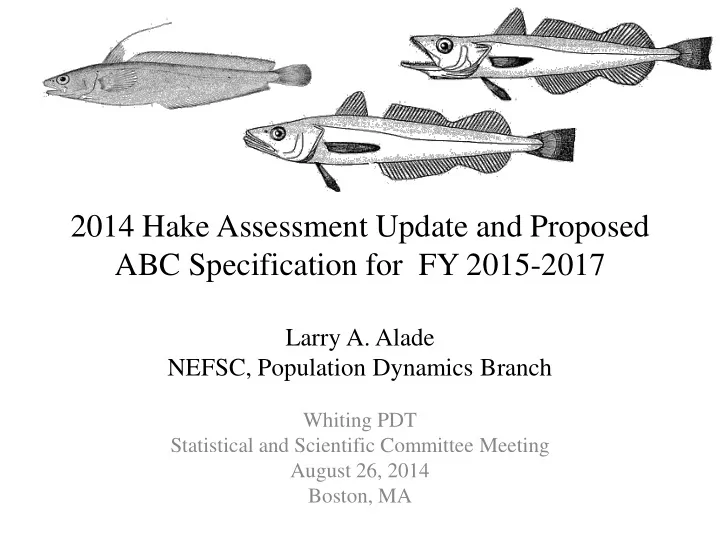
Larry A. Alade NEFSC, Population Dynamics Branch

slide-2
SLIDE 2

State of the Stocks

  • Silver hake

– Both northern and southern Stocks for are NOT overfished and

  • verfishing is NOT occurring
  • Red Hake

– Northern stock is NOT Overfished but Overfishing IS occurring – Southern stock is NOT Overfished and overfishing is NOT

  • ccurring
  • Offshore hake

– stock status determination remains undetermined because the fishery data were not sufficient and the survey trends did not reflect the stock trends

slide-3
SLIDE 3

Outline

  • Survey Data
  • Catch Data
  • OFL and ABC measure of uncertainty
  • NEFSC Survey
  • FMSY Reference Point
  • Risk Analyses
  • Sensitivity Analyses
  • Summary
  • Red hake Letter
  • Survey coverage
  • Stock Structure
slide-4
SLIDE 4

Silver hake Survey Trends

slide-5
SLIDE 5

Survey Strata Map

Northern Strata: 20-30, 36-40 Southern Strata: 01-19, 61-76

slide-6
SLIDE 6

Silver hake NEFSC survey trends

  • Length Based Calibration Coefficients were applied
  • Numbers at Length were converted to weight using a LW relationship
  • The HBB is approx. a factor of 5 in the Spring and a factor of 5-7 in the Fall relative to ALB
slide-7
SLIDE 7

North South

  • Strong recruitment in the recent years
  • Lack of expansion in age structure
  • Predation and Cannibalism could be a factor

Silver hake NEFSC Fall survey Catch-at-age

Age1 15-30cm Age3 38-45cm Age5-6 >45 cm Age2 31-37cm Age4 27-49cm

slide-8
SLIDE 8

Red hake Survey Trends

slide-9
SLIDE 9

Red hake NEFSC survey trends

  • Decline in the spring survey with the exception of 2014
  • Approx. factor of 4 in the spring and factor of 2 in the fall (Conv. HBB to ALB)
slide-10
SLIDE 10

Red hake Spring Survey Length Composition

North South

slide-11
SLIDE 11

Silver and red hake catch Data

slide-12
SLIDE 12

Commercial Statistical Areas

Northern Stock: 512-515, 521-522 and 561 Southern Stock: 525-526, 562, 533-534, 537- 539, 541-543, 611-616, 621- 623, 625-628, 631-638

slide-13
SLIDE 13

Silver hake total catch

2013 North Landings: 1,370 mt (85%) Disc: 250 mt (15%) Total Catch: 1,620 mt > 90% landings contributed by Trawl In recent years 2013 South Landings: 4,790 mt (88%) Disc: 640 mt (12%) Total Catch: 5,420 mt > 90% of landings are also by trawl fishery in recent years

slide-14
SLIDE 14

Percent offshore hake in the Southern whiting (BOTTOM) derived from the length-based model for years 1955-2013

slide-15
SLIDE 15

Red hake Total Catch

2013 North Landings: 95 mt (30%) Rec: 2.4mt (< 1%) Disc: 216 mt (69%) Total Catch: 310 mt > 90% landings contributed by Trawl In recent years 2013 South Landings: 440 mt (40%) Rec: 76mt (7%) Disc: 580 mt (53%) Total Catch: 1100 mt > 90% landings contributed by Trawl In recent years

slide-16
SLIDE 16

SARC 51 Silver hake Biological Reference Points

  • Lack of ASAP model, the panel recommended the fallback

method (Survey Index approach)

  • Biomass reference points based on the arithmetic average of

fall Survey (1973-1982)

  • Exploitation Index is based on ratio b/w total catch and

arithmetic fall survey index averaged from 1973-1982

STOCK THRESHOLDS (SARC 51) TARGETS(SARC 51)

1/2 BMSY Proxy (3.21) FMSY Proxy (2.78) BMSY Proxy (6.42) FMSY Proxy (NA) Northern Silver Hake Southern Silver Hake 1/2 BMSY Proxy (0.83) FMSY Proxy (34.17) BMSY Proxy (1.65) FMSY Proxy (NA)

slide-17
SLIDE 17

Northern Silver hake Fall Survey Biomass (kg/tow) and Relative Exploitation (kt/kg)

slide-18
SLIDE 18

Southern Silver hake Fall Survey Biomass (kg/tow) and Relative Exploitation (kt/kg)

slide-19
SLIDE 19

SARC 51 Red hake Biological Reference Points

  • Lack of adequate model formulations, the panel recommended

the “fall back” 3yr Survey Index method

  • Biomass reference points based on the arithmetic average of

Spring Survey (1980-2010)

  • Exploitation Index is based on ratio b/w total catch and Spring

survey index from 1980-2009 from AIM analyses

STOCK THRESHOLDS (SARC 51) TARGETS(SARC 51)

Northern Red Hake Southern Red Hake 1/2BMSY Proxy (0.51) FMSY Proxy (3.04) BMSY Proxy (1.02) FMSY Proxy (NA) 1/2BMSY Proxy (1.27) FMSY Proxy (0.16) BMSY Proxy (2.54) FMSY Proxy (NA)

slide-20
SLIDE 20

Northern Red hake Fall Survey Biomass (kg/tow) and Relative Exploitation (kt/kg)

slide-21
SLIDE 21

Southern Red hake Fall Survey Biomass (kg/tow) and Relative Exploitation (kt/kg)

slide-22
SLIDE 22

Summary Silver hake Stock Status

slide-23
SLIDE 23

Summary Red hake Stock Status

slide-24
SLIDE 24

Analytical Frame work for Setting ABCs

slide-25
SLIDE 25

Overfishing Level (OFL)

2010 1980 ) ( 1982 1973 ) ( ) / ( ) ( ~

Re 2013 2011 Re 2014 2012 2013 2011 3 1

− = − = = = =

− − − −

hake red proxy F hake silver proxy F South Biomass Spring I North Biomass Spring I Biomass Fall I Where kg kt proxy F x kg I OFL

MSY MSY dhake dhake Silverhake S MSY S yr yr

slide-26
SLIDE 26

Estimating Uncertainty in OFL

  • Uncertainty in OFL

– Estimated as a cross product between the uncertainty (i.e. probability distribution) in FMSY proxy and the most recent 3-year survey Index

  • Uncertainty in FMSY

– Silver hake: Mean and variance of the exploitation ratios from 1973-1982 and assumed lognormal error structure – Red hake: Based on the bootstrap probability distribution from AIM Model (1980-2010) and assumed a normal error structure

slide-27
SLIDE 27

Estimating Uncertainty in OFL cont’d

  • Uncertainty in Survey

– Mean and variance from the most recent three year Survey (2011-2013) in Albatross units – Bigelow Survey variance application – Caveat

  • Incorporates conversion factor and variances of conversion

factor from the calibration experiment

  • Survey mean weights converted to Albatross equivalent

(Length based conversion)

  • Variance derived from constant model as a proxy for

length-based estimates (mean weights were fairly similar)

slide-28
SLIDE 28

Variance Statistics

product cross ) , (Re ) ( update) for (basis 1 ) (Re ..... ) ( ) ( ) , ( 2 ) ( ) ( ) ( ) ( ) ( ) ( ) (Re ) ( ) ( ) ( ) ( ) ( 3 ) (

2 ) ( 1 2 2 2 2 2 2 3 1 3 2 1 Survey n yr yr HBB yr HBB yr HBB yr yr ALB HBB yr HBB yr HBB yr HBB survey

I lF V OFL V n I C I C lF V e Alternativ I E C E I C Cov I E I V C E C V I E C E lF V E V I E I V I I V I I I V I V = −             − =       − +       =       +         =       + + =

− →

ρ ρ ρ

slide-29
SLIDE 29

Proposed OFL and ABC for Northern and Southern Silver hake

North South

Pctile of OFL Catch ( kt) % of 2014 OFL (45.87 kt) % of 2013 Catch Prob. (F > FMSYProxy) 5 9.96 22% 576% 0% 10 13.83 30% 799% 0% 20 20.85 45% 1205% 0% 25 24.38 53% 1409% 0% 30 28.05 61% 1621% 0% 40 36.19 79% 2092% 4% 45 40.79 89% 2358% 25% 50 45.87 100% 2652% 68% 60 58.33 127% 3372% 99% 70 75.43 164% 4360% 99% 80 102.58 224% 5929% 99% Pctile of OFL distr. Catch ( kt) % of 2014 OFL (59.69 kt) % of 2013 Catch Prob. (F > FMSYProxy) 5 12.34 21% 215% 0% 10 17.39 29% 302% 0% 20 26.55 44% 462% 0% 25 31.18 52% 542% 0% 30 36.05 60% 627% 0% 40 46.81 78% 814% 4% 45 52.97 89% 921% 27% 50 59.69 100% 1038% 56% 60 76.23 128% 1326% 97% 70 99.47 167% 1730% 99% 80 136.27 228% 2370% 99%

slide-30
SLIDE 30

Proposed OFL and ABC for Northern and Southern Red hake

Pctile of OFL Catch ( kt) % of 2014 OFL (0.322 kt) % of 2013 Catch (0.364 kt) Prob. (F > FMSYProxy) 5 0.077 24% 21% 0% 10 0.137 43% 38% 0% 20 0.204 63% 56% 0% 25 0.228 71% 63% 0% 30 0.250 78% 69% 0% 35 0.269 84% 74% 0% 40 0.287 89% 79% 6% 45 0.305 95% 84% 17% 50 0.322 100% 88% 37% 60 0.356 111% 98% 78% 70 0.392 122% 108% 95% 80 0.433 135% 119% 99% Pctile of OFL Catch ( kt) % of 2014 OFL (3.40 kt) % of 2013 Catch (1.10 kt) Prob. (F > FMSYProxy) 5 2.08 61% 189% 0% 10 2.34 69% 213% 0% 20 2.68 79% 244% 10% 25 2.82 83% 257% 14% 30 2.95 87% 268% 17% 35 3.07 90% 279% 23% 40 3.18 93% 289% 29% 45 3.29 97% 299% 35% 50 3.40 100% 309% 41% 60 3.63 107% 330% 54% 70 3.88 114% 353% 68% 80 4.19 123% 381% 82%

North South

slide-31
SLIDE 31

Risk Analyses

  • Defined as the probability of exceeding of FMSY proxy

given the current population Index (Two step process):

  • Calculated corresponding Rel. F for each survey

realization from the survey cum. distribution.

– Corresponding Rel F= (OFLcurrent/Index_distr)

  • The Probability of Rel. F for a given catch exceeding

FMSY proxy is a function of two probabilities:

– Probability of each survey realizations – Probability of each corresponding Rel F of exceeding FMSY proxy computed over a range of catch

slide-32
SLIDE 32

Silver hake: Probability of exceeding FMSY Proxy

slide-33
SLIDE 33

Red hake: Probability of exceeding FMSY Proxy

slide-34
SLIDE 34

Summary_Silver Hake

  • Stock status for both stocks of silver hake continues

to improve with increasing trends in the population

  • The proposed OFL suggest that both stocks can

withstand higher level of catches with minimal risk of exceeding FMSY proxy

  • Catch remain a source of major uncertainty for silver

hake as implied in the OFL estimates. Lacks contemporary measures of stock productivity

slide-35
SLIDE 35

Summary_Red Hake

  • For red hake, catches continue to increase, dominated by discards in

the fishery due to little market demand.

  • Although red hake appears to show signs of an incoming year class

in 2014 in the north, prior years have shown a declining trend.

  • The proposed ABC suggests a low risk of exceeding the overfishing

limit, should the population remain at current levels

  • Catches have been at or above ABC in recent years, likely

explaining the poor response to population growth in the north.

  • It would be premature to infer the strength of the 2014 YC until

verified by additional years of survey sampling

  • In the south, red hake population has also shown a declining trend.

Catches has also increased; also dominated by discards.

  • Recruitment has been poor over the last two decades and should the

this trend continue into the future, the population will likely decline.

slide-36
SLIDE 36

Red hake letter - August 18th 2014

  • Addressed to the SSC, PDT and Council members
  • Concerns regarding northern red hake stock
  • Two Main Issues

– Representativeness of Survey Coverage

  • Particularly the inshore region with Commercial Fixed gear

(lobster traps)

– Stock Structure

  • Migration

– Two Recommendations

  • Fixed gear management for sampling purposes
  • Basis for setting ABC
slide-37
SLIDE 37

NEFSC Bottom Trawl Survey

  • Inshore GOM is one of our most difficult regions to sample

– Bad bottom and lobster gear

  • Lobster gear interferes with our ability to sample in GOM

– Particularly in Strata 39 and 40 (See Map)

  • The effect on northern red hake is not well known. The fraction of

positive tows has been steadily increasing since the early 1990s.

  • Presence of fixed gear does make it challenging to sample in these
  • strata. Occasionally we are forced to move to alternate stations due to

time constraints. The frequency of these moves can be quantified.

  • Last 2010 Benchmark – State inshore surveys were explored to evaluate

the utility of these survey for the red hake benchmark assessment (i.e. MassDMF and MENH).

slide-38
SLIDE 38

NEFSC groundfish bottom trawl survey

slide-39
SLIDE 39

NEFSC Spring BTS (1968-2014) based on red hake Strata 20-40

N.GBK W.GOM

  • E. GOM
  • Cent. &

NW GOM

slide-40
SLIDE 40

Proportion +ve Red hake tows vs. Survey Catch

  • Summary represents northern

strata (20-40) for red hake 68-14

  • Increased +ve tows for red

hake in recent decade

  • Index remains relatively low in

spite of red hake availability to the survey

slide-41
SLIDE 41

SARC 51 – Groundfish Inshore survey Maine-New Hampshire

Map from Sherman et al. 2005

slide-42
SLIDE 42

Northern Red hake Trawl Surveys explored during Benchmark Assessment (SARC 51 HWG)

  • Scale of the catches and trends between the ME-NH inshore state

survey and NEFSC BTS appears to be consistent.

  • Implies that red hake is likely not more abundant inshore relative to
  • ffshore habitats
slide-43
SLIDE 43

NEFSC Spring Survey Vs. Inshore ME-NH State Survey 1968-2013(4)

slide-44
SLIDE 44

Northern Red hake Spatial Coverage (1994-2014)

slide-45
SLIDE 45

Inshore Maine-New Hampshire State Survey

slide-46
SLIDE 46

Red Hake Stock Structure

  • The basis for the two stock definition was established at SAW

2 largely based on the analogy with silver hake

  • No morphometrics or genetic analyses on population

structure has been conducted.

  • Explored at the last 2010 Benchmark Assessment (TOR3)
  • Evaluated various life history characteristics (i.e. distribution,

growth and maturity)

  • Conclusion at last benchmark: available evidence was

equivocal as to whether red hake should be considered a single or multi-stock population.

slide-47
SLIDE 47
  • Spring-Summer: move to shallow water to spawn
  • Fall begin migration to deeper water and in Winter – move offshore to deep waters in GOM and

along edge of C.Shelf along SNE and GBK

  • Likely mixing occur on GBK, but degree of mixing and movement is unknown

Red hake Survey : Spring 1968-2010 Red hake Survey : Fall 1963-2009

slide-48
SLIDE 48

Red hake growth pattern

Mean Size at age

  • Age data only available (1975-1985)
  • Similar growth rates until about ages 2-3
  • While older and larger red hake in the northern stock would argue for separate stocks,

there appears to considerable uncertainty in the interpretations of red hake ages in the northern stock due to otolith anomalies (i.e. prominent checks that blur distinction between annular zones)

slide-49
SLIDE 49

Red hake Size at maturity

Slight difference in size at maturity between stocks and also by sex. Females maturing at smaller sizes in the north Vice-Versa for males.

slide-50
SLIDE 50

Summary (1)

  • Concentration of catches of inshore red hake over the last

decade do not appear to be substantially greater than

  • ffshore population
  • NEFSC Survey show fairly consistent sampling frequency in the

GOM in spite of fixed gear interference and bad bottom topography

  • Concentration of catches appear to be occurring in the
  • ffshore region of the GOM
  • Review through the benchmark process
slide-51
SLIDE 51

Summary (2)

  • There is uncertainty in the red hake stock structure

and this research recommendation was identified at the last benchmark assessment.

  • Currently, no new evidence suggests a revision in the

current stock definition

  • Research on red hake stock structure using otolith

microchemistry is in progress

  • A revision in stock structure will require an

independent peer review process