The FEniCS Project Martin Alns, Johan Hake, Anders Logg, Kent-Andre - - PowerPoint PPT Presentation

the fenics project
SMART_READER_LITE
LIVE PREVIEW

The FEniCS Project Martin Alns, Johan Hake, Anders Logg, Kent-Andre - - PowerPoint PPT Presentation

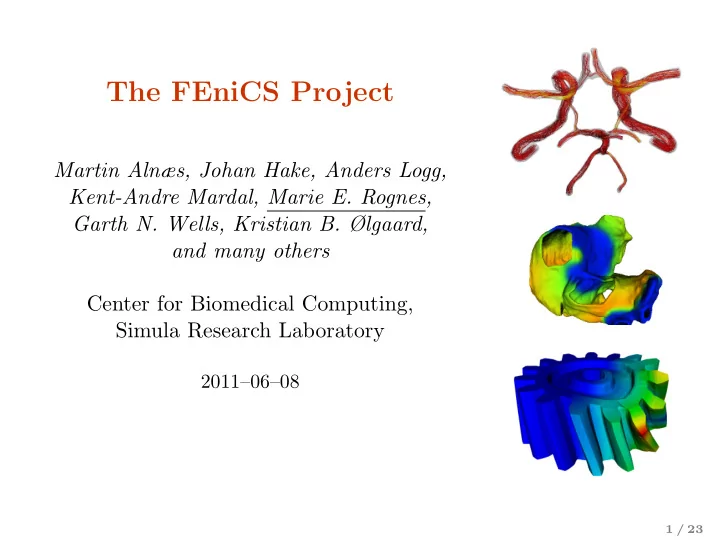
The FEniCS Project Martin Alns, Johan Hake, Anders Logg, Kent-Andre Mardal, Marie E. Rognes, Garth N. Wells, Kristian B. lgaard, and many others Center for Biomedical Computing, Simula Research Laboratory 20110608 1 / 23 Automated


slide-1
SLIDE 1

The FEniCS Project

Martin Alnæs, Johan Hake, Anders Logg, Kent-Andre Mardal, Marie E. Rognes, Garth N. Wells, Kristian B. Ølgaard, and many others Center for Biomedical Computing, Simula Research Laboratory

2011–06–08

1 / 23
slide-2
SLIDE 2

Automated solution of differential equations

Input

  • A(u) = f
  • ǫ > 0

Output u − uh ≤ ǫ

2 / 23

slide-3
SLIDE 3

FEniCS is an automated programming environment for differential equations

  • C++/Python library
  • Initiated 2003 in Chicago
  • 1000–2000 monthly downloads
  • Part of Debian/Ubuntu

GNU/Linux

  • Licensed under the GNU LGPL

http://www.fenicsproject.org/ Collaborators University of Chicago, Argonne National Laboratory, Delft University of Technology, Royal Institute of Technology KTH, Simula Research Laboratory, Texas Tech University, University of Cambridge, . . .

3 / 23

slide-4
SLIDE 4

FEniCS is new technology combining generality, efficiency, simplicity and reliability

Generality Efficiency Code Generation

  • Generality through abstraction
  • Efficiency through code generation, adaptivity, parallelism
  • Simplicity through high level scripting, automation
  • Reliability through adaptive error control

4 / 23

slide-5
SLIDE 5

FEniCS is automated FEM

  • Automated generation of basis functions
  • Automated evaluation of variational forms
  • Automated finite element assembly
  • Automated adaptive error control

5 / 23

slide-6
SLIDE 6

6 / 23

slide-7
SLIDE 7

Computational hemodynamics

  • Low wall shear stress may trigger aneurysm growth
  • Solve the incompressible Navier–Stokes equations on

patient-specific geometries ˙ u + ∇u · u − ∇ · σ(u, p) = f ∇ · u = 0

Valen-Sendstad, Mardal, Logg, Computational hemodynamics (2011) 7 / 23

slide-8
SLIDE 8

Computational hemodynamics (contd.)

# Define Cauchy stress tensor def sigma(v,w): return 2.0*mu*0.5*(grad(v) + grad(v).T)

  • w*Identity(v.cell ().d)

# Define symmetric gradient def epsilon(v): return 0.5*(grad(v) + grad(v).T) # Tentative velocity step (sigma formulation) U = 0.5*(u0 + u) F1 = rho*(1/k)*inner(v, u - u0)*dx + rho*inner(v, grad(u0)*(u0 - w))*dx \ + inner(epsilon(v), sigma(U, p0))*dx \ + inner(v, p0*n)*ds - mu*inner(grad(U).T*n, v)*ds \

  • inner(v, f)*dx

a1 = lhs(F1) L1 = rhs(F1) # Pressure correction a2 = inner(grad(q), k*grad(p))*dx L2 = inner(grad(q), k*grad(p0))*dx - q*div(u1)*dx # Velocity correction a3 = inner(v, u)*dx L3 = inner(v, u1)*dx + inner(v, k*grad(p0 - p1))*dx

  • The Navier–Stokes solver is implemented in Python/FEniCS
  • FEniCS allows the solver to be implemented in a minimal amount of

code

Valen-Sendstad, Mardal, Logg, Computational hemodynamics (2011) 8 / 23

slide-9
SLIDE 9

Tissue mechanics and hyperelasticity

class Twist( StaticHyperelasticity ): def mesh(self): n = 8 return UnitCube(n, n, n) def dirichlet_conditions (self): clamp = Expression (("0.0", "0.0", "0.0")) twist = Expression (("0.0", "y0 + (x[1]-y0)*cos(theta)

  • (x[2]-z0)*sin(theta) - x[1]",

"z0 + (x[1]-y0)*sin(theta) + (x[2]-z0)*cos(theta) - x[2]")) twist.y0 = 0.5 twist.z0 = 0.5 twist.theta = pi/3 return [clamp , twist] def dirichlet_boundaries (self): return ["x[0] == 0.0", "x[0] == 1.0"] def material_model (self): mu = 3.8461 lmbda = Expression("x[0]*5.8+(1-x[0])*5.7") material = StVenantKirchhoff ([mu , lmbda]) return material def __str__(self): return "A cube twisted by 60 degrees"

  • CBC.Solve is a collection of FEniCS-based solvers developed at the

CBC

  • CBC.Twist, CBC.Flow, CBC.Swing, CBC.Beat, . . .
  • H. Narayanan, A computational framework for nonlinear elasticity (2011)

9 / 23

slide-10
SLIDE 10

Fluid–structure interaction

  • The FSI problem is a

computationally very expensive coupled multiphysics problem

  • The FSI problem has many

important applications in engineering and biomedicine

Images courtesy of the Internet 10 / 23

slide-11
SLIDE 11

Fluid–structure interaction (contd.)

  • Fluid governed by the incompressible Navier–Stokes

equations

  • Structure modeled by the St. Venant–Kirchhoff model
  • Adaptive refinement in space and time

Selim, Logg, Narayanan, Larson, An Adaptive Finite Element Method for FSI (2011) 11 / 23

slide-12
SLIDE 12

Computational geodynamics

− div σ′ − ∇ p = (Rb φ − Ra T) e div u = 0 ∂T ∂t + u · ∇ T = ∆T ∂φ ∂t + u · ∇ φ = kc∆φ σ′ = 2η ˙ ε(u) ˙ ε(u) = 1 2

  • ∇ u + ∇ uT

η = η0 exp (−bT/∆T + c(h − x2)/h)

Image courtesy of the Internet 12 / 23

slide-13
SLIDE 13

Computational geodynamics (contd.)

  • The mantle convection simulator is implemented in

Python/FEniCS

  • Images show a sequence of snapshots of the temperature

distribution

Vynnytska, Clark, Rognes, Dynamic simulations of convection in the Earth’s mantle (2011) 13 / 23

slide-14
SLIDE 14

14 / 23

slide-15
SLIDE 15

Hello World in FEniCS: problem formulation

Poisson’s equation −∆u = f in Ω u = 0

  • n ∂Ω

Finite element formulation Find u ∈ V such that

∇u · ∇v dx

  • a(u,v)

=

f v dx

  • L(v)

∀ v ∈ V

15 / 23

slide-16
SLIDE 16

Hello World in FEniCS: implementation

from dolfin import * mesh = UnitSquare(32 , 32) V = FunctionSpace (mesh , "Lagrange", 1) u = TrialFunction (V) v = TestFunction(V) f = Expression("x[0]*x[1]") a = dot(grad(u), grad(v))*dx L = f*v*dx bc = DirichletBC(V, 0.0, DomainBoundary ()) problem = VariationalProblem (a, L, bc) u = problem.solve () plot(u)

16 / 23

slide-17
SLIDE 17

FEniCS (DOLFIN) class diagram

17 / 23

slide-18
SLIDE 18

Implementation of advanced solvers in FEniCS

FSISolver

PrimalSolver DualSolver

CBC.Flow CBC.Twist MeshSolver Residuals

  • K. Selim, An adaptive finite element solver for fluid–structure interaction problems (2011)

18 / 23

slide-19
SLIDE 19

19 / 23

slide-20
SLIDE 20

FEniCS software components

DOLFIN FIAT FErari Instant FEniCS Apps UFC Viper SyFi

PETSc uBLAS UMFPACK SCOTCH NumPy VTK

UFL Puffin

Application Application

Applications Interfaces Core components External libraries

Trilinos GMP ParMETIS CGAL MPI SLEPc

FFC

20 / 23

slide-21
SLIDE 21

Automatic code generation

21 / 23

slide-22
SLIDE 22

Combining it all with external libraries

22 / 23

slide-23
SLIDE 23

Summary

  • Automated solution of differential

equations

  • Simple installation
  • Simple scripting in Python
  • Efficiency by automated code generation
  • Free/open-source (LGPL)

Upcoming events

  • Release of 1.0 (2011)
  • Book (2011)
  • New web page (2011)
  • Mini courses / seminars (2011)

http://www.fenicsproject.org/ http://www.simula.no/research/acdc/

23 / 23