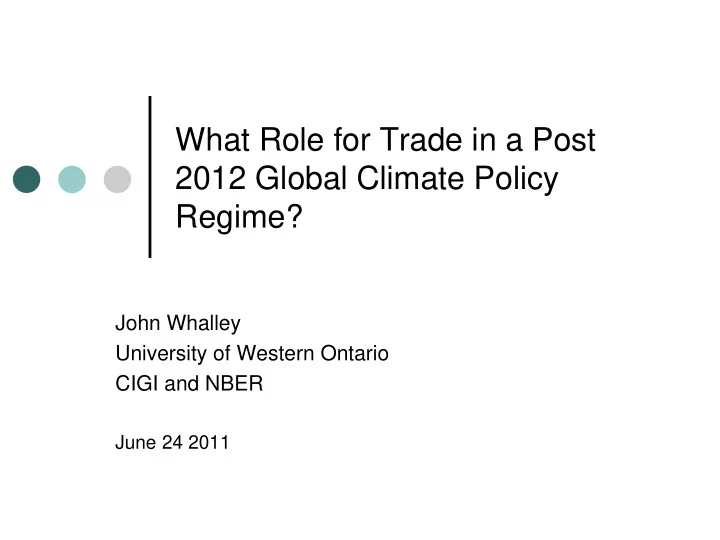
2012 Global Climate Policy Regime? John Whalley University of - - PowerPoint PPT Presentation

2012 global climate policy
SMART_READER_LITE
LIVE PREVIEW

2012 Global Climate Policy Regime? John Whalley University of - - PowerPoint PPT Presentation

What Role for Trade in a Post 2012 Global Climate Policy Regime? John Whalley University of Western Ontario CIGI and NBER June 24 2011 1. Main Themes Little formal role for trade in Copenhagen/Cancun/Durban process; but it lurks in the


slide-1
SLIDE 1

What Role for Trade in a Post 2012 Global Climate Policy Regime?

John Whalley University of Western Ontario CIGI and NBER

June 24 2011

slide-2
SLIDE 2
  • 1. Main Themes

 Little formal role for trade in Copenhagen/Cancun/Durban

process; but it lurks in the background

 As addition to the bargaining set trade, in principle, widens

the bargaining set and can be a facilitator of a global climate regime

 Trade policy can be an instrument for the implementation of

a global climate regime since trade policy can be mechanism for achieving second best internalization. This can, however, also make negotiation more difficult with developing countries

 Little time left to exploit linkage in Durban, and prognoses

for Durban pessimistic

slide-3
SLIDE 3
  • 1. Main Themes

Key things trade cannot do

(i)

resolve property rights issues

(ii)

act as compensation

(iii)

achieve full internalization

Contribution of trade in concluding UNFCCC negotiations that is needed is to be judged against existing unilateral committments

slide-4
SLIDE 4

Trade Climate Linkage

 Institutional Evolution of Linkage

Bretton Woods 1960’s environment movement Global environmentalism in 1980’s Precedence of trade regime

 Elements of linkage

Direct Bargaining linkage Implementation issues

slide-5
SLIDE 5

Trade Climate Linkage

 Direct Interactions

Results from numerical equilibrium models

 Bargaining Interactions

Access in goods/services

 Linkage in Implementation

Border Tax Adjustments Finance Transfers

slide-6
SLIDE 6

Trade in Negotiations Thus Far

 Rio 1992  UNFCCC 1994 – CBDR  Kyoto 1997  Bali 2007  Copenhagen 2009 – Copenhagen Accords  Post Copenhagen  BTA issue

slide-7
SLIDE 7

What Role Can Trade Play in Helping Advance the UNFCCC Process?

 Trade in goods and services / trade in emissions rights  Expanding the bargaining set  Contingent trade measures as penalty system  Efficiency and fairness considerations in use of these trade

measures

slide-8
SLIDE 8

Potential Impacts of Border Tax Adjustments

 The older VAT debate  Neutrality Results  Basis for calculation of carbon adjustment  Sector specificity  Discrimination  WTO issues  What do equilibrium models suggest?

slide-9
SLIDE 9

Concluding Remarks

 Trade’s formal role short term not developed, but lurks as

major consideration

 View climate as addition to global policy mix for negotiated

cooperation

 Institutional issues to the fore