2005: we looked to the future of EU system 2008 2010 2012 2003 - - PowerPoint PPT Presentation

2005 we looked to the future of eu system
SMART_READER_LITE
LIVE PREVIEW

2005: we looked to the future of EU system 2008 2010 2012 2003 - - PowerPoint PPT Presentation

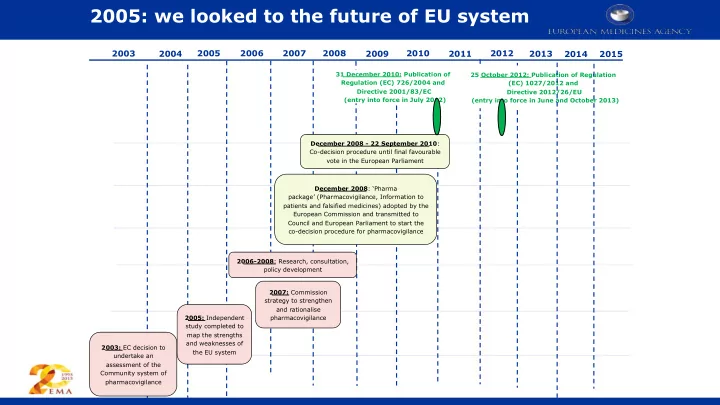
2005: we looked to the future of EU system 2008 2010 2012 2003 2004 2005 2006 2007 2009 2011 2013 2014 2015 31 December 2010: Publication of 25 October 2012: Publication of Regulation Regulation (EC) 726/2004 and (EC) 1027/2012 and


slide-1
SLIDE 1

1 2003 2004 2005 2006 2007 2008 2009 2010 2011 2012 2013

2003: EC decision to undertake an assessment of the Community system of pharmacovigilance 2005: Independent study completed to map the strengths and weaknesses of the EU system 2007: Commission strategy to strengthen and rationalise pharmacovigilance 2006-2008: Research, consultation, policy development December 2008: ‘Pharma package’ (Pharmacovigilance, Information to patients and falsified medicines) adopted by the European Commission and transmitted to Council and European Parliament to start the co-decision procedure for pharmacovigilance December 2008 - 22 September 2010: Co-decision procedure until final favourable vote in the European Parliament 31 December 2010: Publication of Regulation (EC) 726/2004 and Directive 2001/83/EC (entry into force in July 2012) 25 October 2012: Publication of Regulation (EC) 1027/2012 and Directive 2012/26/EU (entry into force in June and October 2013)

2014 2015

2005: we looked to the future of EU system

slide-2
SLIDE 2

2

Future of pharmacovigilance in 2015:

Back to the future

slide-3
SLIDE 3

3

Back to the future of pharmacovigilance

slide-4
SLIDE 4

The future of pharmacovigilance

Thanks to:

  • Munir Pirmohamed
  • Steven Evans
  • June Raine
  • Almath Spooner
  • Bert Leufkens
  • Brian Edwards
  • Peter Backman
  • Mick Foy
  • Corinne de Vries
  • Xavier Kurz
  • Georgy Genov
  • Ana Hidalgo
  • Fergus Sweeney
  • Hans-Georgy Eichler
  • Guido Rasi

4

slide-5
SLIDE 5

5

The future of pharmacovigilance

In this presentation:

  • Introduction: a brief moment in time
  • Axes of influence
  • Societal opportunities
  • Technological opportunities
  • Scientific opportunities
  • The future of pharmacoviglance
slide-6
SLIDE 6

6

The future of pharmacovigilance

In this presentation:

  • Introduction: a brief moment in time
  • Axes of influence
  • Societal opportunities
  • Technological opportunities
  • Scientific opportunities
  • A call to arms for health and innovation
slide-7
SLIDE 7

The future of pharmacovigilance: a brief moment in time

Past

  • From individual cases to pharmacoepidemiology
  • From local to international
  • From exclusive to inclusive
  • From opaque to transparent
  • From pursued to require
  • From safety to benefit risk

7

slide-8
SLIDE 8

The future of pharmacovigilance: a brief moment in time

Present In many countries and regions:

  • Lifecycle approach
  • Planned data collection and risk minimisation
  • Some integration of benefits and risks
  • Clear roles and responsibilities
  • Quality systems approach
  • Engagement with patients and across disciplines (HTA)

8

slide-9
SLIDE 9

9

The future of pharmacovigilance: Looking forward

  • Planned, integrated lifecycle drug development and

surveillance

  • Utilisation of validated scientific methods,
  • Real world data: quality, accessible, timely
  • Best use of technology
  • Meeting expectations of a changing society
  • Delivering timely access for patients to safe and effective

medicines

  • Making an impact on health promotion, protection and

innovation

slide-10
SLIDE 10

The future of pharmacovigilance: a brief moment in time

Future

  • Achieving the vision

….through multiple small steps

10

slide-11
SLIDE 11

11

The future of pharmacovigilance

In this presentation:

  • Introduction: a brief moment in time
  • Axes of influence
  • Societal opportunities
  • Technological opportunities
  • Scientific opportunities
  • A call to arms for health and innovation
slide-12
SLIDE 12

The future of pharmacovigilance: Axes of influence

  • 1. Time: past, present, future
  • 2. Geographic: local vs global
  • 3. Sectors: pharmaceutical, devise, healthcare systems, patients safety
  • 4. Economic (cost): healthcare, medicines, studies, adverse reactions,

unmet need

  • 5. Political: peace, healthcare system, regulation, functioning market
  • 6. Societal: more coming
  • 7. Technological: more coming
  • 8. Scientific: more coming

12

slide-13
SLIDE 13

13

50 years of EU regulation 20 years of EMA 5 years since adoption of Pharmacovig legislation 3 years of PRAC

Time: European Anniversary year 2015:

slide-14
SLIDE 14

Geographic

14

slide-15
SLIDE 15

Sectors

15

slide-16
SLIDE 16

16

Economics: healthcare, medicines, studies, unmet need adverse reactions Medicines save lives and relieve suffering, but:

  • 5% of all hospital admissions are for ADRs,
  • 5% of all hospital patients suffer an ADR,
  • ADRs are the 5th most common cause of hospital

death

  • Estimated 197,000 deaths per year in EU from

ADRs

  • EU Societal cost of ADRs Euro 79 Billion / year
slide-17
SLIDE 17

Economics

17

slide-18
SLIDE 18

Political

18

slide-19
SLIDE 19

19

The future of pharmacovigilance

In this presentation:

  • Introduction: a brief moment in time
  • Axes of influence
  • Societal opportunities
  • Technological opportunities
  • Scientific opportunities
  • A call to arms for health and innovation
slide-20
SLIDE 20

The future of pharmacovigilance: Societal opportunities

  • Patient and healthcare professionals ready to engage: reporting, assessing,

values, deciding, enacting, feeding back

  • Demographics: aging population, new arrivals in the EU
  • Demand for evidence based for use of medicines in pregnancy, and children
  • 24-hour news cycle, web-based communications
  • Demand to fulfil unmet medical needs
  • Demands for simplification
  • Recognition that collaboration can deliver for health, through sharing

expertise, data, new uses for old drugs

  • Better and more accessible information for decision support

20

slide-21
SLIDE 21

More and better patient engagement

21

slide-22
SLIDE 22

Demographics: change is sometimes difficult to predict.

22

slide-23
SLIDE 23

Special populations: good work done but so much more to deliver

slide-24
SLIDE 24

Unmet medical need: Adaptive pathways concept ("widening of the indication")

Final target indication in blue, patient group with highest need in red the sponsor could follow two strategies 1st approval 2nd approval 1st approval Time

slide-25
SLIDE 25

Simplification

25

slide-26
SLIDE 26

26

slide-27
SLIDE 27

Collaboration: to achieve more and better

27

slide-28
SLIDE 28

Decision cycle

28

Information from clinical use

EMA Committee raises issue Meeting to consider further research +/- Regulatory action Communication Measure effectiveness

  • f action

Results to EMA Committee Regulatory assessment Regulatory network study

Adapted from Arlett et al. Pharmacoepidemiol Drug Saf. 2014;23(4):431-4

slide-29
SLIDE 29

29

The future of pharmacovigilance

In this presentation:

  • Introduction: a brief moment in time
  • Axes of influence
  • Societal opportunities
  • Technological opportunities
  • Scientific opportunities
  • A call to arms for health and innovation
slide-30
SLIDE 30

30

The future of pharmacovigilance: Technological opportunities

  • Product types e.g. biologicals, advanced therapy medicinal products, combination

products, vaccines

  • Tracing the distribution of medicines
  • Social media: linkage, privacy, quality. Where to focus, how can the methodologists

help us?

  • m-health: smart phones for case reporting, for patient led cohorts, for recruitment,

to support health decision-making.

  • m-health: patients self monitoring using mobile devices
  • 2025 “Oyster card” for health (not a new idea, but getting closer to possible)
slide-31
SLIDE 31

Monitoring specific product types

31

slide-32
SLIDE 32

EU counterfeit medicines legislation foresees tracking of prescription products

32

slide-33
SLIDE 33

Smartphones and mobile apps

  • 1.75 billion smartphones in

use worldwide

  • 34.6 million in the UK
  • 62% of UK adults and 53%
  • f households have a

smartphone (24% also have a tablet)

  • 1.3 million apps available for

android users (1.2 million for iOS)

  • Around 6,000 health related

apps

  • UK NHS has its own app store
slide-34
SLIDE 34

Social media

  • 1.35 billion active Facebook

users

  • 31.5 million in the UK
  • 680 million on mobile devices
  • 48% log on every day
  • 25-34 largest age group
  • 284 million active Twitter users
  • 15 million in the UK
  • 80% active on mobile
  • 500 million tweets per day

worldwide

slide-35
SLIDE 35

Social media as an opportunity and challenge

35

slide-36
SLIDE 36

m-health: patients self monitoring using mobile devices

36

slide-37
SLIDE 37

Are we heading for patient health cards?

37

slide-38
SLIDE 38

38

The future of pharmacovigilance

In this presentation:

  • Introduction: a brief moment in time
  • Axes of influence
  • Societal opportunities
  • Technological opportunities
  • Scientific opportunities
  • A call to arms for health and innovation
slide-39
SLIDE 39

39

The future of pharmacovigilance: Scientific opportunities 1

  • Adverse Drug Reaction Reports: long live ADR reporting; improve quantity and

quality of reporting; link data to EHR and biological archives

  • Registries / cohorts – key for rare diseases, + hospital and specialist use. Need for

better tools to support: protocols, standard data fields, cheap and accessible data collection

  • Epidemiological methods – PROTECT, ENCePP, EU-ADR, OMOP – infrastructure for

studies (data, access, governance, funding)

  • Signals: combine data sources; multiple imputation for missing data; implement

best established methods; use EHR for some types of events; outliers in clinical trials

slide-40
SLIDE 40

40

The future of pharmacovigilance: Scientific opportunities 2

  • Genomics: eliglustat; abacavir; warfarin – better labelling of genomics to support

decisions; precision medicine techniques; individual patient BR decisions;

  • Integrating benefit and risk (effectiveness and safety) monitoring and rapid-cycle

analytics

  • Benefit risk assessment methods and decisions
  • Impact: ensuring we measure what works and what does not and that we

continuously improve

slide-41
SLIDE 41

Spontaneous reports remain the largest source of signals and big databases detect earlier

41

slide-42
SLIDE 42

Registries / cohorts – key for rare diseases, + hospital and specialist use.

42

slide-43
SLIDE 43

Building capacity for data collection: ENCePP as an example

43

  • 153 centres
  • 23 networks
  • 51 data sources
slide-44
SLIDE 44

Evidence based process improvements: investment in regulatory science

44

slide-45
SLIDE 45

45

slide-46
SLIDE 46

Combining evidence to detect signals

46

slide-47
SLIDE 47

Eliglustat for Gauchers – CYP2D6 genotyping

47

slide-48
SLIDE 48

Genetics Can Prevent Side Effects: Abacavir Hypersensitivity

Clinical phenotype

Association with HLA-B*5701

Clinical genotype

Incidence before and after testing for HLA-B*5701 Country Pre testing Post testing Reference Australia 7% <1% Rauch et al, 2006 France 12% 0% Zucman et al, 2007 UK (London) 7.8% 2% Waters et al, 2007

slide-49
SLIDE 49

Number of users UK:

600,000

Dose (mg) range per day:

0.5-20

Fold variability in dose:

40

Major bleeding rate per 100-person years: 2.6 Ranking in ADR list:

3

Warfarin

Approved for human use in 1954

slide-50
SLIDE 50

Pharmacogenetic-Based Dosing: Warfarin Randomised Controlled Trial

n 454 ¡pa&ents ¡

n 226 ¡in ¡genotype ¡arm ¡ n 228 ¡in ¡standard ¡care ¡arm ¡

n Point ¡of ¡Care ¡test ¡for ¡

genotyping: ¡

n CYP2C9 ¡– ¡metabolises ¡

warfarin ¡

n VKORC1 ¡– ¡inhibited ¡by ¡

warfarin ¡

European Union Pharmacogenetics of AntiCoagulant Therapy

slide-51
SLIDE 51

An agency of the European Union

slide-52
SLIDE 52

ADVANCE: To establish a prototype of a sustainable and compelling system that rapidly provides best available scientific evidence on vaccination benefits and risks post-licensure for well informed decisions. This will be achieved by developing and testing a code of conduct, rules

  • f governance, technical infrastructures, data sources, methods, and

workflows in a European network of stakeholders.

Integrating benefit and risk (effectiveness and safety) monitoring and rapid-cycle analytics

Blueprint of a system

slide-53
SLIDE 53

Benefit risk assessment methods and decisions PROTECT: Examples of presentation formats

53

Survival curve Pictograms

slide-54
SLIDE 54

IMPACT: Remain

  • n target

54

slide-55
SLIDE 55

55

The future of pharmacovigilance

In this presentation:

  • Introduction: a brief moment in time
  • Axes of influence
  • Societal opportunities
  • Technological opportunities
  • Scientific opportunities
  • The future of pharmacovigilance
slide-56
SLIDE 56

56

The future of pharmacovigilance

  • Planned, integrated lifecycle drug development and

surveillance

  • Utilisation of validated scientific methods,
  • Real world data: quality, accessible, timely
  • Best use of technology
  • Meeting expectations of a changing society
  • Delivering timely access for patients to safe and effective

medicines

  • Making an impact on health promotion, protection and

innovation ...achieving the vision….through multiple small steps…

slide-57
SLIDE 57

Thank you for your attention

Peter.arlett@EMA.Europa.eu

European Medicines Agency

30 Churchill Place • Canary Wharf • London E14 5EU • United Kingdom

Telephone +44 (0)20 3660 6000 Facsimile +44 (0)20 3660 5555 Send a question via our website www.ema.europa.eu/contact

Further information

Follow us on @EMA_News