for Spousal and Child Support Navigating Complex SSI and SSDI Rules; - - PowerPoint PPT Presentation

for spousal and child support
SMART_READER_LITE
LIVE PREVIEW

for Spousal and Child Support Navigating Complex SSI and SSDI Rules; - - PowerPoint PPT Presentation

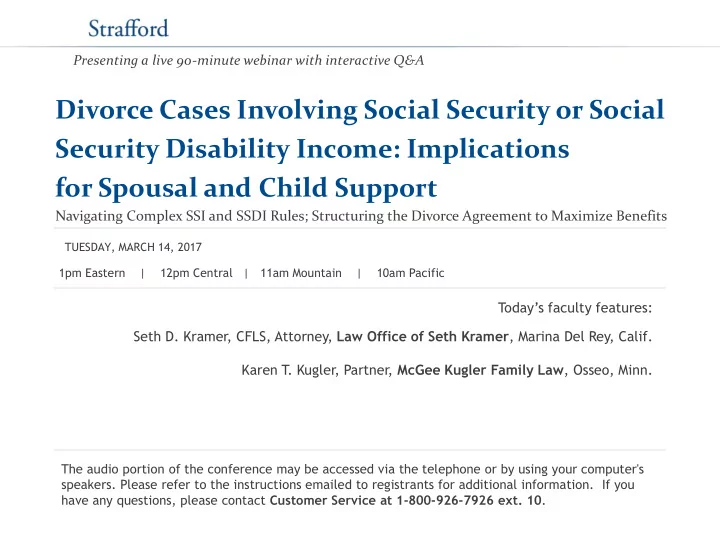
Presenting a live 90-minute webinar with interactive Q&A Divorce Cases Involving Social Security or Social Security Disability Income: Implications for Spousal and Child Support Navigating Complex SSI and SSDI Rules; Structuring the Divorce


slide-1
SLIDE 1

The audio portion of the conference may be accessed via the telephone or by using your computer's

  • speakers. Please refer to the instructions emailed to registrants for additional information. If you

have any questions, please contact Customer Service at 1-800-926-7926 ext. 10.

Presenting a live 90-minute webinar with interactive Q&A

Divorce Cases Involving Social Security or Social Security Disability Income: Implications for Spousal and Child Support

Navigating Complex SSI and SSDI Rules; Structuring the Divorce Agreement to Maximize Benefits Today’s faculty features:

1pm Eastern | 12pm Central | 11am Mountain | 10am Pacific TUESDAY, MARCH 14, 2017

​ Seth D. Kramer, CFLS, Attorney, Law Office of Seth Kramer, Marina Del Rey, Calif. Karen T . Kugler, Partner, McGee Kugler Family Law, Osseo, Minn.

slide-2
SLIDE 2

Tips for Optimal Quality

Sound Quality If you are listening via your computer speakers, please note that the quality

  • f your sound will vary depending on the speed and quality of your internet

connection. If the sound quality is not satisfactory, you may listen via the phone: dial 1-866-961-9091 and enter your PIN when prompted. Otherwise, please send us a chat or e-mail sound@straffordpub.com immediately so we can address the problem. If you dialed in and have any difficulties during the call, press *0 for assistance. Viewing Quality To maximize your screen, press the F11 key on your keyboard. To exit full screen, press the F11 key again.

FOR LIVE EVENT ONLY

slide-3
SLIDE 3

Continuing Education Credits

In order for us to process your continuing education credit, you must confirm your participation in this webinar by completing and submitting the Attendance Affirmation/Evaluation after the webinar. A link to the Attendance Affirmation/Evaluation will be in the thank you email that you will receive immediately following the program. For additional information about continuing education, call us at 1-800-926-7926

  • ext. 35.

FOR LIVE EVENT ONLY

slide-4
SLIDE 4

Program Materials

If you have not printed the conference materials for this program, please complete the following steps:

  • Click on the ^ symbol next to “Conference Materials” in the middle of the left-

hand column on your screen.

  • Click on the tab labeled “Handouts” that appears, and there you will see a

PDF of the slides for today's program.

  • Double click on the PDF and a separate page will open.
  • Print the slides by clicking on the printer icon.

FOR LIVE EVENT ONLY

slide-5
SLIDE 5

Divorce & Social Security Benefits

By: Karen Terese Kugler, Esq. and Seth D. Kramer, Esq.

slide-6
SLIDE 6

Explanation of Social Security Benefits

There are two main types of social security benefits related to disability: – Social security disability insurance (SSDI)

  • For individuals with enough work credits
  • Provides a greater amount of monthly income.

– Supplemental security income (SSI).

  • For individuals without sufficient work credits
  • Provides a much smaller amount of monthly income.

– Some individuals that are not fully eligible for SSDI may receive benefits under both the SSDI and SSI programs.

6

slide-7
SLIDE 7

Explanation of Social Security Benefits

Is It SSI or SSDI?

SSI SSDI What is it?

Disability benefits are based on financial need Disability benefits are based

  • n prior work and work credits

Work history?

Party did not work very much and does not have enough work credits Party has worked 5 out of the last 10 years before application for benefits

Approximate benefit amount

Maximum of $735 per month (for 2017) Varies based on work credits… but higher than $735. The average benefit is $1,111 per month

Additional cash benefit for children

No Yes

Date benefits begin

The date the party made an application for benefits The date the disability began

Asset Limit

Individuals generally are not eligible for SSI if they have resources in excess of $2,000 (or $3,000 for a couple). Certain resources are excluded, most commonly a home, an automobile, and household goods and personal effects No

Reduced by earned income?

Yes For example, a person whose income consists of $500 in gross monthly earnings would receive $527.50 in federal SSI payments (($500 - $85) / 2) = $207.50 countable earnings FBR $735 - $207.50 = $527.50 federal SSI No However, if the earned income is too high this may trigger a termination of benefits

This chart is a summary of the difference between the

  • programs. SSDI is

sometimes called RSDI, for retirement, survivors, and disability

  • insurance. The terms

RSDI and SSDI are used interchangeably.

7

slide-8
SLIDE 8

Explanation of Social Security Benefits: The Process of Obtaining Benefits

Step 1: Initial Application

  • The party applies for SSI, SSDI, or both, either in person at their

local SSA office or via the web.

  • A SSA worker will be assigned to the party’s case and is supposed

to obtain copies of the medical & vocational records for the party.

  • The party may be asked to attend an Independent Medical

Examination (IME) or Special Examination to determine if they are disabled under the rules.

  • The worker reviews the record and determines if the party is

eligible for benefits.

  • It is extremely common for parties to be rejected at this stage.

8

slide-9
SLIDE 9

Explanation of Social Security Benefits: The Process of Obtaining Benefits

Step 2: Request for Reconsideration

  • If the worker rejects the party’s claim, the party receives a

notice and then has 60 days to make a “Request for Reconsideration.”

  • A SSA worker will have the party update their information,

will review the file with this additional information, and will determine if they believe the party is eligible for benefits.

  • Just as with the initial application, it is extremely common

for parties to be rejected at this stage despite severe disabilities.

9

slide-10
SLIDE 10

Explanation of Social Security Benefits: The Process of Obtaining Benefits

Step 3: Hearing with Administrative Law Judge (ALJ)

  • If the party is denied benefits at the Request for Reconsideration

stage of the process they can request a hearing within 60 days of the denial.

  • The party’s best chance of receiving social security disabilities is

likely at the hearing stage of the process.

  • It is very beneficial if the party has a social security law attorney to

represent him or her in this process. The hearing is held in front of an Administrative Law Judge (ALJ) and the hearings generally last 1 to 2 hours. The party will testify and be asked questions by his/her attorney and the ALJ. There may also be a medical expert and a vocational expert present who may testify.

10

slide-11
SLIDE 11

Explanation of Social Security Benefits: The Process of Obtaining Benefits

Step 4: Appeal to Appeals Counsel or Federal District Court.

  • After the hearings level of the process, a party can

appeal to the appeals counsel and then can file a case in Federal District court, but this is not especially common.

11

slide-12
SLIDE 12

Explanation of Social Security Benefits

You cannot obtain social security disability benefits for temporary disabilities

  • In order to qualify for SSI or SSDI, an individual must be unable to engage in

substantial gainful activity (SGA) by reason of a medically determinable physical or mental impairment expected to result in death or last at least 12 months.

  • This means that in order to qualify for social security disability the impairment

in question is usually a permanent and severe one.

  • Five states (California, Hawaii, Rhode Island, New Jersey & New York), Puerto

Rico, and the railroad industry have programs that partially compensate a party for the loss of wages caused by temporary, non-occupational disability or

  • maternity. Those programs are known as temporary disability insurance (TDI)

because the duration of the payments is limited. Federal law does not provide for a federal-state insurance system for short-term disability.

12

slide-13
SLIDE 13

Explanation of Social Security Benefits: How Eligibility Is Determined

  • Option 1: Meets the Listings

– 20 CFR Part 404, Subpart P, Appendix 1. – Each listing describes in detail the level of medical impairment necessary for each medical condition

13

slide-14
SLIDE 14

Explanation of Social Security Benefits: How Eligibility Is Determined

  • Option 2: Equals the Listings

– Often parties have a number of different medical conditions that cause them to be disabled, or alternatively their condition is equal in severity to a similar listing but does not exactly meet the definition in the listings. – In this situation, a party can receive benefits based on medically equaling the listing or combination of listings.

14

slide-15
SLIDE 15

Explanation of Social Security Benefits: How Eligibility Is Determined

  • Option 3: Vocational Impairment

– 20 CFR Part 404, Subpart P, Appendix 2 – Often parties cannot meet or equal a medical listing, but they are unable to work due to the restrictions they have due to a disability. – In this situation the Social Security Administration will analyze if the party is able to engage in substantial gainful employment (SGA).

15

slide-16
SLIDE 16

Issues Specific to Divorce

Back Pay & Assets Attributable to Soc. Sec. Benefits

  • A significant period of time may elapse between the

application for benefits (or onset of disability) and the award of benefits.

  • When benefits are finally awarded, the party will

usually receive “back pay” for monthly benefits that accrued during this time period.

  • The back pay amount can be substantial, especially

in SSDI cases.

16

slide-17
SLIDE 17

Issues Specific to Divorce

Back Pay & Assets Attributable to Soc. Sec. Benefits

  • Social Security benefits (including back pay) are generally treated as a

spouse’s separate (non-marital) property pursuant to federal law and generally will not be subject to division. However, this is not true in all jurisdictions.

– Flemming v. Nestor, 363 U.S. 603 (1960) (social security benefits are distinguished from annuities and are not an accrued property right). – Hisquierdo v. Hisquierdo, 439 U.S. 572 (1979) (state courts are preempted from interfering with RRA benefits).

  • In addition to back pay, some pensions have a social security
  • component. An example would be CSRS, where a party does not

receive social security due to receiving their pension in lieu of benefits. Courts have wrestled with whether to consider the entire pension as marital when dividing this asset, or considering the effect of social security benefits. Does federal law pre-empt such consideration? States are divided on the meaning of Hisquierdo.

17

slide-18
SLIDE 18

Issues Specific to Divorce

Marital Division of Assets Attributable to Soc. Sec. Benefits

State Case

Arizona

Kohler v. Kohler, 118 P.3d 621 (Ariz. App. 2005)

Colorado

In re Marriage of Morehouse, 121 P.3d 264 (Colo. Ct.

  • App. 2005)

Delaware*

Forrester v. Forrester, 953 A.2d 175 (Del. 2008)

Iowa*

In re Marriage of Boyer, 538 N.W.2d 293 (Iowa 1995)

Kansas

In re Marriage of Brane, 908 P.2d 625 (Kan. 1995)

Maine

Depot v. Depot, 893 A.2d 995 (ME 2006)

Maryland*

Jackson v. Sollie, 141 A.3d 1122 (Md. App. 2016)

Massachusetts

Mahoney v. Mahoney, 681 N.E.2d 852 (Mass. 1997)

Missouri

Silcox v. Silcox, 6 S.W.3d 899 (Mo. 1999)

Pennsylvania

Cornbleth v. Cornbleth, 580 A.2d 369 (1990)

Ohio

Walker v. Walker, 677 N.E.2d 1252 (Ohio 1996)

South Dakota

Johnson v. Johnson, 734 N.W.2d 801 (SD 2007)

Washington*

In re Marriage of Zahm, 978 P.2d 498 (Wash. 1999)

State Case

Alaska

Mann v. Mann, 778 P.2d 590 (Alaska 1989)

Arkansas

Gray v. Gray, 101 S.W.3d 816 (Ark. 2003)

California

Marriage of Hillerman, 109 CA.3d 334 (CA 1980)

Florida

Johnson v. Johnson, 726 So.2d 393 (Fla. Dist. Ct. App. 1999)

Illinois

In re Marriage of Crook, 813 N.E.2d 198 (Ill. 2004)

Oregon

In re Marriage of Swan, 720 P.2d 747 (Ore 1986)

Nebraska

Dinges v. Dinges, 16 Neb. App. 275 (Neb. Ct. App. 2008)

Nevada

Wolff v. Wolff, 929 P.2d 916 (Nev. 1997)

North Dakota

Olson v. Olson, 445 N.W.2d 1 (N.D. 1989)

West Virginia

Loudermilk v. Loudermilk, 397 S.E.2d 905 (W.V. 1990)

Wisconsin

Mack v. Mack, 323 N.W.2d 153 (Wis. App. 1982)

Allows some consideration of SS Does not allow consideration

18

slide-19
SLIDE 19

Issues Specific to Divorce

Overpayments

  • Sometimes the social security administration makes a

mistake, and pays the claimant too high a benefit

  • amount. Even if this mistake is due to no fault of the

claimant, the claimant will be required to pay the

  • verpayment back. This could arguably be a marital

debt.

– Lisa M.H. v. Gerald C.H., 35 A.D.3d 1188 (NY 2006) (In New York the overpayment is a marital debt) – Unpublished: Johnson v. Johnson, No. 45A03-1202-DR-94 (Ind.

  • Ct. App. Jan. 29, 2013) (In Indiana overpayment was a marital

debt).

19

slide-20
SLIDE 20

Issues Specific to Divorce

Derivative Benefits – Due to retirement not disability – Payable to a spouse or ex-spouse after the employee’s retirement

  • Ex-spouse does not need to be retired to collect benefit.
  • Irrelevant if ex-spouse is remarried
  • Must have been married to employee for at least 10

years

  • Cannot currently be remarried.
  • Must have been divorced for at least 2 years (unless the

ex-spouse is already receiving benefits). – 42 USC § 402(b) & 416(d)

20

slide-21
SLIDE 21

Issues Specific to Divorce

Derivative Benefits

– Children of retired person may receive social security benefits. – A child will receive up to 50% of the parent’s PIA (primary insurance amount – base amount

  • f the parent’s benefit).

– However, the child’s benefit is subject to a family maximum (150-188% of PIA for retirement benefit recipients).

21

slide-22
SLIDE 22

Ways to Structure Alimony & Child Support Considering Social Security Issues

  • Children can receive funds from social security for their
  • wn disability (through SSI) or due to their parent’s

disability (through their parent’s SSDI).

  • The funds a child receives for their own disability (child’s

SSI) should not be used to calculate a parent’s income for child support.

– A child’s income is not a parent’s income. States base child support awards based on parental income and a parent’s obligation to provide support exists despite a child’s own income.

  • 59 Am. Jur.2d, Parent and Child § 77, p. 169
  • Armstrong v. Armstrong, 544 P.2d 941 (Cal. 1976)

22

slide-23
SLIDE 23

Ways to Structure Alimony & Child Support Considering Social Security Issues

  • The funds a child receives based on a parent’s

disability (parent’s SSDI) may be factored into child support.

– 42 U.S.C. § 407 protects social security benefits from legal process is subject to an exception found in 42 U.S.C. § 659. – Jugovich v. Jugovich, No. A08-0156, 2008 WL 4778019 (Minn. Ct. App. Nov. 4, 2008). – Kimbrell v. Kimbrell, 884 S.W.2d 268 (Ark. 1994). – Brown v. Brown, 849 N.E.2d 610 (Ind. 2006) – CA Family Code § 4058 & 4504 – In Re Marriage of Daugherty, 232 Cal. App. 4th 463 (2014)

23

slide-24
SLIDE 24

Ways to Structure Alimony & Child Support Considering Social Security Issues

  • Depending on the state, a disabled person may want to request that child

support be reduced while a social security case is pending.

  • The majority of jurisdictions will treat back-pay as a child support payment to

be credited towards the child support obligation (including future obligations).

– Wisconsin: Paulhe v. Riley, 722 N.W.2d 155, 158-159 (Wis. App. 2006) – Montana: In re Marriage of Cowan, 928 P.2d 214 (Mont. 1996) – South Dakota: Crago v. Donovan, 594 N.W.2d 726 (S.D. 1999) – North Dakota: Davis v. Davis, 780 N.W2d 707, 711 (N. D. 2010) – Indiana: Anderson v. Anderson, 955 N.E2d 236, 240 (Indi. App. 2011)

  • However, a minority of jurisdictions will not make this credit, so if an obligor

pays the ongoing obligation while waiting to receive social security benefits the back-pay is given as a windfall to the obligee.

– Minnesota: Floding v. Gillespie, 866 N.W.2d 905 (Minn. 2015)

24

slide-25
SLIDE 25

Ways to Structure Alimony & Child Support Considering Social Security Issues

  • Since SSI is a need based program, it is treated as

public assistance when determining a party’s income for child support and is generally excluded as income for determining support.

– 42 U.S.C. § 407 protects SSI benefits from legal process and SSI is generally not subject to the 42 U.S.C. § 659 exception that applies to SSDI benefits. – Minn. Stat. § 518A.29(h) – Davis v. Office of Child Support Enforcement, 20 S.W.3d 273 (Ark. 2000)

25

slide-26
SLIDE 26

Ways to Structure Alimony & Child Support Considering Social Security Issues

When there is a special needs child who receives SSI, the parents may want to carefully consider how child support is structured.

  • Child support will reduce SSI. One third of the child support

received is countable income which causes a dollar for dollar reduction in SSI.

– http://www.socialsecurity.gov/policy/docs/policybriefs/pb2004-02.pdf

  • SSI is required to receive Medicaid in about 36 states.
  • Option: Parents could have the divorce decree direct that the

non-custodial parent pay support to a special needs trust.

– For requirements see 42 U.S.C. § 1396p(d)(4)(A)

  • Option: Obligor could pay child’s expenses directly to provider.

26

slide-27
SLIDE 27

Ways to Structure Alimony & Child Support Considering Social Security Issues

While a party is in the process of attempting to

  • btain social security disability benefits they

may need to find ways to prove that income should not be imputed to them in some states.

– Minnesota statute does not directly exempt a disabled person from having income imputed to them if they do not receive social security benefits. – Engelking v. Engelking, No. A09-2260, 2010 WL 3632479 (Minn. Ct. App. Sept. 21, 2010).

27

slide-28
SLIDE 28

Ways to Structure Alimony & Child Support Considering Social Security Issues

Spousal maintenance can reduce some disability payments.

  • If an obligee is receiving SSDI, spousal

maintenance will not reduce the social security benefits received.

  • If an obligee is receiving SSI, spousal

maintenance will reduce the benefits received.

28

slide-29
SLIDE 29

Ways to Structure Alimony & Child Support Considering Social Security Issues

If an obligee is receiving SSI, spousal maintenance will reduce the benefits received.

  • The first $20 of spousal maintenance will not reduce the SSI amount,

but all spousal maintenance above that amount will reduce the SSI benefit dollar for dollar.

  • I the party receives $400 in SSI, and the party then receives $300 in

spousal maintenance, then SSI would be reduced to $120 per month.

  • Further, spousal maintenance is taxable to the party, while SSI is not

taxable.

  • How to cope?

– Increase a property award and award property that is a non-countable asset – Direct alimony to be paid to a special needs trust.

29

slide-30
SLIDE 30

Collecting Alimony & Child Support From Social Security Benefits

  • Under 42 U.S.C. § 659(a)(2012) a state court is permitted to

withhold Social Security benefits in order to enforce the legal

  • bligation of an individual to provide child support or alimony.
  • Alimony is defined as periodic payments of funds for the

support and maintenance of the spouse (or former spouse) of the individual. 42 U.S.C. § 659(i)(3)(A)(2012).

  • Property settlement payments are not allowed to be withheld

from social security benefits. 42 U.S.C. § 659(i)(3)(B)(ii)(2012).

30

slide-31
SLIDE 31

Discovering & Using Information Found on Social Security Forms

  • Social Security files can be a gold mine of information that

is useful in family court cases. Here are some documents that may be found in an SSA file that may be relevant to family court proceedings

  • Due to confidentiality concerns these documents should be

provided under a Sealed Source Documents cover or a Protective Order should be obtained, so that they do not become public record. It is also important to analyze whether the party has waived privilege by placing his or her medical condition in issue

31

slide-32
SLIDE 32

Possible Item in SSA File What is it? Potential Use(s)

Mental Residual Functional Capacity Assessment Form OMB No. 0960-0431 A form filled out by the party’s doctor

  • r by SSA’s medical expert assessing

the party’s mental condition, and how it limits daily activities. To support or undermine a spousal maintenance claim. To support or undermine a parenting time or custody request. To undermine an imputation of potential income in a child support case. Physical Residual Functional Capacity Assessment Form OMB No. 0960-0431 A form filled out by the party’s doctor

  • r by SSA’s medical expert assessing

the party’s physical condition, and how it limits daily activities. To support or undermine a spousal maintenance claim. To support or undermine a parenting time or custody request. To undermine an imputation of potential income in a child support case. A letter written by their treating physician on the physician’s own stationary. Medical opinion letter To support or undermine a spousal maintenance claim. To support or undermine a parenting time or custody request. To undermine an imputation of potential income in a child support case. Request for Medical Opinion Form (this is a form used by DHS -- DHS- 2114-ENG). Used by social services to determine eligibility for programs such as GA, some parties will provide this to SSA in support of their case. To support or undermine a spousal maintenance claim. To support or undermine a parenting time or custody request. To undermine an imputation of potential income in a child support case.

slide-33
SLIDE 33

Possible Item in SSA File What is it? Potential Use(s) Special Medical Examination In determining eligibility for benefits, SSA may send a party to a special medical examination with a medical expert employed by the

  • SSA. These reports are generally

less favorable to a finding of

  • disability. A medical expert may

also testify at the hearing stage. To undermine a spousal maintenance claim. To support or undermine a parenting time or custody request. Party’s Medical Records Medical Records To support or undermine a spousal maintenance claim. To support or undermine a parenting time or custody request. To undermine an imputation of potential income in a child support case. Vocational Assessment or Vocational Records Some parties will have vocational assessments as a part of their file. There may also be records from day treatment programs, or other social services agency. A vocational expert may also testify at the hearing stage

  • f the process.

To support or undermine a spousal maintenance claim. To support or undermine a parenting time or custody request. To undermine an imputation of potential income in a child support case.

slide-34
SLIDE 34

Structuring the Settlement Agreement

  • SSDI benefits paid on behalf of the child of

the disabled person are generally paid directly to the custodial parent (even if that is not the disabled party) by SSA.

– See CFR § 404.2021(c) – A custodial parent of a child receiving SSDI benefits should contact the SSA and apply to be the minor child’s representative payee. Benefits paid for children must be managed and used in a particular way, so the party should review the responsibilities of being a representative payee.

34

slide-35
SLIDE 35

Social Security Legal Resources

Social security law is a form of administrative law and guidance is found primarily in the Code of Federal Regulations (CFR) – specifically Title 20, Chapter III, of the CFR, Parts 404, 405 and

  • 416. Additionally, the Program Operations Manual System (POMS)

contains the information that SSA employees use when processing social security claims. I have found POMS helpful when SSA employees have wrongfully denied a claim or limited benefits, and have cited to POMS to convince them to change their decision. The Hearings, Appeals, and Litigation Law Manual (HALLEX) is helpful in understanding some of the procedures of the social security law process. All three of these sources can be found at http://www.ssa.gov/.

35

slide-36
SLIDE 36

Questions?

Karen Terese Kugler

McGee Kugler Family Law 106 Central Avenue, Suite C Osseo, MN 55369 (763) 447-6250 Email: karen_atty@yahoo.com Website: www.mcgeefamilylaw.com

Seth D. Kramer

Law Office of Seth Kramer 4223 Glencoe Ave., Suite A225 Marina Del Rey, CA 90292 (310) 474-3030 Email: sdkramer2@aol.com Website: www.la-family-law.com

36