20% by 2020 To help reach the goal, Chile has 1 NAMA implemented - - PowerPoint PPT Presentation

20 by 2020
SMART_READER_LITE
LIVE PREVIEW

20% by 2020 To help reach the goal, Chile has 1 NAMA implemented - - PowerPoint PPT Presentation

A Nationally Appropriate Mitigation Action (NAMA): Agricultural Soil Organic Carbon Sequestration in Chile 20% by 2020 To help reach the goal, Chile has 1 NAMA implemented and 8 NAMAs under development Agricultural NAMA builds on existing


slide-1
SLIDE 1

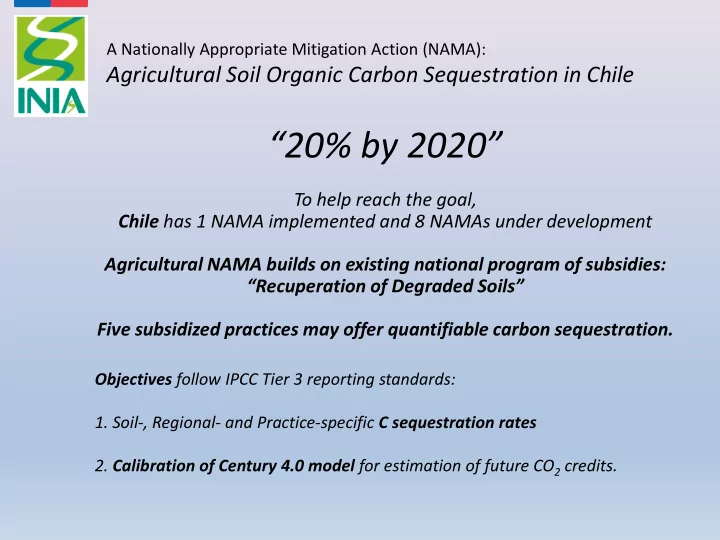
A Nationally Appropriate Mitigation Action (NAMA):

Agricultural Soil Organic Carbon Sequestration in Chile

“20% by 2020”

To help reach the goal, Chile has 1 NAMA implemented and 8 NAMAs under development Agricultural NAMA builds on existing national program of subsidies: “Recuperation of Degraded Soils” Five subsidized practices may offer quantifiable carbon sequestration.

Objectives follow IPCC Tier 3 reporting standards:

  • 1. Soil-, Regional- and Practice-specific C sequestration rates
  • 2. Calibration of Century 4.0 model for estimation of future CO2 credits.
slide-2
SLIDE 2

Methods

Comparisons of Practices:

  • Subsidized Practices vs. Competing Anterior Practices
  • All sites are paired with neighbor for comparison.
  • 15-20 pairs per practice
  • Minimum 5 pairs per Soil-Climate combination
  • ≥ 5 years application
  • n sites with slope < 10% to avoid erosion factor

Statistics Linear Mixed Effects Model Based on Brazilian SOC study by Mello et al. (Nature, 2014). Site pairing ensures balanced dataset and allows modeling. Statistical Variables: SOC, total N, extractable P, soil texture, zone, length of practice Modeling Variables: SOC, total N, extractable P, soil texture, extractable ammonium and nitrate, water retention curve, management history (fert, crops, soil)

slide-3
SLIDE 3

Comparisons of Practices

Subsidized Practice Comparison Practice Geographical Zone(s) Notes

Improved Pasture: P amendments and Clover mixes Unimproved “Natural” Pasture Coastal Range and South Long-term systems without irrigation Crop Residue Incorporation Burning or Straw Removal, depending on Region Central Valley Irrigated Zero Tillage Natural Pasture Andean foothills and South Includes occasional subsoiling or shallow incorporation; unirrigated Compost in crops, primarily vegetables Similar crops under conventional fertilization Central Valley sub-urban (close to markets) Focus on organic farmers; current subsidy pays for finished product; irrigated Stabilized poultry manure in crops Similar crops under conventional fertilization Currently northern coastal range Study required on further available resources; unirrigated

slide-4
SLIDE 4

Results: Possible Policy Effects

Potential NAMA Effects:

  • Credit for Chile in meeting GHG reduction goals
  • Assistance for Chile in development of (Tier 3) modeling

program: I. Organizational Support II. Policy Revision III. Further research as needed IV. Improved soil maps/data V. Improved climate data VI. Integration with global C Seq modeling efforts Domestic Effects:

  • Transition from Burning to Incorporation
  • Assistance to Smallholder Livestock
  • Long-term Pasture-Crop (Zero Tillage) Rotations
  • Compost in Organic Systems and Smallholder Farms
slide-5
SLIDE 5

Instituto de Investigaciones Agropecuarias INIA

Cropland Research Group Meeting Santiago, 17 y 18 de Junio de 2015