2 Cross-linguistic evidence for UH Grammaticality and - - PowerPoint PPT Presentation

2 cross linguistic evidence for uh
SMART_READER_LITE
LIVE PREVIEW

2 Cross-linguistic evidence for UH Grammaticality and - - PowerPoint PPT Presentation

Cristbal Lozano: SLADG presentation, University of Essex, 15 th March 2001 2 Cross-linguistic evidence for UH Grammaticality and [-interpretable] features in Spanish SLA: ! Unaccusatives manifest in different ways in different languages (but out


slide-1
SLIDE 1

Doc: Handouts for SLADG presentation unaccusatives Page 1 of 5

Cristóbal Lozano: SLADG presentation, University of Essex, 15th March 2001 Grammaticality and [-interpretable] features in Spanish SLA: the unergative/unaccusative distinction

1 Assumptions

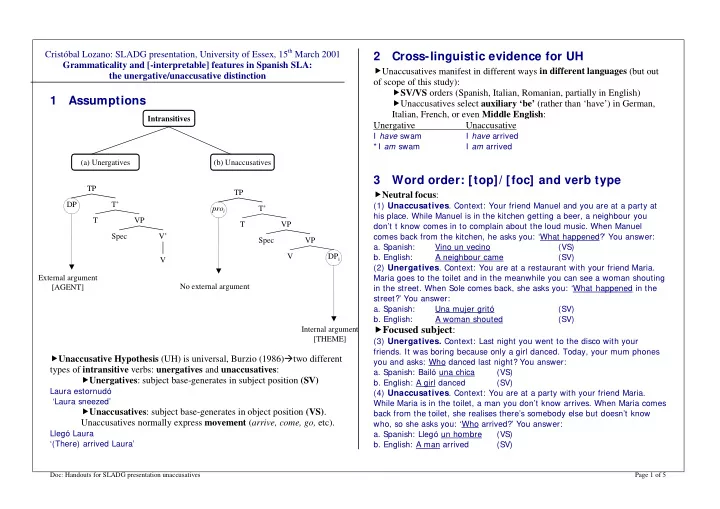
Intransitives (a) Unergatives (b) Unaccusatives T’ DP VP T TP Spec V’ V External argument [AGENT] T’ proi VP T TP Spec No external argument VP V DPi Internal argument [THEME]

!Unaccusative Hypothesis (UH) is universal, Burzio (1986)!two different types of intransitive verbs: unergatives and unaccusatives: !Unergatives: subject base-generates in subject position (SV)

Laura estornudó ‘Laura sneezed’

!Unaccusatives: subject base-generates in object position (VS). Unaccusatives normally express movement (arrive, come, go, etc).

Llegó Laura ‘(There) arrived Laura’

2 Cross-linguistic evidence for UH

!Unaccusatives manifest in different ways in different languages (but out

  • f scope of this study):

!SV/VS orders (Spanish, Italian, Romanian, partially in English) !Unaccusatives select auxiliary ‘be’ (rather than ‘have’) in German, Italian, French, or even Middle English: Unergative Unaccusative

I have swam I have arrived * I am swam I am arrived

3 Word order: [top]/ [foc] and verb type

!Neutral focus:

(1) Unaccusatives. Context: Your friend Manuel and you are at a party at his place. While Manuel is in the kitchen getting a beer, a neighbour you don’t t know comes in to complain about the loud music. When Manuel comes back from the kitchen, he asks you: ‘What happened?’ You answer:

  • a. Spanish:

Vino un vecino (VS)

  • b. English:

A neighbour came (SV) (2) Unergatives. Context: You are at a restaurant with your friend Maria. Maria goes to the toilet and in the meanwhile you can see a woman shouting in the street. When Sole comes back, she asks you: ‘What happened in the street?’ You answer:

  • a. Spanish:

Una mujer gritó (SV)

  • b. English:

A woman shouted (SV)

!Focused subject:

(3) Unergatives. Context: Last night you went to the disco with your

  • friends. It was boring because only a girl danced. Today, your mum phones

you and asks: Who danced last night? You answer:

  • a. Spanish: Bailó una chica

(VS)

  • b. English: A girl danced

(SV) (4) Unaccusatives. Context: You are at a party with your friend Maria. While Maria is in the toilet, a man you don’t know arrives. When Maria comes back from the toilet, she realises there’s somebody else but doesn’t know who, so she asks you: ‘Who arrived?’ You answer:

  • a. Spanish: Llegó un hombre

(VS)

  • b. English: A man arrived

(SV)

slide-2
SLIDE 2

Doc: Handouts for SLADG presentation unaccusatives Page 2 of 5

![± interpretable] features and word order:

!Neutral contexts! [-interpretable] due to universal lexical features of unaccs (VS) vs unergs (SV) !Focused Subject contexts ! [+interpretable] due to movement to satisfy principle [TOP] [FOC] in Spanish (Zubizarreta, 1998) ! therefore VS order with both verbs. !Unergatives:

T’ DP Laura VP T TP Spec tj estornudój V T’ DP Laura VP T TP V’ Spec tj tj XP X estornudój

(a) What happened? (SV) (b) Who sneezed? (VS)

!Unaccusatives:

T’ Spec VP T TP Spec llegój V’ DP V tj Laurai proi

(a) What happened? VS Or (b) Who arrived? (VS)

4 Aims of our study

!Original aim: to test whether learners of Spanish behave differently with [+interpretable] and [-interpretable] verbal (and also pronominal) features: ![+interpretable] more prone to L1 transfer: learners would prefer SV order with both unacc/unerg (instead of expected VS order). ![-interpretable] less prone to L1 transfer as they are universal: learners would prefer in neutral contexts: SV with unergatives and VS with unaccusatives. !These expectations originated from project on attrition (Tsimpli, Sorace & Heycock) !Provisional hypothesis (for today): !(H1) if learners show knowledge of [-interpretable] features, then abstract verbal features located in lexicon are accessible after puberty (Full Access). !(H0) if learners do not show knowledge of [-interpretable] features, then abstract verbal features located in lexicon are not accessible after puberty. !I get a somewhat mixed result (not very good result)

slide-3
SLIDE 3

Doc: H Handouts f s for S SLADG p pres esen entation un

  • n unac

accu cusatives es Pa Page 3 ge 3 of 5

  • f 5

5 Previous SLA studies

!No studies on the nature of [±interpretable] and verb type. However: !Hertel (2000) English learners of Spanish prefer/produce VS with unaccusatives more than with other types of verbs !De Miguel (1993) English native learners of Spanish produce and accept VS order more with unaccusatives than with any other verb type. !Hertel & Pérez-Leroux (1999) English native learners of Spanish accept VS order more with unaccusatives than with unergatives. !Hirakawa (1999) English native learners of Japanese are sensitive to the different interpretation of grammatical subjects with unaccusatives vs. unergatives. ! ! ! !Balcom (1997) Chinese native learners of English preferred passive morphology more with unaccusatives than with any other verb type. !Zobl (1989) learners of English inverted SV order to VS order with unaccusatives (independent of whether this was possible in their L1).

6 Subjects in our study

!Experimental: L1 English learners of L2 Spanish at the Uni. of Essex !Advanced level (University of Wisconsin PT) !n=16 !Control group: Spanish natives (n=15) 7

Method

!Paired GJT: Example:

You are at a party with your friend Laura. Laura leaves the room and at that moment the police arrive because the party is too noisy. When Laura comes back, she asks you: ¿Quién llegó? You answer: (a) La policía llegó. –2 –1 0 + 1 + 2 (b) Llegó la policía. –2 –1 0 + 1 + 2

!Design: 4 conditions: [-interpretable]: neutral “what happened?” [+interpretable]: Foc S “who arrived?” Unerg (a) Susana estornudó (b) ! Estornudó Susana (a) ! Susana estornudó (b) Estornudó Susana Unacc (a) ! Susana llegó (b) Llegó Susana (a) ! Susana llegó (b) Llegó Susana !6 items for each condition (after ‘Darwin’ test): Unergatives Unaccusatives bailar ‘to dance’ entrar ‘to come in’ gritar ‘to shout ’ llegar ‘to arrive’ dormir ‘to sleep’ salir ‘to leave’ reir ‘to laugh’ venir ‘to come’ llorar ‘to cry’ volver ‘to return’ estornudar ‘sneeze’ escapar ‘to escape’ !6 [-interpretable] and 6 [+interpretable] unacussative conditions !6 [-interpretable] and 6 [-interpretable] unergative conditions !All items are randomised (‘blocking’ procedure, Cowart, 1997) !There are 2 versions for each task, so as to minimise order-of-presentation effects.

8 Data analysis

!Data were coded in MS Excel (v. 97) and analysed with SPSS (v.9.0). !Tests I haven’t performed yet: non-parametric tests to check sample’s normality of distribution. !Within-group analysis (for both word orders in a group): paired samples t- test !Between-group analysis (for each word order in a condition): GLM univariate with posthocs (in my date I’ve got 3 groups: Spanish, English and Greek, though Greeks won’t be analysed here)

slide-4
SLIDE 4

Doc: Handouts for SLADG presentation unaccusatives Page 4 of 5

9 Results

! ! ! !Unaccs [-interpretable]

Group

English Spanish

Mean

2.0 1.5 1.0 .5 0.0

  • .5
  • 1.0
  • 1.5
  • 2.0

Unac Neutral: VS Unac Neutral: !SV

!Spanish: VS different from !SV (p=0.01) !English: VS not different from !SV (p=0.34) !HOWEVER, let’s focus on grammatical/ungrammatical !VS not different between Spanish-English (p=0.84) !!SV different between Spanish-English (p=0.03) [not excessively] !CONCLUSION: !Spanish natives show knowledge of [-interp] features since they distinguish gramm./ungramm. word order !English natives don’t show complete knowledge of [-interp], although they show preference like Spanish natives. !Grammatical: both groups show same knowledge !Ungrammatical: Spanish group according to hypothesis, English group indeterminate intuition !Feature transfer? If so, we’d expect English group to prefer !SV order to VS order, which is not exactly the case.

! ! ! !Unergs [-interpretable]

Group

English Spanish

Mean

2.0 1.5 1.0 .5 0.0

  • .5
  • 1.0
  • 1.5
  • 2.0

Unerg Neutral: !VS Unerg Neutral: SV

!Spanish: !VS different from SV (p<0.01) !English: VS not different from !SV (p=0.15) !HOWEVER, let’s focus on grammatical/ungrammatical !!VS different between Spanish-English (p=0.01) !SV different between Spanish-English (p<0.03) but not too significant !CONCLUSION: !Spanish natives show knowledge of [-interp] features since they distinguish gramm./ungramm. word order !English natives don’t show complete knowledge of [-interp], although they show preference like Spanish natives. !Grammatical: both groups show just about same knowledge. !Ungrammatical: Spanish group according to hypothesis, English group indeterminate intuition !Feature transfer? Difficult to decide in this case since SV is grammatical. !Interesting: English natives do prefer !VS with unergatives

slide-5
SLIDE 5

Doc: Handouts for SLADG presentation unaccusatives Page 5 of 5

10 Conclusion

!Learners (advance level) do not seem to be able to make full use of [-interp] features located in the verbal lexicon!support Hawkins and Chan’s (1997) FFFH!after all, functional features in their study are [-interp] !However between groups: learners behave similarly to natives in grammatical contexts; but differently in ungrammatical contexts !need to research it further !However within-groups: learners prefer grammatical constructions to ungrammatical ones!L1-feature transfer not necessarily the case. !Sorace (1993) English subjects show indeterminate intuitions (=divergent representations) with unaccusatives ‘regardless of whether they are grammatical or ungrammatical’ (p. 42) !To do: !Discard some subjects from analysis !Analyse data in more detail !Compare unacc/unerg results with OPC results !My guess for unacc/unerg and OPC (pronouns) results: !IF items are grammatical, THEN Spanish and English groups behave similarly with both [+interpretable] and [- interpretable] !IF items are ungrammatical, THEN Spanish group behaves according to theory; English group shows indeterminate intuitions (although they behave towards the native norm)

11 References

!Balcom, P. (1997): Why is this happened? Passive morphology and

  • unaccustivity. Second Language Research, 13(1): 1-9.

! ! ! !Burzio, L. (1986): Italian Syntax: A Government-Binding Approach. Dordrecht: Reidel. !Cowart, W. (1997). Experimental Syntax: Applying Objective Methods to Sentence Judgments. Thousand Oaks, CA.: SAGE. !De Miguel, E. (1993): Construcciones ergativas e inversión en la lengua y la interlengua española. In J. M. Liceras (ed): La lingüística y el análisis de los sistemas no nativos (pp178-195). Ottawa: Dovehouse. !Hawkins and Chan (1997) !Hertel, T. J. (2000). The second language acquisition of Spanish word

  • rder: lexical and discourse factors. PhD dissertation, Pennsylvania State

University. !Hertel, T. J. and Pérez-Leroux (1999): The second language acquisition

  • f Spanish word order for unaccusative verbs. BUCLD 23 Proceedings, 228-

239. !Hirakawa, M. (1999): L2 acquisition of Japanese unaccusative verbs by speakers of English and Chinese. In K. Kano (ed): The acquisition of Japanese as a second language. Amsterdam: John Benjamins. !Tsimpli, I.-M., Sorace, A., Heycock (2000). Proposal presented to the ESRC on attrition and features. !Zobl, H. (1989): Canonical typological structures and ergativity in English L2 acquisition. In S. M. Gass & J. Schchter (eds): Linguistic perspectives on second language acquisition (pp 203-211). Cambridge: CUP. ! ! ! !Zubizarreta, M. L. (1998). Prosody, focus and word order. Cambridge, Mass: MIT Press.