1D: Midpoint Displacement 2D: Diamond-Square Particle Systems - - PowerPoint PPT Presentation

1d midpoint displacement 2d diamond square particle
SMART_READER_LITE
LIVE PREVIEW

1D: Midpoint Displacement 2D: Diamond-Square Particle Systems - - PowerPoint PPT Presentation

University of British Columbia Procedural Textures Procedural Modeling CPSC 314 Computer Graphics textures, geometry generate image on the fly, instead of Jan-Apr 2016 loading from disk nonprocedural: explicitly stored in


slide-1
SLIDE 1

http://www.ugrad.cs.ubc.ca/~cs314/Vjan2016

Procedural, Collision

University of British Columbia CPSC 314 Computer Graphics Jan-Apr 2016 Tamara Munzner

2

Procedural Approaches

3

Procedural Textures

  • generate “image” on the fly, instead of

loading from disk

  • often saves space
  • allows arbitrary level of detail
4

Procedural Modeling

  • textures, geometry
  • nonprocedural: explicitly stored in memory
  • procedural approach
  • compute something on the fly
  • often less memory cost
  • visual richness
  • fractals, particle systems, noise
5

Fractal Landscapes

  • fractals: not just for “showing math”
  • triangle subdivision
  • vertex displacement
  • recursive until termination condition

http://www.fractal-landscapes.co.uk/images.html

6

Self-Similarity

  • infinite nesting of structure on all scales
7

Fractal Dimension

  • D = log(N)/log(r)

N = measure, r = subdivision scale

  • Hausdorff dimension: noninteger

D = log(N)/log(r) D = log(4)/log(3) = 1.26 coastline of Britain Koch snowflake http://www.vanderbilt.edu/AnS/psychology/cogsci/chaos/workshop/Fractals.html

8

Language-Based Generation

  • L-Systems: after Lindenmayer
  • Koch snowflake: F :- FLFRRFLF
  • F: forward, R: right, L: left
  • Mariano’s Bush:

F=FF-[-F+F+F]+[+F-F-F] }

  • angle 16

http://spanky.triumf.ca/www/fractint/lsys/plants.html

9

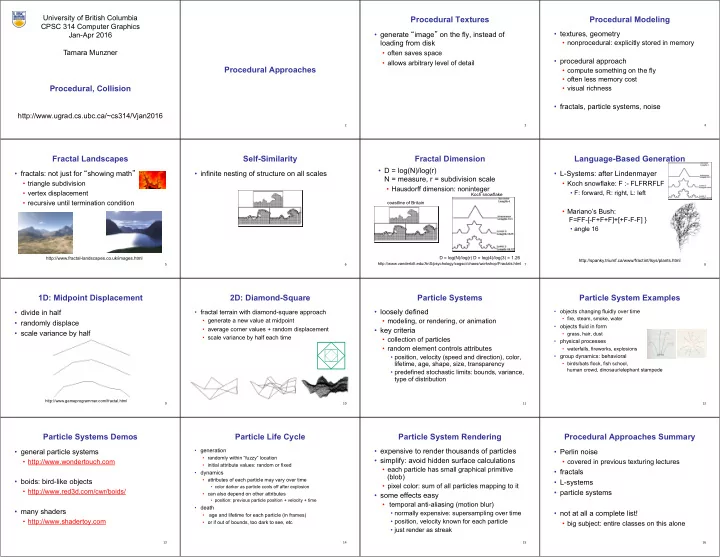
1D: Midpoint Displacement

  • divide in half
  • randomly displace
  • scale variance by half

http://www.gameprogrammer.com/fractal.html

10

2D: Diamond-Square

  • fractal terrain with diamond-square approach
  • generate a new value at midpoint
  • average corner values + random displacement
  • scale variance by half each time
11

Particle Systems

  • loosely defined
  • modeling, or rendering, or animation
  • key criteria
  • collection of particles
  • random element controls attributes
  • position, velocity (speed and direction), color,

lifetime, age, shape, size, transparency

  • predefined stochastic limits: bounds, variance,

type of distribution

12

Particle System Examples

  • objects changing fluidly over time
  • fire, steam, smoke, water
  • objects fluid in form
  • grass, hair, dust
  • physical processes
  • waterfalls, fireworks, explosions
  • group dynamics: behavioral
  • birds/bats flock, fish school,

human crowd, dinosaur/elephant stampede

13

Particle Systems Demos

  • general particle systems
  • http://www.wondertouch.com
  • boids: bird-like objects
  • http://www.red3d.com/cwr/boids/
  • many shaders
  • http://www.shadertoy.com
14

Particle Life Cycle

  • generation
  • randomly within “fuzzy” location
  • initial attribute values: random or fixed
  • dynamics
  • attributes of each particle may vary over time
  • color darker as particle cools off after explosion
  • can also depend on other attributes
  • position: previous particle position + velocity + time
  • death
  • age and lifetime for each particle (in frames)
  • or if out of bounds, too dark to see, etc
15

Particle System Rendering

  • expensive to render thousands of particles
  • simplify: avoid hidden surface calculations
  • each particle has small graphical primitive

(blob)

  • pixel color: sum of all particles mapping to it
  • some effects easy
  • temporal anti-aliasing (motion blur)
  • normally expensive: supersampling over time
  • position, velocity known for each particle
  • just render as streak
16

Procedural Approaches Summary

  • Perlin noise
  • covered in previous texturing lectures
  • fractals
  • L-systems
  • particle systems
  • not at all a complete list!
  • big subject: entire classes on this alone
slide-2
SLIDE 2 17

Collision/Acceleration

18

Collision Detection

  • do objects collide/intersect?
  • static, dynamic
  • picking is simple special case of general

collision detection problem (covered next)

  • check if ray cast from cursor position collides

with any object in scene

  • simple shooting
  • projectile arrives instantly, zero travel time
  • better: projectile and target move over time
  • see if collides with object during trajectory
19

Collision Detection Applications

  • determining if player hit wall/floor/obstacle
  • terrain following (floor), maze games (walls)
  • stop them walking through it
  • determining if projectile has hit target
  • determining if player has hit target
  • punch/kick (desired), car crash (not desired)
  • detecting points at which behavior should change
  • car in the air returning to the ground
  • cleaning up animation
  • making sure a motion-captured character’s feet do not pass

through the floor

  • simulating motion
  • physics, or cloth, or something else
20

From Simple to Complex

  • boundary check
  • perimeter of world vs. viewpoint or objects
  • 2D/3D absolute coordinates for bounds
  • simple point in space for viewpoint/objects
  • set of fixed barriers
  • walls in maze game
  • 2D/3D absolute coordinate system
  • set of moveable objects
  • one object against set of items
  • missile vs. several tanks
  • multiple objects against each other
  • punching game: arms and legs of players
  • room of bouncing balls
21

Naive General Collision Detection

  • for each object i containing polygons p
  • test for intersection with object j containing

polygons q

  • for polyhedral objects, test if object i

penetrates surface of j

  • test if vertices of i straddle polygon q of j
  • if straddle, then test intersection of polygon q

with polygon p of object i

  • very expensive! O(n2)
22

Fundamental Design Principles

  • fast simple tests first, eliminate many potential collisions
  • test bounding volumes before testing individual triangles
  • exploit locality, eliminate many potential collisions
  • use cell structures to avoid considering distant objects
  • use as much information as possible about geometry
  • spheres have special properties that speed collision testing
  • exploit coherence between successive tests
  • things don’t typically change much between two frames
23

Example: Player-Wall Collisions

  • first person games must prevent the player

from walking through walls and other

  • bstacles
  • most general case: player and walls are

polygonal meshes

  • each frame, player moves along path not

known in advance

  • assume piecewise linear: straight steps on

each frame

  • assume player’s motion could be fast
24

Stupid Algorithm

  • on each step, do a general mesh-to-mesh

intersection test to find out if the player intersects the wall

  • if they do, refuse to allow the player to move
  • problems with this approach? how can we

improve:

  • in response?
  • in speed?
25

Collision Response

  • frustrating to just stop
  • for player motions, often best thing to do is move

player tangentially to obstacle

  • do recursively to ensure all collisions caught
  • find time and place of collision
  • adjust velocity of player
  • repeat with new velocity, start time, start position

(reduced time interval)

  • handling multiple contacts at same time
  • find a direction that is tangential to all contacts
26

Accelerating Collision Detection

  • two kinds of approaches (many others also)
  • collision proxies / bounding volumes
  • spatial data structures to localize
  • used for both 2D and 3D
  • used to accelerate many things, not just

collision detection

  • raytracing
  • culling geometry before using standard

rendering pipeline

27

Collision Proxies

  • proxy: something that takes place of real object
  • cheaper than general mesh-mesh intersections
  • collision proxy (bounding volume) is piece of geometry used

to represent complex object for purposes of finding collision

  • if proxy collides, object is said to collide
  • collision points mapped back onto original object
  • good proxy: cheap to compute collisions for, tight fit to the real

geometry

  • common proxies: sphere, cylinder, box, ellipsoid
  • consider: fat player, thin player, rocket, car …
28

Trade-off in Choosing Proxies

increasing complexity & tightness of fit decreasing cost of (overlap tests + proxy update)

AABB OBB Sphere Convex Hull 6-dop

  • AABB: axis aligned bounding box
  • OBB: oriented bounding box, arbitrary alignment
  • k-dops – shapes bounded by planes at fixed orientations
  • discrete orientation polytope
29

Pair Reduction

  • want proxy for any moving object requiring collision

detection

  • before pair of objects tested in any detail, quickly test if

proxies intersect

  • when lots of moving objects, even this quick bounding

sphere test can take too long: N2 times if there are N objects

  • reducing this N2 problem is called pair reduction
  • pair testing isn’t a big issue until N>50 or so…
30

Spatial Data Structures

  • can only hit something that is close
  • spatial data structures tell you what is close

to object

  • uniform grid, octrees, kd-trees, BSP trees
  • bounding volume hierarchies
  • OBB trees
  • for player-wall problem, typically use same

spatial data structure as for rendering

  • BSP trees most common
31

Uniform Grids

  • axis-aligned
  • divide space uniformly
32

Quadtrees/Octrees

  • axis-aligned
  • subdivide until no points in cell
slide-3
SLIDE 3 33

KD Trees

  • axis-aligned
  • subdivide in alternating dimensions
34

BSP Trees

  • planes at arbitrary orientation
  • covered in upcoming hidden surfaces

lectures

35

Bounding Volume Hierarchies

  • covered in previous raytracing lecture
36

OBB Trees

  • oriented bounding boxes
37

Related Reading

  • Real-Time Rendering
  • Tomas Moller and Eric Haines
  • on reserve in CICSR reading room
38

Acknowledgement

  • slides borrow heavily from
  • Stephen Chenney, (UWisc CS679)
  • http://www.cs.wisc.edu/~schenney/courses/cs679-f2003/lectures/cs679-22.ppt
  • slides borrow lightly from
  • Steve Rotenberg, (UCSD CSE169)
  • http://graphics.ucsd.edu/courses/cse169_w05/CSE169_17.ppt