? 190 ATP or ATP-analogues 120 + Hp DnaB ssDNA Laboratory of - - PowerPoint PPT Presentation

190 atp or atp analogues 120 hp dnab ssdna laboratory of
SMART_READER_LITE
LIVE PREVIEW

? 190 ATP or ATP-analogues 120 + Hp DnaB ssDNA Laboratory of - - PowerPoint PPT Presentation

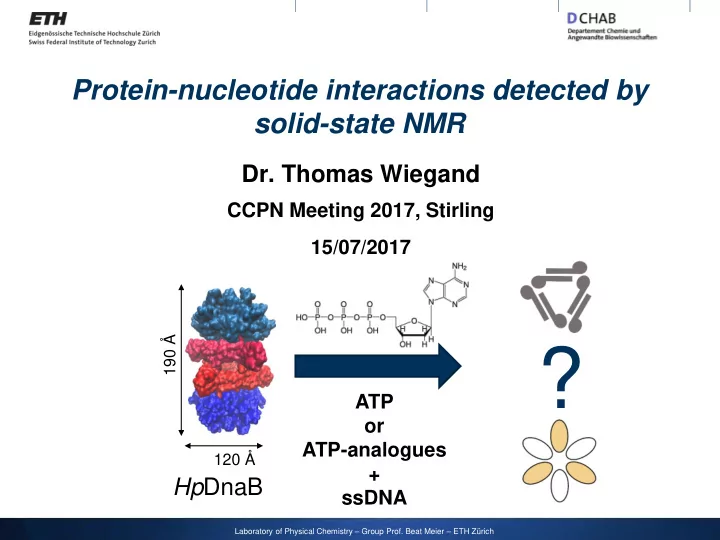
Protein-nucleotide interactions detected by solid-state NMR Dr. Thomas Wiegand CCPN Meeting 2017, Stirling 15/07/2017 ? 190 ATP or ATP-analogues 120 + Hp DnaB ssDNA Laboratory of Physical Chemistry Group Prof. Beat Meier


slide-1
SLIDE 1

Protein-nucleotide interactions detected by solid-state NMR

  • Dr. Thomas Wiegand

CCPN Meeting 2017, Stirling 15/07/2017

Laboratory of Physical Chemistry – Group Prof. Beat Meier – ETH Zürich

120 Å 190 Å

HpDnaB

ATP

  • r

ATP-analogues + ssDNA

?

slide-2
SLIDE 2

2 Laboratory of Physical Chemistry – Group Prof. Beat Meier – ETH Zürich

DnaB helicases unwind double-stranded DNA

  • Structural consequences of nucleotide binding (ATP & DNA)?
  • Structure-function relationships in protein engines?
  • How does DNA replication work on a molecular level?

Adapted from: http://biochem.pepperdine.edu/dokuwiki/doku.php?id=chem331:dnab_helicase

DnaB helicase Topoisomerase Parental strand 3’ 5’ DnaG primase

Taken from: http://love-life- science.blogspot.ch/2014/09/unzipping

  • of-dna.html
slide-3
SLIDE 3

3

ATP-hydrolysis is coupled to molecular functioning

Walker, ..., Gay, The EMBO Journal, 1982, 1, 945-951; Spies, DNA Helicases and DNA Motor Proteins, Springer New York, 2012.

DNA translocation

slide-4
SLIDE 4

4

The helicase from Helicobacter pylori forms dodecameric assemblies

Strycharska, ..., Berger, Molecular Cell, 2013, 52, 844-854, Bazin, …, Terradot, Nucleic Acids Res., 2015, 43, 8564-8576.

6 x CTD 6 x NTD 6 x CTD 6 x NTD Molecular mass of 672 kDa, 488 aa/ monomer

120 Å 190 Å

SF4 helicase

Homology model for the HpDnaB:ADP complex (based on the AaDnaB:ADP crystal structure)

slide-5
SLIDE 5

5

Do the nucleotides bind to the protein? Where do they bind? What are the structural consequences of nucleotide binding?

No single-crystals available Solid-state NMR on sedimented samples

Questions to be addressed by solid-state NMR

slide-6
SLIDE 6

6

Approaches to probe protein-nucleotide interactions

Diamagnetic NMR (e.g. 31P MAS;13C/15N CSPs;

15N,13C NCX; 13C,31P and 15N,31P correlations)

Paramagnetic NMR (e.g. substitution of the Mg2+ cofactor by Mn2+ or Co2+) Dynamic nuclear polarization (DNP) EPR (e.g. Mn2+-Mn2+ DEER)

DNA binding to HpDnaB

ATP/DNA binding

slide-7
SLIDE 7

7

Part 1 Diamagnetic solid-state NMR

How to monitor nucleotide binding? How to distinguish between bound und unbound nucleotides?

slide-8
SLIDE 8

8 8 Laboratory of Physical Chemistry – Group Prof. Beat Meier – ETH Zürich

31P NMR to distinguish between bound and unbound nucleotides

31P,1H cross-polarization (CP)

experiments detect bound AMP-PNP in slightly different conformations

Solution-phase spectra @ 7.05 T Solid-phase spectra @ 11.74 T

31P direct pulsed experiments detect

AMP-PNP and AMP-PN in the solution phase of the NMR rotor

31P solution-state experiments allow

to assign the resonances of AMP- PNP/AMP-PN

HpDnaB + 5mM AMP-PNP + 5mM MgCl2 HpDnaB + 5mM AMP-PNP + 5mM MgCl2 5mM AMP-PNP + 5mM MgCl2

Wiegand,...,Terradot, Böckmann, Meier, Angew. Chem. Int. Ed., 2016, 55, 14164-14168.

slide-9
SLIDE 9

9 9 Laboratory of Physical Chemistry – Group Prof. Beat Meier – ETH Zürich

31P NMR: Does ssDNA bind to the helicase?

31P,1H cross-polarization (CP)

experiments detect bound ssDNA to the helicase

Solution-phase spectra @ 7.05 T Solid-phase spectra @ 11.74 T

31P direct pulsed experiments detect

hydrolyzed AMP-PNP (AMP-PN) in the solution-phase of the NMR rotor

31P solution-state experiments allow

to detect unbound ssDNA

HpDnaB + 5mM AMP-PNP + 5mM MgCl2 + 0.5mM ssDNA HpDnaB + 5mM AMP-PNP + 5mM MgCl2 + 0.5mM ssDNA 5mM MgCl2 + 0.5mM ssDNA

Wiegand,...,Terradot, Böckmann, Meier, Angew. Chem. Int. Ed., 2016, 55, 14164-14168.
slide-10
SLIDE 10

10

31P chemical shifts are very sensitive to the choice of the ATP-analogue

31P,1H CP-MAS NMR @ 11.74 T

  • 31P,1H cross-polarization

experiments allow to detect the bound ATP-analogues.

  • Structural inhomogeneities
  • bserved upon AMP-PNP

binding.

  • ATP gets hydrolyzed during rotor

filling.

pre-hydrolytic “transition state” post-hydrolytic

slide-11
SLIDE 11

11

DNA-binding monitored by 31P,1H cross-polarization experiments

31P,1H CP-MAS NMR

@ 11.74 T

DnaB + ATP-analogue + ssDNA

pre-hydrolytic “transition state” post-hydrolytic

( )

DNA binding

slide-12
SLIDE 12

12

Arginine sidechains of the protein bind to ssDNA

15N-13C NCX @

850 MHz

arginine sidechain phosphate backbone of DNA

slide-13
SLIDE 13

13

CSPs indicate nucleotide binding & conformational switch of the CTD

13C-13C 20 ms DARR @ 850 MHz

CSP > 0.3 ppm HpDnaB HpDnaB + AMP-PNP + MgCl2

Chemical-shift perturbations (CSPs)

  • Consequence of nucleotide-binding
  • Related to allosteric effects

+ 3D NMR experiments

Wiegand,...,Terradot, Böckmann, Meier, Angew. Chem. Int. Ed., 2016, 55, 14164-14168.

slide-14
SLIDE 14

14 14 Laboratory of Physical Chemistry – Group Prof. Beat Meier – ETH Zürich

How to assign such a large system? Building block approach

NTD

1-153

CTD

152-488

FL

+ =

δ2(13C)/ ppm δ1(13C)/ ppm

?

Tuesday, 08/09/15

Are the domains conserved? Transfer of assignments between NTD (assignment available) and FL HpDnaB possible?

Wiegand, Gardiennet, .., Terradot, Böckmann, Meier, Biomol. NMR Assign., 2016, 10, 13-23; Wiegand, Gardiennet, ...,Terradot, Böckmann, Meier, J. Biomol. NMR, 2016, 65, 79-86.

13C-13C 20 ms DARR @ 850 MHz

slide-15
SLIDE 15

15

Averaged absolute 13C and 15N chemical shift differences between NTD and FL HpDnaB

15 Laboratory of Physical Chemistry – Group Prof. Beat Meier – ETH Zürich

Building block approach: Assignment of the full-length protein

Wiegand, Gardiennet, ...,Terradot, Böckmann, Meier, J. Biomol. NMR, 2016, 65, 79-86.

And the CTD? Sequential assignment of the full-length protein

Structural differences between isolated NTD and NTD in FL DnaB

slide-16
SLIDE 16

16

Part 2 Paramagnetic solid-state NMR to determine protein-ATP interactions

Where does the metal ion bind?

slide-17
SLIDE 17

17

Paramagnetic solid-state NMR allows to identify residues in NBD

Mn2+: Paramagnetic relaxation enhancements (PREs) Co2+: Pseudo-contact shifts (PCSs)

Tamaki, ..., Demura, J. Biomol. NMR 2016, 64, 87-101.

  • Ipara/Idia ratio for 2D 13C-13C

DARR

  • B0=20.0 T
  • T1e(Mn2+)= 30 ns
  • T1e(Co2+)= 0.1 ns
  • ICP, It1, It2, IDARR
  • experimental conditions
slide-18
SLIDE 18

18 18 Laboratory of Physical Chemistry – Group Prof. Beat Meier – ETH Zürich

NMR: Diamagnetic Mg2+ can be substituted by paramagnetic Mn2+ ions

13C-13C 20 ms DARR @ 850 MHz

3 types of resonances: a) Not-influenced by AMP-PNP:Mn2+ binding (e.g. 24A) b) Attenuated upon AMP-PNP:Mn2+ binding (e.g. 228A) c) Broadened beyond detection upon AMP-PNP:Mn2+ binding (e.g. 203A, 351A)

Wiegand, Lacabanne, Keller...,Terradot, Jeschke, Böckmann, Meier, Angew. Chem. Int. Ed., 2017, 56, 3369-3373.

slide-19
SLIDE 19

19 19 Laboratory of Physical Chemistry – Group Prof. Beat Meier – ETH Zürich

How to determine PREs with CCPN?

  • Assign 3D spectra of diamagnetic protein sample
  • Scale the spectra (use a resonance not affected by PREs, here 34V)
  • Assign 3D spectra of paramagnetic protein sample
  • Extract intensities from peak assignment lists

Wiegand, Lacabanne, Keller...,Terradot, Jeschke, Böckmann, Meier, Angew. Chem. Int. Ed., 2017, 56, 3369-3373.

slide-20
SLIDE 20

20 20 Laboratory of Physical Chemistry – Group Prof. Beat Meier – ETH Zürich

Site-specific determination of PREs from 3D experiments

Wiegand, Lacabanne, Keller...,Terradot, Jeschke, Böckmann, Meier, Angew. Chem. Int. Ed., 2017, 56, 3369-3373.

Residues with effective distances < 15 Å (distance between Cα and the two nearest metal centers)

slide-21
SLIDE 21

21

Paramagnetic solid-state NMR allows to identify residues in NBD

Long-range distance information (> 20 Å) becomes accessible, nucleotide binding domains are identified.

Wiegand, Lacabanne, Keller...,Terradot, Jeschke, Böckmann, Meier, Angew. Chem. Int. Ed., 2017, 56, 3369-3373.

slide-22
SLIDE 22

22

Part 3

31P,13C correlation experiments to probe

protein-nucleotide interactions

Where do the ATP-analogues and DNA bind?

slide-23
SLIDE 23

23

MAS-DNP for studying protein-DNA interactions

Dynamic nuclear polarization (DNP)- enhanced MAS

31P-13C/15N correlations suffer from weak NMR

signal

Collaboration with Prof. C. Copéret (ETH Zürich) Taken from: http://www.coperetgroup.ethz.ch/research/dynam ic-nuclear-polarization--dnp--.html

slide-24
SLIDE 24

24

MAS-DNP for studying protein-DNA interactions

Collaboration with Prof. C. Copéret (ETH Zürich)

HpDnaB:ADP:ssDNA

ρ= (SNDNP/SNNMR)

Ravera, ..., Griffin, Luchinat, Bertini, J. Am. Chem. Soc., 2013, 135, 1641-1644; Wiegand, ..., Copéret, Böckmann, Meier, J. Biomol. NMR, submitted.

Highest sensitivity without d8-glycerol. 2 mM AMUpol radical concentration (not optimized).

slide-25
SLIDE 25

25

MAS-DNP for studying protein-DNA interactions

Collaboration with Prof. C. Copéret (ETH Zürich)

10.0 kHz @ 14.1 T 395 GHz gyrotron

Measurement time 21 h.

Morag, ..., Goldbourt, JACS, 2014, 136, 2292-2301; Wiegand, ..., Copéret, Böckmann, Meier, J. Biomol. NMR, submitted.

Lowest contour level: 2.1 times noise RMSD

HpDnaB:ADP:ssDNA

slide-26
SLIDE 26

26

Any chance for probing DNA interactions under conventional NMR conditions (in reasonable measurement time)?

X

CHHP & NHHP

Morag, ..., Goldbourt, JACS, 2014, 136, 2292-2301.

slide-27
SLIDE 27

27

CHHP 2D experiments for studying protein-DNA interactions

Measurement time 13 d.

200 μs H-H spin diffusion time 11.74 T @ 17.0 kHz

HpDnaB:ADP:AlF4

  • :ssDNA
slide-28
SLIDE 28

28

Conclusions

  • 31P NMR allows to monitor nucleotide binding
  • 13C/15N CSPs highlight conformational

changes

  • Paramagnetic NMR allows to probe protein-

ATP interactions

  • DNA binding can be detected in 31P/13C

correlation experiments

slide-29
SLIDE 29
  • Prof. Beat H. Meier

Riccardo Cadalbert

  • Prof. Gunnar Jeschke

Katharina Keller

  • Dr. Maxim Yulikov
  • Prof. Christophe Copéret
  • Dr. Anja Böckmann

Denis Lacabanne

  • Dr. Laurent Terradot
  • Dr. Joanna Timmins

(Grenoble) Lyon