
SLIDE 1
18TH INTERNATIONAL CONFERENCE ON COMPOSITE MATERIALS
1 Introduction Fiber Reinforced Plastics (FRP) has been used by Kockums' shipyard in the manufacturing of ships
- ver 35 years, during which time is has been proven
to be durable and practical. The light weight makes it a more and more attractive material as energy and material expenditure decreases are required. A special application is the Composite Superstructure Concept [1] where composite materials are added on top of a steel hull, which decreases the weight and running costs considerably, and makes it possible to even add extra levels while keeping the same center
- f gravity.
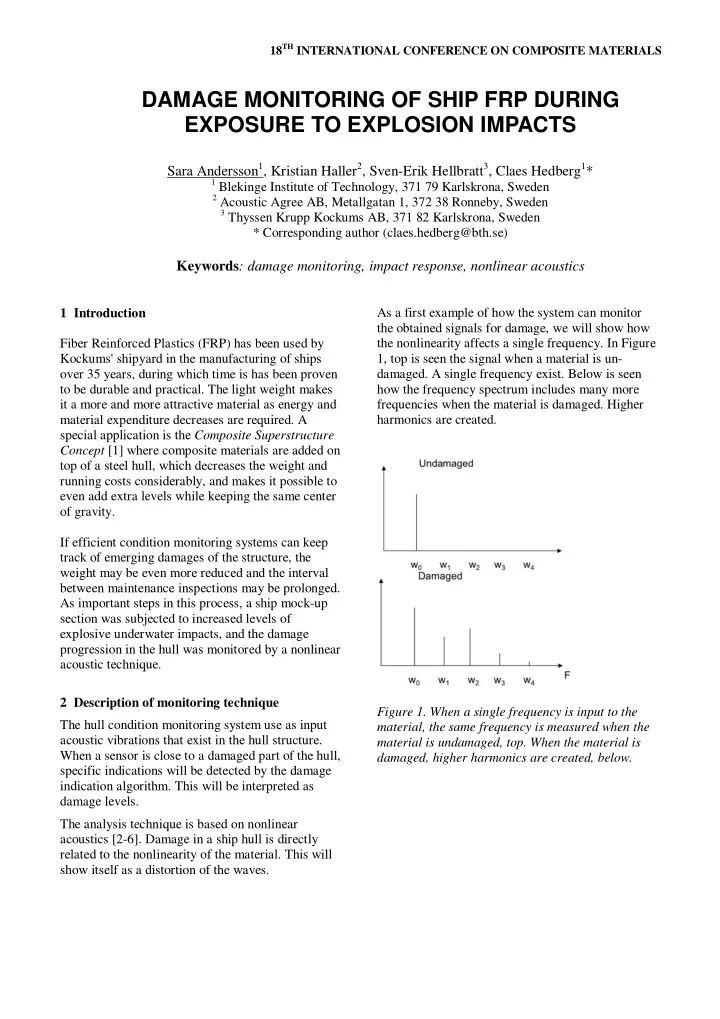
If efficient condition monitoring systems can keep track of emerging damages of the structure, the weight may be even more reduced and the interval between maintenance inspections may be prolonged. As important steps in this process, a ship mock-up section was subjected to increased levels of explosive underwater impacts, and the damage progression in the hull was monitored by a nonlinear acoustic technique. 2 Description of monitoring technique The hull condition monitoring system use as input acoustic vibrations that exist in the hull structure. When a sensor is close to a damaged part of the hull, specific indications will be detected by the damage indication algorithm. This will be interpreted as damage levels. The analysis technique is based on nonlinear acoustics [2-6]. Damage in a ship hull is directly related to the nonlinearity of the material. This will show itself as a distortion of the waves. As a first example of how the system can monitor the obtained signals for damage, we will show how the nonlinearity affects a single frequency. In Figure 1, top is seen the signal when a material is un-
- damaged. A single frequency exist. Below is seen
how the frequency spectrum includes many more frequencies when the material is damaged. Higher harmonics are created. Figure 1. When a single frequency is input to the material, the same frequency is measured when the material is undamaged, top. When the material is damaged, higher harmonics are created, below.
DAMAGE MONITORING OF SHIP FRP DURING EXPOSURE TO EXPLOSION IMPACTS
Sara Andersson1, Kristian Haller2, Sven-Erik Hellbratt3, Claes Hedberg1*
1 Blekinge Institute of Technology, 371 79 Karlskrona, Sweden 2 Acoustic Agree AB, Metallgatan 1, 372 38 Ronneby, Sweden 3 Thyssen Krupp Kockums AB, 371 82 Karlskrona, Sweden