15/02/2018 The role of the science-policy-society interface in the - - PDF document

15 02 2018
SMART_READER_LITE
LIVE PREVIEW

15/02/2018 The role of the science-policy-society interface in the - - PDF document

15/02/2018 The role of the science-policy-society interface in the 2030 Agenda New York, 25.09.2015 Journes Biennales des Goscience et de lEnvironnement, Universit de Lausanne Peter Messerli, Centre for Development and Environment


slide-1
SLIDE 1

15/02/2018 1

The role of the science-policy-society interface in the 2030 Agenda

Journées Biennales des Géoscience et de l’Environnement, Université de Lausanne Peter Messerli, Centre for Development and Environment (CDE) Universität Bern

New York, 25.09.2015

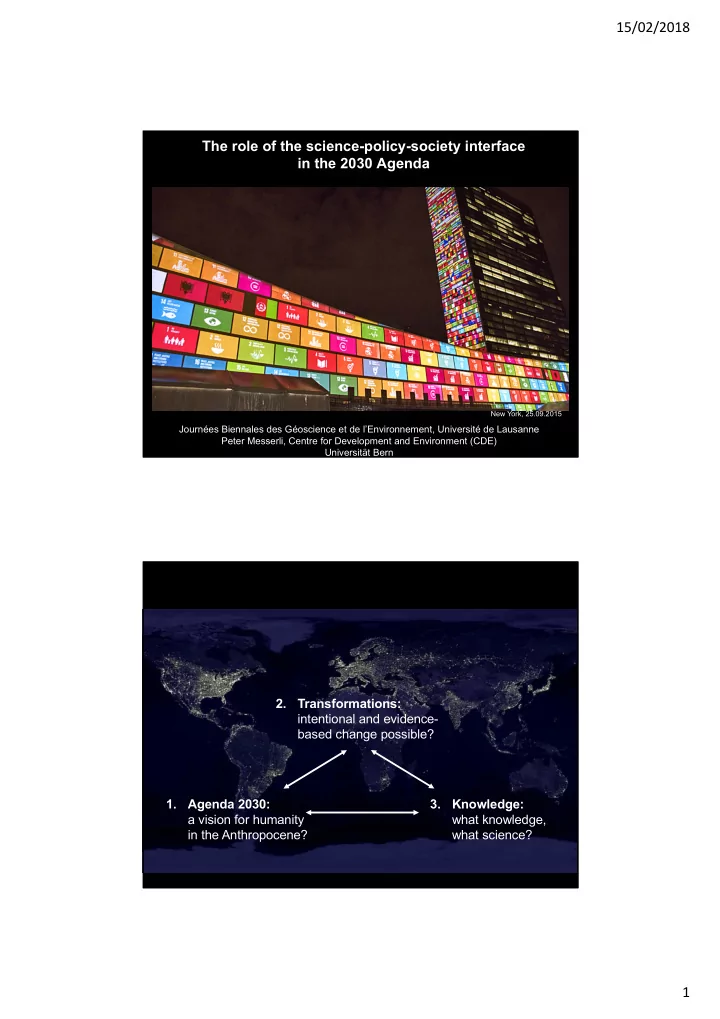
1. Agenda 2030: a vision for humanity in the Anthropocene? 2. Transformations: intentional and evidence- based change possible? 3. Knowledge: what knowledge, what science?

slide-2
SLIDE 2

15/02/2018 2

«Humans’ ability to do has outstripped its ability to understand»

  • 1. Agenda 2030 – a vision for humanity in the Anthropocene?

Ox Oxfam am 2012 bas ased on Google NG NGrams

Su Sustain inable le Develop lopment – th the key concept t of f our ti times?

slide-3
SLIDE 3

15/02/2018 3

Un Understa tanding g susta tainable deve velopment: t: exa example e of land use e changes es in Southea east Asia

Th The pat ath to

  • the 2030

2030 Ag Agenda

>

1962 Silent Spring

>

1967 Environmental Defense Fund

>

1968 Biosphere UNESCO Conf.

>

1968 The Population Bomb

>

1969 Friends of the Earth

>

1969 National Environmental Policy Act

>

1970 First Earth Day

>

1971 Greenpeace starts in Canada

>

1971 Polluter pays principle

>

1971 Only One Earth & Founex Report

>

1972 Limits to Growth

>

1972 UNCHE Stockholm

>

1973 OPEC oil crisis

>

1973 Chipko movement in India

>

1974 Latin American World Model

>

1975 Worldwatch Institute

>

1976 UN-Habitat

>

1977 UN Conference on Desertification

>

1979 Three Mile Island nuclear accident

>

1980 World Conservation Strategy

>

1980 Global 2000 report

6 >

1982 International debt crisis

>

1982 World Resources Institute

>

1984 Drought in Ethiopia

>

1986 Chernobyl nuclear accident

>

1987 Our Common Future

>

1988 IPCC founded

>

1991 Global Environment Facility

>

1992 Earth Summit

>

1995 World Trade Organization (WTO)

>

1995 World Summit for Social Development

>

1995 Fourth World Conference on Women

>

2000 UN Millennium Development Goals

>

2002 World Summit on S. Development

>

2005 Kyoto Protocol enters into force

>

2005 Millennium Ecosystem Assessment

>

2006 Stern Review

>

2008 Green economy ideas

>

2009 Planetary boundaries

>

2009 Nobel Prize E. Ostrom

>

2011 Climate change negotiations in Durban

>

2012 Rio +20

Source: IISD, 2012 SD timeline

Milestones of Sustainable Development at Global Level
slide-4
SLIDE 4

15/02/2018 4 Turning points in globalization

Future Earth, 2017, based on Schellnhuber et al. 2016

Credit Suisse 2015. Global Wealth Report

Turning points in globalization

World Bank 2017. World Poverty in Absolute Number by Region

slide-5
SLIDE 5

15/02/2018 5 Turning points in globalization

2.

  • 2. Tran

Transform

  • rmat

ation

  • ns to
  • a

a 2030 2030 Ag Agenda

slide-6
SLIDE 6

15/02/2018 6

2030 2030 Agenda fo for Sustainable Development: Th Three transfo formative po potentia ials ls

Le Blanc, 2015

1.Interlinkages: è Challenged Silos? è New Development Pathways! 2.Universality: è Autonomy of States? è Lever Across Place & Scale! 3.New Key Actors: è Development Authorities? è Innovative Partnerships!

Th Theories of ch change?

slide-7
SLIDE 7

15/02/2018 7

Simple

Uncontested facts: cause-effect, rational decisions, project planning

Complicated

Contested facts: Negotiate, decisions Based on scenarios and majority rule:

Complex

Uncontested knowledge gaps: expertise, systemic analysis, modelling, hypotheses

Wicked

Contested knowledge gaps: Learning processes with stakeholders and researchers; Participatory negotiations of solutions guided by equity

Chaos

Unknowable and non-negotiable: neglect, ignore, populism, violence

Simple

  • Recycling
  • Nature protection
  • Technical

innovations

Complicated

  • Exit of nuclear

power

  • Carbon tax
  • Redistribution

Complex

  • Agro-ecology
  • Maintain social

cohesion

  • Equal opportunities

Wicked

  • Energy transition

and decarbonisation

  • Sustainable rural-urban

development

  • Equitable trade and

investment networks

  • Fighting corruption

Chaos

  • Melting of

polar ice shield

  • Alternative facts
  • Fundamentalism
  • ..

Factual certainty Factual certainty Societal agreement Societal agreement low high high low high low high low Theories of change Examples

Messerli P. and S. Bieri. Forthcoming. Inspired by Stacey R. 1996.

Theories of change

Knowledge Navigating trade-offs (sectors and scale) Goal oriented and equitable decision making Sustainable development

3.

  • 3. Know
  • wledge for
  • r Sus

ustaina nable Deve velopment nt

slide-8
SLIDE 8

15/02/2018 8

Scale an Scale and co contex text m t matter atter!

Source: World Bank indicators 16

Te Teleco coupling in land system m sci cience ce fr from a a s sustainability p perspective

slide-9
SLIDE 9

15/02/2018 9

“The vision of Future Earth is for people to thrive in a sustainable and equitable world.

Future Earth Strategic Research Agenda, 2014

Changing international science policy iniatives

“We aim to accelerate joint learning and promote integrated approaches that address the interconnected economic, social, and environmental challenges confronting the world.”

slide-10
SLIDE 10

15/02/2018 10

WWF: Making conservation profitable? FAO: Climate smart, hihghly productive agriculture for poverty alleviation? ILC: Securing land rights for human wellbeing, food security and environmental stability? WWF: Making conservation profitable? FAO: Climate smart, hihghly productive agriculture for poverty alleviation? ILC: Securing land rights for human wellbeing, food security and environmental stability?

70% additional calories needed by 2050 70% of global fresh water use for food production Agriculture and land use change account for 32% GHG emissions

slide-11
SLIDE 11

15/02/2018 11

WWF: Making conservation profitable? FAO: Climate smart, hihghly productive agriculture for poverty alleviation? ILC: Securing land rights for human wellbeing, food security and environmental stability?

Small-scale agriculture offers 1bn jobs Reduced meat consumption can decrease 29-70%

  • f GHG emissions

Women’s land rights significantly increase agricultural productivity

Example Sweden: Evidence-informed policy making

Weitz et al, 2017

slide-12
SLIDE 12

15/02/2018 12

Science-policy-society interfaces The Global Sustainable Development Report

?

Boundary organizations as brokers Joint reflection on sust. values Bi-directional knowledge sharing Co-production and social learning

Bu Buildin ilding s g scien cience ce-po policy y interfaces

slide-13
SLIDE 13

15/02/2018 13

The need for contextualized and balanced perspectives on transformations to SD

Source: Number of Researchers per million inhabitants by country, UNESCO Institute for Statistics, viewed 7th March, 2011

1. Agenda 2030: a vision for humanity in the Anthropocene? 2. Transformations: intentional and evidence- based change possible? 3. Knowledge: what knowledge, what science?

Co Conclusions

slide-14
SLIDE 14

15/02/2018 14

Un Understa tanding g susta tainable deve velopment: t: exa example e of land use e changes es in Southea east Asia

slide-15
SLIDE 15

15/02/2018 15

Th Theories of (g (great) ) transforma mations

WGBU 2011, based on Grin et al. 2010