15/02/2016 After an inspirational Mediterranean campaign HMAS Sydney - - PDF document

15 02 2016
SMART_READER_LITE
LIVE PREVIEW

15/02/2016 After an inspirational Mediterranean campaign HMAS Sydney - - PDF document

15/02/2016 After an inspirational Mediterranean campaign HMAS Sydney II and its crew had become Australian icons & a symbol of hope as the war widened. Here a celebratory march past in Perth captures that mood. Sydney Why it was necessary


slide-1
SLIDE 1

15/02/2016 1

Sydney

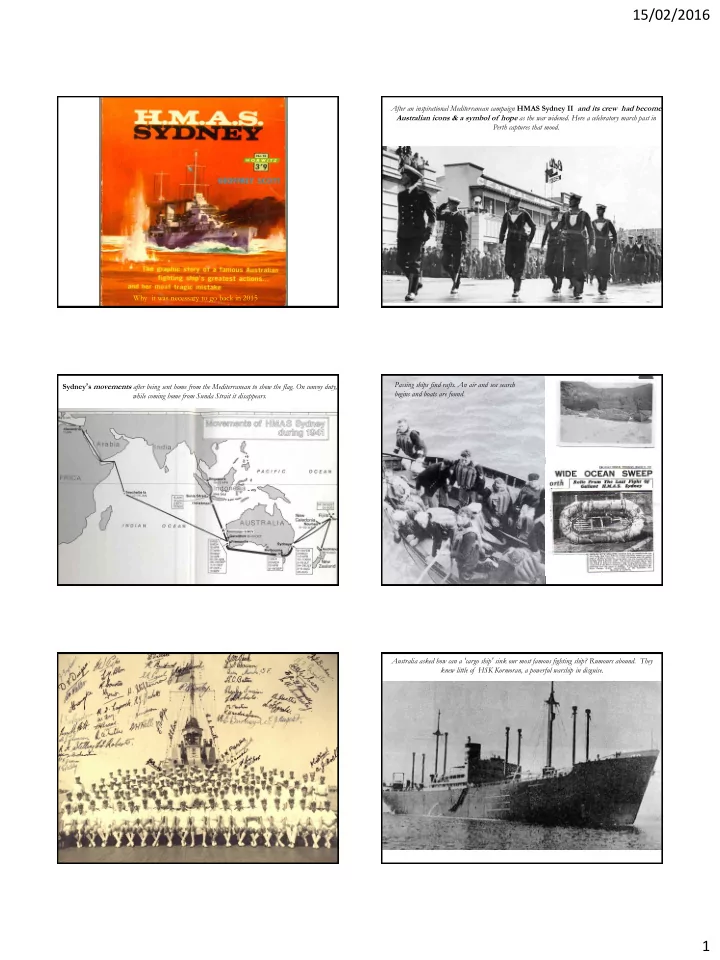
Why it was necessary to go back in 2015 After an inspirational Mediterranean campaign HMAS Sydney II and its crew had become Australian icons & a symbol of hope as the war widened. Here a celebratory march past in Perth captures that mood. Sydney’s movements after being sent home from the Mediterranean to show the flag. On convoy duty, while coming home from Sunda Strait it disappears.

Kormorans in boat

Passing ships find rafts. An air and sea search begins and boats are found.

Gone…. the entire Sydney crew. 645 men and boys. All bar a handful are aged 18 to 35. Only a carley float and a lifebelt are found.

Australia asked how can a ‘cargo ship’ sink our most famous fighting ship? Rumours abound. They knew little of HSK Kormoran, a powerful warship in disguise.

slide-2
SLIDE 2

15/02/2016 2

Penhurst Long ‘ . . . There has now been accumulated a mass of confirmatory information that leaves no doubt that there are no survivors . . . There are a number of reasons, however, why the full analysis should not be published, the principle that such an analysis would still not be accepted by some people as being absolute confirmation of the loss of all

  • f the “Sydney’s” complement.

It is intended not to publish anything further concerning this action and its results, unless the Board is forced by Ministerial pressure to write a Ministerial Statement.’

Roebotham.

Faced with CMDR Long’s decision, yet convinced the German survivors buried film of the battle on Quobba station north

  • f Carnarvon, Jonathan Robotham, the

Intelligence Officer who had guarded the Kormorans, commenced a lone obsessive search for the ‘truth’. He also believed that the official accounts were wrong. He advised all who inquired that Kormoran surrendered and he often showed a ‘diary’ (PO engineer Heinz Kitsche’s?) in ‘Old German’ to that effect. It was a fake, the first of many. One can trace the need for the 2015 re- visitation to Sydney and Kormoran back to CMDR Long’s decision and Lt Robotham’s reaction to it.

Winter

Montgomery’s book, this next hoax (also apparently designed to force the government’s hand) and other claims were met with a terse

  • response. From

here debate raged. It was (and still is) inconceivable that a nation with a proud military history and a professed commitment to the common man could permit the fate of one of its most famous warships and her 645 crew to remain shrouded in mystery & effectively unverified for over half a century. The Western Australian Museum actively sought a resolution and led the process into the mid- 1990s, thereafter providing every support. It was driven by the duty owed to those lost.

HMAS SYDNEY II:

slide-3
SLIDE 3

15/02/2016 3

Under the terms of the 1976 Historic Shipwrecks Act the Director of the WA Museum became responsible for the wrecks. From then on we examined reports possibly related to Sydney-Kormoran. Here was our first link with CMST in the search for HMAS Sydney. (L) John Penrose: founder of CMST

Pryor report

Wreck reports flowed in to WAM. This was found off Steep Point, Shark Bay by the late Ray Pryor, a crayfisherman. The Museum looked at the site with the RAN in 1992, and then independently. It and the RAN examined many

  • thers similar

throughout the 1980s and 90s. DHI Grave

The RAN provided HMAS Moresby and

  • ther vessels. It was prepared to act, sometimes

independently) on even the most flimsy evidence. It also called the RAAF in!

WW

There was even a tech-based hoax for us to deal with! According to the Australian Skeptics Association, such beliefs are often genuinely held. Many were drawn in by these claims and many of them appeared in an un-critical national press driven by sensational claims regardless of the effect on the relatives of those lost.

Titanic 1985

Woods Hole Oceanographic Institute’s location of RMS Titanic in c. 3800 m of water in 1985 and then the battleship Bismarck in c. 4800 m of water in 1989 saw them invited to join the WA Museum in the following year.

MAAC 1990

The proposal obtained the support

  • f the RAN, the RSL, Office of War

Graves, RAN, the Kormoran Survivor’s Association and the German Government. In 1991 the Museum convened a seminar to encapsulate all the evidence in readiness for a possible search.

M.McCarthy and Kim Kirsner (UWA) Convenors

slide-4
SLIDE 4

15/02/2016 4

Beazley letter

There was some very high level support. NOCWA (for the RAN)

  • pened proceedings and

here Minister Kim Beazley provides support for the Museum forum on finding Sydney.

WAM then assisted other institutions and experts in finalising the forum recommendations. Here on behalf of Australian Archives, Richard Summerrell presented its HMAS Sydney holdings. The AWM commenced work on the analysis of its Carley Float. Dr Thomas O. Paine, head of the American Submarine Warfare library was asked to comment on claims that IJN I 124 was involved in sinking Sydney. Once a Fremantle-based submariner, engineer he had also been head of the Apollo space program. His dispassionate account was tabled at the forum. It dispelled any doubt that Kormoran needed help in overcoming Sydney. The exposed torpedo deck and ‘open’ 4 inch AA guns were all vulnerable to Kormoran’s machine gun fire. The 3.7 cm rapid fire gun (shown following) on the Kormoran bridge was especially deadly .

Model K& H.

Narrowing the search zone

Frame

With the Museum still the only government institution actively seeking a resolution until the mid-1990s, the application of scientific reason, historical analysis and logic (e.g. by Kirsner, Tom Frame, Wes Olson et al. ) was submerged in an increasing tide of speculation. HERE THE PREVAILING VIEW AT THE TIME.

slide-5
SLIDE 5

15/02/2016 5

Books Carl In 1994 Woods Hole departs the scene. There were too many doubts for them to continue for while the search area for Titanic and Bismarck were under 500 square kilometres, and while the Sydney/Kormoran battle position had been ‘proved’ at the 1991 Forum, the search area for HMAS Sydney was still in excess of 7,000 square kilometres. Without access to the required deep water expertise, the WA Museum shelved its search plans and lent its support to private finding Sydney groups formed in 1995. The Foundation garnered strong political and official (RAN, RSL, AWM) support, successfully pushing for a Parliamentary Inquiry that began sitting in 1997.

HMAS Sydney Trust

(Wayne Sydney Born: Chair)

HMAS Sydney Foundation

(Ed Punchard: Chair)

Two Private Members Bills tabled in the Federal Legislative Assembly, one by Paul Filing and the other by Steven Smith, both of th e HMAS Sydney Foundation. These provided for the establishment and composition of a committee to investigate the loss

  • f HMAS Sydney. In June the parameters for the inquiry were set leading to its sitting

across Australia in the following year. One of its six aims was to examine the . . . desirability and practicability of conducting a search for HMAS Sydney and the extent to which the Commonwealth Government should participate in such a search should one be deemed desirable and practi cable The question of whether archival material was also still to be found was also raised as a matter of considerable prio

  • rity. Finally, after an exhaustive round of national

hearings and after collating all the evidence received into an 18-volume set, the Committee made 17 recommendations, including Recommendation 10. The Royal Australian Navy sponsor a seminar

  • n the likely search areas for Sydney and Kormo ran, involving as many
  • f the individual researchers and groups as possible.

Recommendation 11. After the search area is more accurately defined, some preliminary surveys be undertaken to try and confirm the accuracy

  • f the wreck locations, prior to a full in-water search. An initial search

for HSK Korm oran at or near 26°32-34’S, 111°E, if supported by the seminar, would seem a logical starting point . The SPC Seminar was split between proponents of a northern battle position (Detmer’s area) and a southern battle (Abrolhos area). The latter was part-based on 1) reports of flashes and gunfire one November night in WWII. 2) Lindsay Knight’s map dowsing method and his Knight Subtle Energy Detection System ‘found’ three wrecks off the Abrolhos. 3) Some (including former RAN navigators) claimed that it was impossible for German lifeboats to make the voyage from the Detmer’s position to the Cliffs north of Carnarvon. The Museum’s attempts to find a solution came to nought.

The Southern-northern battle position impasse was resolved gratis by a local consortium led by John Begg

slide-6
SLIDE 6

15/02/2016 6

Though the 2001 RAN Seminar found against conducting a search the WA Museum continued to urge for action. (Wes Olson’s archival committee placed Kormoran near 25°58'S 110°56'E, with Sydney possibly lying within 15NM). The Museum also supported noted wreck hunter David Mearns 2002 expression of interest in leading a

  • search. He was following on from

a 1996 suggestion by Museum director Graeme Henderson. After WHOI departed Mearns became the only deep water wreck searcher with the required experience and credentials.

The Southern-northern battle position impasse was resolved gratis by DOFSubsea and also by a local consortium led by John Begg. DoFSubsea proved the Knight reports were entirely spurious

and the consortium proved the wrecks were not near the Abrolhos 5 10 15 20 26° S 111° E 26 32 111 27 111 coast 150 25 111 26 111-40 F 100 SW F 20 sw land 60 Position to know uncertain Position to know

Defining the Search Area – The German Accounts

Correlation of reports from German survivors

(As determined by Kim Kirsner and John Dunn

  • f the University of Western Australia.)

In their work for the Finding Sydney Foundation cognitive scientists Kim Kirsner and John Dunn of UWA showed that: ‘The variations in the German accounts accord with the true pattern of archival memory’. ‘The personnel that could be expected to have direct access to the navigation information provided complementary information as depicted in the table (right)’

  • No. of personnel

Defining the Search Area – Oceanographic Reconstructions

  • A number of objects

were picked up after drifting from the wreck sites

  • Including
  • ceanographic data

from the Museum’s 1991 Finding Sydney Seminar and from other researchers Kirsner and Dunn generated an area of probability for the origin of the drift

  • bjects.
  • This research generally

confirmed the proposed search area

David Mearns joins

Sunday Times: November 12 2006

Defining the Search Area – Independent Corroboration

  • The Foundation’s researchers

Kim Kirsner, John Dunn, Bob King et al. compile all the data to define a Search Area with high probability of discovery

  • David Mearns (BWR) & his

assistants Capt. Peter Hore (RAN Retd. and Wes Olson, do similar and through Barbara (Winter) Poniewierski are led to ‘new’ archival data that supports the German accounts.

  • This is the PRIMARY SOURCE

that independently convinces Mearns, the German account is correct.

  • The Search Area, however

remained very large.

BWR most likely battle location Sydney Search most likely battle location

After Kirsner & Dunn FSF
slide-7
SLIDE 7

15/02/2016 7

Detner’s diary Akers Other claimants also came forward, some as far away as Britain. This one from late 2006 used ‘satellite imagery, claiming to have found the wrecks at the Detmer’s position and wanting £000s to reveal all. As with all others, it was initially treated with due respect, and properly scrutinised by the Museum. Claims that a Japanese aircraft carrier was also found nearby saw our books firmly closed on it. The proponent continues his claims to this day. In 2007 another claim to have found HMAS Sydney off Shark Bay, nearly derailed the process until the Museum and the RAN joined to show it was a fishing vessel. Williamson & Associates of Seattle

DOFsubsea

Brian Bunge’s schematic

The tow search schematics

Kormoran SS Sydney ss

slide-8
SLIDE 8

15/02/2016 8

Map of finds

The FSF Board

  • G. McDonald, K.

Rowe, D. Pridmore,

  • R. Trotter and T.
  • Graham. (Retired

members were R. Birmingham, R. King, K. Kirsner) David Mearns ( Search Director) with Lt J. Perryman RAN.

Ted and PM

A national disgrace?

26-111 ROV activity Alston

slide-9
SLIDE 9

15/02/2016 9

Crossed boats Watching working Sydney spread Kormoran Kormoran gun

slide-10
SLIDE 10

15/02/2016 10

Kormoran break Cole cover

"Those relatives are entitled to assume that Australia will do all it can to establish the circumstances in which the deaths occurred,” the Commissioner [TH Cole QC] said. "To quote the words of Dr Michael McCarthy, an early and persistent campaigner for finding Sydney II, the failure to do so would strike 'at the very heart of the notion of service to one's country and the possibility of making the ultimate sacrifice in times of dire need.'”…

Exhibits 1

The ‘Unknown Sailor’ is finally acknowledged and is subsequently interred in a gazetted Commonwealth War Grave at Geraldton. Though DNA studies are continuing to this day and though a few conspiracy theorists remained, a time of relative quiet set in after the services, the official commemorations of 2008, the production

  • f websites, books,

the striking of commemorative coins etc etc.

slide-11
SLIDE 11

15/02/2016 11

November 2011 Two ‘dreamers’ from Curtin University arrive on the scene: They show a 3D reconstruction based on the 2008 imagery and seek the Museum’s support for a return to the wrecks.

Andrew Woods Andrew Hutchison

‘Making the Inaccessible Accessible’

‘INACCESSIBLE HISTORIC SITES MUST BE MADE ACCESSIBLE TO ALL, BECAUSE THEY BELONG TO THE PEOPLE.’

(Andrew. Viduka, Heritage & Wildlife Division. Commonwealth Government)

Being a science-based institution, Curtin has extended accessibility to the nation’s scientists while at the same time keeping the WA Museum’s focus on those lost. This only became possible through DofSubsea’s extraordinary ‘gift to the nation’.