
SLIDE 1
12/3/2016 1
Jennifer Rose-Nussbaumer, MD Assistant Professor UCSF/Proctor Foundation
I have no financial interests in this subject matter.
12/3/2016 I have no financial interests in this subject matter. - - PowerPoint PPT Presentation
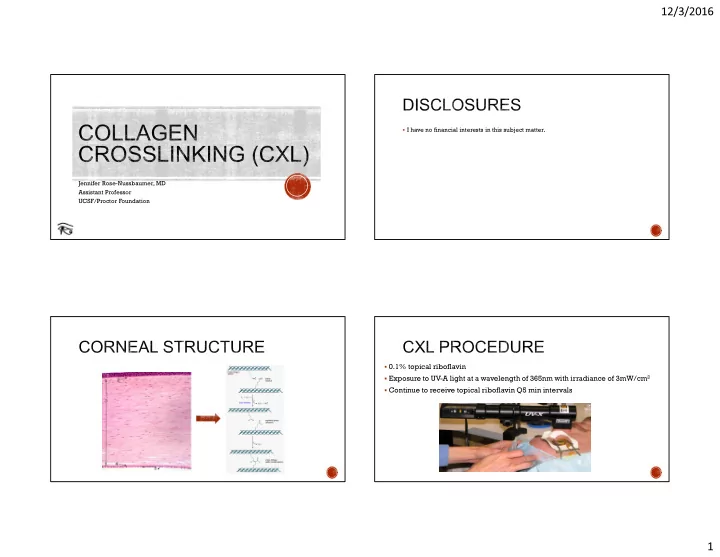
12/3/2016 I have no financial interests in this subject matter. Jennifer Rose-Nussbaumer, MD Assistant Professor UCSF/Proctor Foundation 0.1% topical riboflavin Exposure to UV-A light at a wavelength of 365nm with irradiance of 3mW/cm
Jennifer Rose-Nussbaumer, MD Assistant Professor UCSF/Proctor Foundation
I have no financial interests in this subject matter.
Included 3 RCTs from UK, US and Australia 225 adult eyes and randomized to epithelium-off CXL vs control All studies has issues with masking and incomplete follow-up On average, treated eyes had a less steep cornea (~ 2D) and better UCVA (~2
lines)
Adverse effects of CXL included K edema, AC inflammation, recurrent erosions,
infectious keratitis, sterile K infiltrates
No studies reported decreased VA or endothelial damage compared to untreated
eyes
Sykakis et al. Cochrane Database of Systematic Reviews 2015, Issue 3
12 year old boy -
Failed vision screen at Pediatrician office VA: 20/20 OD 20/60 OS Pachy: 497 OD 444 OS SLE: OD: Prominent cornea nerves OD; OS: Mild apical thinning, + vogt striae OS MRx: OD: -1.00 +1.00 x 125 OS: -8.50 + 5.00 x 029
Two possible mechanisms:
Antimicrobial effects of CXL Increased resistance of corneal tissue
to enzymatic degradation Other potential benefits:
Treat drug resistant or difficult to treat
bacteria/fungi
Decrease toxicity Non-compliance
Two-arm masked randomized controlled trial with 1:1 randomization to: Collagen cross-linking & moxifloxacin Moxifloxacin medical therapy alone Four-arm masked randomized controlled trial with adaptive randomization to: Collagen cross-linking & Natamycin (5%) Collagen cross-linking & Ampho (0.15%) Natamycin medical therapy alone (5%) Ampho medical therapy alone (0.15%)
3-month BSCVA Infiltrate/scar size Rate of perforation Astigmatism Corneal thickness IND-VFQ
CXL has finally been FDA approved in the US for treatment of KCN UCSF will begin CXL in January 2017 Call (415) 514-8200 or (415) 514-6853 for patient referrals Fax (415) 514-6845 Future directions include shorter less invasive CXL techniques Potential innovative treatments for refractive surgery and infectious keratitis.