12/22/2016 Control Flow Computers execute instructions in sequence. - - PDF document

12 22 2016
SMART_READER_LITE
LIVE PREVIEW

12/22/2016 Control Flow Computers execute instructions in sequence. - - PDF document

12/22/2016 Control Flow Computers execute instructions in sequence. Except when we change the flow of control Jump and Call instructions Controlling Program Flow Unconditional jump Direct jump: jmp Label Jump target is specified


slide-1
SLIDE 1

12/22/2016 1 Controlling Program Flow

– 2 –

Control Flow

Computers execute instructions in sequence. Except when we change the flow of control

 Jump and Call instructions  Unconditional jump  Direct jump: jmp Label

» Jump target is specified by a label (e.g., jmp .L1)  Indirect jump: jmp *Operand » Jump target is specified by a register or memory location (e.g., jmp *%rax)

– 3 –

Conditional statements

Some jumps are conditional

 A computer needs to jump if certain a condition is true  In C, if, for, and while statements

if (x) {…} else {…} while (x) {…} do {…} while (x) for (i=0; i<max; i++) {…} switch (x) { case 1: … case 2: … }

– 4 –

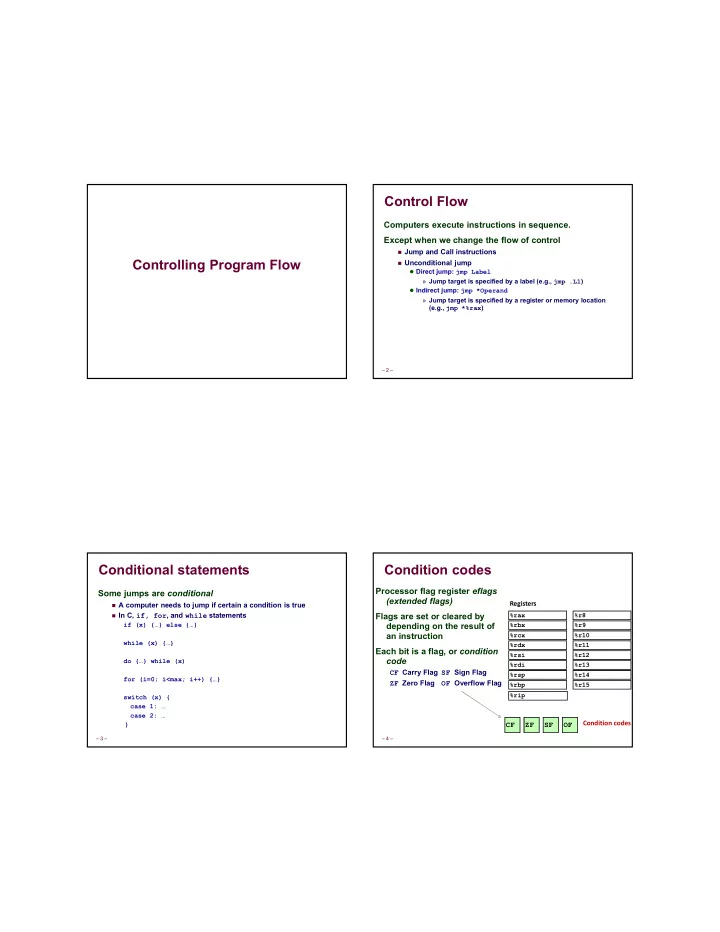
%rip

Registers CF ZF SF OF Condition codes

%rsp %r8 %r9 %r10 %r11 %r12 %r13 %r14 %r15 %rax %rbx %rcx %rdx %rsi %rdi %rbp

Condition codes

Processor flag register eflags (extended flags) Flags are set or cleared by depending on the result of an instruction Each bit is a flag, or condition code

CF Carry Flag SF Sign Flag ZF Zero Flag OF Overflow Flag

slide-2
SLIDE 2

12/22/2016 2

– 5 –

Implicit setting

Automatically Set By Arithmetic and Logical Operations

Example: addq Src,Dest C analog: t = a + b

 CF (for unsigned integers) set if carry out from most significant bit (unsigned overflow)

(unsigned long t) < (unsigned long a)

 ZF (zero flag) set if t == 0  SF (for signed integers) set if t < 0  OF (for signed integers) set if signed (two’s complement) overflow

(a>0 && b>0 && t<0) || (a<0 && b<0 && t>=0)

Not set by lea, push, pop, mov instructions

– 6 –

Explicit setting via compare

Setting condition codes via compare instruction

cmpq b,a

 Computes a-b without setting destination  CF set if carry out from most significant bit  Used for unsigned comparisons  ZF set if a == b  SF set if (a-b) < 0  OF set if two’s complement (signed) overflow

(a>0 && b<0 && (a-b)<0) || (a<0 && b>0 && (a-b)>0)

 Byte, word, and double word versions cmpb, cmpw, cmpl – 7 –

Explicit setting via test

Setting condition codes via test instruction

testq b,a

 Computes a&b without setting destination  Sets condition codes based on result  Useful to have one of the operands be a mask  Often used to test zero, positive

testq %rax, %rax

 ZF set when a&b == 0  SF set when a&b < 0  Byte, word and double word versions testb, testw,

testl

– 8 –

jX Condition Description

jmp 1 Unconditional je, jz ZF Equal / Zero jne,jnz ~ZF Not Equal / Not Zero js SF Negative jns ~SF Nonnegative jg ~(SF^OF)&~ZF Greater (Signed) jge ~(SF^OF) Greater or Equal (Signed) jl (SF^OF) Less (Signed) jle (SF^OF)|ZF Less or Equal (Signed) ja ~CF&~ZF Above (unsigned) jb CF Below (unsigned)

Overflow flips result

Conditional jump instrcutions

Jump to different part of code based on condition codes

slide-3
SLIDE 3

12/22/2016 3

– 9 –

Jump instructions

What’s the difference between jg and ja ? Which one would you use to compare two pointers?

– 10 –

long absdiff(long x, long y) { long result; if (x > y) result = x-y; else result = y-x; return result; } absdiff: cmpq %rsi, %rdi # x:y jle .L4 movq %rdi, %rax subq %rsi, %rax ret .L4: # x <= y movq %rsi, %rax subq %rdi, %rax ret

Non-optimized

gcc –Og -S –fno-if-conversion control.c

Register Use(s) %rdi Argument x %rsi Argument y %rax Return value

Conditional jump example

– 11 –

C Code

val = Test ? Then_Expr : Else_Expr;

Goto Version

ntest = !Test; if (ntest) goto Else; val = Then_Expr; goto Done; Else: val = Else_Expr; Done: . . .

General Conditional Expression Translation (Using Branches)

Create separate code regions for then & else expressions Execute appropriate one

val = x>y ? x-y : y-x;

– 12 –

Practice problem 3.18

/* x in %rdi, y in %rsi, z in %rdx */ test: leaq (%rdi,%rsi), %rax addq %rdx, %rax cmpq $-3, %rdi jge .L2 cmp %rdx,%rsi jge .L3 movq %rdi, %rax imulq %rsi, %rax ret .L3: movq %rsi, %rax imulq %rdx,%rax ret .L2 cmpq $2, %rdi jle .L4 movq %rdi, %rax imulq %rdx, %rax .L4 ret long test(long x, long y, long z) { long val = ____________ ; if ( ____________ ) { if ( ____________ ) val = ____________ ; else val = ____________ ; } else if ( ____________ ) val = ____________ ; return val; } x+y+z x < -3 y < z x*y y*z x > 2 x*z

slide-4
SLIDE 4

12/22/2016 4

– 13 –

Avoiding conditional branches

Modern CPUs with deep pipelines

 Instructions fetched far in advance of execution  Mask the latency going to memory  Problem: What if you hit a conditional branch?  Must predict which branch to take!  Branch prediction in CPUs well-studied, fairly effective  But, best to avoid conditional branching altogether – 14 –

Conditional moves

Conditional instruction exectuion

cmovXX Src, Dest  Move value from src to dest if condition XX holds

 No branching  Handled as operation within Execution Unit  Added with P6 microarchitecture (PentiumPro onward, 1995)

Example Performance

 14 cycles on all data  More efficient than conditional branching (single control flow path)  But overhead: both branches are evaluated

# %rdi = x, %rsi = y # return value in %rax returns max(x,y) movq %rdi,%rdx # Get x movq %rsi,%rax # rval=y cmpq %rdx, %rax # rval:x cmovl %rdx,%rax # If <, rval=x

– 15 –

Conditional Move template

 Instruction supports  if (Test) Dest  Src  GCC attempts to restructure

execution to avoid disruptive conditional branch

 Both values computed  Overwrite “then”-value with “else”-value if condition doesn’t hold  Conditional moves do not

transfer control

C Code

val = Test ? Then_Expr : Else_Expr;

result = Then_Expr; eval = Else_Expr; nt = !Test; if (nt) result = eval; return result;

General Conditional Expression Translation (Using conditional move)

Branch version

ntest = !Test; if (ntest) goto Else; val = Then_Expr; goto Done; Else: val = Else_Expr; Done:

– 16 –

Conditional Move example

absdiff: movq %rdi, %rax # x subq %rsi, %rax # result = x-y movq %rsi, %rdx subq %rdi, %rdx # eval = y-x cmpq %rsi, %rdi # x:y cmovle %rdx, %rax # if <=, result = eval ret long absdiff(long x, long y) { long result; if (x > y) result = x-y; else result = y-x; return result; } Register Use(s) %rdi Argument x %rsi Argument y %rax Return value absdiff: cmpq %rsi, %rdi # x:y jle .L4 movq %rdi, %rax subq %rsi, %rax ret .L4: # x <= y movq %rsi, %rax subq %rdi, %rax ret

Branch version

slide-5
SLIDE 5

12/22/2016 5

– 17 –

Practice problem 3.21

/* x in %rdi, y in %rsi */ test: leaq 0(,%rdi,8), %rax testq %rsi, %rsi jle .L2 movq %rsi, %rax subq %rdi, %rax movq %rdi, %rdx andq %rsi, %rdx cmpq %rsi, %rdi cmovge %rdx, %rax ret .L2: addq %rsi, %rdi cmpq $-2, %rsi cmovle %rdi, %rax ret long test(long x, long y) { long val = ____________ ; if ( ____________ ) { if ( ____________ ) val = ____________ ; else val = ____________ ; } else if ( ____________ ) val = ____________ ; return val; } 8*x y > 0 x < y y-x x&y y <= -2 x+y – 18 –

When not to use Conditional Move

val = Test(x) ? Hard1(x) : Hard2(x); val = x > 0 ? x*=7 : x+=3;

Expensive computations

 Both Hard1(x) and Hard2(x) computed  Use branching when “then” and “else” expressions are more

expensive than branch misprediction

Computations with side effects

 Executing both values causes incorrect behavior

Condition must hold to prevent fault

 Null pointer check – 19 –

Implemented in assembly via tests and jumps

 Compilers implement most loops as do-while  Add additional check at beginning to get “while-do”

do { body-statements } while (test-expr);

Loops

– 20 –

long factorial_do(long x) { long result = 1; do { result *= x; x = x-1; } while (x > 1); return result; }

C example

http://thefengs.com/wuchang/courses/cs201/class/07

factorial_do: movq $1, %rax ; result = 1 .L2: imulq %rdi, %rax ; result *= x subq $1, %rdi ; x = x - 1 cmpq $1, %rdi ; if x > 1 jg .L2 ; goto loop ret ; return result

slide-6
SLIDE 6

12/22/2016 6

– 21 –

long factorial_do(long x) { long result = 1; do { result *= x; x = x-1; } while (x > 1); return result; }

Are these equivalent?

long factorial_while(long x) { long result = 1; while (x > 1) { result *= x; x = x-1; } return result; } C code of do-while C code of while-do

– 22 – factorial_do: movq $1, %rax .L2: imulq %rdi, %rax subq $1, %rdi cmpq $1, %rdi jg .L2 ret factorial_while: movq $1, %rax jmp .L2 .L3: imulq %rdi, %rax subq $1, %rdi .L2: cmpq $1, %rdi jg .L3 rep ret

Assembly of do-while Assembly of while-do http://thefengs.com/wuchang/courses/cs201/class/07 diff factorial_do.s factorial_while.s

– 23 –

“For” Loop Example

long factorial_for(long x) { long result; for (result=1; x > 1; x=x-1) { result *= x; } return result; }

General Form Init

result = 1

Test

x > 1

Update

x = x - 1

Body

{ result *= x; } for (Init; Test; Update ) Body Is this code equivalent to the do-while version or the while-do version?

– 24 –

“For” Loop Example

factorial_while: movq $1, %rax jmp .L2 .L3: imulq %rdi, %rax subq $1, %rdi .L2: cmpq $1, %rdi jg .L3 ret

http://thefengs.com/wuchang/courses/cs201/class/07 diff factorial_for.s factorial_while.s

factorial_for: movq $1, %rax jmp .L2 .L3: imulq %rdi, %rax subq $1, %rdi .L2: cmpq $1, %rdi jg .L3 ret

slide-7
SLIDE 7

12/22/2016 7

– 25 –

Problem 3.26

fun_a: movq $0, %rax jmp .L5 .L6: xorq %rdi, %rax shrq %rdi .L5: testq %rdi, %rdi jne .L6 andq $1, %rax ret long fun_a(unsigned long x) { long val = 0; while ( _______ ) { _______________ ; _______________ ; } return ____________ ; } x val = val ^ x x = x >> 1 val & 0x1 – 26 –

C switch Statements

long switch_eg(long x) { long result = x; switch (x) { case 100: result *= 13; break; case 102: result += 10; /* Fall through */ case 103: result += 11; break; case 104: case 106: result *= result; break; default: result = 0; } return result; }

Test whether an expression matches one of a number of constant integer values and branches accordingly Without a “break” the code falls through to the next case If x matches no case, then “default” is executed

– 27 –

C switch statements

Implementation options

 Series of conditionals  testq/cmpq followed by je  Good if few cases  Slow if many cases  Jump table (example below)  Lookup branch target from a table  Possible with a small range of integer constants

GCC picks implementation based on structure Example:

switch (x) { case 1: case 5: code at L0 case 2: case 3: code at L1 default: code at L2 }

.L2 .L0 .L1 .L1 .L2 .L0 .L3

  • 1. init jump table at .L3
  • 2. get address at .L3+8*x
  • 3. jump to that address

– 28 –

Example revisited

long switch_eg(long x) { long result = x; switch (x) { case 100: result *= 13; break; case 102: result += 10; /* Fall through */ case 103: result += 11; break; case 104: case 106: result *= result; break; default: result = 0; } return result; }

slide-8
SLIDE 8

12/22/2016 8

– 29 – leaq

  • 100(%rdi), %rax

cmpq $6, %rax ja .L8 jmp *.L4(,%rax,8) .section .rodata .L4: .quad .L3 .quad .L8 .quad .L5 .quad .L6 .quad .L7 .quad .L8 .quad .L7 .text .L3: leaq (%rdi,%rdi,2), %rax leaq (%rdi,%rax,4), %rax ret .L5: addq $10, %rdi .L6: leaq 11(%rdi), %rax ret .L7: movq %rdi, %rax imulq %rdi, %rax ret .L8: movl $0, %eax ret

Key is jump table at L4 Array of pointers to jump locations http://thefengs.com/wuchang/courses/cs201/class/07/switch_code.c

long switch_eg(long x) { long result = x; switch (x) { case 100: result *= 13; break; case 102: result += 10; /* Fall through */ case 103: result += 11; break; case 104: case 106: result *= result; break; default: result = 0; } return result; }

– 30 –

Practice problem 3.30

The switch statement body has been omitted in the C

  • program. GCC generates

the code shown when compiled

 What were the values of the

case labels in the switch statement?

 What cases had multiple labels

in the C code?

void switch2(long x, long *dest) { long val = 0; switch (x) { } *dest = val } /* x in %rdi */ switch2: addq $1, %rdi cmpq $8, %rdi ja .L2 jmp *.L4(,%rdi,8) .L4 .quad .L9 .quad .L5 .quad .L6 .quad .L7 .quad .L2 .quad .L7 .quad .L8 .quad .L2 .quad .L5 – 31 –

Practice problem 3.30

void switch2(long x, long *dest) { long val = 0; switch (x) { } *dest = val } /* x in %rdi */ switch2: addq $1, %rdi cmpq $8, %rdi ja .L2 jmp *.L4(,%rdi,8) .L4 .quad .L9 .quad .L5 .quad .L6 .quad .L7 .quad .L2 .quad .L7 .quad .L8 .quad .L2 .quad .L5

Start range at -1 Top range is 7

case –1: /* Code at .L9 */ case 0,7: /* Code at .L5 */ case 1: /* Code at .L6 */ case 2,4: /* Code at .L7 */ case 5: /* Code at .L8 */ case 3,6: default: /* Code at .L2 */

Default goes to .L2

– 32 –

Homework A3
slide-9
SLIDE 9

12/22/2016 9

– 33 –

Extra slides

– 34 –

Reading Condition Codes

  • SetX Instructions

– Set low-order byte of destination to 0 or 1 based on combinations of condition codes – Does not alter remaining 7 bytes

SetX Condition Description sete ZF Equal / Zero setne ~ZF Not Equal / Not Zero sets SF Negative setns ~SF Nonnegative setg ~(SF^OF)&~ZF Greater (Signed) setge ~(SF^OF) Greater or Equal (Signed) setl (SF^OF) Less (Signed) setle (SF^OF)|ZF Less or Equal (Signed) seta ~CF&~ZF Above (unsigned) setb CF Below (unsigned)

– 35 –

cmpq %rsi, %rdi # Compare x:y setg %al # Set when > movzbl %al, %rax # Zero rest of %rax ret

Reading Condition Codes (Cont.)

SetX Instructions:

– Set single byte based on combination of condition codes

One of addressable byte registers

– Does not alter remaining bytes – Typically use movzbl to finish job

  • 32-bit instructions also set upper 32 bits to 0

int gt (long x, long y) { return x > y; } Register Use(s) %rdi Argument x %rsi Argument y %rax Return value http://thefengs.com/wuchang/courses/cs201/class/07/setg_code.c

– 36 –

x86 REP prefixes

Loops require decrement, comparison, and conditional branch for each iteration Incur branch prediction penalty and overhead even for trivial loops REP, REPE, REPNE

 Instruction prefixes can be inserted just before some

instructions (movsb, movsw, movsd, cmpsb, cmpsw, cmpsd)

 REP (repeat for fixed count)

  • Direction flag (DF) set via cld and std instructions
  • esi and edi contain pointers to arguments
  • ecx contains counts

 REPE (repeat until zero), REPNE (repeat until not zero)

  • Used in conjuntion with cmpsb, cmpsw, cmpsd
slide-10
SLIDE 10

12/22/2016 10

– 37 –

x86 REP example

.data source DWORD 20 DUP (?) target DWORD 20 DUP (?) .code cld ; clear direction flag = forward mov ecx, LENGTHOF source mov esi, OFFSET source mov edi, OFFSET target rep movsd

– 38 –

x86 SCAS

Searching

 Repeat a search until a condition is met  SCASB SCASW SCASD

  • Search for a specific element in an array
  • Search for the first element that does not match a

given value

– 39 –

x86 SCAS

.data alpha BYTE "ABCDEFGH",0 .code mov edi,OFFSET alpha mov al,'F' ; search for 'F' mov ecx,LENGTHOF alpha cld repne scasb ; repeat while not equal jnz quit dec edi ; EDI points to 'F'

– 40 –

x86 L0DS/STOS

Storing and loading

 Initialize array of memory or sequentially read array from

memory

 Can be combined with other operations in a loop  LODSB LODSW LODSD

  • Load values from array sequentially

 STOSB STOSW STOSD

  • Store a specific value into all entries of an array
slide-11
SLIDE 11

12/22/2016 11

– 41 –

x86 LODS/STOS

.data array DWORD 1,2,3,4,5,6,7,8,9,10 multiplier DWORD 10 .code cld ; direction = up mov esi,OFFSET array ; source index mov edi,esi ; destination index mov ecx,LENGTHOF array ; loop counter L1: lodsd ; copy [ESI] into EAX mul multiplier ; multiply by a value stosd ; store EAX at [EDI] loop L1h