12/2/2016 Is there a role for sentinel lymph node biopsy in eyelid - - PowerPoint PPT Presentation

12 2 2016
SMART_READER_LITE
LIVE PREVIEW

12/2/2016 Is there a role for sentinel lymph node biopsy in eyelid - - PowerPoint PPT Presentation

12/2/2016 Is there a role for sentinel lymph node biopsy in eyelid malignancies? Primary tumor known to result in regional nodal mets Selective drainage to nodal basin Presume discovery and removal of microscopic mets results in


slide-1
SLIDE 1

12/2/2016 1

Is there a role for sentinel lymph node biopsy in eyelid malignancies? Primary tumor known to result in regional nodal

mets

Selective drainage to nodal basin Presume discovery and removal of microscopic

mets results in improved survival v delayed excision after nodal mets clinically apparent

OR early discovery of nodal mets allows initiation

  • f adjuvant tx which improves survival

OR staging of disease

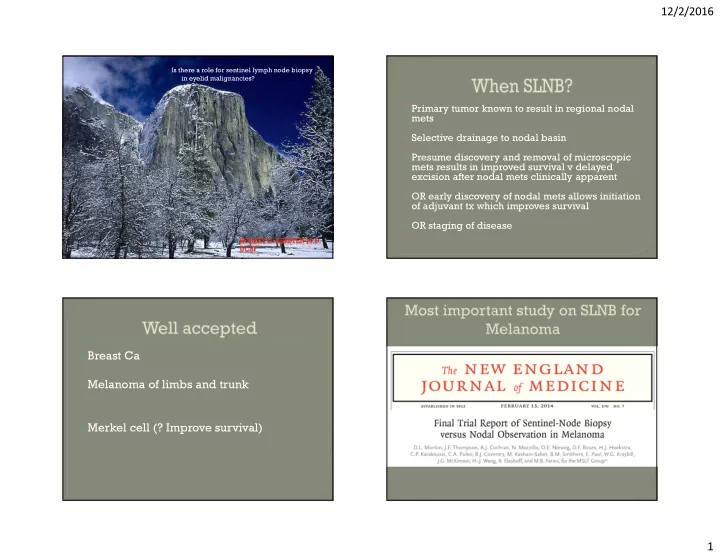
Breast Ca Melanoma of limbs and trunk Merkel cell (? Improve survival)

slide-2
SLIDE 2

12/2/2016 2

Intermediate thickness (1-3.5 mm) Observation group: 17% had nodal

mets at median of 19 months

Immediate biopsy group: 16% had

nodal mets

If SLNB was negative in biopsy group:

5% eventually developed nodal mets (false –’ve)

Intermediate thickness: Randomized to SLNB and +’ve micromets:

  • Melanoma specific survival 61%

Randomized to observation and

developed macromets:

  • Melanoma specific survival 42% (p= 0.006)

If SNLB –’ve, no difference in survival of

SNLB (88%) v observation (86%)

No benefit melanoma specific survival

between the two randomized groups

  • due to only 16-18% either group had nodal mets

Select malignancies proclivity to develop

nodal metastases

  • Melanoma
  • Sebaceous Ca
  • Squamous cell Ca
  • Merkel cell tumor

Lymphoscintigraphy can define nodal

drainage

  • Pre-auricular in large majority

Biopsy of “sentinal” nodes can identify if

micrometastases present- if +’ve then perform complete nodal basin excision.

slide-3
SLIDE 3

12/2/2016 3

Does sentinal node accurately predict

ultimate nodal mets (how often false negative SLNB)

Does excision of micro-metastases confer

survival benefit v wait and watch for macro- mets

? Other benefits to identifying micro-mets

  • Prognosis
  • Adjuvant tx

SLNB itself can be performed at the time of surgical excision or

after tumor removal

Steps: 1.

Inject Tc-labeled sulfur colloid near site of tumor 3 h prior

2.

Remove primary

3.

Use a gamma-probe to localize where tracer has accumulated

4.

Remove nodes until radioactivity is <10% of baseline in the basin

Multiple different SLNB techniques exist Tc sulfur colloid injection +/- vital blue dye Only injecting vital blue dye Using large skin incision vs. small incision for nodal removal Using ICG dye SPECT CT lymphoscintigraphy

slide-4
SLIDE 4

12/2/2016 4

slide-5
SLIDE 5

12/2/2016 5

slide-6
SLIDE 6

12/2/2016 6

slide-7
SLIDE 7

12/2/2016 7

Frozen section and immediate excision

basin if +’ve vs

Permanent section and delayed neck

dissection if +’ve (esp if melanoma)

Melanoma

  • `Skin
  • Conjunctiva

Sebaceous Ca SCCa Merkel Cell SLNB +’ve 15-21%

  • Intermediate thickness (1-4 mm)
  • 1 mm high risk melanomas

Ulcerated Clark level IV False –’ve rate 3.3-44% (mean 20.4%) If sentinel node +’ve, additional nodes

+’ve in 25%

+’ve SLNB predicts worse prognosis Removal nodal basin improves

locoregional control

No benefit on tumor related survival

slide-8
SLIDE 8

12/2/2016 8

No prospective / large study on impact of SLNB for eyelid melanoma Regional lymph node metastases: 11 to 29% Based on expert opinion and many small case series, indications for SLNB

may include (any one of the following):

≥ 1mm thick Clark level ≥ IV > 1 mitotic figure per HPF Histologic ulceration

Useful for prognosis But, there is no proven survival benefit to earlier detection and removal of micro-metastases in head and neck melanoma No prospective or large study Regional lymph node mets : 15% to 41%

  • Current indications for SLNB (any one)

≥2mm thick Non-limbal location Histologic ulceration SLNB +’ve: 11% to 16% False negativity rates have decreased from 16% to

8% in recent years

Lymphoid drainage from mucosal origin less predictable

Only small retrospective series Regional node metastasis rate: 7% to 20% Recommendations based on expert opinion >10mm ≥ stage T2b (full thickness eyelid) SLNB positivity rate: 17% (2/12) to 20% (1/5) Regional mets at presentation in 3.8% and did not

correlate w survival in recent series of 52 cases from Bascom Palmer

20% reported false negatives in periocular region

No prospective eyelid studies Regional nodal mets eyelids: 1.3% to 24.3% Rates of regional mets from the conj: 1%

  • No consensus on when to perform SLNB

Common indications (any one of the following): >2cm in diameter Locally recurrent Perineural invasion
slide-9
SLIDE 9

12/2/2016 9

Recent meta-analysis of SLNB for head

and neck SCC:

false negative rate: 13.7% Only limited experience with SLNB in

periocular region Positivity rate: 12.5% (1/8) to 14% (1/7)

No reports of false-negative biopsies

All based on retrospective studies Regional node metastasis from the eyelid: 21% to

66%

Most authors suggest SLNB in every case Data on SLNB for MCC of the head and neck Positive sentinel nodes in 20% False-negative nodes in 12% SLNB positivity rate for MCC in all anatomic

locations: 24% to 48%

Data from non-eyelid sites is inconclusive re impact

  • n survival or recurrence rates
  • Some suggest just radiate nodal basin all cases

Sentinel nodes can be identified for

eyelid drainage (pre-auricular)

Periocular malignancies can spread to

nodes

  • Melanoma

11-29%

  • Sebaceous Ca

3.8%-20%

  • SCCa

1-24%

  • Merkel Cell

21-66%

  • No evidence yet SLNB improves survival

in any periocular malignancy

Even with –ve sentinel node, may still

develop nodal macrometastases

  • Melanoma

3.3-44% (median 20%)

  • Sebaceous Ca

0-20%

  • SCCa

0 (head and neck 13.7%)

  • Merkel Cell

12%

slide-10
SLIDE 10

12/2/2016 10

“Recommendations” based on likelihood

  • f finding a positive sentinel node

False –’ves can mislead No evidence SLNB prolongs survival in

periocular region