12/10/2014 Special Operations Combat Medic PFN: SOMTCL02 Hours: 2.0 - - PDF document

12 10 2014
SMART_READER_LITE
LIVE PREVIEW

12/10/2014 Special Operations Combat Medic PFN: SOMTCL02 Hours: 2.0 - - PDF document

12/10/2014 Special Operations Combat Medic PFN: SOMTCL02 Hours: 2.0 Instructor: JSOMTC, SWMG(A) Slide 1 Terminal Learning Objective Action: Communicate knowledge of the Special Operations Combat Medic Condition: Given a lecture in a


slide-1
SLIDE 1

12/10/2014 1

Slide 1 JSOMTC, SWMG(A)

Special Operations Combat Medic PFN: SOMTCL02

Hours: 2.0 Instructor:

Slide 2

JSOMTC, SWMG(A)

Terminal Learning Objective

 Action: Communicate knowledge of the

Special Operations Combat Medic

 Condition: Given a lecture in a classroom

environment

 Standard: Received a minimum score of

75% on the written exam IAW course standards

Slide 3

JSOMTC, SWMG(A)

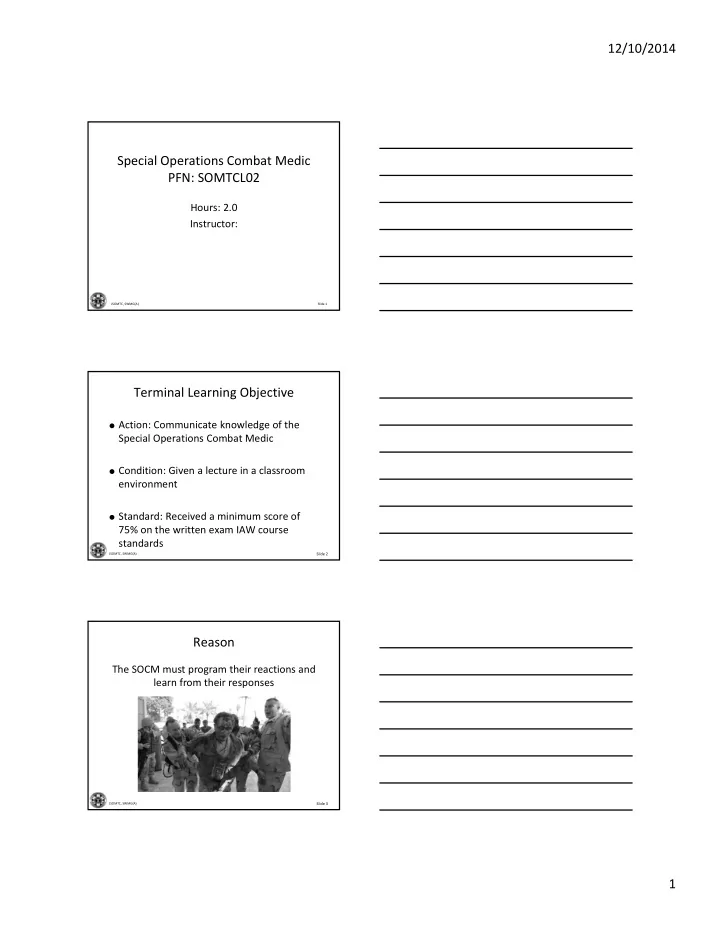
Reason

The SOCM must program their reactions and learn from their responses

slide-2
SLIDE 2

12/10/2014 2

Slide 4

JSOMTC, SWMG(A)

Agenda

 Define the Special Operations Combat Medic  Outline SOCM trauma training  Identify Combat Medic variables  Describe environment based thinking  Identify Combat Medic equipment  Identify SOCM packing principles  Determine death and resuscitation

termination

 Identify SOCM Pearls of Wisdom

Slide 5 JSOMTC, SWMG(A)

Special Operations Combat Medic

Slide 6

JSOMTC, SWMG(A)

“ Special Operations Combat Medics (SOCMs) may often find themselves in austere tactical environments where evacuation of a teammate to a medical treatment facility may not be possible or may be severely

  • delayed. They must be prepared for any

injury within any environment.”

SOCM

slide-3
SLIDE 3

12/10/2014 3

Slide 7

JSOMTC, SWMG(A)

SOCM Abilities

 Capability to treat numerous different

types of traumatic wounds

 Aptitude to increase team survivability  Comprehension of multisystem trauma

patients

 Dexterity to operate in all types of

environments tactically and medically

 Competence to self adjust shortfalls

Slide 8

JSOMTC, SWMG(A)

Core Attributes

 Integrity  Courage  Perseverance  Personal Responsibility  Professionalism  Adaptability  Team Player  Capability

Slide 9

JSOMTC, SWMG(A)

SOCM Trauma Training

slide-4
SLIDE 4

12/10/2014 4

Slide 10

JSOMTC, SWMG(A)

Trauma 1

 ACLS  PEPP  Military Medicine  Lecture / PMST II

Slide 11

JSOMTC, SWMG(A)

Trauma 2

 Trauma Patient Assessment (TPA)  Trauma Surgical Skills (TSS)  Combat Trauma Management (CTM)

Slide 12

JSOMTC, SWMG(A)

Trauma 3

 K9 Instruction  Tactical Combat Casualty Care  Military Triage  MASCAL  Advanced Trauma Management (ATM)  Field Training Exercise (FTX)

slide-5
SLIDE 5

12/10/2014 5

Slide 13

JSOMTC, SWMG(A)

Summation

 Each training block is built to add onto the

next section

 Skills are introduced and reinforced  The medical information will always be

changing and the SOCM needs to be informed and integrating the new knowledge

Slide 14 JSOMTC, SWMG(A)

Combat Medic Variables

Slide 15

JSOMTC, SWMG(A)

Two Types Of Variables

 Controllable  Uncontrollable

slide-6
SLIDE 6

12/10/2014 6

Slide 16

JSOMTC, SWMG(A)

Controllable Variables

What are the variables we can control?

  • 1. Preparation/ Training/ Contingency Plans
  • 2. Mental Capacity/ Composure/ Emotion
  • 3. Education/ Medical Updates

Slide 17

JSOMTC, SWMG(A)

Mental Capacity

 Developed securely through experience  The ability to filter out what is important in

relation to all stimuli

 Maturity to distinguish threat from non‐

threat medically and tactically

 Maturity of reaction

Slide 18

JSOMTC, SWMG(A)

Preparation

Preparation entails:

  • 1. Team training
  • 2. Medic training
  • 3. Augmentee training in medical skills
  • 4. Indigenous integration
  • 5. Equipment placement (individual vs. aid bag)
  • 6. PCI checks for mission
slide-7
SLIDE 7

12/10/2014 7

Slide 19

JSOMTC, SWMG(A)

Training

 Medical skills are perishable  Team Medical SOP’s (must be enforced)  Medical training should not be a separate

event from other training

 Focus on the basics when training

teammates (BLS, bandaging and splinting)

Slide 20

JSOMTC, SWMG(A)

Numerous Concerns

Slide 21

JSOMTC, SWMG(A)

Beyond Medical Concerns

Mini‐gun

Feed mechanism for the Mini‐gun

Load plan for rounds(mini‐gun)

Round box maintenance

Pindle configuration for Mini‐gun

Power Layout

Feed tube immediate action

Trigger operation

Trigger maintenance

M240 operation (butterfly trigger)

M249 operation

M4 operation

M9 operation

DAMA

MERC Chat

MBTIR fill

MBTIR zero

MBTIR operation

Winch operation (GMV)

Compressor

Power converter

AT‐4 safety

AT‐4 operation

Carl Gustav safety

Carl Gustav operation

60mm mortar

Trigger fire operation

Mortar round settings

102 SAT

Team internal chat

slide-8
SLIDE 8

12/10/2014 8

Slide 22

JSOMTC, SWMG(A)

Preparation is Controllable

 There are many, many competing

considerations besides medical proficiency and training (weapons maintenance)

 As a medical operator, stressing medical

training will be a non‐stop job requirement

 Training and preparation is a controllable

variable that needs to be stressed in terms

  • f the medical component

Slide 23

JSOMTC, SWMG(A)

Uncontrolled Variables

Slide 24

JSOMTC, SWMG(A)

Uncontrollable Aspects

 Weather  Follow‐on missions  Enemy activity  Unavoidable equipment malfunction  Changing environment  Number of casualties  Evacuation response time

slide-9
SLIDE 9

12/10/2014 9

Slide 25

JSOMTC, SWMG(A)

Variables Continued

 Resupply response time  Time of day  Augmentee additions to mission  Force strength (teammates leaving or

entering theatre)

 Loyalties of Indigenous forces

Slide 26

JSOMTC, SWMG(A)

Key points

 Categorizing variables helps the operator

define the battlefield

 “How can I deflate this variable which is

uncontrollable?”

 Each mission requires a different thought

process for the SOCM

 The mission may be constant but the

execution will change (multi‐use items)

Slide 27

JSOMTC, SWMG(A)

Key points Continued

 “The operator cannot wait for information

to come to them, they must first establish what information they need and then seek it out until they find a required answer”

 Developing initiative for preparation will

save more lives than any other skill

slide-10
SLIDE 10

12/10/2014 10

Slide 28 JSOMTC, SWMG(A)

Environment Based Thinking

Slide 29

JSOMTC, SWMG(A)

All Actions Depend on Environment

Slide 30

JSOMTC, SWMG(A)

Casualty Movement

slide-11
SLIDE 11

12/10/2014 11

Slide 31

JSOMTC, SWMG(A)

Casualty Aid

Slide 32

JSOMTC, SWMG(A)

Casualty Movement

Slide 33

JSOMTC, SWMG(A)

2nd Soldier Shot

slide-12
SLIDE 12

12/10/2014 12

Slide 34

JSOMTC, SWMG(A)

What is the Environment?

Slide 35

JSOMTC, SWMG(A)

Review of Reaction

 Casualty appears in open area  Rescuer responds by running to casualty

(unknown suppressive fire extent)

 Casualty weight is overwhelming limiting

speed of exit to solid cover

 2nd rescuer responds in same manner  One rescuer becomes casualty  Rescuer retreats from open area to regroup

Slide 36

JSOMTC, SWMG(A)

Schematic

Road Road Wood Building Enemy fire Enemy fire Rescuer direction

  • f travel
slide-13
SLIDE 13

12/10/2014 13

Slide 37

JSOMTC, SWMG(A)

Environmental Factors

 Enemy position unknown or well covered  Large open area, little solid cover  Casualty is unresponsive, no help with

extraction

 Casualties equipment adds weight  Daylight, full visibility  Distance to solid cover extensive

Slide 38

JSOMTC, SWMG(A)

Keys to Rescue/ SOCM Thought Process

 Enemy position located (fire superiority)  Location for casualty located (solid cover)  Method of extraction (casualty carry)  Aided rescue tactics (smoke, vehicle cover)  Factors of speed (equipment necessity)  Factors of speed (# of rescuers, pros, cons)  Coordination/ Orchestration (effective fire)  Communication

Slide 39

JSOMTC, SWMG(A)

Schematic

Road Road Wood Building Enemy fire Enemy fire Rescuer direction

  • f travel

Vehicle

Which way to bring casualty?

slide-14
SLIDE 14

12/10/2014 14

Slide 40

JSOMTC, SWMG(A)

Tactical Principles

 3 F’s of Combat

  • Find
  • Fix
  • Finish

 Finding the enemy is easier said than done  Fixing the enemy requires accurate

suppression

 Finishing may require any number of

possibilities

Slide 41

JSOMTC, SWMG(A)

Medic Considerations

 The thought process and communication

requirements for the Medic revolves around the 3 F’s.

 Care Under Fire phrase is misleading  Limited medical care should be given to the

casualty until SOLID cover is between you and the enemy

 SOLID cover will be different for every

environment

Slide 42

JSOMTC, SWMG(A)

Considerations Continued

SOLID cover examples

slide-15
SLIDE 15

12/10/2014 15

Slide 43

JSOMTC, SWMG(A)

Environment Scenario

Slide 44

JSOMTC, SWMG(A)

Suicide Bomber

 Your clinic has been

targeted by suicide bombers

 As the only medic

involved in the clinic you need to make the clinic safe due to this threat

Slide 45

JSOMTC, SWMG(A)

Schematic

Two way road 10 meter mud wall Door Entrance Female Clinic Male Clinic Door Entrances 50 meter distance

Suicide Bomber Threat is imminent from cross checked intelligence reports and HUMINT resources.

Safe Area to the West

slide-16
SLIDE 16

12/10/2014 16

Slide 46

JSOMTC, SWMG(A)

Resources available

 2inX4inX8ft wood planks (unlimited)  Nails unlimited  5 Camp workers with necessary tools (shovels,

hammers, etc)

 1 loader  3ftX3ft Hesco containers

(unlimited amount)

 30 man Afghan Infantry Co  All the mud you want

Slide 47

JSOMTC, SWMG(A)

Exercise

 With the schematic and the resources given

you must make the clinic safe for your patients, the host nation doctors working for you, your teammates, and any other guests which may visit the clinic at any time

 You now have 10 minutes to think about

and draw out a strategy for safety

 Questions?

Slide 48

JSOMTC, SWMG(A)

Schematic Review

Two way road 10 meter mud wall Door Entrance Female Clinic Male Clinic Door Entrances 50 meter distance

Suicide Bomber Threat is imminent from cross checked intelligence reports and HUMINT resources.

Safe Area to the West

slide-17
SLIDE 17

12/10/2014 17

Slide 49

JSOMTC, SWMG(A)

Answer Considerations

 The Threat: suicide bomber

  • Characteristics : On foot?
  • More than one individual?
  • Armed with one bomb, weapon and bomb, just

grenades, RPG’s

  • Male, female, child?

 Channelize threat  Increase time to react  Address cultural concerns  Use Host Nation Soldiers whenever possible

Slide 50

JSOMTC, SWMG(A)

Schematic Review

Two way road 10 meter mud wall Female Clinic Male Clinic

Safe Area to the West

Hescos Female (Host Nation) Searcher/ Guard Male (Host Nation) Searcher/ Guard

Exit

Patient Exit

Slide 51

JSOMTC, SWMG(A)

Conclusion

 Clinic safety involves

environment based thinking

 In theatre the

available resources may be limited and creativity comes into play for success

 Have contingency

plans for botched attempts (CCP’s, rally points designated)

slide-18
SLIDE 18

12/10/2014 18

Slide 52

JSOMTC, SWMG(A)

Key Operational Points

 If Hescos are scarce, digging trenches for

VBIED protection is an alternative (remember channelization)

 Static site security is executed in layers Outer layer is made up

  • f host

nation Inner layer may be U.S. regular army

  • r more

host nation Team layer for all team members

Slide 53

JSOMTC, SWMG(A)

Changing Environments

Slide 54

JSOMTC, SWMG(A)

Firebase Clinic

Medicine in this environment requires a different approach than the situation we just critiqued

slide-19
SLIDE 19

12/10/2014 19

Slide 55

JSOMTC, SWMG(A)

Rural Vehicle Combat

* Courtesy SFC Elwood (1SFG)

Slide 56

JSOMTC, SWMG(A)

Urban Foot Combat

Slide 57

JSOMTC, SWMG(A)

7000 Feet Logar Province, Afghanistan

slide-20
SLIDE 20

12/10/2014 20

Slide 58

JSOMTC, SWMG(A)

Jungle Combat

Slide 59

JSOMTC, SWMG(A)

Operating in Rotary Wing Aircraft

Slide 60

JSOMTC, SWMG(A)

Darkness Considerations

slide-21
SLIDE 21

12/10/2014 21

Slide 61 JSOMTC, SWMG(A)

Combat Medic Equipment

Slide 62

JSOMTC, SWMG(A)

Soldier Load

 Soldier load given the

terrain

 Mobility requirements

given combat action

 Mission dependent

variables for equipment considerations

Slide 63

JSOMTC, SWMG(A)

Soldier Kit Issues

 Very bulky on the

anterior

 The posterior

camelback makes movement difficult

 The prone

shooting position is almost impossible

slide-22
SLIDE 22

12/10/2014 22

Slide 64

JSOMTC, SWMG(A)

Principles for Equipment Selection

 Mission specific (don’t forget contingencies)  Multi‐use items  Contents should be mission tested  Packaging should be water resistant/durable  Equipment should be team‐member specific

in certain cases

 Chosen articles need to address possible

injuries seen at each level of the mission

Slide 65

JSOMTC, SWMG(A)

Mission Dependent/ Operator Dependent Medical Gear Matrix Designated by Grades

IFAK/Blowout Kit AID BAG EVAC Ground/ AIR FireBase/FAST/CASH Grade 1 MED gear Grade 2 MED gear Grade 3 MED gear Grade 4 MED Gear NPA Cric kit Extra fluids Ultrasound Tourniquet IV (2) IV supplies ECG/Monitors Chest Seal Drugs Israeli Litter Ventilator ACE Wrap Airway Kit Blankets/Hypothermia kit Oxygen Kerlex Chest Tube Kit Thermal Angel Field Blood Supply 14ga (ND) Kerlex/Ace Wrap Traction Devices Extra/Additional Drugs Alcohol/Betadine Sam Splint C‐collar Foley/NG Cravats Extra‐Bandages/ Ace wraps Suction ABD dressing Tourniquets Pleurovac Tourniquets Skedco BVM with mask Stethescope Hemostats Bandage Scissors OPA

Slide 66

JSOMTC, SWMG(A)

Grade I

 Operator equipment

is stream line

 IFAK worn on left side‐

rear

 Pros and Cons for IFAK

position

 Mobility needs to be

considered when placing Grade I gear

slide-23
SLIDE 23

12/10/2014 23

Slide 67

JSOMTC, SWMG(A)

Grade II

 M9 Medic Bag  Low profile  Used mainly for

assaults or short term missions

 May be used for long

range patrol; weight and equipment decisions become potential issues

Slide 68

JSOMTC, SWMG(A)

Grade II Continued

 Larger medical bag  Used for vehicle

  • perations

 May be used as “drop

and go bag” when assaulting

 Medical bag for range

  • perations

 More room more

possibilities

Slide 69

JSOMTC, SWMG(A)

Grade III

 GMV, ATV, or any

alternate place where follow on medical gear may be stored for use

  • n the battlefield

 This Grade is open to

places of experience

  • r creativity of the
  • perator and the

team

slide-24
SLIDE 24

12/10/2014 24

Slide 70

JSOMTC, SWMG(A)

Grade IV

 Firebase medical clinic  Usually a stable place

to set up continued

  • perations

 Larger medical

equipment used for treatment

 The facility is fixed and

continuous

Slide 71

JSOMTC, SWMG(A)

Grade IV Continued

 FAST Operating Room  The Forward Area

Surgical Team is staffed with U.S. surgeons

 They have life saving

stabilization and damage control capabilities

Slide 72

JSOMTC, SWMG(A)

Summation of Grades

 Grade I gear is defined as a small kit on a

person

 Grade II gear is a Medic Bag which may be

worn or used as a “drop off” before assault

 Grade III items are “cached” for later use

whether in a vehicle or at an ORP, CCP

 Grade IV equipment is located at the

Firebase or established CSH, FAST location

slide-25
SLIDE 25

12/10/2014 25

Slide 73 JSOMTC, SWMG(A)

SOCM Packing Principles

Slide 74

JSOMTC, SWMG(A)

Packing Gear Principles

 Waterproof and preferably CBRNE proof  Compact  Easy to locate within the bag  Contents ordered in terms of use

Slide 75

JSOMTC, SWMG(A)

Gear Principles Continued

 Extra items available  Sterility kept with products  Kits made for procedures  Items are tested and familiar to operator

slide-26
SLIDE 26

12/10/2014 26

Slide 76

JSOMTC, SWMG(A)

Waterproof Contents

Slide 77

JSOMTC, SWMG(A)

Vacuum Sealing Pros

 Excess air is evacuated decreasing size of

medical components or kits

 All contents are sealed and dry  Gives the operator the ability to package

kits for a team member to carry

 Gives the Medic freedom to include what

contents are deemed personally necessary

Slide 78

JSOMTC, SWMG(A)

Vacuum Sealing Cons

 Time consuming  Resource intensive (vacuum sealer and

vacuum bags)

 May not have the ability to perform in

austere conditions

 Some products don’t seal well

slide-27
SLIDE 27

12/10/2014 27

Slide 79

JSOMTC, SWMG(A)

Compact

Cricothyroidotomy Kit Repackaged 6” Ace

Slide 80

JSOMTC, SWMG(A)

Easy to Locate Inside Medic Bag

Slide 81

JSOMTC, SWMG(A)

Contents Ordered in Terms of Use

 Tape on

tape

 Trash

stays with cravat

 Contents

may be placed in

  • rder of

use

slide-28
SLIDE 28

12/10/2014 28

Slide 82

JSOMTC, SWMG(A)

Retrieving Contents

Slide 83

JSOMTC, SWMG(A)

Extra Items Available

Slide 84

JSOMTC, SWMG(A)

Sterility Kept with Products

* Courtesy Mr. Resurreccion

slide-29
SLIDE 29

12/10/2014 29

Slide 85

JSOMTC, SWMG(A)

Drug Box Design

Slide 86

JSOMTC, SWMG(A)

Kits Made for Common Procedures

Cricothyroidotomy Contents Cricothyroidotomy Kit

Slide 87

JSOMTC, SWMG(A)

Battle Tested Products

 DO NOT use untested

equipment while performing missions

 There is a tendency to

throw new products in your bag without training or testing them first

 Just opening the

package does not count

slide-30
SLIDE 30

12/10/2014 30

Slide 88

JSOMTC, SWMG(A)

Discussion

 This is the modified ET

tube for the Cricothyroidotomy Kit

 Why is there a STYLET

placed inside the tube? * RAISE your hand with the answer

Slide 89

JSOMTC, SWMG(A)

Answer

 The stylet is used only

to keep the tube open while it is stored inside the kit

 Without the stylet the

tube will be flattened and during use may be altered, decreasing the flow of air through the tube

Slide 90 JSOMTC, SWMG(A)

Determine Death and Resuscitation Termination

slide-31
SLIDE 31

12/10/2014 31

Slide 91

JSOMTC, SWMG(A)

Determine Death and Resuscitation Termination

 Obvious death

  • Decapitation
  • Massive crush injury and or penetrating

trauma with evisceration of heart, lung or brain

  • Incineration
  • Decomposition of body tissues
  • Rigor Mortis or post mortem lividity

Slide 92

JSOMTC, SWMG(A)

Determine Death and Resuscitation Termination

 Termination of resuscitation efforts

  • After 15 minutes if MOI is unknown or due to

trauma, PLUS

  • After 30 minutes if MOI is hypothermia,

lightning strike, electrical injury, cold water drowning PLUS

  • Persistent absent pulse and respirations when

adequate ventilation, fluids and medications have been administered

Slide 93

JSOMTC, SWMG(A)

Determine Death and Resuscitation Termination

 Termination of resuscitation efforts

  • Persistent absent pulse and respirations
  • Pupils are fixed and dilated
  • No deep pain response
  • Absence of end tidal CO2 from a correctly

placed ET tube or alternate airway device

slide-32
SLIDE 32

12/10/2014 32

Slide 94 JSOMTC, SWMG(A)

SOCM Pearls of Wisdom

Slide 95

JSOMTC, SWMG(A)

Tourniquet Requirements

 Operators coming

home have stated the need for 3 tourniquets

  • n each Soldier

 The need for 2

tourniquets on some leg wounds has driven the change

 Remember in harsh

environments check tourniquet serviceability regularly

Slide 96

JSOMTC, SWMG(A)

Products Seen Downrange

 Combat Gauze  S‐Rolled Kerlex  Saline Lock Kit  Altered Cric Tube  Altered Scalpel

for Cric

slide-33
SLIDE 33

12/10/2014 33

Slide 97 JSOMTC, SWMG(A)

Tourniquet Placement

 Tourniquets may be placed

anywhere for easy access

 Inside this GMV there are

numerous tourniquets accessible at any time

 They were secured to many

different non‐removable features of the GMV by electrical tape

 The idea used was for

breakaway capability of use

Slide 98 JSOMTC, SWMG(A)

Low Visibility Operations

 Low Visibility

Operations create issues for medical requirements

 Prior planning and

medical kit component choices are the keys

 What do you bring

for this mission?

Slide 99 JSOMTC, SWMG(A)

Firebase Clinic Safety

 Patients screened

prior to entrance to clinic (Indigenous then U.S.)

 Holding area

established

 No vehicles allowed to

deliver patients to clinic (VBIED concerns)

slide-34
SLIDE 34

12/10/2014 34

Slide 100 JSOMTC, SWMG(A)

Firebase Cultural Concerns

 Treating women in

Afghanistan is culturally sensitive

 In this picture the

curtain is a shield for the male medical personnel to conceal himself while verbally treating females

*Courtesy SFC Elwood (1SFG)

Slide 101 JSOMTC, SWMG(A)

Table 8. OIF Medical Reasons for Evacuations (as of August 31, 2010) Number Percentage Wounded in Action 8,954 18.1% Non‐Hostile Injuries 10,383 21.0% Disease/Other Medical 30,053 60.1% Total 49,390 100% Source: Department of Defense, Defense Manpower Data Center, http://siadapp.dmdc.osd.mil/personnel/ * The Department of Defense defines a “non‐hostile injury” as an injury that is not directly attributable to hostile action or terrorist activity, such as casualties due to the elements, self‐inflicted wounds, or combat fatigue.

OIF Statistics

Slide 102 JSOMTC, SWMG(A)

OEF Statistics

Table 9. OEF Medical Reasons for Evacuation (as of August 31, 2010) Number Percentage Wounded in Action 2,788 20.1% Non‐Hostile Injuries 2,771 20.0% Disease/Other Medical 8,292 60.0% Total 13,851 100% Source: Department of Defense, Deployment Health Support Directorate, http://siadapp.dmdc.osd.mil/

slide-35
SLIDE 35

12/10/2014 35

Slide 103 JSOMTC, SWMG(A)

Statistical Meaning for the SOCM

 81.1% of Injuries were non‐action issues (OIF)  80% of Injuries were non‐action issues (OEF)  Wounded in Action results in approximately

20% of the injuries seen

 That 20% will be the most serious injuries the

SOCM will see while deployed

 Do not become complacent with preparation

and skills given the make‐up of injuries

Slide 104 JSOMTC, SWMG(A)

Amputations for OIF,OEF, Etc

Table 3. Count of Individuals with Amputations by Service for OIF, OEF, and Unaffiliated Conflicts, 2001 to September 1, 2010 Theater Type of Amputation Army Marine Navy Air Force Foreign Other Total OIF Major Limb 620 158 18 8 4 8 816 Partial(Hand/Foot,Toes/Fingers) 272 49 7 11 0 3 342 OEF Major Limb 145 53 5 6 4 4 217 Partial(Hand/Foot,Toes/Fingers) 24 6 0 2 0 0 32 Unaffiliated Major Limb 94 12 25 31 1 26 189 Conflicts Partial(Hand/Foot,Toes/Fingers) 20 1 2 1 0 1 25 Total 1,621 Source: Personal correspondence with Dr. Michael J. Carino, Army Office of the Surgeon General, September 21, 2010.

Slide 105 JSOMTC, SWMG(A)

TBI Incidence

Table 2. Traumatic Brain Injuries in the U.S. Military (2000 to 2010 Q1) Year 2003 2004 2005 2006 2007 2008 2009 2010 Total Incident 12,886 13,271 12,025 16,873 23,002 28,557 27,862 7,604 178,876

Source: The Defense and Veterans Brain Injury Center, http://www.dvbic.org/TBI‐Numbers.aspx, last updated on May 20, 2010.
slide-36
SLIDE 36

12/10/2014 36

Slide 106 JSOMTC, SWMG(A)

Lessons

 Be aware and prepared for the TBI patient  Have systems in place to deal with TBI

suspected casualties

 Extremity injury is very common  Focus on courses of action for extremity

trauma (teach your teammates)

Slide 107 JSOMTC, SWMG(A)

Discussion

You are the Senior medic without a Junior medic tasked with a vehicle mounted direct hit on a small collection of buildings 20km East of Bagram, Afghanistan. Provide a medical load out plan for all 9 personnel and the 3 GMV’s in your team. All answers will be written. All materials will be collected with your name attached.

Slide 108 JSOMTC, SWMG(A)

Your Target Landscape

slide-37
SLIDE 37

12/10/2014 37

Slide 109 JSOMTC, SWMG(A)

Carrying Load for Personnel

 NPA (1)  Tourniquet X 3  Cric Kit  2 inch Ace with 1 Kerlex  1 pack Combat Gauze  Needle Decompression Kit (2:14ga Needles)  2 Asherman chest seals

Slide 110 JSOMTC, SWMG(A)

Possible Outload Plan

 Driver  TC  Gunner  Large MED Bag

Marks the position of break away tourniquets attached to the

  • vehicle. The front

2 are attached to the sun visors and the rear 2 to the frame cross bar.

Slide 111 JSOMTC, SWMG(A)

GMV Med Bag Contents

Tourniquet (4)

Compressed Kerlex (8)

6in Ace Wraps (8)

Abdominal Bandage w/cravat (2)

Chest tube Kit (1)

IV kits with 500ml Hextend (2)

FAST 1 IO (1)

SAM Splints (3)

Cravats (8)

Sodium Chloride 100ml (2)

Airway Kit with Laryngoscope (1)

Field Dressings (5)

Cricothyroidotomy kit (1)

Hypothermia Kit (1)

Nine Line Casevac Card (2)

BVM w/mask

KTD Traction device (1)

Combat Gauze (2)

Penlight (2)

Stethescope (1)

BP cuff (1)

C‐Collar (1)

Trauma Shears (1)

Sharpies pens (3)

Head lamp (1) Extra Batteries

Drugs:

  • Invanz (3 vials)
  • Moxifloxacin (2 vials)
  • Fentanyl Lollipops
  • Morphine (3 Vials)

Snivel Drugs

Indigenous Drugs

Any Extra contents

slide-38
SLIDE 38

12/10/2014 38

Slide 112 JSOMTC, SWMG(A)

Contingencies

 The mission starts as vehicle mounted,

remember concerns for dismounted

  • perations

 Your proposed CASEVAC time is just

proposed and will probably be longer

 Mass casualty events are always a concern  Pre‐hit and Post‐hit travel  Nail down CASEVAC plan with the pilots if

possible

Slide 113 JSOMTC, SWMG(A)

Questions?

Slide 114

JSOMTC, SWMG(A)

Terminal Learning Objective

 Action: Communicate knowledge of the

Special Operations Combat Medic

 Condition: Given a lecture in a classroom

environment

 Standard: Received a minimum score of

75% on the written exam IAW course standards

slide-39
SLIDE 39

12/10/2014 39

Slide 115

JSOMTC, SWMG(A)

Agenda

 Define the Special Operations Combat Medic  Outline SOCM trauma training  Identify Combat Medic variables  Describe environment based thinking  Identify Combat Medic equipment  Identify SOCM packing principles  Determine death and resuscitation

termination

 Identify SOCM Pearls of Wisdom

Slide 116

JSOMTC, SWMG(A)

Reason