SLIDE 1
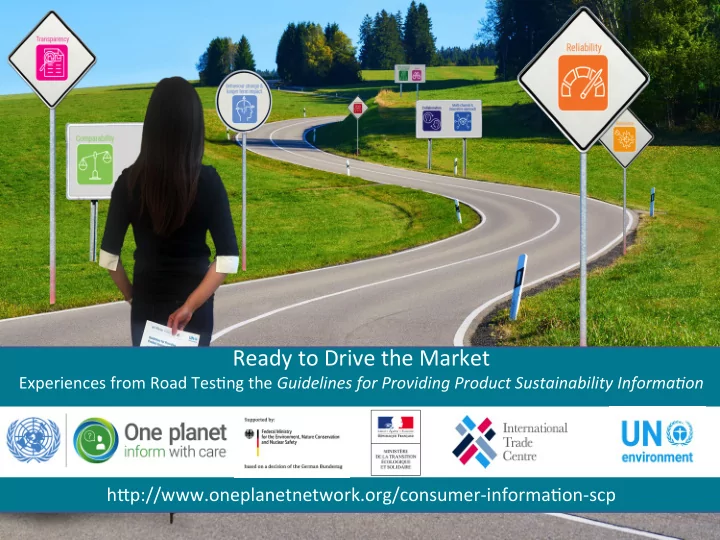
Ready to Drive the Market
Experiences from Road Tes9ng the Guidelines for Providing Product Sustainability Informa8on
h;p://www.oneplanetnetwork.org/consumer-informa9on-scp
SLIDE 2
11th Mar 11th March 2019 Nair h 2019 Nairobi, K bi, Ken enya a
SLIDE 3 PAGE
OBJECTIVE
Support the provision of quality informa9on on goods and services, and effec9ve strategies to engage consumers in sustainable consump9on
Co-led by: Supported by: Mul9-stakeholder Advisory Commi;ee; partner ins9tu9ons h;p://www.oneplanetnetwork.org
Sign up to our newsle=er and/or become a partner by emailing: CISCP@un.org
SLIDE 4 Ob ObjecI jecIves es of t
e Guidel elines es
Ø Contribute to the achievement of SDG 12 Ø Improve the reliability of consumer informaAon for sustainable consumpAon through interna9onal consensus Ø Set a common ground of minimum requirements to remove poten9al for greenwashing Ø AcAvely encourage organiza9ons to take leadership and communicate quality, useful informa9on to consumers
Sustainable Development Goal 12 Ensure sustainable consump8on and produc8on pa>erns Target 12.8 By 2030, ensure that people everywhere have the relevant informa8on and awareness for sustainable development and lifestyles in harmony with nature
SLIDE 5
Th The P e Princi ciples es
SLIDE 6
Ro Road TesIng Exercise
To understand how feasible it is to apply the Guidelines, including over different sectors and type of claims To iden9fy where most challenges lie for future work on product sustainability informa9on To collect good prac9ce case studies and lessons learned in different regions and sectors
For companies & standard-se1ng organisa3ons: Serve as reference to compare their sustainability claims or their cer8fica8on schemes to the Guidelines
SLIDE 7 THE ‘ROAD TESTERS’
ESPAÑA
SLIDE 8 Gen Gener eral R Res esults
- Overall per9nence of the two categories of principles
propounded by the Guidelines (fundamental and aspira9onal principles) was confirmed
- The 10 Principles are easy to comprehend and have the poten9al
to help organiza9ons improve the communica9on tools they employ
- The applica9on of the Guidelines can indeed make claims more
- bjec9ve, consistent and clear for consumers
Challenges and strengths in applying the different principles might vary over types of
- rganiza9ons and claims (i.e. regarding challenges and strengths in mee9ng different
principles)
SLIDE 9 Gen Gener eral R Res esults
Standard-seMers
Principle 7 (Behaviour Change and Longer Term Impact) hard to apply: they usually do not have direct interac9on with individual end consumers Principle 6 (Three Dimensions
- f Sustainability) hard to apply
for single-issue cer9fica9on schemes: overall sustainability is not claimed
Companies
Companies that analysed self- assessed claims found the more difficult ques9ons were around rigor and credibility (principle 1 Reliability and principle 2 Relevance) SMEs faced greatest challenges when applying principle 8 (Mul9-Channel and Innova9ve Approach) and principle 9 (Collabora9on): demand addi9onal resources and planning
SLIDE 10 Main Challeng Main Challenges es
Availability of space on pack
- The compe99on with other messages concerning safety, nutri9on,
health, and performance was regarded as a great challenge.
Complexity of sustainability informaAon
- Road testers acknowledged the difficulty in communica9ng technical
terms to the general public, without oversatura9ng or confusing consumers.
Lack of harmonized approaches
- Collabora9on should be increased between standard-se_ng
- rganisa9ons and the brands that have a consumer-oriented approach,
as well as an extra effort to work towards greater harmoniza9on between the various standard schemes.
SLIDE 11 Ho How t w to fu
rther p er progr
ess in t the fiel e field
Provide addi9onal guidance on implementa9on of the following approaches and principles Provide further instruc9ons on how the Guidelines can be applied by different type of organiza9ons and claims Enhance collabora9ons and create synergies Work on policy level
SLIDE 12 (1) Pr (1) Provide addiIo vide addiIonal guidance o nal guidance on implemen n implementaIo aIon o n of the f the fo following approaches and principles
Hotspots Analysis Approach: The majority of road testers were not familiar with this approach prior to the road tes9ng. More guidance is needed in order to clarify what hotspots analysis means and its relevance to communica9ng product sustainability informa9on. Principle 4 (Transparency): The poten9al that new technologies can bring for progress in this principle should be recognized and further discussed, considering that data-enabled technologies provide informa9on to consumers first hand in real 9me, while also addressing the challenge of limited space on pack. Principle 6 (Three Dimensions of Sustainability): Considering there are s9ll no interna9onally recognized standards or labels that cover all three aspects
- f the full life cycle, the Guidelines suggest that companies look at combining
standards and methodologies to ensure all three dimensions of sustainability are taken into account.
SLIDE 13 (1) Pr (1) Provide addiIo vide addiIonal guidance o nal guidance on implemen n implementaIo aIon o n of the f the fo following approaches and principles
Principle 7 (Behaviour Change and Longer Term Impact): Further guidance should be provided on how to monitor changes in behaviour of consumers. This process is regarded as demanding and onerous, especially for small and medium sized organiza9ons. Principle 9 (CollaboraAon): It was recognised as a crucial next step to involve consumers in the development of the claims. Need of addi9onal advice on how SMEs could use their limited resources and capacity to involve relevant stakeholders during the development of the claims. Principle 10 (Comparability): Developing compara9ve claims is challenging. Defini9on of comparable methods and criteria for higher number of product categories could s9mulate the coherent implementa9on of this principle.
SLIDE 14 Promote good pracAces from various types of Tools (labels, product declara9ons, ra9ngs, marke9ng claims, communica9on campaigns, life cycle assessment); Organiza9on (companies or standard-se;ers); Approach (single or mul9-issue); Status (exis9ng or under development) Give more prac9cal advice for other corporate areas such as markeAng, procurement and product development.
(2) Pr (2) Provide further ins vide further instrucIo trucIons o ns on ho n how the G w the Guidelines c uidelines can be an be applie applied b d by diffe y different type t type o
f organiz anizaIo aIons and c ns and claims laims
SLIDE 15
Build partnerships with a focus on a replicaAon effect Promote ac9vi9es to strengthen collaboraAon with retailers considering their role in promo9ng more sustainable goods in a visible and appealing way to end consumers Collaborate for country and sector level awareness raising and iden9fica9on of na9onal and sectoral specifici9es
(3) Enhance c (3) Enhance collabo llaboraIo aIons and cr ns and crea eate s e syner ynergies gies
SLIDE 16
(4) W (4) Work o rk on P n Policy Le licy Level el
Provide examples of how countries are applying the Guidelines and make them a more concrete tool for governments Link to naAonal processes and instruments, although recognizing that consumer informa9on is an issue that needs interna9onal consensus Engage with naAonal markeAng surveillance authori9es and regulators responsible for overseeing consumer marke9ng and claims on a na9onal level Con9nue to lic the Guidelines to a more poliAcal and strategic global sphere, for which the involvement of governments will be crucial
SLIDE 17 TESTIMONIES
ESPAÑA
Download report & case studies at h>p://www.oneplanetnetwork.org/consumer-informa8on-scp/
SLIDE 18
On Online Hu e Hub
h>p://www.oneplanetnetwork.org/consumer-informa8on-scp/ product-sustainability-informa8on-hub
SLIDE 19
Road-testing the ‘Guidelines for Providing Product Sustainability Information’ – our experiences
SLIDE 20 Leaping Bunny
- The Leaping Bunny is the international gold-
standard certification for cruelty-free cosmetics, personal care and household products
- The Leaping Bunny logo is the best assurance that
a brand has committed to driving animal testing out
- f its entire supply chain
- Operated globally by Cruelty Free International and
- ur partners
- Over 1,200 brands certified worldwide, growing
rapidly as consumers increasingly demand more ethical & sustainable products
SLIDE 21 Challenges of applying the guidelines to Leaping Bunny
- Certification deals only with
animal testing
- Hard to assess against some
- f the aspirational principles
Ø Three dimensions of sustainability
consumers that the certification influences behaviour change Ø We are to develop evidence
SLIDE 22
- Strong responses to all of
the fundamental principles Ø Reliability Ø Relevance (criteria stricter than legislation) Ø Accessibility through the Leaping Bunny logo
useful tool for assessing the certification
next steps and global growth
Positives from applying the guidelines to the Leaping Bunny
SLIDE 23
Phone: +44 (0) 207 700 4888 Address: 16a Crane Grove, London, N7 8NN, UK Email: jack.mcquibban@crueltyfreeinternational.org Website: www.CrueltyFreeInternational.org
Road-testing the ‘Guidelines for Providing Product Sustainability Information’
www.CrueltyFreeInternational.org
SLIDE 24 THANK YOU!
Sign up t Sign up to o
ur newsle sle=e =er and/ r and/or be r become me a partne a partner b r by e y emailing: mailing:
CIS CISCP@ CP@un.or