
SLIDE 1
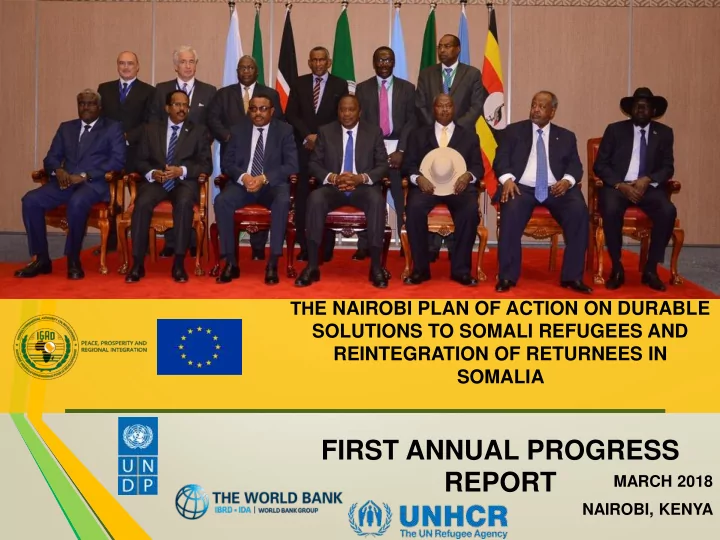
THE NAIROBI PLAN OF ACTION ON DURABLE
SOLUTIONS TO SOMALI REFUGEES AND REINTEGRATION OF RETURNEES IN SOMALIA
FIRST ANNUAL PROGRESS REPORT
MARCH 2018 NAIROBI, KENYA
I
REPORT MARCH 2018 NAIROBI, KENYA Somalia Context Over 2 million - - PowerPoint PPT Presentation
I TH E NAIROBI PLAN OF ACTION ON DURABLE SOLUTIONS TO SOMALI REFUGEES AND REINTEGRATION OF RETURNEES IN SOMALIA FIRST ANNUAL PROGRESS REPORT MARCH 2018 NAIROBI, KENYA Somalia Context Over 2 million internally displaced persons
THE NAIROBI PLAN OF ACTION ON DURABLE
SOLUTIONS TO SOMALI REFUGEES AND REINTEGRATION OF RETURNEES IN SOMALIA
FIRST ANNUAL PROGRESS REPORT
MARCH 2018 NAIROBI, KENYA
I
and Yemen
drought between November 2016 and May 2017
and in need of large-scale humanitarian assistance
4 Regional Commitments Towards Durable Solutions
1. Creating conditions for safe and dignified return to Somalia 2. Expansion of protection and asylum space and enhancing self-reliance of refugees in hosting states in the region 3. Development
capacity and cooperation framework to spearhead the implementatio n of regional commitments for refugees 4. Forging a stronger international solidarity framework for responsibilit y sharing
COMMITMENT NO. 1 Creating Conditions for Safe Return of Refugees to Somalia
I
PROGRESS SO FAR
POLICY AND LEGISLATIVE ARCHITECTURE
Refugees, Returnees & IDPs developed and adopted
Refugees, Returnees & IDPs has been developed and adopted
Management Policy Developed
Policy for Returning
PROGRESS SO FAR
SECURITY SECTOR REFORM
1. New Policing Model 2. Justice and Corrections Model 3. Political agreement on the National Security Architecture 4. Formulation of National Defence Strategy 5. Formulation of Internal Security Strategy 6. Agreement on integration of 2,400 Puntland troops into Somalia National Army (SNA). 7. Peace deal and Power-sharing agreement between Ahlu Sunna
PROGRESS SO FAR
SECURITY SECTOR REFORM 1. New Policing Model 2. Justice and Corrections Model 3. Political agreement on the National Security Architecture 4. Formulation of National Defence Strategy 5. Formulation of Internal Security Strategy 6. Agreement on integration of 2,400 Puntland troops into Somalia National Army (SNA). 7. Peace deal and Power-sharing agreement between Ahlu Sunna Waljama’a (ASWJ) and Galmudug State Government 8. Somalia Security Conference – agreement between Federal Government, the Federal Member States and the Benadir Regional Administration
PROGRESS SO FAR
Restoration of Civil Authority 1. Enactment of local government laws. 2. Two district councils out of the eight targeted districts formed 3. Formulation of National Stabilization Strategy Delivery of Basic Social Services
education, health, housing, sanitation and water in areas of return within the Somali Drought Impact Needs Assessment (DINA) Accelerated Economic Recovery and Development
under the IMF Staff Monitor Program
PROGRESS SO FAR
Reconciliation and Social Cohesion
communities that host large numbers of IDPs and where returnees settle to promote durable solutions
known as Core Facilitation Teams
(CAP) for Baidoa and Kismayo Response to the Drought
improved access to food and cash - over 3 million people per month enjoying access to food and emergency cash transfers Protection Framework
for the protection and assistance of
TECHNICAL EXPERTS’ RECOMMENDATIONS ON CREATING CONDITIONS FOR SAFE AND DIGNIFIED RETURN TO SOMALIA
1.Continue facilitating the return of those who choose to voluntarily return 2.Increase support for returnees from 6
Months. 3.Support host countries in enhancing knowledge gathering and sharing capacities
Gov’t approach
funding to ease implementations of the NAP per the Nairobi Declaration.
improve the development of coastal cities where many returnees are likely to be hosted
COMMITMENT NO. 2 Expansion of Protection And Asylum Space in Refugee-Hosting States in the Region and Enhancing Self- Reliance for Refugees
I
7 Country reports tabled showing that IGAD Member States;
National Refugee Laws
Open Door Policy
use of Biometric Identity Management Systems
for refugees With regard to enhancing self-reliance, IGAD Member States are; 1. Formulating legislation and promoting Local integration 2. Establishing a favourable Business environment for refugees 3. Providing Education and Skills Training 4. Supporting sustainable environmental management practices in refugee hosting areas 5. Extending Healthcare, water and sanitation services 6. Experimenting with Cash-based Assistance
Recommendations on Asylum, Protection and Self-Reliance for Djibouti
System for data collection
well as civil registration of refugees
refugees and asylum seekers
refugees
integrate refugees in the national education, skills training and health system, access to water, jobs and education
Recommendations on Asylum, Protection and Self-Reliance for Ethiopia
1.Continue sustaining the Open door policy 2.Conclude ongoing legislative reforms to roll out
the CRRF
3.Enhance self-reliance through access land (10,000
hectares in the Somali region),
4.Improve access to gainful employment though the
Job compact - industrial parks linking trained students to the labour market
5.Enhance access to education, including University
and basic services
6.Complete development of ‘Out of camp in 10 years’
strategy
Recommendations on Asylum, Protection and Self-Reliance for Kenya
1.Accelerate progress towards open door policy and improve
turnaround times for Refugee Status Determination (RSD) - currently 10,000 asylum seekers awaiting clearance
2.Finalize with 12 months amendments to 2006 and 2014 bills
to enhance opportunities to implement CRRF pledges and access to documents, including provision of opportunities in banking, mobility and access to economic opportunities (businesses)
3.Conclude Guidelines developed by Working Group within 12
months on admissions to educational institutions, including universities) National Action Plan drafted-
4.Continue pursuing avenues of return of refugees to their
country of origin
5.Enhance active communication among national authorities
dealing with refugees
Recommendations on Asylum, Protection and Self-Reliance for South Sudan
1.Continue and enhance the open-door policy 2.Ratify the 1967 Protocol within the next 3
months
3.Follow through on plans to allocate land and
provide non-food items to refugees
4.Improve access to education within the next 6
months
5.Ensure standardization of medical screening of
medical conditions and data collection particularly for refugees crossing borders.
Recommendations on Asylum, Protection and Self-Reliance for Sudan
currently in discussion within the Parliament
access to land for agriculture
community to improve healthcare access for refugees
Recommendations on Asylum, Protection and Self-Reliance for Uganda
1.Maintain the open door policy (despite the ongoing
emergency)
2.Secure additional funding to implement activities outlined
in National Action Plan to facilitate improved access to registration, access to services, education and jobs. Looking for further funding
3.Conclude mapping of financial resources, investments
and who is doing what to
4.Strengthen the humanitarian-development nexus 5.Complete the process initiated by national planning
authorities to include refugees in the national budgetary allocation for health, education and water.
6.Ramp up efforts towards enhancing social cohesion the
next 6 months, followed by longer-term strategy
COMMITMENT NO. 3 Development of a regional capacity and cooperation framework to spearhead the implementation of regional commitments for refugees
I
Activities & Achievements
developed
processes established
and Meetings
Transhumance
Key actions for Stronger Regional Cooperation on durable solutions for Somali Refugees over the next 12 months
policy dialogue around durable solutions (stock-taking of existing legal frameworks and their application to support work around durable solutions; and the various actions by countries):
reintegration efforts with more investments targeted at creating a conducive environment in Somalia
crises in the region as fundamental to managing the refugee crisis (Organize special Summit of Heads of State and Government or similar high level platforms as follow-up)
promote accountability
and promote knowledge sharing across the region
Recommendations on Regional capacity and cooperation
1.Focus on protection, self reliance, access to services,
education and health.
2.Work with Ministries of health of all member states in
improving access to healthcare facilities for refugees within the national health system.
3.Coordinate international partners to support the inclusion
systems
4.initiate discussion with Somalia and South Sudan for
institutional capacity development (needs assessment and response), for the implementation of durable solutions
5.Operationalize the Djibouti Declaration on refugee
education, and mobilize support for education structures in member states
COMMITMENT NO. 4 Forging a strong international solidarity framework for responsibility sharing
I
Findings on international solidarity
and responsibility sharing
Aid mapping exercise
funding increased, but struggling to keep pace with scale of need.
development finance emerging with shift to self-reliance and inclusion, & support to host communities
mechanisms.
Recommendations on international solidarity and responsibility sharing
and diversify finance sources, including the private sector.
including reinforcing local planning and capacities.
enhance the local economy.
localization through employment, contracts, purchase of local products etc.
Recommendations on international
solidarity and responsibility sharing
benefits of self-reliance and inclusion of refugees into social services, and how best to support this transition.
accountability of refugee operations
resettlement and expedite the processing time.
Conclusion – Priority Actions
1.Enact or implement refugee legislation 2.Finalize and deliver national action plans 3.Take forward the Djibouti declaration 4.Hold next thematic meeting on jobs and
livelihoods
5.Mobilize adequate finance and develop better
financing tracking
6.Enhance preparedness of IGAD Member States
to receive and host refugees
7.Invest in data and evidence to enhance shift to
self-reliance and inclusion into social services
8.Strengthen cross-border initiatives