1
11/6/13 I. Subcommittee Overview II. Overview of 2013-2014 Student - - PowerPoint PPT Presentation
1 11/6/13 I. Subcommittee Overview II. Overview of 2013-2014 Student Enrollment III. Short-Term Projections- Proposed Methodology IV. Long-Term Forecast Update 2 I. Subcommittee Overview II. Overview of 2013-2014 Student Enrollment III.
- I. Subcommittee Overview
- II. Overview of 2013-2014 Student
Enrollment
- III. Short-Term Projections-
Proposed Methodology
- IV. Long-Term Forecast Update
2
- I. Subcommittee Overview
- II. Overview of 2013-2014 Student
Enrollment
- III. Short-Term Projections-
Proposed Methodology
- IV. Long-Term Forecast Update
3
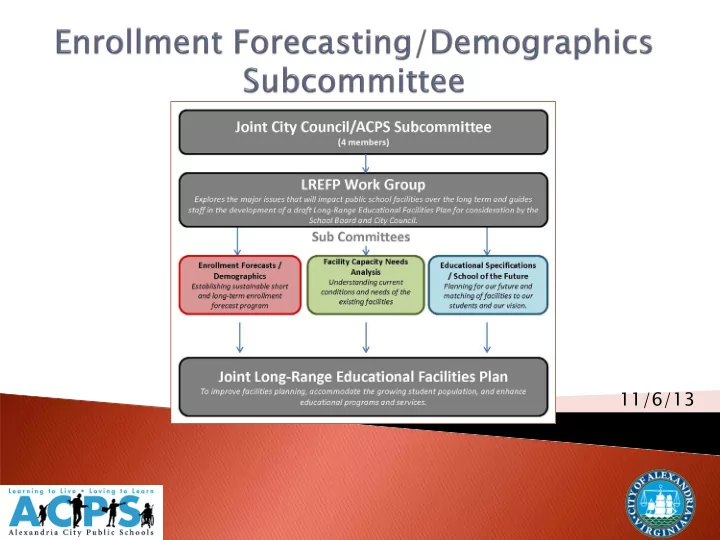
- Improve facilities planning, accommodate the
growing student population, and enhance educational program and services.
- Enrollment up 3,100 since 2007 (29.5% increase)
4
Su Subcommi mmittee Role
- Review the details of the forecasting research
topics
- Collaborate on the development of a short term
and long term enrollment forecast
- Report results to the LREFP workgroup
5
Timeline line
- June
une
- Reviewed role of the subcommittee
- Reviewed overall work program and research elements: births, cohort survival,
capture rates, student generation
- July
ly
- Reviewed research elements: housing affordability programs, aggregate cohort
survival, birth rates
- September
- Reviewed research elements: market affordability, cohort survival by individual student
- Octob
tober
- Reviewed current year enrollment numbers
- Consolidated research elements to create short & long term assumptions
- Reviewed multiple forecast scenarios
- Novem
ember ber/December mber
- Produce preliminary long-term forecast
- Produce recommended short-term and long-term forecasts
- Develop process for regular updates
6
Subcomm
- mmitte
ttee Res Resear earch Topic
- pics
7
Multip tiple le Enrol
- llme
lment F t Forecasts ts
- Sh
Shor
- rt Term (
rm (1-6 year 6 years)
- Most specific forecast. Is done for every school by every grade. Informs
near-term capacity and operating needs.
- Mid
id Term ( rm (6-10 year 10 years)
- Is a citywide forecast. Informs the 10 year Capital Improvement Plan (CIP).
- Long Ter
Term ( (30 30 year years)
- Is citywide forecast. Informs long term public facility needs.
8
- I. Subcommittee Overview
- II. Overview of 2013-2014 Student Enrollment
- Overall
- By Grade
- Elementary Growth by Region
- Actual versus Projected
- III. Short-Term Projections- Proposed
Methodology
- IV. Long-Term Forecast Update
9
FY2013
- Total Enrollment: 13,114
- 5.6% increase from FY12
- K-12 Enrollment: 12,759
- Prek Enrollment: 276
- Growth
- Elementary 5.9%
- Middle School 4.3%
- High School 5.7%
10
FY2014
- Total Enrollment: 13,622
- 3.9% increase from FY13
- K-12 Enrollment: 13,277
- Prek Enrollment: 285
- Growth
- Elementary 2.3%
- Middle School 7.9%
- High School 5.2%
October 1 Student Enrollment
11
Central: C. Barrett, D. MacArthur, G. Mason East: C. Kelly, J.-Houston, L.-Crouch, M. Maury, Mt. Vernon West: J.K. Polk, J. Adams, P. Henry, S. Tucker, W. Ramsay
12
Grade FY2014 Final Projected FY2014 10/1/2013 Projection Error PK 295 285
- 3.4%
K 1,578 1,418
- 10.1%
1 1,484 1,462
- 1.5%
2 1,270 1,255
- 1.2%
3 1,212 1,181
- 2.6%
4 1,085 1,063
- 2.%
5 1,013 1,013 +.% 6 897 946 +5.5% 7 828 872 +5.3% 8 758 784 +3.4% 9 807 892 +10.5% 10 861 845
- 1.9%
11 809 832 +2.8% 12 716 714
- .3%
Grand Total 13,613 13,562
- .37%
13 School Name FY2014 Final Projected FY2014 10/1/2013 Projection Error Charles Barrett Total 442 446 +.9% Cora Kelly Total 367 373 +1.6% Douglas MacArthur Total 715 704
- 1.5%
George Mason 525 512
- 2.5%
James K. Polk 708 690
- 2.5%
Jefferson Houston 385 356
- 7.5%
John Adams 883 874
- 1.%
Lyles-Crouch 457 437
- 4.4%
Matthew Maury 461 418
- 9.3%
Mount Vernon 836 768
- 8.1%
Patrick Henry 621 586
- 5.6%
Samuel Tucker 729 740 +1.5% William Ramsay 870 831
- 4.5%
ES Total 7,999 7,735
- 3.3%
Francis Hammond MS Francis Hammond MS 1 445 462 +3.8% Francis Hammond MS 2 449 459 +2.2% Francis Hammond MS 3 447 465 +4.% George Washington MS George Washington MS 1 540 580 +7.4% George Washington MS 2 540 578 +7.% MS Total 2,421 2,544 +5.1% Minnie Howard Center 695 714 +2.7% TC Williams HS 2,498 2,569 +2.8% HS Total 3,193 3,283 +2.8% Grand Total 13,613 13,562
- .37%
I.
Subcommittee Overview
II.
Overview of 2013-2014 Student Enrollment
III.
- III. Sh
Short-Te Term rm Pro roject ctio ions- Prop
- pos
- sed
Method
- dolog
- gy
- Foundat
dations
- Kin
inderga gart rten Tre Trends and Ca Capture re Ra Rates
- Co
Cohort rt Surv rviv ival
- En
Enro rollm llment: His Historica rical l and Pro roject cted
- IV. Long-Term Forecast Update
14
Founda
dation tion o
- f the Short
rt- and nd Mi Mid-Term E rm Enrollme llment t Forecas casts
- Changes in
in birt births
- Changes in
in th the kin kinderg rgarten captu pture ra rate te
- Cha
hang nges i in n cohort s
- rt surv
rviv ival l
- Changes to s
to stu tude dent ge genera ration ra rate te
15
Key Assumptions
- Births/Birth Rate
Increasing
- Kindergarten Capture Rate
FY2014 rate of .581 or 58.1% (projected 64%) FY2013 rate of .66 or 66% Recommend using 5-year average of 60.9% for projections
16
Alexandria’s Birth Rates are higher than those of Northern Virginia and the nation as a whole.
17
Birth Data- Virginia Department of Health
- Births to Alexandria mothers
- Revised to ensure valid Alexandria addresses and adjust to months of
kindergarten eligibility (October – September)
18 FY Total Births 5 Yrs Before Kindergarten Enrollment K Capture 2009
2,126 1,179 55.5%
2010
2,277 1,236 54.3%
2011
2,133 1,313 61.6%
2012
2,129 1,364 64.1%
2013
2,289 1,516 66.2%
2014
2,442 1,418 58.1%
2015
2,546 1,550 60.9%
2016
2,576 1,569 60.9%
2017
2,584 1,573 60.9%
2018
2,683 1,634 60.9%
2019
2,711 1,651 60.9%
2020
2,762 1,682 60.9%
- Compares the number of students in a grade to the
number of students in the previous grade the previous school year.
- Annual ratios are averaged and then used to project future
enrollment.
- Using a 3-year average for projections.
3-Year Average FY12-14
- Lower Elementary (K-3) 96.4
- Upper Elementary (3-5) 97.5
- Middle School (6-8) 97.3
- Lower High (8-10) 108.6
- Upper High (10-12) 93.1
3-Year Average FY11-13
- Lower Elementary (K-3) 96.3
- Upper Elementary (3-5) 97.5
- Middle School (6-8) 96.8
- Lower High (8-10) 106.5
- Upper High (10-12) 93.1
19
20
80.0% 85.0% 90.0% 95.0% 100.0% 105.0% 110.0% 115.0% 120.0% FY00-02FY03-05FY06-08FY09-11FY12-14FY15-17FY18-20
3 Year Average Cohort Survival: Historical and Projected
Lower Elem (k-3) Upper Elem (3-5) MS 8th-10th 21 Lower Elem (k-3)
Upper Elem (3-5) MS 8th-10th 10th-12th
FY00-02
95.8% 96.7% 96.0% 112.9% 82.5%
FY03-05
94.2% 94.0% 93.7% 106.7% 84.2%
FY06-08
93.3% 93.0% 94.1% 99.8% 90.9%
FY09-11
98.5% 98.5% 98.4% 106.5% 93.5%
FY12-14
96.4% 97.4% 97.3% 108.6% 93.1%
FY15-17
96.2% 97.0% 95.5% 106.4% 92.3%
FY18-20
96.7% 97.4% 95.2% 108.3% 92.2%
22
11,203 10,339 13,622
- 5,000
10,000 15,000 20,000 FY00 FY02 FY04 FY06 FY08 FY10 FY12 FY14 FY16 FY18 FY20
ACPS Enrollment Growth: Historical and Projected
Actual Enrollment FY15Projected Enrollment- 3yr CSR Last Year's Projections
FY 2007 FY 2014
5,591 2,112 2,867 6,342 2,220 2,936 7,147 2,242 2,955 7,735 2,544 3,283 8,374 2,669 3,487 8,829 2,863 3,761 9,262 3,138 3,985
- 1,000
2,000 3,000 4,000 5,000 6,000 7,000 8,000 9,000 10,000 ES MS HS
ACPS Enrollment by School Level: Past and Future
FY2008 FY2009 FY2010 FY2011 FY2012 FY2013 FY2014 FY15 FY16 FY17 FY18 FY19 FY20 23
- Calculate student generation rates for SY2013-
2014
- Calculate detailed by school, by grade projections
- Capacity Analysis to determine how the projections
affect capacity
24
I.
Subcommittee Overview
- II. Overview of 2013-2014 Student
Enrollment
- III. Short-Term Projections- Proposed
Methodology
IV.
- IV. Lo
Long ng-Ter erm F Forec recast Upda Update
25
Shor hort-Ter erm Forecas cast Long
- ng-Te
Term F Forecas cast Known birt births for recent years How will births and birth rates change? Kinder erga garten en cap capture – recent years average from known births How could kindergarten capture change and why? Cohort rt s surv rviv ival by grade – recent years average How could cohort survival change? Students from new de develo lopm pment – approved projects Approved projects and po potentia ial l futu uture p proj
- jects
Student g nt gene nerati tion per housing unit for existing development and new projects – recent years average How could student generation to change over time?
26
27
Early 2000s boom brought a big young
cohort to the region for jobs. This group is now having families.
The housing boom and subsequent financial
crisis disrupted a pattern of moves up and
- utward in the region as families grow.
Racial and ethnic trends may also have been
disrupted by the recent boom and bust.
The 2000s show a substantial disruption in
the long-term enrollment trend.
28
Reduced birth rates per 1000 population as
population ages, and among immigrant populations in particular.
Families choosing more urban lifestyles but
limited by housing types available.
Nearly all new development is in building
types less preferred by families.
Continued pressure on prices and rents as
region grows outward may threaten affordability and economic diversity.
29
Shor hort-Ter erm Trend nd Long
- ng-Ter
erm T Trend Birt irths and birth rate increasing Birth rates expected to decline with changing demographics Kinder erga garten en cap capture – sharp decline from recent peak Slow decline to somewhat higher than pre-boom and crisis rates Cohor
- hort surv
rviv ival l at high Expected slight decline with normalization of markets, but steady with return to the city New ew d devel elopmen ent: New housing units about 1% per year Continued new housing units about 1% per year Student g nt gene nerati tion dropped in housing bubble, then rose rapidly since 2007 Student generation expected to rise somewhat as current cohorts reach graduation, then gradually decline.
30
31
Pre redic dictor Current T nt Trend nd Expec ected ed F Future T e Tren end Housing affordability Decreasing Neutral or decreasing Job growth Sustained Sustained Age of housing Average increasing Average increasing Net out-migration of pre-school and school-age children High during housing bubble, then much lower in crisis Stabilize at a somewhat higher level than during housing crisis Student participation rate Similar to other area jurisdictions Remains similar to
- ther area jurisdictions
Race and ethnicity, income, origins Hispanic share increasing Hispanic share increasing Historic cohort survival Stable at lower than recent high Slight decline Size of housing units Most new units small Most new units small
32
Metho thod Process ss Development Forecast Estimate future development based on approved projects, plans, and likely development areas. (Use current forecast with alternate scenarios) Enrollment Trends Forecast Births, kindergarten capture and grade cohort survival Generation Rates Forecast Estimate future generation rates based on trends, building types, structure age and limitations of current inventory Demographic Forecast Age distribution, race and ethnicity, birth rates, cohort survival and immigration
33
Model similar to short-term model. Assume changes over time in:
- Birth rates
- Kindergarten capture
- Cohort survival
Assumptions based on:
- Development forecast
- Student generation potential by housing type
- Demographic changes in age, race and ethnicity
34
35
Assumptions: Kindergarten capture falls to slightly lower than 2013, birth rates gradually decline.
36
Upper trend line would not be expected based
- n expected fall in birth rates, and requires
sustained kindergarten capture rate substantially higher than historic averages.
Reasonable assumptions for student
generation rates by housing type, size and affordability
Reasonable rates of change in generation
rates with changes in occupancy, births and aging of children to school age, more seniors
- ver time
Generation rates increase somewhat as units
age and some become more affordable
No explicit assumptions about birth rates,
kindergarten capture or cohort survival
37
38
39
Assumptions: Rates rise until recent cohort starts to graduate. Rates gradually fall but to higher than recent rates, particularly for single-family, townhouse and affordable units, with return of families to the city.
40
41
Generation rate scenario applied to housing mix of COG Round 8.2 development forecast
42
43
Millions of People per Year of Age Senior share nearly doubles as boomers all pass age 65
Develop assumptions for long-term birth rate
trends based on demographic scenarios.
Evaluate long-term generation rate trends:
- Review 2013 student generation data
- Consider potential change in affordability of
existing units over time.
Prepare candidate scenarios with sensitivity
analysis.
Review with enrollment and forecasting
committee at next meeting.
44