11/25/18 Overall Message Interval Training for Athletic Performance - - PDF document

11 25 18
SMART_READER_LITE
LIVE PREVIEW

11/25/18 Overall Message Interval Training for Athletic Performance - - PDF document

11/25/18 Overall Message Interval Training for Athletic Performance and the Role of Nutrition Interval training is an infinitely variable form of exercise that elicits physiological adaptations linked to improved health and performance in a


slide-1
SLIDE 1

11/25/18 1

Martin Gibala, PhD McMaster University Hamilton, Canada

Interval Training for Athletic Performance and the Role of Nutrition

@ gibalam gibalam@ mcmaster.ca www.martingibala.com @ gibalam gibalam@ mcmaster.ca www.martingibala.com

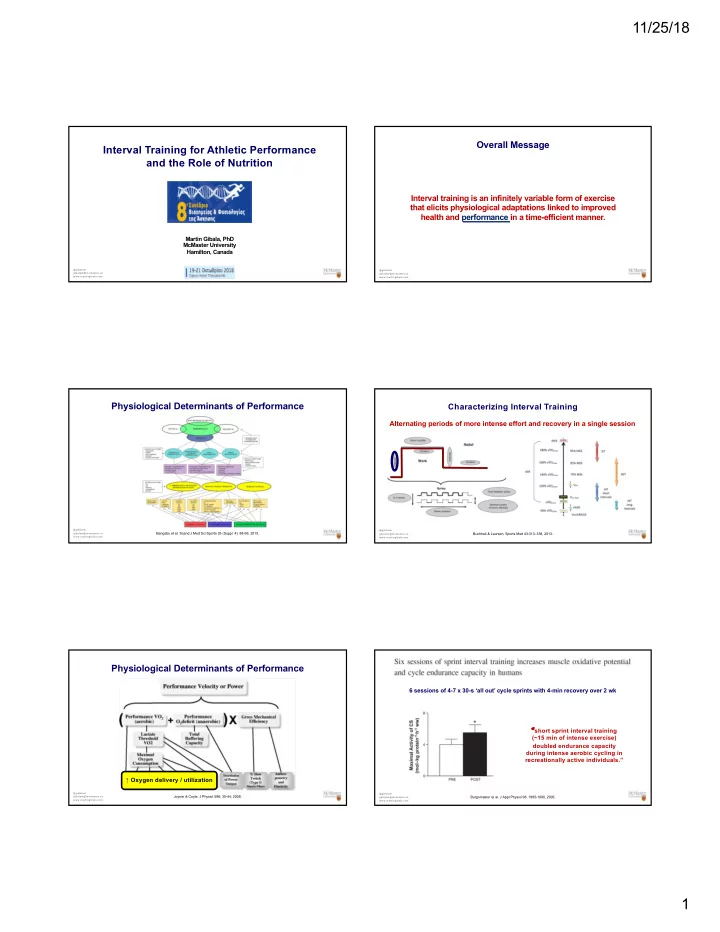
Interval training is an infinitely variable form of exercise that elicits physiological adaptations linked to improved health and performance in a time-efficient manner.

Overall Message

@ gibalam gibalam@ mcmaster.ca www.martingibala.com

Bangsbo et al. Scand J Med Sci Sports 25 (Suppl. 4): 88-99, 2015.

Physiological Determinants of Performance

Characterizing Interval Training

@ gibalam gibalam@ mcmaster.ca www.martingibala.com

Buchheit & Laursen, Sports Med 43:313–338, 2013.

Alternating periods of more intense effort and recovery in a single session

@ gibalam gibalam@ mcmaster.ca www.martingibala.com

Joyner & Coyle. J Physiol 586: 35-44, 2008.

Physiological Determinants of Performance

↑ Oxygen delivery / utilization

@ gibalam gibalam@ mcmaster.ca www.martingibala.com

Burgomaster et al. J Appl Physiol 98: 1985-1990, 2005.

6 sessions of 4-7 x 30-s ‘all out’ cycle sprints with 4-min recovery over 2 wk short sprint interval training (~15 min of intense exercise) doubled endurance capacity during intense aerobic cycling in recreationally active individuals.”

slide-2
SLIDE 2

11/25/18 2

@ gibalam gibalam@ mcmaster.ca www.martingibala.com

Gibala et al. J Physiol 575: 901-911, 2006.

intense interval training is a time- efficient strategy to induce rapid performance adaptations comparable to traditional endurance training (despite) a training volume for the SIT group was

  • nly ∼10% that of the ET group.”

6 sessions of 4-7 x 30-s ‘all out’ sprints or 90-120 min continuous moderate ex over 2 wk

@ gibalam gibalam@ mcmaster.ca www.martingibala.com

www.theguardian.com/sport/2014/may/05/roger-bannister-sixty-years-four-minute-mile

Optimizing Performance in Highly-Trained Individuals?

the additional training method imposed on the LONG group did not produce a greater improvement in performance…

@ gibalam gibalam@ mcmaster.ca www.martingibala.com

Costill et al. Med Sci Sports Exerc. 23: 371-377, 1991.

It is difficult to understand how training at speeds that are markedly slower than competitive pace for 3-4 h•d-1 will prepare the swimmer for the supramaximal efforts of competition.” Collegiate male swimmers maintained or doubled volume for 6 wk during a 25-wk period

Incorporating HIIT with “Regular” Training: Potential Strategies

Normal

HIIT

Increase Volume

HIIT

Same Volume

HIIT

Reduce Volume

@ gibalam gibalam@ mcmaster.ca www.martingibala.com

Lindsay et al. Med Sci Sports Exerc. 28: 1427-1434, 1996.

6 HIIT sessions over 4 wk (6-8 x 5 min @ 80% PPO)

@ gibalam gibalam@ mcmaster.ca www.martingibala.com

Lindsay et al. Med Sci Sports Exerc. 28: 1427-1434, 1996.

a 4-wk program of HIT increased the PPO and fatigue resistance of competitive cyclists and improved their 40-km time-trial performance.” 6 HIIT sessions over 4 wk (6-8 x 5 min @ 80% PPO)

@ gibalam gibalam@ mcmaster.ca www.martingibala.com

Weston et al. Eur J Appl Physiol. 75: 7-12, 1997.

slide-3
SLIDE 3

11/25/18 3

6 HIIT sessions over 4 wk (6-8 x 5 min @ 80% PPO)

@ gibalam gibalam@ mcmaster.ca www.martingibala.com

Weston et al. Eur J Appl Physiol. 75: 7-12, 1997.

Oxidative muscle enzyme activities were not altered by the HIT regime (but) Bm was sensitive to sustained submaximal HIT in already well-trained cyclists and emerged as a significant predictor of high-intensity endurance performance.”

4 x 4 min (>85% HRmax) / 2 min Continuous (75% HRmax) 8-12 x 30 sec all out / 3 min

@ gibalam gibalam@ mcmaster.ca www.martingibala.com

Bangsbo et al. J Appl Physiol. 107: 1773-1780, 2009.

Trained runners added SIT and reduced volume by ~25% for ~2 months Trained runners added SIT and reduced volume by ~25% for ~2 months

@ gibalam gibalam@ mcmaster.ca www.martingibala.com

Bangsbo et al. J Appl Physiol. 107: 1773-1780, 2009.

3 km run Na+-K+ pump

In already trained subjects, further muscle adaptations can occur and performance can be improved by adding speed endurance training (combined) with a reduction in training volume.”

@ gibalam gibalam@ mcmaster.ca www.martingibala.com

Joyner & Coyle. J Physiol 586: 35-44, 2008.

Physiological Determinants of Performance

↑ Ionic Regulation

Optimizing Performance: What Is the Right Mix?

HIT is a critical component in the training of all successful endurance athletes (and) an ~80- to-20 ratio of LIT to HIT gives excellent long-term results.”

@ gibalam gibalam@ mcmaster.ca www.martingibala.com

Seiler et al. Int J Sports Physiol Perform 5: 276-291, 2010.

Polarized (POL): 6 x 4-min, Zone 3 intensity, 2-min rest PO ≈ 330 W, HR ≈ 172 bpm, RPE ≈ 7-8 Threshold (THR): 60 min continuous, Zone 2 intensity PO ≈ 275 W, HR ≈ 158 bpm, RPE ≈ 5-6

@ gibalam gibalam@ mcmaster.ca www.martingibala.com

Neal et al. J Appl Physiol. 114: 461-471, 2013.

slide-4
SLIDE 4

11/25/18 4

A polarized training model is recommended for trained cyclists wishing to maximally improve performance.” There is, however, much still to be understood regarding the impact (of) different training-intensity distributions in endurance athletes.”

@ gibalam gibalam@ mcmaster.ca www.martingibala.com

Neal et al. J Appl Physiol. 114: 461-471, 2013.

@ gibalam gibalam@ mcmaster.ca www.martingibala.com

Seiler et al. Scand J Med Sci Sports 23: 74-83, 2013.

INT Group %HRpeak Blood La RPE 4 x 16-min 88 ± 2 5 ± 2 15 ± 1 4 x 8-min 90 ± 2 10 ± 3 16 ± 1 4 x 4 min 94 ± 2 13 ± 2 19 ± 1

Trained cyclists (~52 ml/kg/min) performed 7 wk of continuous low-moderate training

  • r incorporated 1 of 3 interval protocols matched for maximal overall effort (n=9)

@ gibalam gibalam@ mcmaster.ca www.martingibala.com

Seiler et al. Scand J Med Sci Sports 23: 74-83, 2013.

Trained cyclists (~52 ml/kg/min) performed 7 wk of continuous low-moderate training

  • r incorporated 1 of 3 interval protocols matched for maximal overall effort (n=9)

Put in the popular vernacular of training investment and reward, cycling 4 x 8 min intervals at 90% of HRmax yielded the highest gain for the pain.”

@ gibalam gibalam@ mcmaster.ca www.martingibala.com

Sylta et al. Med Sci Sports Exerc 48: 2165-2174, 2016.

Trained cyclists (~60 ml/kg/min) assigned to 1 of 3 matched-load INT protocols (n=20 each)

@ gibalam gibalam@ mcmaster.ca www.martingibala.com

Sylta et al. Med Sci Sports Exerc 48: 2165-2174, 2016.

  • rganizing different interval sessions in a specific periodized mesocycle order or

in a mixed distribution during a 12-wk training period has little or no effect on training adaptation when the overall training load is the same.” Trained cyclists (~60 ml/kg/min) assigned to 1 of 3 matched-load INT protocols (n=20 each)

Evidence-based recommendations are limited because most of the scientific studies have been performed on sub-elite athletes. When long-duration low-intensity training is periodically supplemented with or partly replaced by high-intensity interval training, physiological and performance adaptations are enhanced in highly trained athletes.

@ gibalam gibalam@ mcmaster.ca www.martingibala.com

slide-5
SLIDE 5

11/25/18 5

Nutrition Manipulation of Exercise Adaptation: Theoretical Basis

Egan & Zierath, Cell Metab 17: 162-184, 2013.

@ gibalam gibalam@ mcmaster.ca www.martingibala.com

Nutrition Manipulation of Exercise Adaptation: Theoretical Basis

@ gibalam gibalam@ mcmaster.ca www.martingibala.com

  • Intervention augments power output during

exercise and enhances the training stimulus

  • Intervention alters substrate utilization during

exercise and enhances metabolic stress

  • Is the surplus or lack of substrate the ‘trigger’?

Nutrition Manipulation of Exercise Adaptation: Reduced Carbohydrate Availability

Hawley & Morton, Clin Exper Pharm Physiol 41: 608-613, 2014.

@ gibalam gibalam@ mcmaster.ca www.martingibala.com @ gibalam gibalam@ mcmaster.ca www.martingibala.com

Psilander et al. Eur J Appl Physiol. 113: 951-963, 2013.

Trained cyclists performed acute intermittent exercise with normal or low glycogen (n=10)

Energy-matched high

  • r low-CHO meals

exercise with low glycogen levels amplifies the expression of the major genetic marker for mitochondrial biogenesis in highly trained cyclists (and) may be beneficial for improving muscle oxidative capacity.”

@ gibalam gibalam@ mcmaster.ca www.martingibala.com

Yeo et al. J Appl Physiol 105: 1462–1470, 2008.

Trained cyclists performed single sessions daily or two sessions every other day for 3 wk

Photo courtesy Dr. M. Hargreaves

@ gibalam gibalam@ mcmaster.ca www.martingibala.com

Yeo et al. J Appl Physiol 105: 1462–1470, 2008.

Trained cyclists performed single sessions daily or two sessions every other day for 3 wk

Photo courtesy Dr. M. Hargreaves

slide-6
SLIDE 6

11/25/18 6

@ gibalam gibalam@ mcmaster.ca www.martingibala.com

Yeo et al. J Appl Physiol 105: 1462–1470, 2008.

Trained cyclists performed single sessions daily or two sessions every other day for 3 wk

@ gibalam gibalam@ mcmaster.ca www.martingibala.com

Yeo et al. J Appl Physiol 105: 1462–1470, 2008.

Trained cyclists performed single sessions daily or two sessions every other day for 3 wk training twice every second day compromised high-intensity training capacity but augmented selected markers of training adaptation (e.g., mitochondrial content)… despite creating conditions that, in theory, should enhance endurance performance capacity, performance of a 1-h time trial (was) similar.”

@ gibalam gibalam@ mcmaster.ca www.martingibala.com

Cochran et al. IJSNEM 25: 463-470, 2015.

Active but not highly trained subjects performed 6 twice-daily HIIT sessions over 2 wk Energy-matched high or low-CHO meals

@ gibalam gibalam@ mcmaster.ca www.martingibala.com

Cochran et al. IJSNEM 25: 463-470, 2015.

Active but not highly trained subjects performed 6 twice-daily HIIT sessions over 2 wk Further research is needed to determine whether this type of manipulation can also enhance performance in highly-trained subjects.”

@ gibalam gibalam@ mcmaster.ca www.martingibala.com

Impey et al. Sports Med. 48: 1031-1048, 2018.

  • Should train-low sessions always be left to low intensity-type sessions
  • r is it the deliberate completion of a high-intensity session (even at

the expense of a potential reduction in absolute workload) that is really required to create the metabolic milieu that is conducive to signalling?

  • What is the minimal CHO intake and glycogen concentration required

to facilitate periods of ‘train low’ without compromising absolute training intensity during specific sessions?

@ gibalam gibalam@ mcmaster.ca www.martingibala.com

Interval training enhances performance in highly-trained individuals although the mechanisms are likely different compared to less- trained individuals; nutritional interventions (e.g, manipulating carbohydrate availability) can alter acute exercise responses and selected markers of training adaptation but the impact on performance is less clear and depends on numerous variables.

Take Home Point