( ) 100 DPcs CPCcs CPRcs Where: DPcs: Product availability - - PDF document

100
SMART_READER_LITE
LIVE PREVIEW

( ) 100 DPcs CPCcs CPRcs Where: DPcs: Product availability - - PDF document

MOL2NET, 2017, 3, doi: 10.3390/mol2net-03-04620 MOL2NET, International Conference Series on Multidisciplinary Sciences MDPI http://sciforum.net/conference/mol2net-03 Amazonian fruits availability in agro-alimentary primary chain in Pastaza,


slide-1
SLIDE 1

MOL2NET, 2017, 3, doi: 10.3390/mol2net-03-04620

MDPI

MOL2NET, International Conference Series on Multidisciplinary Sciences http://sciforum.net/conference/mol2net-03

Amazonian fruits availability in agro-alimentary primary chain in Pastaza, Ecuador Authors: Neyfe Sablón (e-mail: nsablon@utn.edu.ec)a, Ruth Irene Áreas (e-mail: rareas@uea.edu.ec)b, Manuel Pérez (e-mail: mperez@uea.edu.ec)b, Fabiola Sánchez (e-mail: fsgalvan@hotmail.com)c, Horacio Bautista (e- mail: horacio_bautista@hotmail.com)c

aProfessors-Researchers. North Technical University, Avenida 17 de julio y José Maria Córdova, ciudadela

Universitaria Bario el Olivo. Tel. (06) 2997800 Casilla 199. Postal Code: 100150, Ibarra. Ecuador. e-mail corresponding author: nsablon@utn.edu.ec

bProfessors-Researchers. Amazon State University, Km. 2 ½, vía Puyo a Tena (Paso Lateral). Tel. 032-888-118

/ 032-889-118. Postal Code: 160150. Puyo, Ecuador.

c Professors-Researchers. Tantoyuca High Technology Institute, Desviación Lindero Tametate S/N, La Morita.

  • Tel. +52 789 893 1680. Postal Code: 92100. Tantoyuca, Veracruz, México.

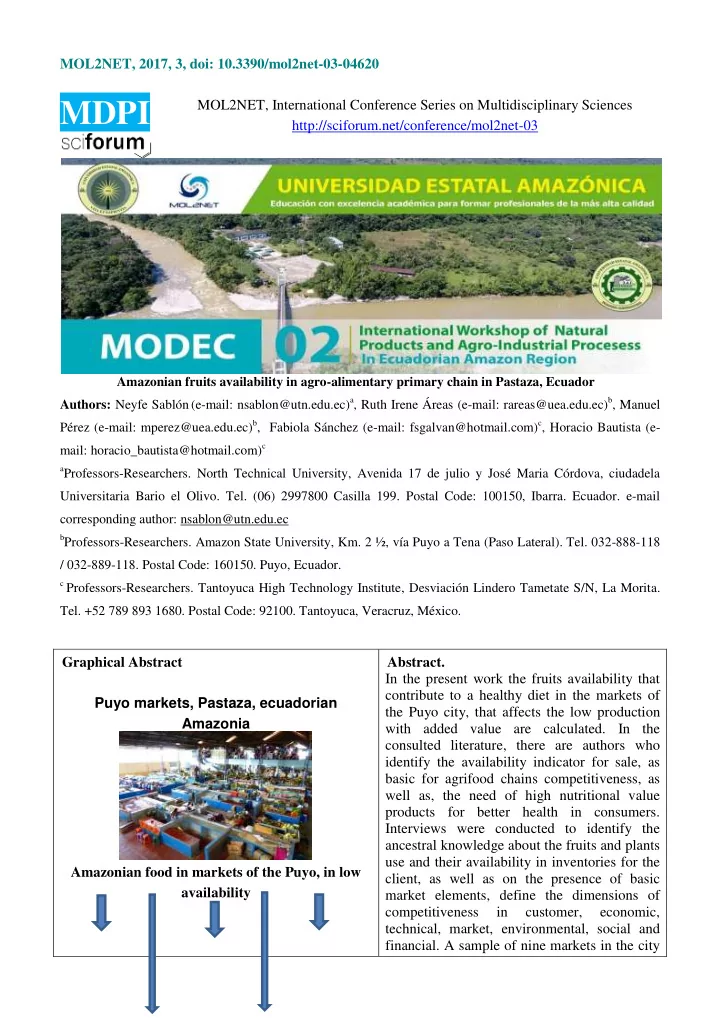
Graphical Abstract Puyo markets, Pastaza, ecuadorian Amazonia Amazonian food in markets of the Puyo, in low availability Abstract. In the present work the fruits availability that contribute to a healthy diet in the markets of the Puyo city, that affects the low production with added value are calculated. In the consulted literature, there are authors who identify the availability indicator for sale, as basic for agrifood chains competitiveness, as well as, the need of high nutritional value products for better health in consumers. Interviews were conducted to identify the ancestral knowledge about the fruits and plants use and their availability in inventories for the client, as well as on the presence of basic market elements, define the dimensions of competitiveness in customer, economic, technical, market, environmental, social and

  • financial. A sample of nine markets in the city
slide-2
SLIDE 2

LOW AVAILABILITY OF AMAZON FOODS, PUYO MARKETS, ECUADOR

  • f

Puyo was made, the fundamental characteristic being that they are the largest markets of the city, although they cannot be classified according to the international

  • classification. 140 products were studied in the

Puyo city markets. The results showed the products availability per family, where the highest value with 0,37% is represented by banana and cassava, 0,12% vegetables, 0,14% fruits, 0,13% grains, 0,12% processed fruits and 0,12 % processed meat products. It is concluded that there is a lack of Amazonian products in the markets of the city of Puyo due to the low production of tangibles typical of the area. Keywords: Food availability, amazon, Ecuador, agrofood chains

  • 1. Introduction

Amazonia is an important center of plant domestication (Meyer, Duval & Jensen, 2012). Its great biological and cultural diversity (Balée, 2013) make it an especially interesting area to study the role of human societies in plant domestication and diversification (Clement et al., 2010). There are several articles that describe and illustrate the fruits of all woody plants occurring in the Amazonian forest (Van Roosmalen et al., 2000). It is estimated that at least 10,000 species of trees, shrubs, lianas, twiners and hemi-epiphytes occur in lowland Amazonia, five times as many as have been included in the Field Guide to the Fruits of the Guianan Flora. The cultivated plants efficiency in terms of yield production can be measured by means of the growth indexes, which indicate the plants efficiency for environmental factors at the site where they grow and the way the plants distribute their nutrients (Archila et al. 1998). Globally, an estimated 1.02 billion people are undernourished (FAO, 2009). The literature on vulnerability, food security and ecosystem services has tended to emphasize cultivated foods (Ericksen et al., 2009). However, there is substantial evidence that wild foods are an important part of the global food basket. By other hands There is a growing evidence supporting the hypothesis that the Amazon is a mosaic of anthropogenic landscapes, managed and domesticated by indigenous pre-Columbian people in various degrees, rather than a pristine and untouched forest (Levis et al., 2012). In this study the fruits availability that contribute to a healthy diet in the markets of the city of the Puyo, that affects the low products production with value added, are calculated.

  • 2. Materials and methods

An interview was conducted to identify the ancestral knowledge of fruits and plants where names and surnames, province, region, fruit name, leaf, product derivative, name of remedy with the plants, plant

  • rigin and disease that heals were investigated.

The calculation of the product availability for sale is calculated as:

100 ) (   CPRcs CPCcs DPcs

Where: DPcs: Product availability according to customer's order DPCcs: Number of completed orders delivered to the customer CPRcs: Number of orders made by the customer Sample A sampling from nine markets in the city of Puyo was made, the fundamental characteristic being that they are the largest markets of the city, although they cannot be classified in this way according to the

slide-3
SLIDE 3

MOL2NET, 2017, 3, doi: 10.3390/mol2net-03-04614 3 international classification. A range of 140 products were studied in each Puyo markets, representing a 37% in banana and cassava, 12% in vegetables, 14% I fruits, 13% in grains, 12% in processed products and 12 % processed meat products.

  • 3. Results and discussion

The products availability per family is analyzed, the highest value of the indicator is the bananas (table 1). Vegetables, fruits, grains, processed products and meat products are presented in percentage values ranging from 0.12 to 0.14%. Table 1: Products Availability per family Product family Availability (%) banana and cassava 0.37 Vegetables 0.12 Fruits 0.14 Grain 0.13 Processed products 0.12 Meat products 0.12 The products availability per market is shown in figure 1. It is observed that banana and cassava with 0.40% represents the greatest presence. The remainders of the foods are the percentage range of 0.12 to 0.14%. Figure 1. Products availability in the markets, Puyo (%). Fruits and plants availability from Amazonian origin in the Puyo Markets is shown in table 2. The low existence of these foods in the shops of the Puyo is observed. In larger markets the food products availability of Amazonian origin is almost nothing. Table 2. Amazonian fruits and plants availability in the Puyo shops.

0,05 0,1 0,15 0,2 0,25 0,3 0,35 0,4 0,45 Banana and cassava Vegetables Fruits Grains Elaborated products Meat products

Porcentajes (%)

Market Availability Market 1 0,01 Market 2 0,00 Market 3 0,01 Market 4 0,01 Super Market 1 0,00

slide-4
SLIDE 4

MOL2NET, 2017, 3, doi: 10.3390/mol2net-03-04614 4 The interviews show the role of the Amazon State University with research projects in the environment, agriculture and agroindustry thematic that allow the development of agricultural production in the Amazon that enable increases in the availability of primary food consumption and the agro industrial processes development. The main production form in the Amazon region is the chakra, in which the majority of the agricultural products shown in this work are obtained. The "chakra" attracts attention because it is an element of the traditional multifaceted agriculture, understood as one that is not completely inserted in the models of agriculture industry (Azevedo, 2004). The Ecuadorian Amazon is occupied by ten groups indigenous peoples who use and transform the forest unique according to its own conceptions

  • f the world. The subsistence activities are agriculture, harvesting, hunting and fishing; the economy of
  • ther groups has diversified with the commercialization of agricultural and forestry products, as well

as paid employment (Gray et al., 2008). Amazonian conditions, with a high fragility and need for environmental protection, require the cooperative work of producers and incipient marketers in order to increase the foods availability that allow an increase in agro industrial processes.

  • 4. Conclusions

It is concluded that there are no Amazonian products in the markets of the Puyo city, which affects the low production of products in this society. This effect is due to the agricultural development that

  • ccurs in the Amazon. The Amazon Stated University could be changing this reality with research

projects in the environment, agriculture and agroindustry thematic that allow the agricultural production development and agro industrial process.

  • 5. Bibliography

1) Archila, P.; U. Contreras; H. Pinzón; H. Laverde y G. Corchuelo. (1998). Análisis de crecimiento de cuatro materiales de lechuga (Lactuca sativa). Agronomía Colombiana 15, (1): 68-75. 2) Van Roosmalen, Marc G. M. and da Cruz Gomes García Olimpia María. (2000). Fruits of the amazonian forest. Part II: Sapotaceae. Acta Amazónica. 30(2): 187-290. 3) Balée W. (2013). Cultural forests of the Amazon: A historical ecology of people and their

  • landscapes. Tuscaloosa, AL: The University of Alabama Press.

4) Clement C. R., de Cristo‐Araújo M., D'Eeckenbrugge G. C., Pereira A. A., & Rodríguez D. P. (2010). Origin and domestication of native amazonian crops. Diversity, 2, 72–106. doi:10.3390/d2010072. 5) Ericksen P. J., Ingram J. S. I., Liverman D. M. (2009). Food security and global environmental change.

  • Environ. Sci. Policy 12, 373–377 (doi:10.1016/j.envsci.2009.04.007)

6) Levis C, Souza PFd, Schietti J, Emilio T, Pinto JLPdV. (2012) Historical Human Footprint on Modern Tree Species Composition in the Purus-Madeira Interfluve, Central Amazonia. PLoS ONE 7(11): e48559.doi:10.1371/journal.pone.0048559 [PMC free article] [PubMed]. 7) FAO (2009). The state of food insecurity in the world. Rome, Italy: FAO. 8) Azevedo, R. A. B. (2004). Descrição dos sistemas agrários de Mato Grosso– bases teóricas e critérios para descrição e análise. Cuiabá, MT. 27p. Texto produzido para disciplina de sistemas Agrícolas Tropicais. 9) Gray, Clark L.; Bilsborrow, Richard E.; Bremner, Jason L.; LU, Flora E. Indigenous land use in the Ecuadorian Amazon: a cross-cultural and multilevel analysis. Human Ecology. 36(1): 97-109. DOI: http://dx.doi.org/10.1007/s10745-007-9141-6.

Super Market 2 0,00 Super Market 3 0,00 Super Market 4 0,00 Super Market 5 0,03