100 Gbit/s Carrier Grade Ethernet Transport Introduction EuroView - - PDF document

100 gbit s carrier grade ethernet transport
SMART_READER_LITE
LIVE PREVIEW

100 Gbit/s Carrier Grade Ethernet Transport Introduction EuroView - - PDF document

100 Gbit/s Carrier Grade Ethernet Transport Introduction EuroView 2008 Wrzburg, July 21st, 2008 Kurt Lsch , Bell Labs, Germany Alcatel-Lucent (Kurt.Loesch@alcatel-lucent.de) Overall Goal: Ethernet Evolution into the Core LAN Metro Core


slide-1
SLIDE 1

100 Gbit/s Carrier Grade Ethernet Transport

Introduction

EuroView 2008

Würzburg, July 21st, 2008

Kurt Lösch, Bell Labs, Germany Alcatel-Lucent (Kurt.Loesch@alcatel-lucent.de)

2

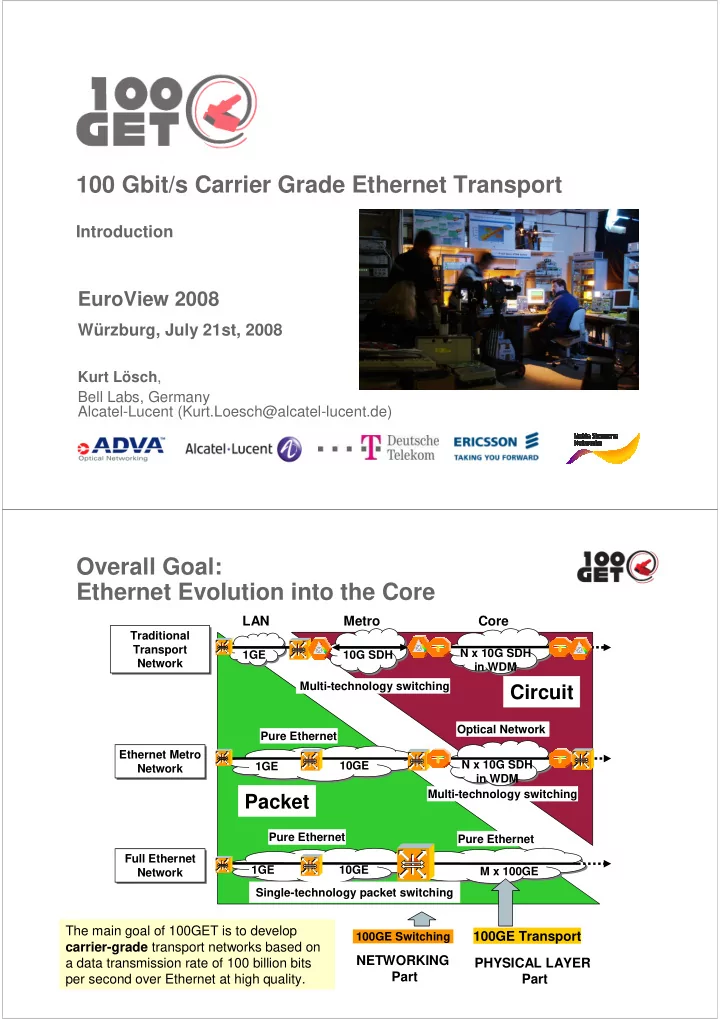
Overall Goal: Ethernet Evolution into the Core

Traditional Transport Network Traditional Transport Network Ethernet Metro Network Ethernet Metro Network Optical Network Pure Ethernet

Metro Core LAN

Full Ethernet Network Full Ethernet Network Pure Ethernet 1GE 10GE 1GE 10G SDH N x 10G SDH in WDM N x 10G SDH in WDM 1GE 10GE M x 100GE 100GE Switching

100GE Transport

Multi-technology switching Single-technology packet switching Multi-technology switching

Circuit Packet

Pure Ethernet

NETWORKING Part PHYSICAL LAYER Part The main goal of 100GET is to develop carrier-grade transport networks based on a data transmission rate of 100 billion bits per second over Ethernet at high quality.

slide-2
SLIDE 2

3

Project Structure

4 Working Committees for technical exchange:

1: Network aspects and standardization (lead: Gert Eilenberger, Alcatel-Lucent ) 2: 100GbE system technology and transmission (lead: Bernd Spinnler, NSN) 3: 100GbE technologies, comp. and measurements“ (lead: Martin Schell, Fraunhofer–HHI) 4: Reference scenarios and test environment (lead: Ralf-Peter Braun, Deutsche Telekom)

4 Project Clusters Cross-Project Activities

+

Total Effort (3 years) 356 Person x Years Total Budget *: 63 M€*

38 PY 144 PY 47 PY 106 PY

100GET

Coordination Committee

100GET

Coordination Committee Common testbed (DTAG) and technologies Common testbed (DTAG) and technologies

Universities -- Research institutes – Small / medium enterprises

ADVA Alcatel- Lucent Ericsson NSN

* Funded in part by BMBF (Germany), MEFI (France), VINNOVA (Sweden), TEKES (Finland)

+

4

100GET Partners

German Partners:

  • ADVA Optical Networking AG
  • Agilent Technologies R&D and Marketing GmbH & Co. KG
  • Alcatel-Lucent Deutschland AG
  • Atesio GmbH
  • CoreOptics
  • Deutsche Telekom
  • Ericsson GmbH (EDD)
  • FhG - Heinrich Hertz Institut (HHI)
  • IHP GmbH
  • JDSU Deutschland GmbH
  • Konrad Zuse Zentrum für Informationstechik (ZIB)
  • Ludwig-Maximilians-Universität München (LMU)
  • MICRAM Microelectronik GmbH
  • NSN - Nokia Siemens Networks
  • Technical University Braunschweig
  • Technical University München
  • Technische Universität Dresden
  • TUHH (Technische Universität Hamburg-Harburg)
  • u2t Photonics AG
  • Uni Kiel - Christian Albrecht Univ. (CAU)
  • Universität Dortmund
  • Universität Stuttgart (IKR & INT)
  • Universität Würzburg
  • VPIsystems

French Partners:

  • Alcatel THALES III-V Lab
  • IntexyS SA
  • University of Limoges

Swedish Partners:

  • Ericsson AB (EAB)
  • Chalmers Univ. of Technology (CTH)
  • Royal Institute of Technology (KTH)
  • Acreo AB
  • SP Devices (SPD)

Finnish Partners (contracts under negotation)

  • NSN
  • Nethawk
  • Tellabs
  • VTT
  • TKK, University of Helsinki
slide-3
SLIDE 3

5

Main Challenges in the Networking Domain

  • Carrier-grade and core-compatible Ethernet:

– Multi-layer network management, operation, and interworking – Multi-domain operation and interworking

  • Ethernet/DWDM network architecture optimized for total cost of ownership

– Combination of service/application-oriented L2 switching with cost-efficient L1

switching

– Algorithms for NW migration and capacity planning (grooming, routing and

resilience)

– Multi-layer optimisation – Automated network management & control (“plug & play”)

  • Prototyping & lab trials; field trials
  • Joint standardisation effort of major European players

– ITU-T SG 15, – IEEE 802.1/.3 Higher Speed Study Group IEEE802.3ba 40Gb/s and 100Gb/s

Ethernet Task Force since Dec.‘07 http://www.ieee802.org/3/ba/)

6

Physical Layer Challenge: „more bits in a given frequency channel“

100 Gb/s on existing wavelength grids (100 or even 50 GHz spacing)

  • Im{Ex}

Re{Ex}

Ex … Optical field, x-polarization Ey … Optical field, y-polarization

  • Im{Ex}

Re{Ex} Im{Ex} Re{Ex} Im{Ey} Re{Ey} New optical measurement systems needed e.g. constellation analysis

  • Horizontal activity

(JDSU)

slide-4
SLIDE 4

7

Main Challenges for Components and Electronics

  • Very high bandwidth devices for On/Off Keying

3dB corner frequency = 70 GHz;

  • Integration of complex transmitter and receiver optics for

coherent polarisation multiplexing systems

  • High speed Analog/Digital Converters and Digital/Analog

Converters

e.g. 4 channels in one device: sampling rate 28 GSample/s resolution 4 bit/Sample

  • Packaging and subsystem assembly

Total Throughput = 448 Gb/s

8