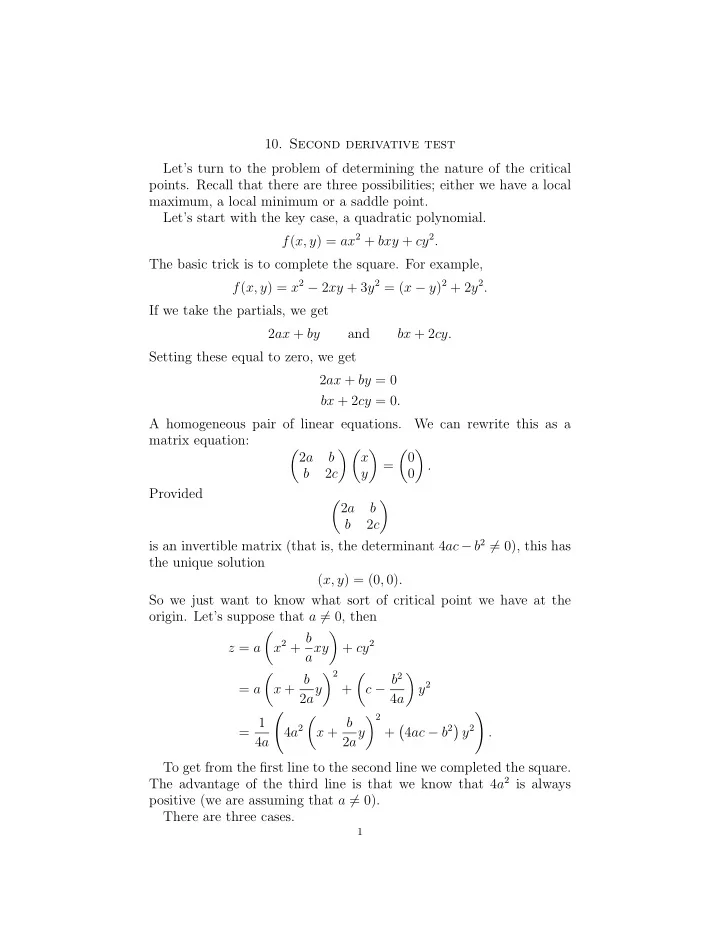

SLIDE 1
- 10. Second derivative test
Let’s turn to the problem of determining the nature of the critical
- points. Recall that there are three possibilities; either we have a local
maximum, a local minimum or a saddle point. Let’s start with the key case, a quadratic polynomial. f(x, y) = ax2 + bxy + cy2. The basic trick is to complete the square. For example, f(x, y) = x2 − 2xy + 3y2 = (x − y)2 + 2y2. If we take the partials, we get 2ax + by and bx + 2cy. Setting these equal to zero, we get 2ax + by = 0 bx + 2cy = 0. A homogeneous pair of linear equations. We can rewrite this as a matrix equation:
- 2a
b b 2c x y
- =
- .
Provided
- 2a
b b 2c
- is an invertible matrix (that is, the determinant 4ac − b2 = 0), this has
the unique solution (x, y) = (0, 0). So we just want to know what sort of critical point we have at the
- rigin. Let’s suppose that a = 0, then
z = a
- x2 + b
axy
- + cy2
= a
- x + b
2ay 2 +
- c − b2
4a
- y2
= 1 4a
- 4a2
- x + b
2ay 2 +
- 4ac − b2
y2
- .