10/21/19 Faculty Briefing: New and Revised Academic Programs - - PDF document

10 21 19
SMART_READER_LITE
LIVE PREVIEW

10/21/19 Faculty Briefing: New and Revised Academic Programs - - PDF document

10/21/19 Faculty Briefing: New and Revised Academic Programs Navigating SACSCOC, U.S. Department of Education and UNC System Requirements Successfully Review and Approval Processes Curriculum Committees Faculty Council (and Graduate


slide-1
SLIDE 1

10/21/19 1

Faculty Briefing: New and Revised Academic Programs

Navigating SACSCOC, U.S. Department of Education and UNC System Requirements Successfully

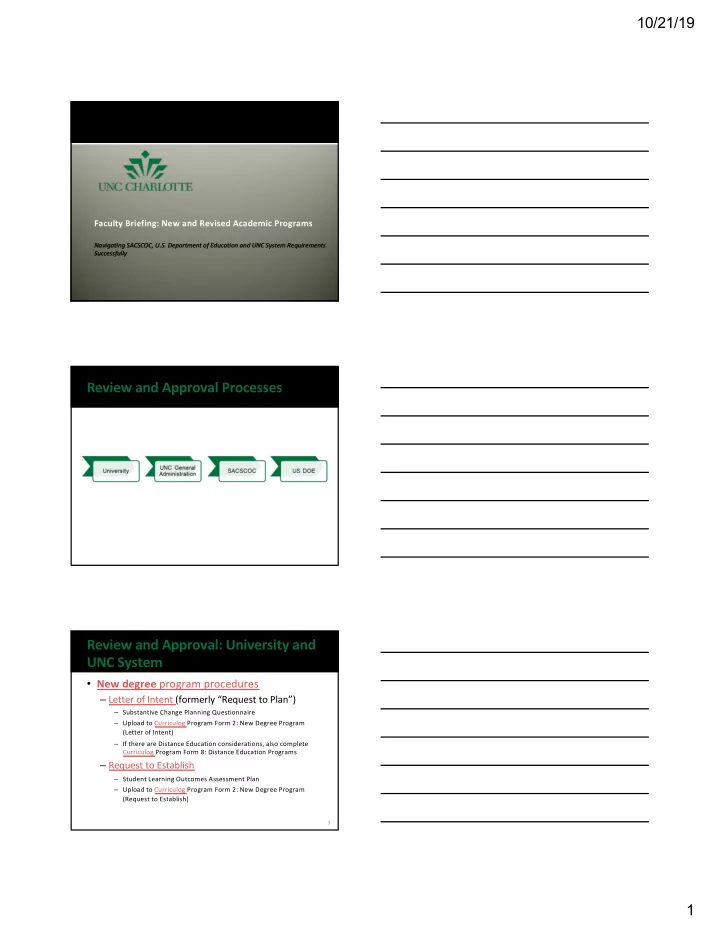
Review and Approval Processes

  • Curriculum Committees
  • Faculty Council (and Graduate Council for graduate programs)
  • Office of Academic Affairs
  • Office of Assessment and Accreditation

Review and Approval: University and UNC System

  • New degree program procedures

– Letter of Intent (formerly “Request to Plan”)

– Substantive Change Planning Questionnaire – Upload to Curriculog Program Form 2: New Degree Program (Letter of Intent) – If there are Distance Education considerations, also complete Curriculog Program Form 8: Distance Education Programs

– Request to Establish

– Student Learning Outcomes Assessment Plan – Upload to Curriculog Program Form 2: New Degree Program (Request to Establish)

3

slide-2
SLIDE 2

10/21/19 2 Review and Approval: University and UNC System, cont.

  • New online or off-campus delivery of existing

program – Request to Deliver

  • Complete Curriculog Program Form 8: Distance

Education Programs

  • Program, site, delivery closure – Request to

Discontinue

  • Complete Curriculog Program Form 4: Program

Revision or Inactivation

4

Review and Approval: SACSCOC

  • Substantive Change Overview
  • Certain educational practices that trigger

compliance concerns (quality)

  • Procedures to address compliance
  • Consequences exist when we are not

vigilant

5

What is a substantive change?

The addition of courses or programs that represent a significant departure, either in content and expertise or method of delivery, from those that were offered when the institution was last evaluated.

6

  • New degree or certificate program (new course content)
  • New off-site w/ 50% or more of program credits
  • Increasing or decreasing the program’s number of credit

hours by 25% or more

  • Dual or joint degree (non-SACSCOC partner)
  • Closing a degree or certificate program

Major change examples (approval required)

  • New degree or certificate program (using existing course

content)

  • New off-site w/ 25 – 49% or more of program credits
  • Change of program’s name or CIP code

Minor change examples (notification required)

slide-3
SLIDE 3

10/21/19 3

Question

Why is there interest in changes occurring at an already accredited institution?

  • Changes must align with the institutional

mission

  • Changes must have sufficient resources
  • Educational practices must be sound

7

Review and Approval: Dept of Ed

Assessment and Accreditation will provide notification to U.S. Department of Education following SACSCOC approval/notification

▪ Is facilitated and documented via workflow in

Curriculog

How long will it take?

9

Campus and UNC System Approval SACSCOC Prior Approval USDOE Approval Total Time

New degree or certificate program (25%- 33% or more new content) New off-site w/ 50% or more of program credits Dual or joint degree Increasing or decreasing the program’s number

  • f credit hours by

25% or more* 1-2+ years 1 year 1-2 years 2-6 months 6-11 months 6-11 months 6 months 6 months 3 - 4 months 3 - 4 months 3 - 4 months 3 - 4 months 2-3+ years 1-2+ years 2-3+ years 1+ year

slide-4
SLIDE 4

10/21/19 4 How long will it take?

10

Campus and UNC System Approval SACSCOC Prior Approval USDOE Approval Total Time

Closing a degree or certificate program New off-site w/ 25- 49% or more of program credits Change of program’s name or CIP code 2-6 months 2-6 months 2-6 months 4-5 months N/A (notification

  • nly)

N/A (notification

  • nly)

3 - 4 months N/A 3 - 4 months 1-2 years < 1 year < 1 year

Other Timing Considerations

This timeline begins when the Letter of Intent is submitted to the System Office and does not take into account other factors such as: The Provost and Chancellor need to approve the program to go forward The need for availability in

  • ur queue at the System

Office Course development/approval The time it takes the unit to discuss, plan, draft, and revise the proposal The time it takes the Dean, Provost and Chancellor to review and comment on the proposal Academic year/summer (implications for faculty governance and Board of Governors review) SACSCOC submission deadlines Jan 1 and July 1

Other Timing Considerations

Course/program modality

▪ DE will create an online course development schedule based on internal capacity ▪ All off-site activities must be approved by UNC SO. ▪ Off-site locations must be reviewed and approved by DE

Recruitment and Enrollment

Advertising and marketing Recruitment Application processes Enrollment

Distance Education

slide-5
SLIDE 5

10/21/19 5

Website Resources

  • Assessment and Accreditation
  • Academic Program Planning and

Authorization (UNC Charlotte)

  • Procedure: Letter of Intent
  • Procedure: Request to Establish
  • Academic Program Planning and

Authorization (UNC System)

  • Curriculog

Personnel Resources

  • Christine Robinson, Executive Director, Office of Assessment and

Accreditation, serves as the SACSCOC accreditation liaison for UNC

  • Charlotte. crobinson@uncc.edu
  • Leslie R. Zenk, Assistant Provost, serves as the Campus Program

Coordinator for UNC Charlotte and UNC System Office. lzenk@uncc.edu

  • Jody Cebina, Director, Distance Education and Summer School,

serves as a resource for Distance Education program approval and

  • peration, including online and off-site instruction.

jcebina@uncc.edu

  • Johnna Watson, Associate Dean, Graduate School, serves as a

resource for graduate programs. jwwatson@uncc.edu

Questions?

Think years, not months