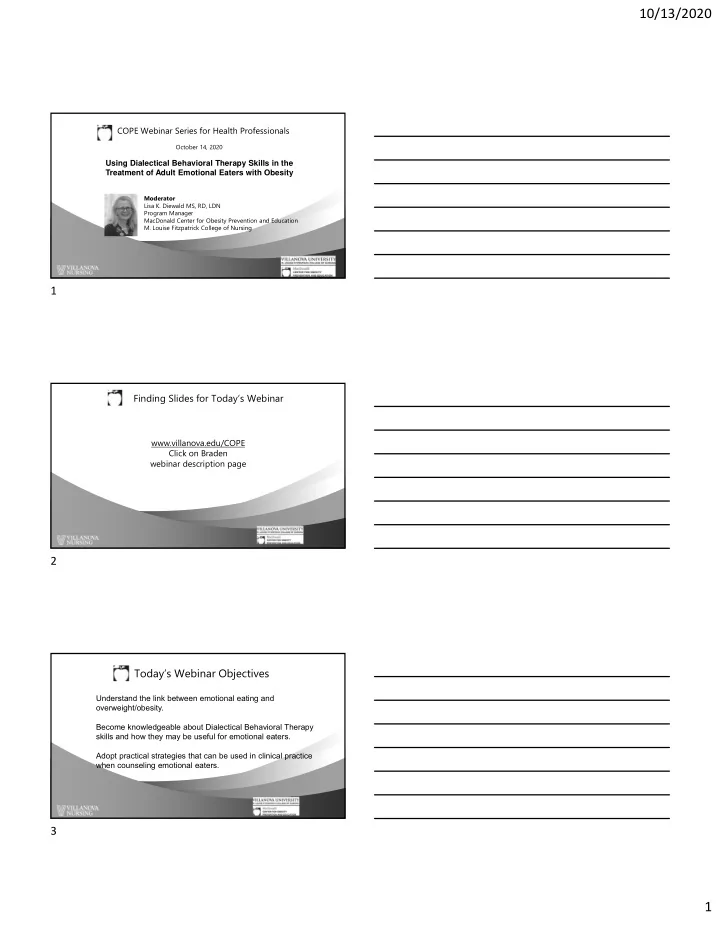
10/13/2020 COPE Webinar Series for Health Professionals October 14, - - PDF document

10 13 2020
SMART_READER_LITE
LIVE PREVIEW

10/13/2020 COPE Webinar Series for Health Professionals October 14, - - PDF document

10/13/2020 COPE Webinar Series for Health Professionals October 14, 2020 Using Dialectical Behavioral Therapy Skills in the Treatment of Adult Emotional Eaters with Obesity Moderator Lisa K. Diewald MS, RD, LDN Program Manager MacDonald


slide-1
SLIDE 1

10/13/2020 1

COPE Webinar Series for Health Professionals

October 14, 2020

Using Dialectical Behavioral Therapy Skills in the Treatment of Adult Emotional Eaters with Obesity

Moderator Lisa K. Diewald MS, RD, LDN Program Manager MacDonald Center for Obesity Prevention and Education

  • M. Louise Fitzpatrick College of Nursing

Finding Slides for Today’s Webinar

www.villanova.edu/COPE Click on Braden webinar description page

Today’s Webinar Objectives

Understand the link between emotional eating and

  • verweight/obesity.

Become knowledgeable about Dialectical Behavioral Therapy skills and how they may be useful for emotional eaters. Adopt practical strategies that can be used in clinical practice when counseling emotional eaters.

1 2 3

slide-2
SLIDE 2

10/13/2020 2

Continuing Education Credit Details

Villanova University M. Louise Fitzpatrick College of Nursing is accredited as a provider of nursing continuing professional development by the American Nurses Credentialing Center’s Commission on Accreditation. Villanova University College of Nursing Continuing Education/COPE is a Continuing Professional Education (CPE) Accredited Provider with the Commission on Dietetic Registration

Continuing Education Credit Details

This webinar awards 1 contact hour for nurses 1 CPEU for dietitians Level 2 CDR Performance Indicators: 6.2.5, 9.1.3, 9.6.1, 9.6.6 Using Dialectical Behavioral Therapy Skills in the Treatment of Adult Emotional Eaters with Obesity Abby L. Braden, Ph.D. Assistant Professor Licensed Psychologist Department of Psychology Bowling Green State University

6

4 5 6

slide-3
SLIDE 3

10/13/2020 3

Disclosures

The planners and presenter of this program have no conflicts of interest to disclose. Accredited status does not imply endorsement by Villanova University, COPE or the American Nurses Credentialing Center of any commercial products or medical/nutrition advice displayed in conjunction with an activity.

Using Dialectical Behavioral Therapy Skills in the Treatment of Adult Emotional Eaters with Obesity

Abby Braden, Ph.D. Assistant Professor Psychology Department Bowling Green State University abbym@bgsu.edu

7 8 9

slide-4
SLIDE 4

10/13/2020 4 Outline

  • Overview of emotional eating
  • Describe Dialectical Behavior Therapy
  • Describe Live FREE: FReedom from

Emotional Eating

  • Practical strategies for emotional eaters

Eating in response to emotions as

  • pposed to a physiological

need for food.

Arnow, Kenardy, Agras, 1995 Geliebter & Aversa, 2003

10 11 12

slide-5
SLIDE 5

10/13/2020 5 Specific emotions and eating

Depression Anxiety/Anger Boredom

Koball et al., 2012

Emotional eating

  • Prevalence:
  • ¼ - ½ of general samples (Gibson, 2012)
  • Approximately 60% of adults with overweight/obesity

(Ganley, 1989; Peneau et al., 2013)

  • Emotional eating is related to negative psychological

and physiological correlates and poor dietary habits.

Emotional eating and weight loss

  • Emotional eating prior to weight loss treatment is

predictive of less weight loss in behavioral (Niemeier et al., 2007) and surgical (Canetti et al., 2009) treatments.

  • Decreased emotional eating during treatment

associated with better outcomes (Braden et al., 2016).

13 14 15

slide-6
SLIDE 6

10/13/2020 6

Adapted from Safer, Telch, & Chen, 2009

Theory - Key point

  • Emotional eating does not occur because of a negative emotion

but because of an inability to regulate that emotion effectively.

Why do emotional eaters have difficulty with weight loss? 16 17 18

slide-7
SLIDE 7

10/13/2020 7

New approaches to weight loss Dialectical Behavioral Therapy (DBT)

  • Psychological treatment
  • Originally designed for suicidal adults
  • Adapted for various patient groups
  • Focus on change + acceptance

Linehan, 2014

Dialectical Behavioral Therapy (DBT)

Biosocial Model

  • Combination of emotional reactivity + emotional invalidation

leads to problems with emotion regulation which contributes to problematic behaviors (Linehan, 2014)

  • Some evidence that this model may explain emotional eating

(Braden et al., 2020)

19 20 21

slide-8
SLIDE 8

10/13/2020 8

DBT and emotional eating

Swenson, 2000

DBT and emotional eating

  • DBT for overweight/obese adults without behavioral

weight loss (Beaulac et al., 2019; Cancian et al., 2019; Dastan et al., 2019; Roosen et al.,

2012)

Live FREE: FReedom from Emotional Eating

  • 16 session, group-based intervention

Emotion Regulation Training (DBT) Traditional Behavioral Weight Loss Techniques

+

22 23 24

slide-9
SLIDE 9

10/13/2020 9

Live FREE: FReedom from Emotional Eating

  • Premise: learning emotion regulation strategies first may

promote improved implementation of weight loss techniques

INTERVENE Adapted from Safer, Telch, & Chen, 2009

Live FREE: Preliminary Investigation

Primary aim: refine the treatment protocol

Braden & O’Brien, in press

25 26 27

slide-10
SLIDE 10

10/13/2020 10

Live FREE: Preliminary Investigation

Participants: 10 adults with BMI ≥25 and emotional eaters

Live FREE: Preliminary Investigation

Procedures:

  • Baseline assessment
  • Pre-treatment session
  • 16 group sessions
  • Psychologist and co-leader
  • Post-treatment assessment
  • $25 compensation

Live FREE: Preliminary Investigation 28 29 30

slide-11
SLIDE 11

10/13/2020 11

Live FREE: Preliminary Investigation

Treatment Overview:

  • First 30 minutes to check-in
  • Didactic approach to teaching new material
  • DBT skills (1-9)
  • BWL (10-16)
  • Measurement of weight

Live FREE: Preliminary Investigation Live FREE: Preliminary Investigation 31 32 33

slide-12
SLIDE 12

10/13/2020 12

Live FREE: Preliminary Investigation Live FREE: Pilot Study

Primary aim: feasibility and acceptability Secondary aim: initial efficacy

Live FREE: Pilot Study

Participants:

  • adults with a BMI ≥25
  • elevated emotional eating

34 35 36

slide-13
SLIDE 13

10/13/2020 13

Live FREE: Pilot Study Live FREE: Pilot Study

Design:

  • single-group design
  • Assessments at baseline, post-treatment, and 6

month follow-up

Live FREE: Pilot Study 37 38 39

slide-14
SLIDE 14

10/13/2020 14

Live FREE: Pilot Study 86% said they loved the program Live FREE: Pilot Study

Treatment Dose:

  • Mean # of sessions completed = 14.33 (SD=4.02)
  • 35/39 (89.7%) participants completed the intervention
  • 32/39 (82.1%) participants completed the 6-month

follow-up

Live FREE: Pilot Study

Weight Change:

  • 3.22% of initial body weight lost (mean of 3 kg)
  • 2.89% from baseline to 6-month follow-up

Waist Circumference Change:

  • 4.23 cm decrease

40 41 42

slide-15
SLIDE 15

10/13/2020 15

Live FREE: Pilot Study Live FREE: Case Study

Braden et al., 2019

Live FREE: Case Study 43 44 45

slide-16
SLIDE 16

10/13/2020 16

Live FREE: Case Study Live FREE: Case Study Live FREE: Case Study 46 47 48

slide-17
SLIDE 17

10/13/2020 17

Live FREE: Conclusions, limitations, future directions

  • Treatment has been refined
  • Evidence of acceptability and feasibility
  • Indication of initial efficacy
  • Conduct a randomized clinical trial
  • Larger, more diverse sample

Emotional Eaters: Practical Strategies

1) Adopt a dialectical approach

  • Synthesis of opposites
  • Clients can learn change and acceptance simultaneously
  • Teach clients dialectical abstinence:
  • Wholeheartedly committing to stopping emotional eating

while simultaneously being prepared to re-commit should

  • ne emotionally eat

Emotional Eaters: Practical Strategies

2) Help clients be more aware of emotions

  • Clients can document emotions on their food log
  • May provide a list of emotions and ask client to rate intensity

49 50 51

slide-18
SLIDE 18

10/13/2020 18

Emotional Eaters: Practical Strategies

3) Help clients see the value in emotions

  • Goal is not to get rid of emotions
  • Think non-judgmentally – just the facts
  • Emotions serve an important function
  • Ask client: How can you respond effectively?

Emotional Eaters: Practical Strategies

4) Encourage clients to learn and practice diaphragmatic breathing

  • Practice daily for 5-10 minutes
  • Can also use when emotions are intense

Emotional Eaters: Practical Strategies

5) Urge Surfing with the use of distraction and self-soothing

  • Cravings are a type of urge that will eventually go away
  • Goal is to tolerate the urge rather than try and “get rid of it”
  • Distracting activities: walk, favorite show, clean, help someone
  • Self-soothe: engage senses

52 53 54

slide-19
SLIDE 19

10/13/2020 19

Emotional Eaters: Practical Strategies

6) Refer clients to mental health specialist when necessary

  • If it appears that emotions/emotional eating are interfering
  • Some people need sole focus on in-depth emotion regulation

training prior to making dietary changes

Special thanks to the members of the Balanced Eating and Emotions Lab.  Thank you!! Questions??

To Receive Your CE Certificate

  • Look for an email containing a link to an evaluation.

The email will be sent to the email address that you used to register for the webinar.

  • Complete the evaluation soon after receiving it.

It will expire after 3 weeks.

  • You will be emailed a certificate within 5 business days.

55 56 57

slide-20
SLIDE 20

10/13/2020 20

COPE Fall Webinar Series

  • 11/11/20 Lauren Sastre, PhD, RD, LDN

Sharing the “weight” of obesity management in primary care: Integration of RDs/RDNs

  • 12/2/20 Michelle Long, M.D.

Nonalcoholic Fatty Liver Disease and Obesity Treatment To register: villanova.edu/cope 1

58

Be a part of the CHAMPS Study!

  • A study of the experience and self-reported health

and well-being of essential workers, first responders, service staff and healthcare professionals who provided support for patients, treatment sites and the community during the COVID-19 pandemic.

  • Survey: 15-20 minutes
  • See Villanova.edu/cope for more info
  • Pass along to colleagues

59

P r e-r ecor ded Webinar s and Confer ences COPE

  • ffe rs an o nline c atalo g o f we binars

and pre se ntatio ns Yo u c an e arn CE c re dits fo r vie wing Se arc h fo r to pic s that inte re st yo u Affo rdable : 2 CPE U / 2 c o ntac t ho urs fo r $20 Go to https:/ / bit.ly/ COPE c o urse s to ac c e ss the c o urse s!

58 59 60

slide-21
SLIDE 21

10/13/2020 21

Questions?

Moderator: Lisa Diewald MS, RD, LDN cope@villanova.edu www.villanova.edu/cope

61